One slate out of place can look trivial from the garden, and sometimes it is. A branch, a bad footstep or a single broken slate is a ten-minute job for a roofer with the right ladder and a bag of matching slates. The harder case is the slate that has slipped for a reason, because the reason will still be there tomorrow.
That is why slate repair is mostly detective work. Slates are held by nails into timber battens, the strips fixed across the rafters, and the fixings, the timber and the slate can each be the weak link. Repair the slate without reading the other two and you often fix the picture but not the problem. Below we look at what makes slates slip or crack, how tingles and hooks hold a slate in place, how a replacement is matched to the old ones, what a repair costs as a typical UK range, and how to tell when the sums have turned against patching. It sits within our wider slate roofing service across Taunton and Somerset.
What makes slates slip or crack
Slates slip because they lose their grip, and they crack because something has pushed on them harder than they can take. Naming the cause tells you what repair to expect.
Why do slates slip down?
The usual cause is a failed nail. Slates are pinned near their top edge, and the nails rust over decades until the shank has thinned or snapped, and the slate slides down. This is called nail sickness, and it tends to show up on a whole slope at once because the nails are all the same age. A second cause is soft or split batten timber that will no longer hold a nail. A third is a slate that was fixed badly in the first place, with nails driven too tight or too high.
Why do slates crack?
Cracks come from impact and from stress. Footsteps on a slate roof can do it, because a slate is strong across its face but can snap when a boot lands between two battens. Falling branches, ladders leant on the slates and shifting scaffold boards do the same. Older slates can also fail along their natural layers, which is what a flaking slate looks like when it starts to peel.
A third group of faults looks like slate trouble but is not. Water coming through near a valley, a chimney or the ridge is often a lead or mortar problem, and replacing slates alone will not cure it. This is why a roofer should trace the leak before ordering slates. Valleys are covered further down this page.
Tingles, hooks and how a slate is held
How the new slate is secured decides whether a repair lasts. Two methods do most of the work on slipped slates, and they behave very differently.
What is a slate tingle?
A tingle is a small strip of metal, usually copper or lead, screwed or nailed down to the batten, then folded up round the lower edge of the replacement slate to keep it from sliding. It lets a roofer slide a new slate into a gap without taking nails out of the courses above, which saves lifting good slates. It is a recognised repair and is quick, but it is also a patch, and a slope dotted with tingles is usually a slope with failing nails. Our page on slate tingles explains when one is the right choice and when it is only buying time.
Where do slate hooks fit in?
Some roofs hold slates with hooks rather than nails, and a slate hook catches the slate at its tail instead of its head. Hooks need enough slope to work, and the slate maker's data sheet sets the limit. Natural slate has its own floor under BS 5534, which gives 20 degrees as the lowest pitch, so the slope decides what is possible before anyone picks a fixing.
For a lasting repair, the new slate should be nailed in the same way as the originals, using copper nails that will not rust, and the tingle kept for the places where nailing is not possible. If a roofer reaches for tingles across most of a slope, ask why. It may be the quickest option and not the best one.
Matching replacement slates
A repair that works but looks wrong is only half a repair. Slates on an older roof have weathered for decades, and a bright new slate among them stands out for years.
What has to match?
Four things matter: size, thickness, colour and the way the slate splits. Sizes vary from roof to roof, and an older roof may carry slates in a size that merchants no longer stock. A new slate that is too thick lifts the ones above it and leaves a gap for the wind. One that is too thin can crack under the next footstep. Colour is the part you notice from the road, and slate from different quarries can differ in tone, even when both are called grey.
Where do matching slates come from?
Often from the roof itself. Slates lifted from a hidden slope, a lean-to or a chimney run can be moved to a prominent area, and new slates fitted where they will not be seen. Reclaimed slate is another route, and a good supplier will have sizes to suit older houses. Our guide on matching replacement slates covers sizes and sourcing in more detail.
If the building has listed status or lies within a conservation area, matching goes beyond appearance. A listed house keeps its Class C permitted development right for roof work, although listed building consent is still required where the work alters its character. Before changing the material or the slate size, ask Somerset Council's planning team. Slate stays slate on these roofs, and the right consent route comes first. Photographs of the existing slates, with a ruler held against one, help whoever is ordering replacements and anyone handling the consent.
How a slate repair is carried out
The process matters as much as the price, because repairs go wrong in the details. Here is how a competent repair should run.
- The roofer looks over the slope from the ground, then from a roof ladder or scaffold, and works out what caused the fault.
- Loose and broken slates are removed carefully, with the nails cut or drawn without cracking the slates around them.
- The underlay beneath, the sheet that catches rain driven past the slates, is checked for tears.
- The battens are checked for rot. Soft timber is renewed.
- New or reclaimed slates are fixed, with tingles only where nails will not reach, and the area is tidied.
- Gutters below are cleared of slate fragments and the waste is taken away, so the site is left tidy.
Why can't I just push a slate back up?
You may spot a slate that has slid a few centimetres and looks as if it could be pushed back. Resist the urge, because the nail has let go, so the slate will slide again, and the climb is dangerous. Slate roofs are slippery, and a boot can crack the neighbours, so a repair that starts as one slate can end as five.
What does a repair cost?
An average roof repair comes to around £650 (MyJobQuote, Oct 2026). Your own price turns on the access, the number of slates affected, whether scaffold is needed, and what lies under the slates once they are lifted. Scaffold alone can run to £550 to £750 for a week's hire at the front of a house (MyJobQuote, Oct 2026), which on a small job can outweigh the cost of the slates.
Leaks that start in the metal, not the slate
Many calls about slipped slates turn out to be calls about water in the loft, and the slates are only the first thing someone noticed. Lead and mortar fail more often than slate does, so a repair that stops at the slates can miss the true cause.
Valleys and flashings
A valley is the channel lined with lead where two slopes run into each other. Flashing is the metal that closes the gap between the slates and a chimney or wall. When either splits, rain runs behind the slates and appears indoors as a stain. Leaf litter in a valley can also pool water and push it back under the slates, so sweeping out debris is part of the job. Debris trapped there also holds moisture against the lead and the timber boards beneath it, which is a slower route to the same leak. Renewing a valley is a lead job and not a slate job, and a roofer who treats it as a slate repair has probably missed the cause.
Ridges and hips
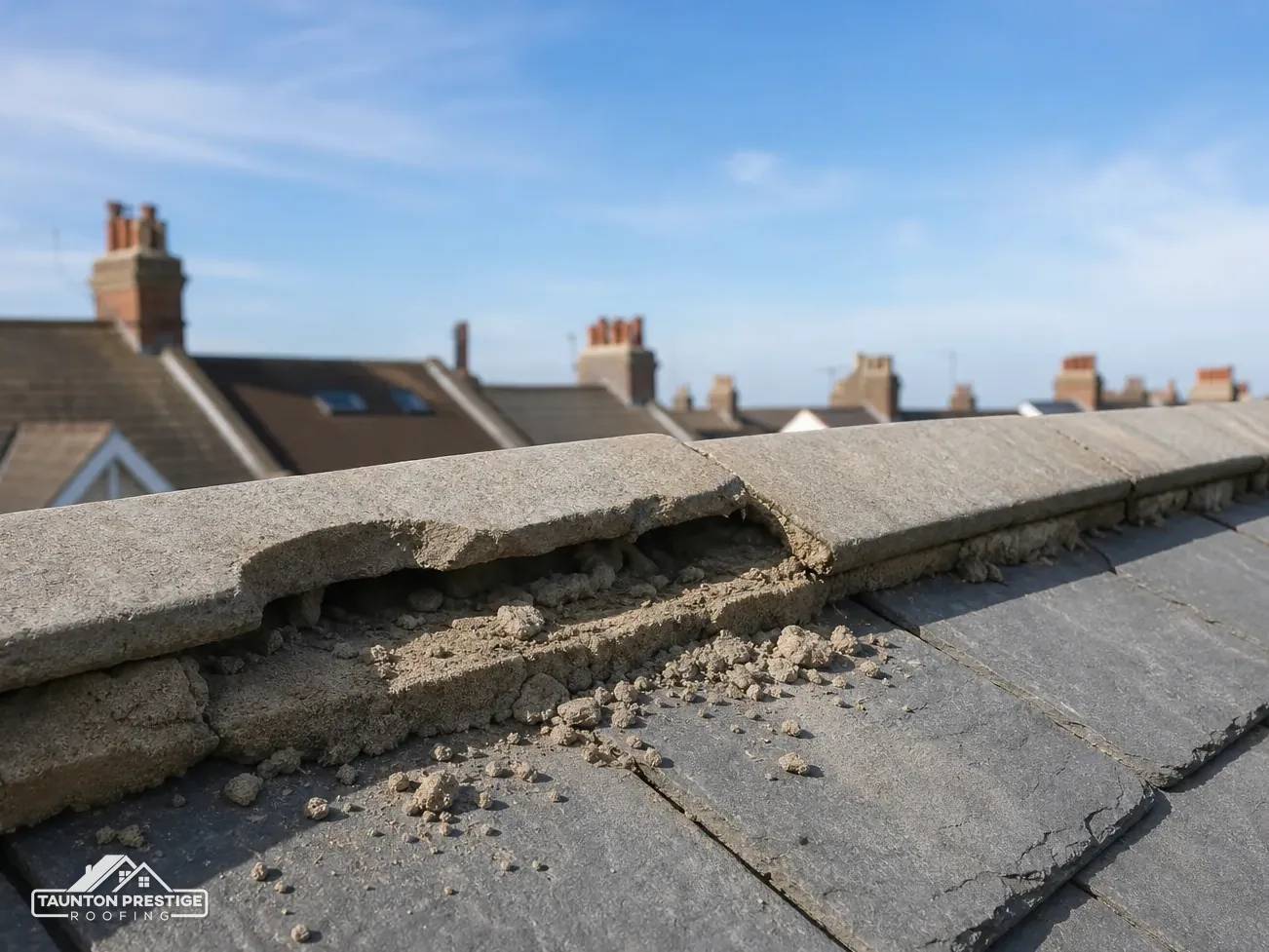
The ridge crowns the roof, and a hip slopes down an outside corner of it. Ridge and hip lines are capped with ridge tiles, which were once bedded in mortar only. Since BS 5534 was revised in 2014, repairs add mechanical fixings, because bedding mortar was no longer treated as enough on its own.
When we survey a leaking slate roof we trace the water from the stain in the loft to where it entered, rather than starting from the nearest slipped slate. You get photos of the actual fault, whether a rusted nail, a split valley or a cracked slate, and nothing is booked until you have seen them.
When repairs stop working
Repair is the right answer more often than people expect. It stops being the right answer at a recognisable point, and it is worth knowing where that point is before you pay for a third visit.
How do I know patching has stopped paying?
Three signs usually appear together. Slates keep slipping in new places even after repairs. The loft shows wet or soft battens beneath those slates. And repairs are being done mostly with tingles, because nails will not hold. When all three are present, the fixings and timber have reached the end of their life, and each repair is only moving the fault along the slope.
At that point the sensible route is to strip the failing area or slope, renew underlay and battens, and re-slate using the good original slates and new copper nails. Our guide to re-slating a roof describes the work. Slate that is sound can often be reused, so the roof keeps its look and the cost is mostly labour and new fixings.
Does re-slating need building control?
Small re-slating jobs normally need no building control application where less than 25 per cent of the building envelope and less than 50 per cent of the roof is affected, which is the Planning Portal's test. Class C permitted development normally takes in slate relaid to match on a dwellinghouse. A covering that raises the roof's weight by 15 per cent or more is the case that calls for Building Regulations approval.
A survey tells you which case your roof is, with photos of the slope, the fixings and the batten.
Slate repair questions
What usually makes slates slip or crack?
Slipping is usually a failed nail or a soft batten that will no longer hold one. Cracking comes from impact, such as footsteps, ladders or a fallen branch, and from older slates splitting along their layers. A roofer should find the cause before replacing the slate, or the fault will return.
Can a single slipped slate be fixed on its own?
Yes, if the surrounding fixings and battens are sound. A new or reclaimed slate is nailed or held with a tingle, and the repair takes little time. If several slates nearby have also slipped, the nails or timber are likely failing, and a wider repair will last longer than patching one slate.
Do replacement slates have to match the originals?
They should match in size, thickness and colour, otherwise the repair stands out and may sit unevenly. Sound slates from a hidden slope can be moved to a visible one, and reclaimed slate suits older houses. On a listed house, check the consent route before changing the material.
More on this subject: Slate roofing in Taunton