Ask how long a slate roof lasts and you will hear a big number, sometimes followed by a shrug. The big number is fair. CORC, the Confederation of Roofing Contractors, words it as "Slate, if well maintained can last 100+ years". The shrug is fair too, because a slate roof is not only slate. It is a covering held up by fixings, timber and metal, and any one of those can wear out decades before the stone does.
That is the useful way to think about the question. A century is what the stone itself can manage. What your own roof manages depends on the nails that pin each slate, the battens that receive them, the lead around the chimney and the valleys, and how well the gutters and ridge have been looked after. This guide goes through each of those in turn, shows what an ageing slate roof looks like when you stand in the garden or put your head through the hatch, and explains when a repair is the sensible buy. It belongs to our wider slate roofing work across Taunton and Somerset.
What the published figures actually say
Lifespan figures for roofing are ranges that makers and trade bodies publish, and none of them is a promise about your particular roof. For natural slate, CORC's published wording carries the weight: "Slate, if well maintained can last 100+ years". The three words in the middle matter, because slate does not reach a hundred years by being ignored.
How does slate compare with other coverings?
Clay has a figure of its own, and for clay tiles BRE quotes "a minimum life expectancy of 60 years" as its yardstick. Concrete tile is a separate case, and Marley says its roof tiles are "expected to last for around 60 years" while being careful to add that the figure promises nothing about longevity. So slate carries the longest published figure of the common coverings, and the other two come with their own small print.
Read lifespan tables with one distinction in mind: a warranty period and a lifespan are different things. A maker or installer may stand behind a roof for a set number of years, but that period says how long they will answer for a fault, not how long the roof will stay watertight.
For a rough idea of the money involved, a new slate roof averages around £7,800 on MyJobQuote's October 2026 figures, a typical UK range. Set against that sum, getting the full life out of an existing slate roof is worth some effort. Sound slates that stay in use also keep the roof looking as it was built.
Why fixings fail before the slate does
Each slate is normally held by two nails, passing through holes punched close to its head and into the batten beneath. Battens are the sawn timber strips that run across the rafters, which form the sloping frame of the roof. The slate overlaps the course below it, so the nails are hidden, and you only learn about a problem when a slate slides down.
What is nail sickness?
Nail sickness is the trade name for nails that have rusted or worked loose until they no longer grip. The slate is perfectly sound, but it has nothing left holding it. Slates begin to slip one or two at a time, then more, and the pattern spreads across a slope as every nail of the same age and metal reaches the end of its life together. We cover it in more detail on our page about nail sickness in slate roofs.
Do copper nails and hooks make a difference?
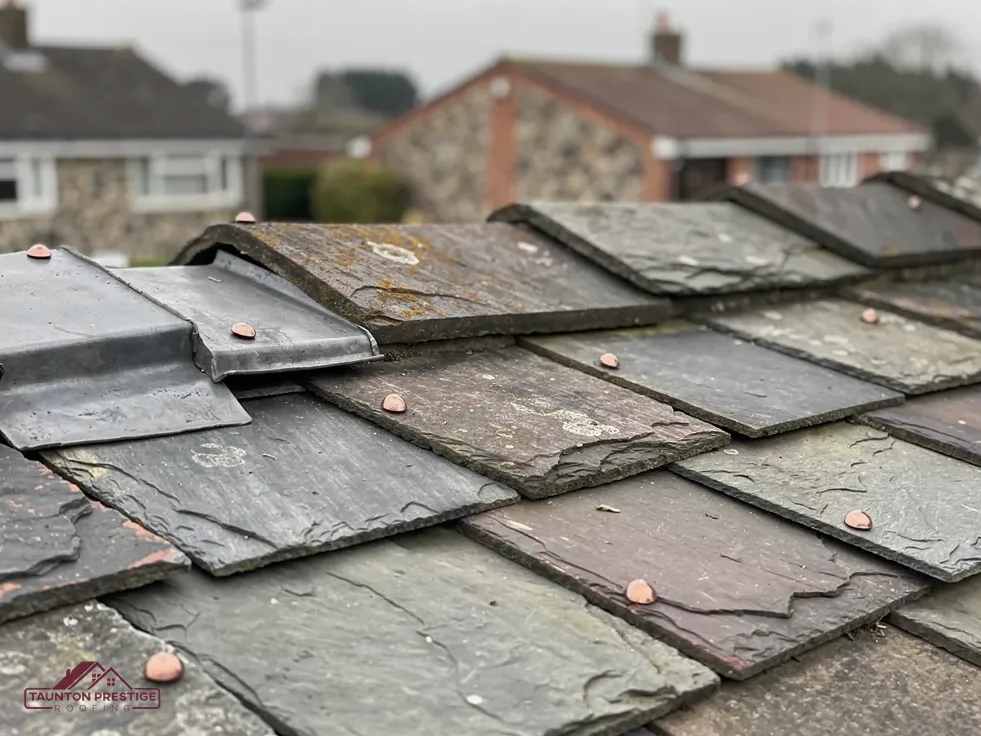
The metal matters. Copper does not rust, which is why it is a sound choice for a re-slate. Some roofs use slate hooks instead of nails, which catch the slate at its tail rather than its head. Cupa, a slate maker, advises against hooks on a pitch below 25 degrees, so the right fixing depends on the slope.
Battens go the same way as nails. Timber that has been damp for years softens, and fresh nails will not hold in it. Once that happens, replacing a few slates no longer settles anything and the question moves to the whole slope. The slate may have another fifty years in it while the fixings and timber behind it have none.
Reading an ageing roof from the garden
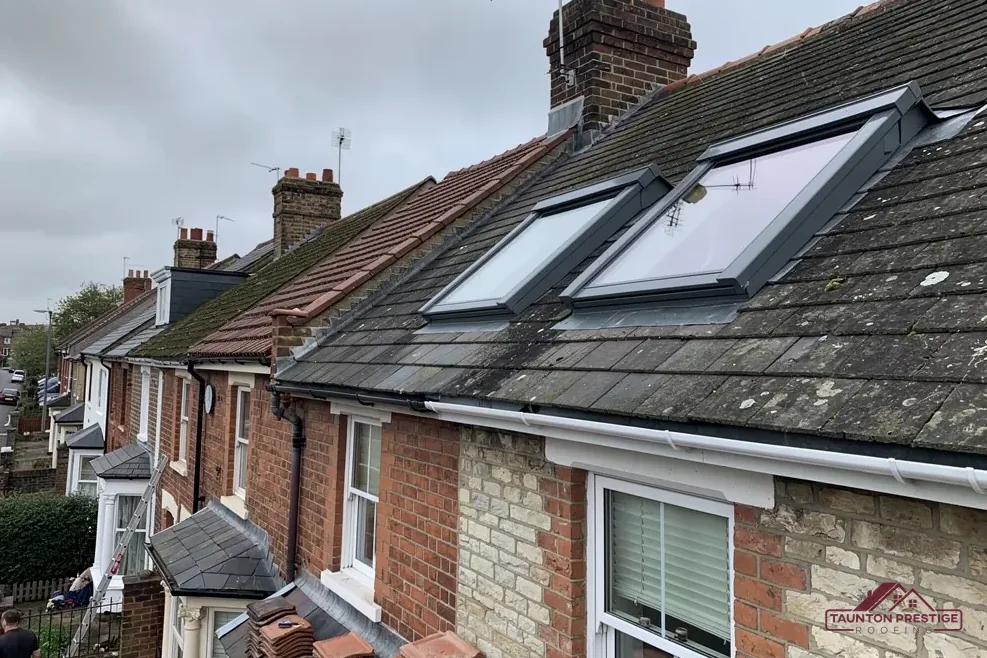
You can learn a good deal about your roof without leaving the garden. Step back, perhaps to the far side of the road, and sight along each slope instead of looking at it head on. A healthy slate roof looks even, with courses running in straight lines. An ageing one starts to look uneven in ways you notice once you know what to look for.
- Slates that have slipped part way down and sit proud of their neighbours.
- Gaps where a slate has gone altogether, showing darker underlay or timber.
- Slates that are flaking in thin layers, or splitting along their length.
- Dips and waves in the courses, which can point to battens that have given way.
- Tingles, small metal strips used as temporary repairs, dotted across the slope.
What can you see from the loft?
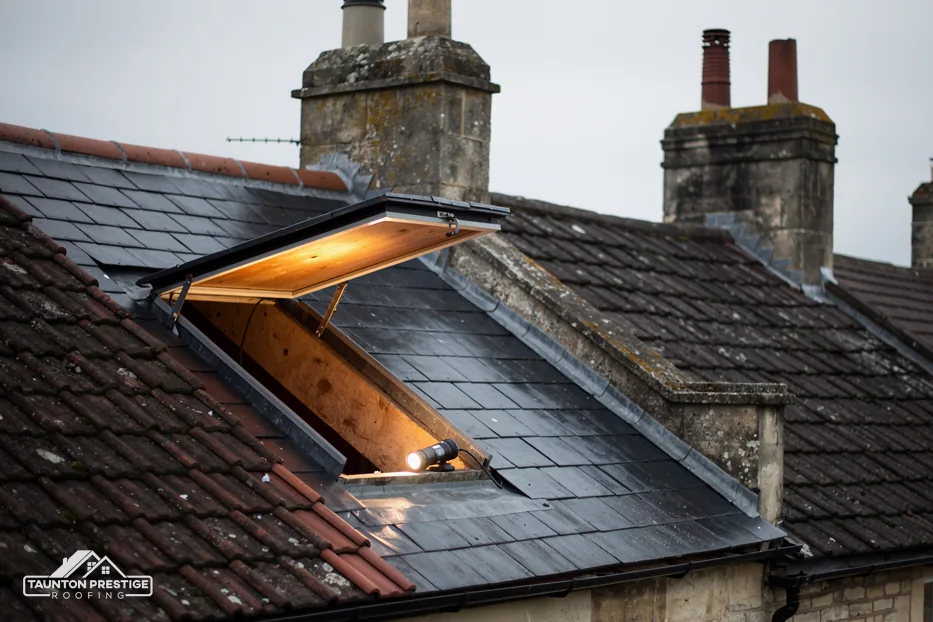
On a dry day, take a torch and keep to the joists, or to boards bridging them. Look for daylight showing through the roof, dark staining on the rafters and battens, and slate fragments lying on the insulation. Daylight means a slate has gone or shifted. Staining means water has been finding a way in for a while. Soft or spongy timber means the battens or rafters have taken damage.
None of these signs says the roof has reached the end. A few slipped slates on an otherwise sound roof is an ordinary repair. A slope where slates slip every winter, and the loft shows wet timber beneath, is telling you the fixings and the battens are done. Take photos of whatever you find, since they let a roofer form a view before anyone visits.
Lead, valleys and ridges age differently
A slate roof is more than its flat faces. A valley is the gutter-like channel where two slopes meet, and the water from both runs down it. Where a roof meets a chimney or a wall, a strip of metal called flashing is tucked into the masonry and lapped over the slates to seal the joint. Both are usually made in lead, and both age on their own timetable.
How long does lead last on a slate roof?
On MyJobQuote (Oct 2026), lead is said to be a metal that "can last for over 80 years" when used as flashing. That is a floor, not a ceiling, and it assumes the lead has been fitted well and left undisturbed. Lead that has been dressed badly, cracked by movement in an old chimney, or patched with sealant is a different story. The metal is often still fine while the joint around it has failed.
Valleys are worth watching because they carry the most water. MyJobQuote (Sep 2026) gives around £540 as the typical UK cost of a full valley replacement. That is a modest sum compared with the cost of repairing damage after a valley has leaked through a winter. Our page on the slate roof valley explains the options.
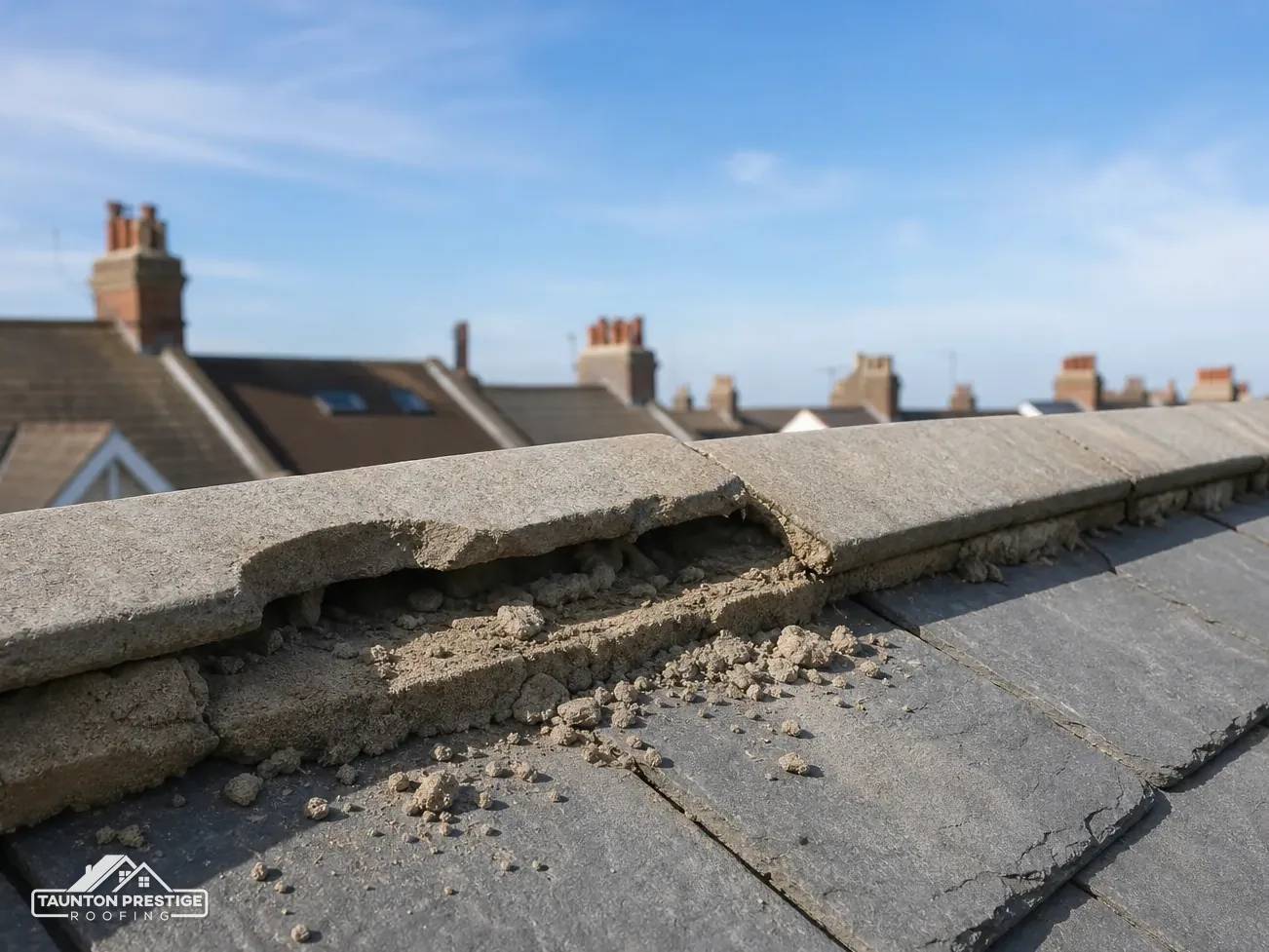
The ridge runs along the crest of the roof and is capped with ridge tiles. Traditional ridges are bedded in mortar, and mortar can crack and fall away. Marley points out that the 2014 revision of BS 5534 stopped treating bedding mortar as enough on its own, so a good ridge today also has mechanical fixings. If your ridge was bedded in mortar only, and it shows cracks, it will want attention long before the slate does.
Care that adds years to a slate roof
Slate is a low-maintenance covering, but low is not none. A few habits make the difference between a roof that reaches a great age and one that needs rescuing at fifty, and none of them involves a lot of money.
Keeping water moving
Gutters and downpipes are part of the roof system. When they clog, water backs up under the lowest course of slates and soaks the eaves timbers, which are the first battens to rot. Clearing leaves in autumn and checking joints after storms costs very little. Leave the climbing to a roofer, because a footstep can crack a slate that looked perfectly sound.
Cleaning without harm
If moss or lichen bothers you, ask a roofer to treat or brush it off. Marley does not recommend high-pressure jets on a roof, whatever a leaflet through the door suggests.
Small repairs early
Around £650 is MyJobQuote's average for a roof repair (Oct 2026), as a typical UK range. Replacing a single slipped slate, or renewing a failed length of lead, costs far less than the repair that follows a winter of leaking. The cheap job done early is what keeps the expensive one away, and a small repair also gives you a chance to see the state of the battens and underlay while the roof is open.
Photos of the roof taken once a year, from the same spot, make slow changes easy to see. If you are unsure what you are looking at, a survey is the cleaner answer, since we study the slates before anything is priced.
Repair, partial re-slate or a new roof?
The honest decision on an older slate roof is rarely "repair or replace" in one go. It is a three-way choice, settled by what the survey turns up.
When does a repair make sense?
If the fixings and battens are sound and the trouble is a handful of broken slates, a failed valley or tired flashing, repair is the better buy. Sound slate is worth keeping, and the roof keeps its character, its colour and its slightly uneven, hand-split look. Slate stays slate wherever that matters, and that is the thinking behind most of our slate work.
When is a partial re-slate better?
If one slope has failing nails and soft battens while the others are fine, stripping that slope and re-slating it with the original slates and new copper fixings is often sensible. Our page on re-slating a roof describes how the work runs. The slope is stripped, new underlay and battens are fixed at the right gauge, and the good slates go back. BS 5534 indicates a minimum roof pitch of 20 degrees for natural slate, which is checked at the same time.
When is a full re-slate the answer?
When the whole roof shows nail sickness, soft timber and failing lead, patching one area simply moves the problem. Cost follows the roof area, the access and scaffold, how many slates are fit for reuse, and the state of the timbers under the covering. MyJobQuote (Oct 2026) puts front-elevation scaffold at £550 to £750 for a week's hire, as a typical UK range. The survey comes first, then you get a single total in writing.
Slate lifespan questions
How many years should a slate roof last?
CORC says well-maintained slate can last 100+ years, which describes the stone itself. A roof as a whole lasts as long as its nails, battens, lead and ridge allow, so fixings and flashing often need renewing long before the slates do. No figure is a promise for one roof.
How long do slate roofs last compared with tiles?
Published figures give well-maintained slate 100+ years. Clay tile has its own published minimum of 60 years. Concrete tile is a different product with a different source, Marley, which quotes around 60 years. None of these is a warranty, so condition and upkeep decide the real number.
Does a slate roof need replacing when the nails fail?
Not always. If the slates are sound and the battens are firm, the roof can be stripped and re-slated with the original slates and new copper nails. If the battens are soft or the slates are flaking, more of the roof needs renewing. A survey with photos shows which case you have.
More on this subject: Slate roofing in Taunton