Slate is a long-lived covering, so most slate roofs never need replacing from end to end. They need looking after: one slipped slate nudged back into line, a cracked one swapped, a valley cleared. The trouble starts when the repairs begin to come round faster, with a slate sliding in one corner this winter and another two on the opposite slope the next. That pattern says the problem is no longer the slates. It is whatever holds them up.
Re-slating means stripping a slope or the whole roof, checking and renewing the timber and underlay beneath, and laying slates again, using the good old ones where they suit and new ones where they do not. This guide covers the signs that point towards it, the two faults that most often force the decision (rusted fixings and slates that split into layers), how salvaged and new slate are combined, what a re-slate involves day by day, and the rules and costs to know about. It sits within our wider slate roofing work in Taunton and across Somerset.
Signs that a repair will not hold
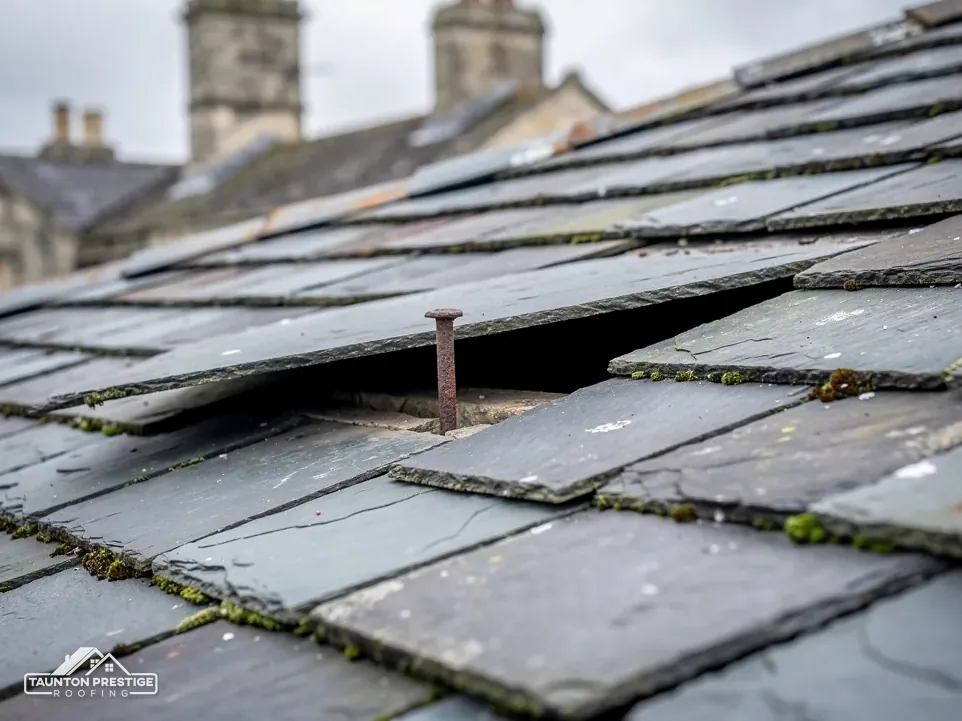
One slate on the lawn is a repair. A pattern is something else. Stand across the road with binoculars, or simply look along each slope from the garden, and count how many slates are out of line. A single stray slate has a local cause, such as a broken piece or a single bad nail. Several slipped slates spread across the same slope point to the fixings holding all of them.
These are the signs that push a job from repair towards re-slating:
- Slipped slates in many places on the same slope, not a cluster.
- Fresh slipping near spots you or a previous roofer already repaired.
- Slates that rattle in wind or lift at their lower edge.
- Chips of slate turning up in the downpipe base or the flower bed after ordinary weather.
- A lower edge that sits proud of the row beneath it, which shows the slate has begun to slide.
- Stains on loft timber below, showing water has been getting in for some time.
How do I know whether my roof needs repairing or replacing?
Two questions settle most cases. How far has the fault spread, and what is it caused by? If it is limited to a small area with a clear cause, such as a branch strike or a failed section of lead, repair is the right buy. If it has spread across a whole slope and the cause is the fixings, repair only buys time, because each slate you disturb loosens its neighbours. A survey, with the slates lifted in a few spots and photographed, answers both questions with evidence rather than guesswork. The photographs show the nail heads, the timber and the back of the slates, so the decision is yours and rests on what the roof looks like beneath its surface.
Nail fatigue and delamination explained
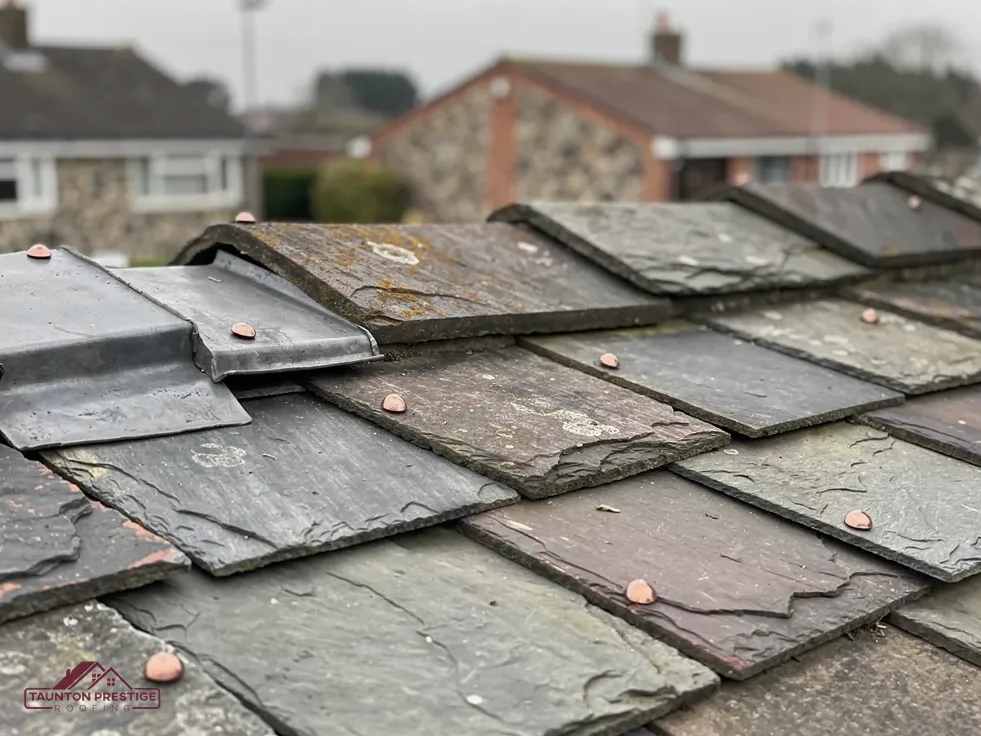
Nearly every slate hangs from a pair of nails driven through its upper part into the batten, the timber lath fixed across the rafters. Over decades those nails can corrode, and a corroded nail shears or lets the slate drop. Roofers call this nail sickness, and some insurers and surveyors use the phrase nail fatigue. A slate that has slipped for this reason is sound; it is the nail that failed. Our answer on nail sickness on slate shows what the failure looks like.
Delamination is a different fault. Some slate splits along its natural layers, flaking away in thin sheets from the exposed surface until the slate is thin and soft. It is a fault in the stone itself, not the fixings, and it tends to show first on the slates that take the most weather.
Can nail fatigue be repaired slate by slate?
For a few slates, yes. Slate tingles, strips of metal that hold a slate in place from beneath, are a sensible fix when only a handful have slipped. When a wide area is affected, tingles are a running repair that leaves the old nails in place, and you end up repeating the work. Where delamination is widespread, new slates are the only cure, because a flaking slate cannot be saved.
The test is how much of the covering is affected and what you would be paying for the tenth repair visit. Roofs of this kind also tend to leak at the worst moment, in the first hard rain after a dry spell, which is a poor time to be arranging scaffold. When the answer is most of a slope, the sums favour renewing that slope in one go.
When a wider renewal is better than repair
A wider renewal makes sense when three things line up. First, the fault is in the fixings or the slates, not an isolated accident. Second, it covers a large part of the slope. Third, the work to reach one spot disturbs the next, so a patch costs nearly as much per slate as a proper job.
When is a wider slate renewal better than repair?
Think of a slope as a woven surface. Each slate overlaps the one below and the one beside, so lifting a slate to replace it loosens the nail holding its neighbour. On a roof with sound nails that matters little. On a roof where every nail is thin with rust, a repair crew can easily break more than it mends. That is the moment to stop patching, strip the slope, and start from clean battens.
It does not always mean the whole house. Many roofs fail on the side facing the weather first, so one slope can be re-slated while the sheltered slope is left. We would rather say so than quote you for a complete roof you do not yet need, and the survey photographs let you see each slope for yourself.
Repair wins where the cause is local and the nails around it are sound. Re-slating wins where the cause is the nails themselves.
Another trigger is the underlay and battens. If the timber beneath is soft, a re-slate is the time to replace it, since the slates are coming off anyway. Our slate roof repair guide covers the repair side of the choice.
Salvaged slate and new slate together
A re-slate rarely means throwing the old slates away. When a roof is stripped, the slates are lifted by hand, stacked and sorted. Sound ones go back on, which preserves the look of the roof and cuts the number of new slates to buy. Slates that are cracked, delaminated or chipped are set aside.
Sorting matters because slates differ in size and thickness. A roof that has been repaired over generations often carries a mix, and laying them back at random gives uneven courses. Sound slates are graded, with the larger ones used in the lower courses of a slope and the smaller ones towards the ridge. That is the traditional way of laying graded slate, and it is also how an old roof keeps its character.
Can new slate match the old?
Reasonably well, if it is chosen with care. A new slate is a different age and its colour will usually look slightly sharper beside weathered ones, then settle in over a few winters. Putting new slates on the least visible slope, or mixing them into the courses a few at a time, softens the join. Our answer on matching replacement slates sets out how size, thickness and colour are matched.
On homes in conservation areas or on listed buildings, slate stays slate, and the replacement is chosen to suit the existing roof. If the house is listed, check the consent position before anything is ordered.
What a re-slate involves day by day
A re-slate is a staged job, and you should be told what happens each day. A typical sequence on a house runs as follows.
- Access goes up first. Should any scaffold occupy the public highway, it needs its own licence from the highway authority, handled between us and the scaffolder.
- The slates are stripped slope by slope, stacked and sorted into sound and unsound.
- The old underlay comes off with the battens, and the rafters are checked. Underlay is the membrane sheet under the battens that carries off any water blown past the slates.
- New underlay and battens go on, set out at the correct gauge, which is the spacing that gives each slate its overlap.
- Slates are laid back, using stainless or copper nails, and the ridge, hips and valleys are rebuilt.
- The waste is cleared, the site is swept, and you see the finished slopes.
Are bats a concern when slates come off?
They can be. GOV.UK's bat guidance names roof repair and replacement among activities that can affect bats, which are fully protected, together with the places they rest and breed. We look for signs before stripping starts, and if any turn up, the job pauses while proper advice is sought.
Weather decides the pace. The aim is never to leave the house open overnight, with tarpaulin and batten fixed down if a slope cannot be finished before dark, so each slope is stripped and re-covered, or at least made watertight, within the working day. Waste is taken away, not left to build up in the garden, and you are told each evening what the next day holds. For how long the whole thing takes, our answer on how long re-slating a roof takes is the next stop.
Rules and costs to know before you agree
Class C permitted development normally takes in re-covering a house, and that includes re-slating with like-for-like slates. A listed house still needs listed building consent where the work alters its special character, and a conservation area or an Article 4 direction can change what you may do, so check with Somerset Council's planning team first.
For Building Regulations, the Planning Portal sets the national test: normally no application where under 25 per cent of the building envelope and under 50 per cent of the roof are involved. Somerset Building Control has no figure of its own to add. A new covering that weighs 15 per cent or more above the old one needs Building Regulations approval, so changing from natural slate to something else is checked first. A full re-slate usually means replacing the underlay, so ask your building control body whether the work is notifiable before the date is fixed. Somerset Building Control is on 0300 303 7790 for anywhere in the former Taunton and West area.
What does a slate roof cost?
MyJobQuote gives an average of around £7,800 for a new slate roof (MyJobQuote, Oct 2026), while a typical roof repair averages around £650 on the same site. Those are typical UK averages, never a quote. What decides your figure is roof area, the amount of timber that needs renewing, access and scaffold, and how many old slates can be reused. Whichever firm you ask, find out if its price takes in VAT and scaffold. Ours is a single written total sent after the survey, naming the slate going on.
Our slate roof cost guide goes through the numbers.
Re-slating queries
Can I re-slate only the worst slope?
Yes, and it is often sensible. Weather wears the exposed slopes first, so one side may need renewing while the sheltered side is still sound. The survey photographs show both. The two slopes are then dealt with separately, and any ridge or valley between them is checked and made good as part of the work.
Will re-slating change how my roof looks?
Only a little, if the sound old slates go back on and any new ones are chosen to suit. A fresh slate looks sharper for a few winters. Putting the new ones on the least visible slope, or spreading them in the courses, keeps the roof looking like itself.
Does a re-slate mean scaffolding around the house?
Almost always. Stripping a slope safely, and keeping slates, tools and people from falling, needs proper access along the edge. If the scaffold ends up on the public highway, the highway authority licenses it, and the arrangements for that go through the scaffolder we work with.
More on this subject: Slate roofing in Taunton