Householders who have decided that spray foam must go often assume the next step is simple: a team clears the loft, the roof is left as it was, and life returns to normal. On some roofs that is exactly what happens. For others, the foam has been sprayed hard against the underlay and the back of the tiles, and getting it off means taking the covering off with it.
When that is the case, the choice is no longer foam removal against doing nothing. It is patching a worn roof back together against laying a new one properly, and over the years the second can cost less. This guide explains the signs that point towards a re-roof, what the Building Regulations say about re-roofing and about the weight and insulation of a new covering, what typical UK costs look like, and how the foam work and the roof work fit together when both are needed. It is part of our spray foam insulation removal service across Taunton and Somerset.
When foam turns a repair into a re-roof
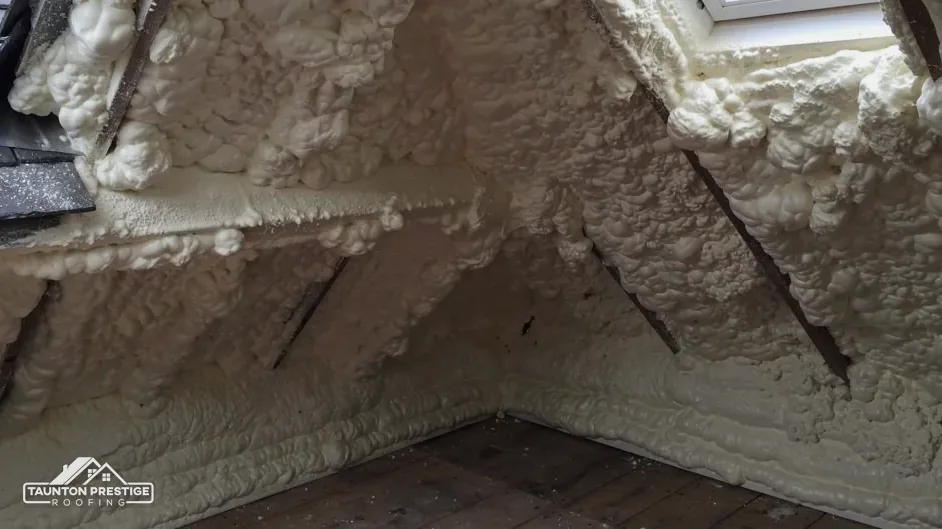
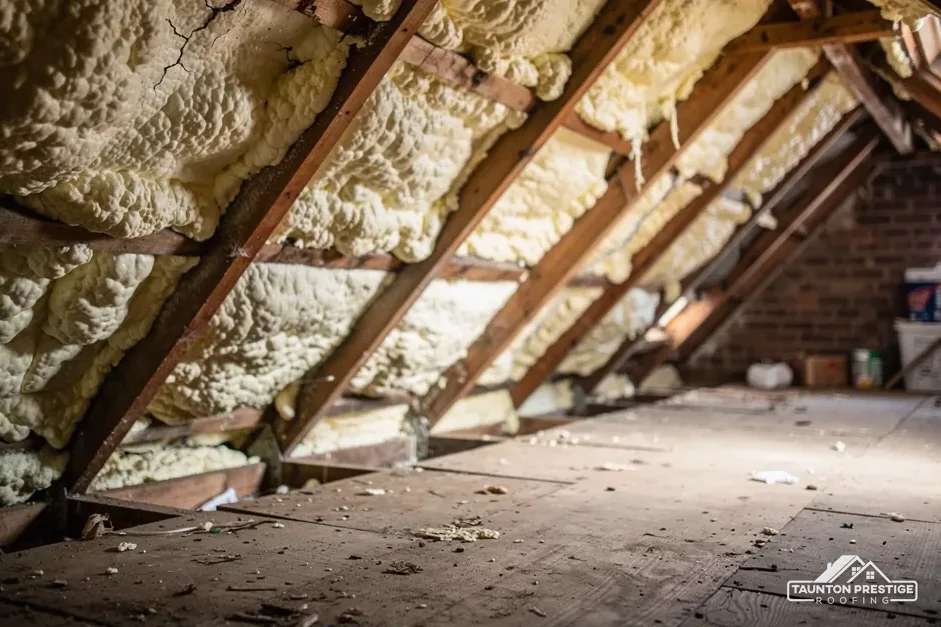
A pitched roof has layers. The tiles or slates sit on battens, which are thin strips of timber nailed across the rafters, and below them there is usually a sheet of felt or membrane called underlay that deals with whatever water gets past the tiles. Spray foam is applied from inside, so it meets the underside of that stack. If the foam went onto bare rafters and a sound membrane, it can often be cut away from the timber with the covering left alone.
What if the foam has reached the felt and tiles?
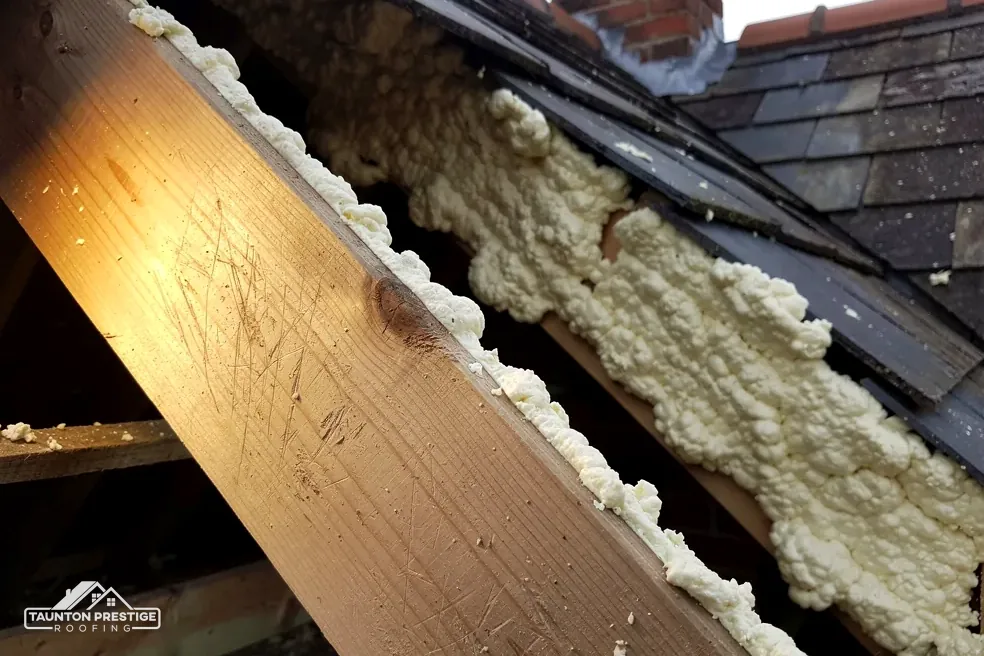
Some installers sprayed in a way that pushed foam through gaps in old felt, around battens, and onto the back of tiles and slates. Once it sets, the foam acts like glue, and the felt and the covering are held to it. Pulling the foam then pulls the felt apart, lifts tiles from their battens and cracks old clay and slate. Our guides on foam on roof felt and foam stuck to roof tiles go through each case in detail.
A roof like that is already compromised. Felt that has been bonded and torn cannot be trusted to keep out wind-driven rain, and the covering is more likely to have broken pieces than a clean slope. Replacing the covering is not an upgrade at that point. It is the removal job, done from the outside.
That is why the survey photographs both sides of the roof, from the loft and from a ladder or a drone view, before anyone suggests a price.
Signs that favour a new roof
No single sign settles it. A re-roof makes sense when several of them appear together, and a survey is how you find out which apply to you.
What should you look for?
From inside, look for foam that runs through the gaps between battens and spills over their top edges, because that is the foam holding the covering. Look for felt that is torn, stiff or visibly stuck to the foam, and for timber that is dark, damp or soft where the foam touches it. From outside, look for slipped, cracked or patched tiles, ridge tiles that rock, and lines across a slope that no longer run straight.
The age of the roof matters as well. If the covering was already near the end of its life when the foam went on, it is hard to justify taking it apart carefully only to put the same tired tiles back. Lifespans are ranges and never promises. Marley, for instance, expects concrete roof tiles to last around 60 years while stressing that the figure says nothing about what any warranty covers.
Ask what the roofer expects to find and why. A sound explanation names the specific signs seen in the photographs. A vague suggestion that you need a whole new roof, with no pictures, deserves a second opinion from another roofer.
Where only a patch of the roof is affected, a partial removal may suit better, and the price follows the same drivers either way: foam type, area, access and the repairs afterwards.
What the Building Regulations say about re-roofing
The Planning Portal sets the national test for re-roofing. No building control application is normally needed where under 25 per cent of the building envelope is affected and under 50 per cent of the roof. The envelope is everything that separates inside from outside: roof, walls, floor, glazing and doors. If a re-roof goes beyond those limits, it is notifiable work.
Does Somerset have its own threshold?
Not one that Somerset Building Control publishes. Its guidance gives no percentage for re-roofing, which leaves the national test as the yardstick. Its fee calculator does carry a heading for renovating a thermal element of one dwelling, which lists re-roofing and insulation upgrades, and notifiable re-roofing is charged under it.
Two further triggers apply whatever the area. Where a new covering would add 15 per cent or more to the weight carried by the roof, the work needs Building Regulations approval. Before starting, the Planning Portal recommends putting the question to a structural engineer or a surveyor. Approval is also needed where the new covering would behave significantly differently in a fire.
On insulation, Approved Document L (2021 edition) treats renovation of an existing roof differently from a new roof: Table 4.3 gives a threshold of 0.35 and an improved figure of 0.16 W/(m²·K), with paragraph 4.13 allowing the best feasible upgrade where that is not technically possible. A 2026 edition takes effect on 24 March 2027. Your building control body decides how it applies to your job.
Planning permission is a separate matter. Class C normally covers re-covering a house roof.
What a new roof costs in typical ranges
Published cost guides help you size the job, and none of them is a Taunton Prestige price. MyJobQuote (Oct 2026) lists £3,000 to £8,000 for re-tiling an entire 80m² roof across the UK, and its average figure for a new roof is around £5,250. For a slate roof, the same guide gives an average of around £7,800. HomeBuilding (Sep 2025) quotes £10,000 to £15,000 for a three-bed semi of about 65m² in plain concrete tiles, and that figure takes in labour, scaffolding and insulation.
Why do the guides disagree?
They measure different things. A re-tile may keep existing battens, whereas a new roof from the rafters up includes timber, underlay and a fresh covering. The HomeBuilding figure bundles insulation and scaffold, which others leave out. Because of that spread, treat these numbers as a way of sizing the job and not as a forecast for your own house.
Scaffold is worth checking in any quote. For a three-bed semi, HomeBuilding allows approximately £1,000 with permits in the sum, whereas MyJobQuote has £550 to £750 for a week of scaffold across the front elevation. Ask whether VAT is included, since the standard rate is 20 per cent for re-roofing an existing home.
What sets your own price is the area of roof, the covering you choose, the pitch and access, how much timber needs renewing once the covering is off, and whether the foam work is part of the same visit. A roof where foam must come off the back of the tiles costs more than one where the covering is stripped clean first.
Doing the foam and the roof together
When both jobs are needed, doing them in one sequence is usually tidier than two separate visits. The covering is stripped in stages, so no slope stands open for longer than it must. With tiles and battens gone, the foam can be cut from the timbers and from under the felt from above, where there is room to work. The rafters are inspected in daylight, which is the only time rot or splitting is easy to see.
What goes back on?
New underlay goes down first, then new battens spaced for the chosen covering, then the tiles or slates themselves. The fixing method follows BS 5534, the slating and tiling code, which is guidance and not the law. Ventilation needs a look too, because a foamed roof may have lost its eaves gaps. Under a non-breathable HR underlay, Marley's figure for a cold roof is 25mm of opening along the eaves up to a 15° pitch, and 10mm on steeper ones.
Access is part of the planning. Where scaffolding obstructs the road or footway, the highway authority has to license it under the Highways Act 1980. Somerset Council states that its permits go to accredited contractors only and that the contractor named for the job completes the form; the fee is £124.60 for each 28 days (April 2026), and the notice period is 10 working days. We sort out the permit with the scaffolder and give you the dates early, so the access holds no surprises.
Waste does not pile up. Foam and old felt are bagged and carried away as work proceeds, and the site is swept at each day's end, so you know what to expect each morning.
Deciding between removal and a new roof
A few questions settle it. How much of the covering is bonded to the foam? How old is the covering, and what condition is the timber in? Do you want to keep the original slate or clay? How long do you plan to stay? The photographs from a survey answer most of these, and the rest depend on what you want from the house.
Is re-roofing always dearer than removal?
Not over the long run. Where removal would damage most of the covering, paying for careful removal and then paying again for a new roof is the costlier path. Where the foam sits cleanly on timber, removal alone is cheaper and the roof stays. Neither answer is the right one in the abstract; the photographs choose it.
Lenders and insurers can influence the timing. RICS suggests asking your mortgage provider about foam, so if a sale or remortgage is coming, raise it early. If you think a claim is possible, tell your insurer before work begins; our guide to whether home insurance covers spray foam problems explains the order of events.
For older houses, the question has an extra layer, because the covering may be worth keeping for how the house looks. Our guide on spray foam in older and listed homes covers that. Once the survey photographs are in front of you, the decision usually makes itself, and the one written total price follows from it.
Foam removal or a new roof
Can foam be removed without replacing the roof covering?
Often it can, when it sits on rafters and a sound membrane. When it has set into old felt or onto the backs of tiles and slates, removal may pull the covering apart, and relaying or replacing that area becomes part of the job. Photographs from the loft and from outside, taken at survey, show which applies.
Does a new covering need Building Regulations approval?
Not normally, going by the Planning Portal test of under 25 per cent of the building envelope and under 50 per cent of the roof. Approval does apply when the new covering is 15 per cent or more heavier. Your building control body confirms how the rules apply to your job.
What does a re-roof cost compared with foam removal alone?
Cost guides publish typical UK ranges for a re-tile, such as £3,000 to £8,000 for 80m² (MyJobQuote, Oct 2026). Foam stuck to the covering adds labour in separating it. Foam removal is priced on other things: foam type, area, reach and what repairs follow. Together they form one job, quoted as a single written total.
More on this subject: Spray foam insulation removal in Taunton