St Andrew's Grade I church
Listed Grade I in February 1955 and still a Church of England church, so roof repairs need a faculty.
A Blackdown Hills village with a Grade I church and listed lanes
Broadhembury lies inside the Blackdown Hills National Landscape, with 38 list entries within 500 metres of its centre and a Grade I church.
Listed Grade I in February 1955 and still a Church of England church, so roof repairs need a faculty.
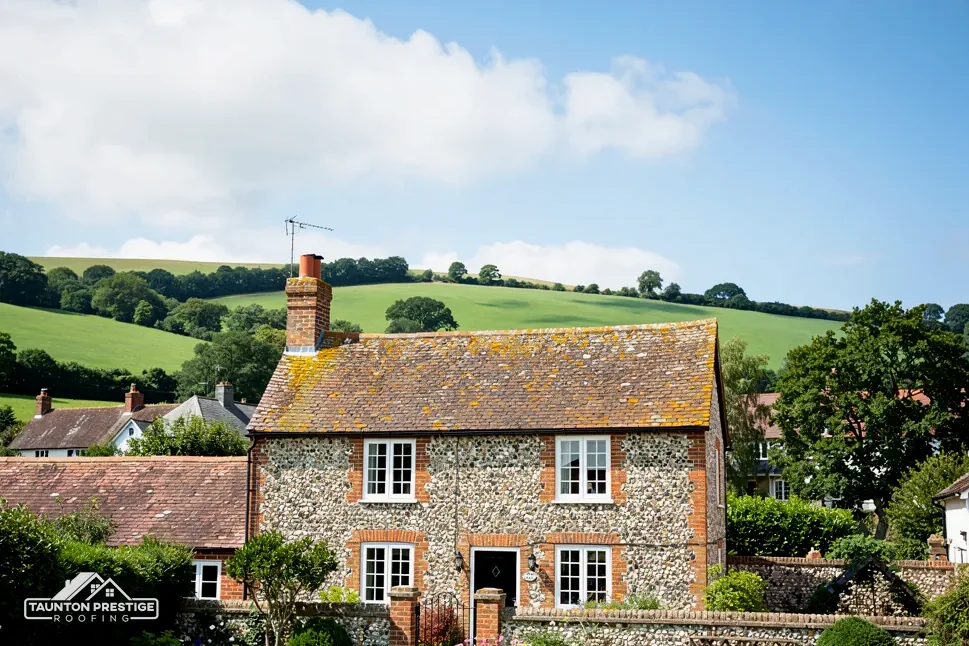
A house on Church Lane is listed Grade II*, and Blackmores and Broadhembury House are Grade II.
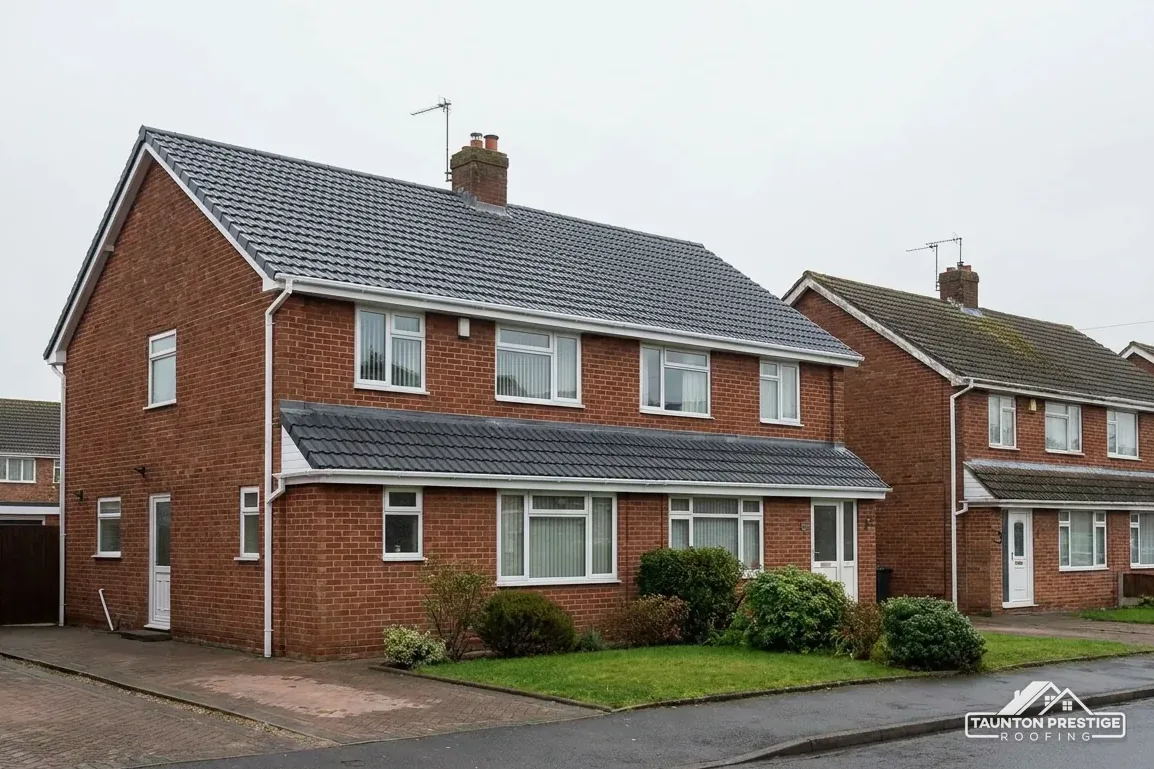
Inside the Blackdown Hills National Landscape, formerly an AONB, which affects which roof changes need an application.
Street map of Broadhembury with Payhembury, Kentisbeare, Dunkeswell, Feniton marked around it, and Taunton.
Payhembury and Feniton lie to the south, with Kentisbeare to the north-west, Dunkeswell to the north-east and Honiton to the south-east.
About 14 miles south-west of Taunton, East Devon District Council and Devon County Council.
Four checks under the Blackdowns
Four checks for a listed, landscape-protected village, and what each one adds to the work and the price.
Broadhembury sits inside the Blackdown Hills National Landscape. In November 2023 the Blackdown Hills Area of Outstanding Natural Beauty was renamed, along with every AONB in England. GOV.UK adds that the new name has no statutory force, which is why the planning rules still use the older wording, area of outstanding natural beauty. For a roof it matters most when the plan changes the roof's shape: dormer rules are tighter inside a National Landscape, and East Devon District Council, as planning authority, is the body that decides.
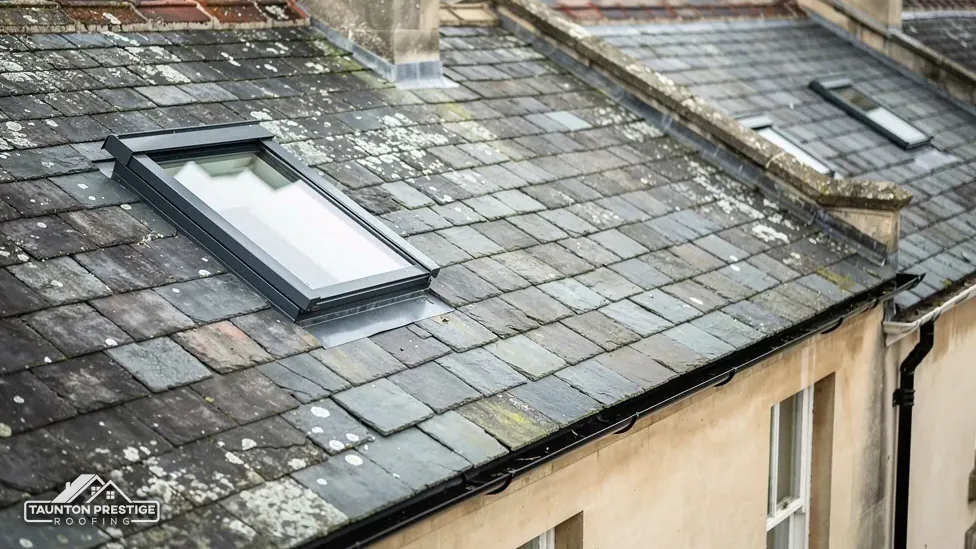
A roof window that sits flush in the slope is a different thing from a dormer, and the planning rules treat the two separately; our planning guide explains how. Put your address to East Devon District Council's planners before you order anything. Our roof window installation page covers the options.
Approved Document L (2021 edition) gives a window figure of 1.4, or Window Energy Rating Band B, and a roof window takes that figure. A rooflight, the flat or domed unit on a flat roof, takes 2.2. People mix the two up all the time, and the right number depends on which one you are fitting. MyJobQuote puts a standard mid-range Velux at around £1,100, with a straightforward swap about £100 less (Sep 2026).
At the survey we measure the opening, check the rafters either side and look at the flashings, so you know what the window will need before you choose it.
Conservation and landscape rules shape smaller choices as well. A change of ridge style, a different colour of slate or an added rooflight on a front slope can draw questions where a like-for-like repair would not. We note the existing details before suggesting any alternative, so the question put to the council is specific and short.
Look for
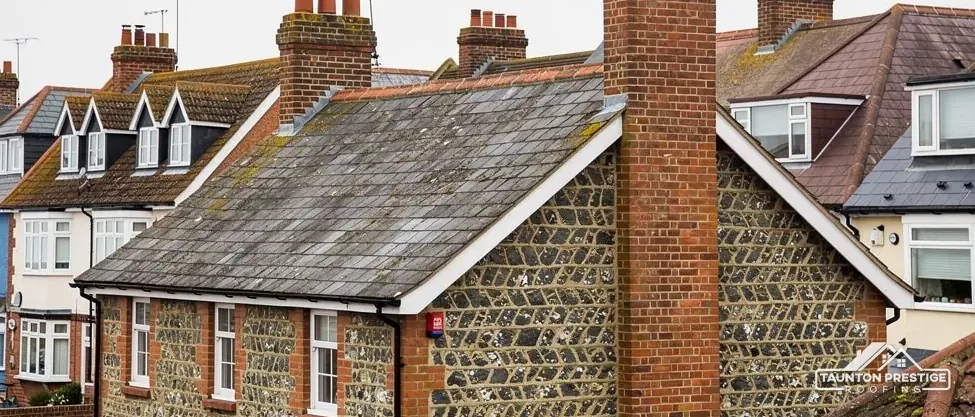
St Andrew's was first listed at Grade I on 22 February 1955, and Church of England worship continues there. That puts its roof under the faculty system, not the council's listed building process. A house on Church Lane carries a Grade II* listing, and Blackmores, sometimes called Pennywain, and Broadhembury House are Grade II. There are 38 entries on the National Heritage List within 500 metres of the centre, and Broadhembury also has a conservation area, which East Devon District Council can describe for your address.
What decides the price
Putting back what was there is a repair. Anything that alters character, such as a different covering or a rebuilt chimney, needs listed building consent, and our page on roof consent for listed buildings sets out the steps. A listed owner keeps ordinary permitted development as well, and the consent sits on top of it. Because matching matters, we look at slate size, thickness and colour before suggesting reuse or replacement.
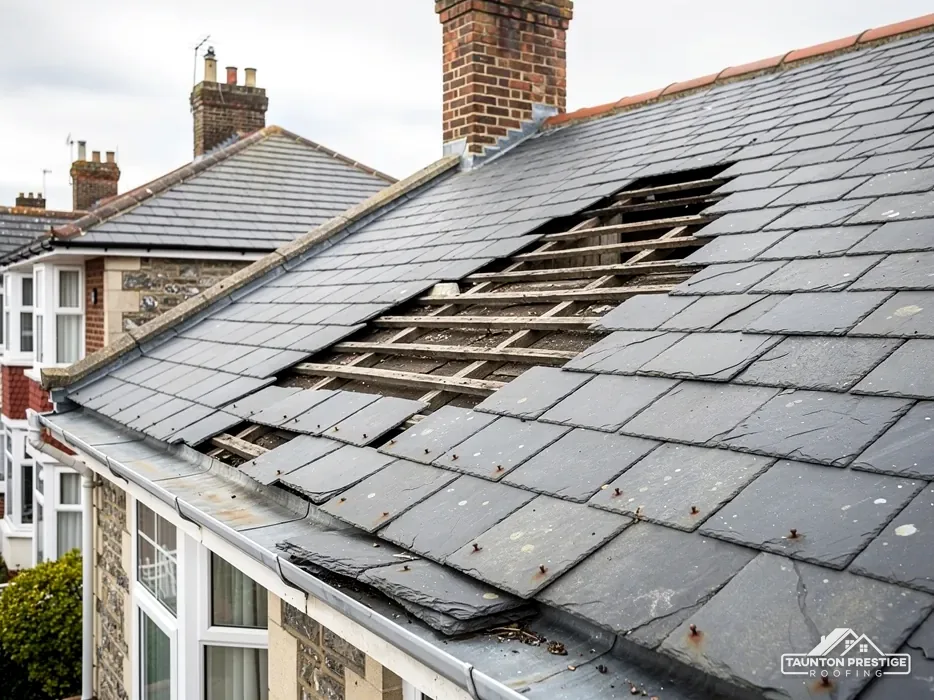
Look from the ground for slates that have slid, for patches of moss that hold water and for brown stains on the ceiling beneath. CORC's guidance has well-kept slate lasting 100+ years, so age alone is rarely the problem. The nails, hooks and battens are what fail first, and a closer look from the ladder tells us which. Our slate roofing page goes deeper.
Church Lane roofs also ask for care at the eaves and the chimney. On older houses the lead flashing round a stack, and the mortar collar on the pots called the flaunching, are common weak points, and repairing them like for like usually keeps the character of the house intact. If a stack needs more than that, it goes back to the question of consent.
The ridge crowns the roof, while the verge finishes the covering where a gable wall rises. Both were once bedded on mortar alone. Marley explains that the 2014 revision of BS 5534 made clear that mortar by itself could not be relied on to hold the tiles on a ridge or hip, so bedded tiles are fixed mechanically as well. Dry-fix systems do the job with clips and screws, and BS 8612 is the test specification for them. Marley also states that installing to BS 5534 is not required by law, so neither a ban on mortar nor a free pass for it is true.
A ridge that was fixed with mortar alone is a ridge that was fixed to an older standard.
MyJobQuote says a dry verge system usually falls between £500 and £2,000, with an average around £1,000 (Oct 2026). Replacing ridge tiles is £225 to £550 as a typical UK range, and a full roof valley replacement (a valley is the inside angle where two slopes meet) averages around £540 (Sep to Oct 2026). A ridge test is simple: we press each tile gently to feel for rock and take photos of any that move. Roof shape, height and access move those numbers up or down. Our dry ridge and verge page explains the systems.
It changes how the ridge looks and sits, so on a listed house the swap may need consent. In the conservation area or the National Landscape the look of the roofline still counts. We tell you what each option would change, and the council has the last word. Dry verge and ridge systems change maintenance too. With clips and screws, one loose tile can be re-fixed on its own, while a bedded ridge that has cracked usually needs the affected run lifted and laid again. Either way the battens below the ridge get checked, because a ridge fixed to rotten timber is only as good as the timber.
Scaffold on a lane or pavement needs a licence under section 169 of the Highways Act 1980, and Devon County Council is the highway authority for Broadhembury. It requires the licence to be applied for by a scaffolding company acting for the customer. Devon's page lists £158.00 for a licence, a minimum of 10 working days' notice, a maximum length of 12 weeks, and £100.00 to extend or amend one. A licence applied for with under 10 working days' notice is treated as an emergency at £238.00. Poles on your own land never reach the highway, and a repair on a single slope may need only a tower. On a narrow lane the practical points matter as much as the licence. We agree where materials can be unloaded, how neighbours get past and what happens if the weather turns, and you hear the plan for each day before it starts. Deliveries are timed for the quietest part of the day. Waste leaves with us, and the site is left tidy and safe each evening.
What decides the price
The Environment Agency's planning flood map places the centre point of Broadhembury in Flood Zone 2. That describes the ground, not the roof. GOV.UK offers a long-term flood risk check by address, and a roof's job is simply to pass its rain on without leaving it at the wall.
Ask your building control body. The Planning Portal's tests are under 25 per cent of the building envelope and under 50 per cent of the roof, and a covering 15 per cent or more heavier needs Building Regulations approval.
Tell us your lane and the symptom, and a survey day is arranged. Photos of your own roof come first, and one total price in writing follows.
Walked the roof?
When you have read the checks, we walk the roof and show you the photos.
No. A re-roof is still possible, and a like-for-like covering is the simplest case. What the National Landscape changes is the list of extras: a new dormer, for instance, faces tighter rules there. If a conservation area or a listing applies as well, East Devon District Council's planning team can say what you need.
The Church of England's faculty system, because the church is in use for worship, and not the council's listed building process. Whoever looks after the building takes the request forward. The roofer follows the approved scheme. Planning permission for outside development can still apply, so the approval route is worth confirming early.
A like-for-like repair, in the same material and pattern, keeps the appearance as it was, which is what a conservation area exists to protect. A change of covering, a new style of ridge or an added roof window is where questions start. East Devon District Council's planning team can tell you whether your address is inside the boundary and what a change would need.
No. Mortar is not banned. BS 5534 changed in 2014 so that mortar by itself no longer counts as enough for ridge tiles, and Marley states that installing to the standard is not required by law. A mortar-bedded ridge is simply not what a new fix would use, and we show you the difference in your photos.
Tell us your lane and the symptom you have noticed, and we will find a day to survey.