St John the Baptist's church
Grade I red sandstone; its west tower was rebuilt in 1870 and the rest restored in 1862 and 1863.
A Grade I sandstone church and cottages on the Exmoor edge
Carhampton stands on the A39 between Dunster and Williton, with part of the ground around it inside Exmoor National Park and 27 listed entries within 500 metres of its centre.
Grade I red sandstone; its west tower was rebuilt in 1870 and the rest restored in 1862 and 1863.
Court Cottage, Footlands Cottage and Forge Cottage are each listed Grade II, so their roofs fall under listed rules.
Roughly 35 per cent of a 1.5 km square around the village lies in Exmoor National Park.
Street map of Carhampton with Dunster, Old Cleeve, Washford, Minehead marked around it, and Taunton.
Dunster lies north-west of Carhampton with Minehead beyond it, while Old Cleeve, Washford, Watchet and Williton follow along the road to the east.
About 18 miles north-west of Taunton, Somerset Council (unitary).
Four checks beside Exmoor
What to check on a house, cottage or church roof here, and how each check changes who decides, what is allowed and what it costs.
Part of the ground around Carhampton belongs to Exmoor National Park. Our boundary check found 35 per cent of a 1.5 km square around the village inside it. So some Carhampton addresses sit in the Park and others do not, and for roof work that single fact changes who you deal with.
Inside the Park, Exmoor National Park Authority is the sole planning authority, not Somerset Council. That includes listed building consent for a protected house. Outside the Park, Somerset Council takes both. The first job at a survey is to establish which side of the line your address falls, and the Park Authority's planning team can settle it if the map is unclear. Enforcement of planning and listed building control inside the Park sits with the Authority too, so it is the body to hear from if a roof plan changes.
Dormers are the big one. The rules for a dormer are tighter inside a National Park, so a house inside Exmoor starts that conversation with the Park Authority's planners before any drawing is made. Our Exmoor roof planning page explains the rest. Building Regulations are a separate matter, and for Somerset addresses in the Park the contact is Somerset Building Control.
Dunster, the nearest conservation area on the national dataset, lies within about 2.5 km of Carhampton, a reminder that heritage rules vary from village to village along this road.
Whichever body decides, a clear photographic record of the covering, the ridge and the chimneys as they stand today lets it judge a proposal quickly, and it spares you a second visit. If a roof window or a change of covering is on your list, tell us at the first call so the survey records the slopes that matter.
Look for
The Church of St John the Baptist is listed Grade I. The Somerset Historic Environment Record describes a red sandstone church whose west tower was rebuilt in 1870, with the rest restored in 1862 and 1863. A 14th-century window survives in the vestry and the south aisle is 15th or 16th century. The record also gives grounds for believing it was an early Anglo-Saxon minster, and it has carried its dedication since at least 1407. A building with that history is looked after carefully, and a roof repair is no small matter for the parish.
Sound or needs work
What decides the price
Since it is an Anglican parish church that remains in use, St John's takes roof work through the faculty system, the church's own consent route, and not through listed building consent from the council. The parish arranges the faculty, and the roofer then follows the specification it approves, with matching materials and recorded methods.
Lead seals the valleys, the foot of the tower and the joints between roof and wall. MyJobQuote gives flashing a life of over 80 years as a lower bound. Failures gather at joints and fixings, and a split along a fold lets water in behind stonework, where the damage stays hidden for years. Sandstone that stays damp can lose its surface, which is why a small lead fault on a tower deserves attention soon. Our lead work page explains the codes and what each is used for.
A parish planning a roof repair wants a specification it can put in front of the church's advisers: the covering to be renewed, the fixings, the lead code and the access. We describe each in plain words and photograph every slope and gutter, so the paperwork is ready when the faculty is applied for.
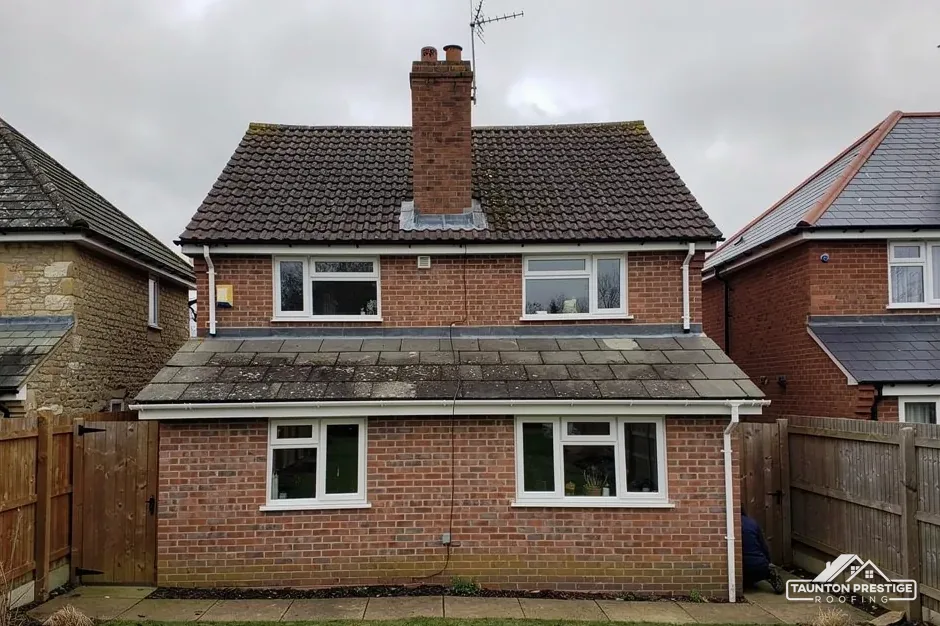
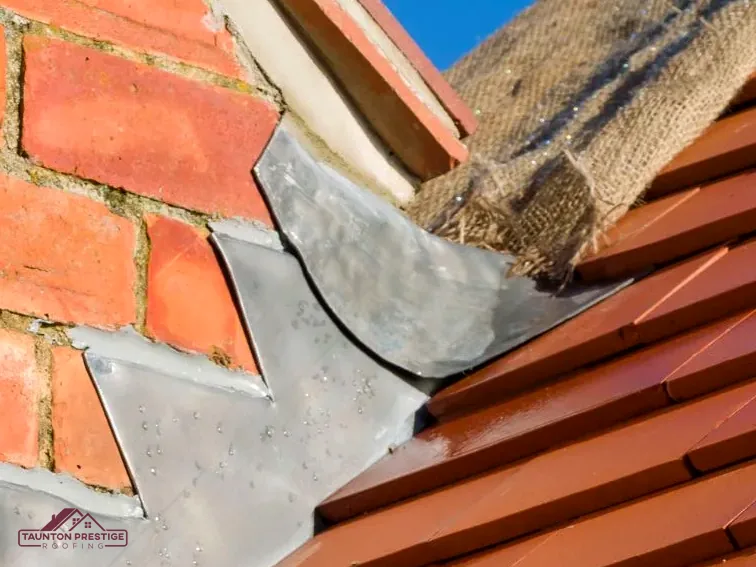
Court Cottage was first listed on 7 July 2017, and Footlands Cottage and Forge Cottage are Grade II as well. Old cottages share a weak point: the stack. A chimney rises clear of the roof, takes wind and rain on four faces and must be sealed where it meets the slope. When that seal fails, the stain appears on a bedroom ceiling a long way from the cause.
A stain on a bedroom ceiling can start at a chimney stack some distance away.
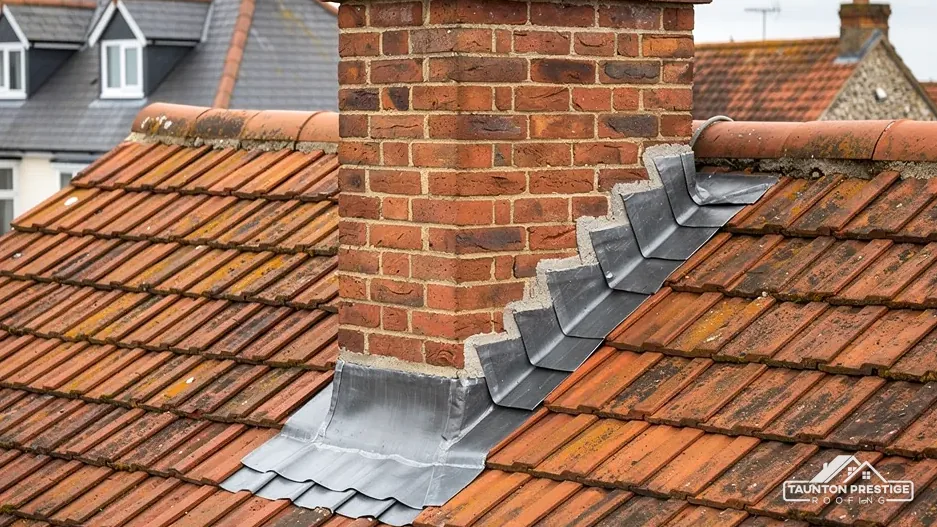
Usually the soft parts. The flaunching is the sloped mortar cap that grips the chimney pots, and it cracks as it ages. Pointing between the bricks or stones washes out. The flashing is the strip of lead let into the stack and dressed over the roof covering, and it lifts or splits. A pot that rocks, a crack in the cap, or green growth on the stack all deserve a closer look. Our chimney repairs page goes through each part.
Renewing flaunching, pointing and flashing in matching materials counts as repair. Rebuilding or taking down a stack can change a listed house's character and may need listed building consent. Building Regulations approval is required whenever a chimney breast is removed from inside the house, the Planning Portal says. If the stack sits on a shared wall, the Party Wall etc. Act 1996 may also apply, and a party wall surveyor handles that.
We photograph the stack from every side at the survey, so you see what we see before deciding.
Cottage roofs have small slopes and awkward junctions, so a leak often turns out to be several small faults close together. The survey follows the water from the ceiling stain through the loft to the slope, instead of stopping at the first suspect. That way the repair you are quoted for is the one that stops the drip, and not a neighbouring job that merely looks likely.
Where a house fronts the A39 or one of the lanes behind it, the road may be right at the front door. That matters for scaffold. A frame planted on the footway or the carriageway is on the highway, and section 169 of the Highways Act 1980 asks the highway authority to licence it; in Carhampton that is Somerset Council. A frame inside your own boundary, on a lawn or hardstanding, needs no licence. A modest repair may need nothing taller than a tower or ladder; the survey confirms which, so you pay for no scaffold you do not need.
What decides the price
For scaffold on the highway Somerset Council works with accredited contractors only, and the contractor appointed to the job makes the application. Allow 10 working days or more before the frame goes up. The fee is £124.60 for each 28-day period (April 2026), and an overrun needs an extension. We choose start dates with that notice in mind, and we tell you early if the weather could push a job past a licence period.
Sometimes. Building control is not normally needed on the Planning Portal's test while the work touches under 25 per cent of the building envelope and under 50 per cent of the roof. Weight is a separate test: a new covering 15 per cent or more above the old needs a structural check as well as approval under the Building Regulations. Somerset Building Control, on 0300 303 7790, covers Somerset addresses, Exmoor included.
The survey closes with photographs of the roof as it stands and a single written figure covering the whole job, with all waste taken off site by us. Send your Carhampton address and say which roof it is, and we will fix the visit.
Walked the roof?
When you have read the checks, we walk the roof and show you the photos.
Only part of the ground around the village is inside the Park, so the address matters. Exmoor National Park Authority is the planning authority inside the boundary and Somerset Council is outside it. Ask the Park Authority's planning team to confirm your address before any covering is changed, and we will note the answer on the survey.
In the National Park or a conservation area the dormer rules are tighter, so speak to the right planning authority first, and a listed cottage needs listed building consent as well. Roof windows that sit flush with the slope are a lighter change than a dormer, though listed status still applies and the Park Authority's view counts.
CORC says well-maintained natural slate can last 100+ years. Marley puts concrete roof tiles at around 60 years and says that is no guarantee. Nails, hooks and battens often give up before either covering does, so an old roof is judged on its fixings as well as on the slates or tiles that you can see.
It can be either. A patch that follows heavy rain suggests failed lead or flaunching at the stack. One that follows cold, still weather can be condensation in the flue. Soot-stained damp points to an unused flue with no air moving through it. We look at the stack outside and the breast inside before recommending a fix.
Give us your Carhampton address and say whether it is a house, a cottage or the church roof.