5 and 7, the Square
Listed Grade II* on 26 March 1984, with 1, the Square and 10, Silver Street both listed Grade II.
A medieval borough, a brewery past and a 1975 conservation area
Wiveliscombe is a small town with a conservation area, 52 list entries within 900 metres and a Grade II* church. We read each Wiveliscombe roof before pricing it.
Listed Grade II* on 26 March 1984, with 1, the Square and 10, Silver Street both listed Grade II.
First listed on 25 January 1956; the parish, not the council, handles consent for its roof.
A trust survey of older buildings seen from roads put Pickwell Down Sandstone at 82% of the stone recorded.
Street map of Wiveliscombe with Milverton, Leigh, Houndsmoor, Preston Bowyer marked around it, and Taunton.
Milverton lies south-east of Wiveliscombe, with Langford Budville and Houndsmoor also south-east, Preston Bowyer and Halse east, and Leigh north-east.
About 9 miles west of Taunton, Somerset Council (unitary).
Wiveliscombe roof notes
A conservation area, shop and works roofs, a Grade II* church and the stone walls beneath the eaves: four checks for a market town.
Somerset Council's table of conservation areas gives Wiveliscombe a designation date of 5 February 1975, revised on 25 September 2008. Historic England's list has 52 entries inside a 900-metre radius of the town centre. Two on the Square stand out: 5 and 7, the Square, listed Grade II* on 26 March 1984, and 1, the Square, listed Grade II, with 10, Silver Street also Grade II. Together they mean a roofer in Wiveliscombe asks two questions before pricing: is the house inside the conservation area, and is it listed?
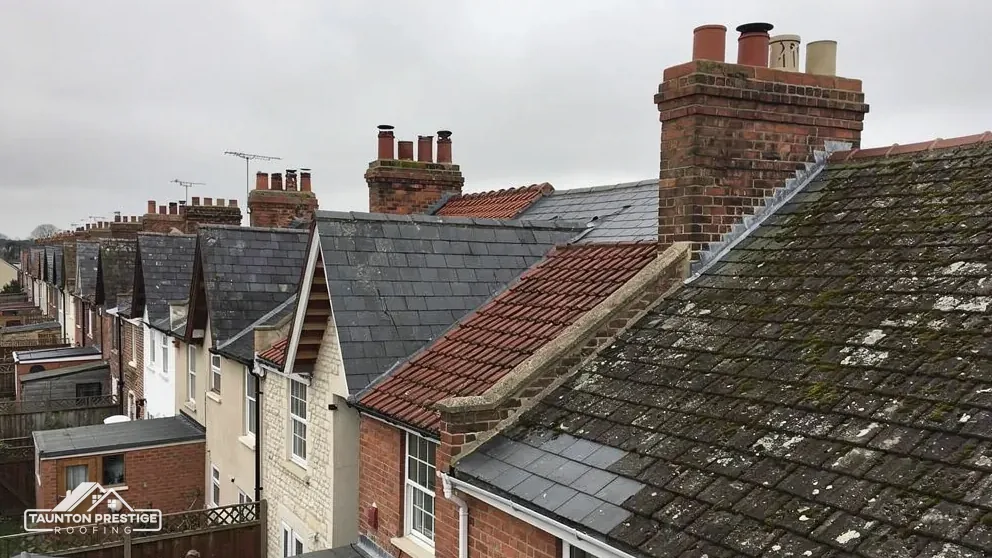
The town centre is compact, so a roof here rarely stands alone. Neighbouring gables and a pavement below shape how the work is done. Photographs of the street elevation help a council officer see what is proposed in context, so we take them from the pavement as well as from the roof. Those pictures also record the condition of the eaves and gutters seen from below, which is often where a problem first shows.
Look for
Not in itself. Restoring what was there seldom changes the appearance planners care about. The difference lies in work that would change how the street looks: a dormer, a new material, roof windows on the front slope. Those are questions for the council before they are questions for a roofer. Our guide to planning permission for roof work explains the routes. Put your address to Somerset Council's planners before settling on a different covering.
The covering found on each slope, the pitch, the ridge and verge details, the state of lead and the timbers visible from the loft, all with photographs. Those notes show the council what exists today, which is where any application has to start. Matching a slate or tile in size, colour and texture then keeps the street looking as it did, and on a listed house that care is a legal matter as well as a visual one.
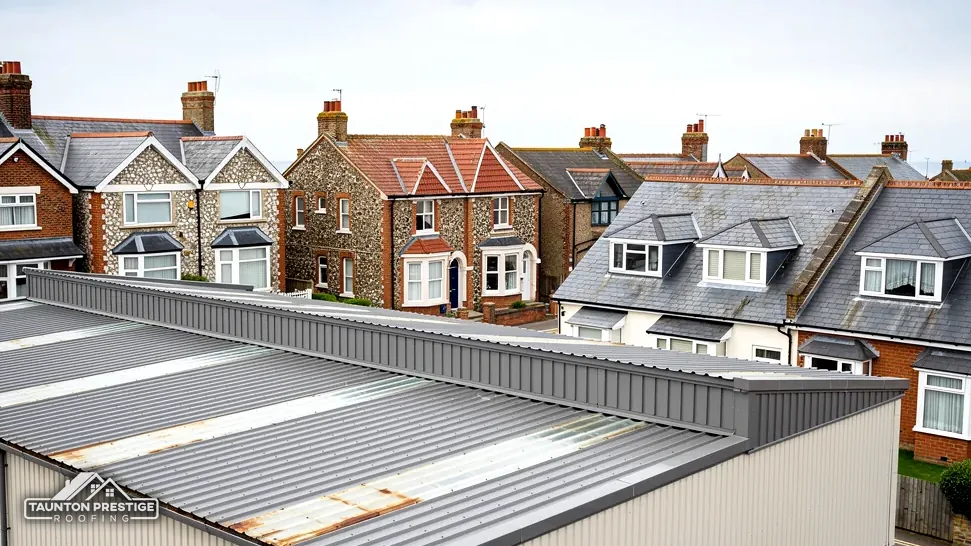
Wiveliscombe grew around a market. The Somerset Extensive Urban Survey notes a papal bull of 1179 as the first reference to a town, a weekly market and annual fair granted to the Bishops of Wells in 1284 or 1285, and a borough by 1301. When the woollen trade declined in the first half of the 19th century, Hancock's Brewery, the biggest in the west of England by the 1860s according to Kelly's Directory, and quarrying cushioned the blow. Not every roof here is a house roof, and shops, workshops and storage units need different handling.
Look for
What decides the price
An owner who lets or runs the building as a business falls outside the domestic category. HSE keeps that label for an individual commissioning work on their own home, or a relative's, where no business is involved. A business owner carries the client duties under CDM 2015 directly. Where two or more contractors work, or may work, on one project, regulation 5(1) requires the client to appoint a principal designer and a principal contractor in writing.
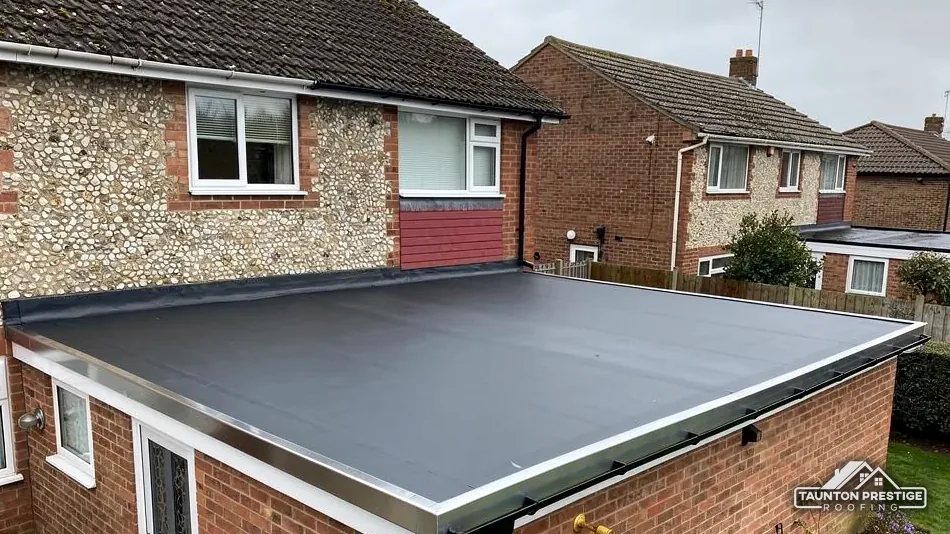
Height drives everything: guardrails at the edge, a route for people and materials that avoids the shop floor, and a clear idea of who works or stores stock underneath. We sequence the job in bays, closing each to the weather before opening the next, so trade can continue. A written construction phase plan comes with every project, large or small. Our commercial roofing page sets out how bigger buildings are surveyed.
HSE's rule of thumb is to treat a building completed or refurbished before 2000 as asbestos-bearing until shown otherwise, and its guidance A14 rates asbestos cement roofs as always fragile. They are never walked on, and the material is identified before anyone lifts a sheet.
St Andrew's church has been Grade II* since its first listing on 25 January 1956. Because it is a working Anglican church, it falls under the faculty system, which the parish applies for, rather than the council's listed building consent. A tower or nave roof is a specialist job: lead on parapets and in gutters, access that may need a tower or a hoist, and a specification agreed before work starts.
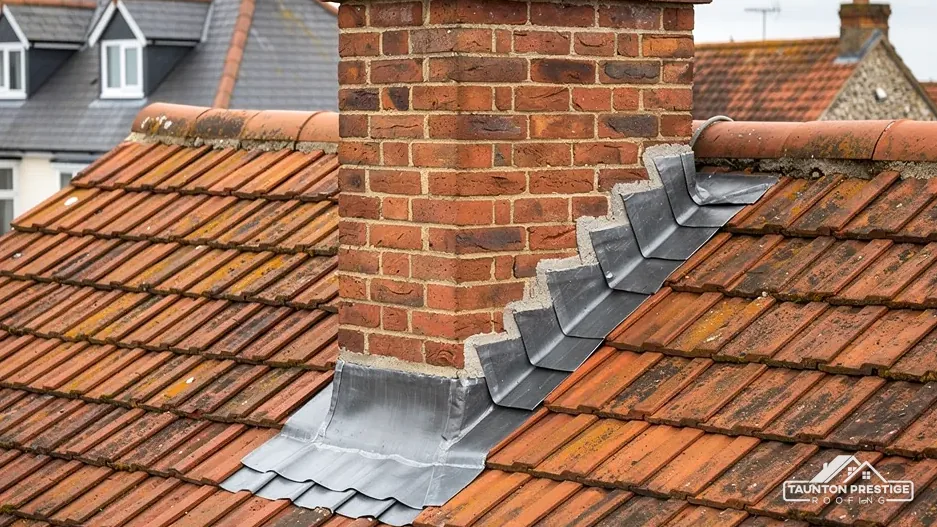
Where a lead flashing meets old stone, the pointing decides the repair.
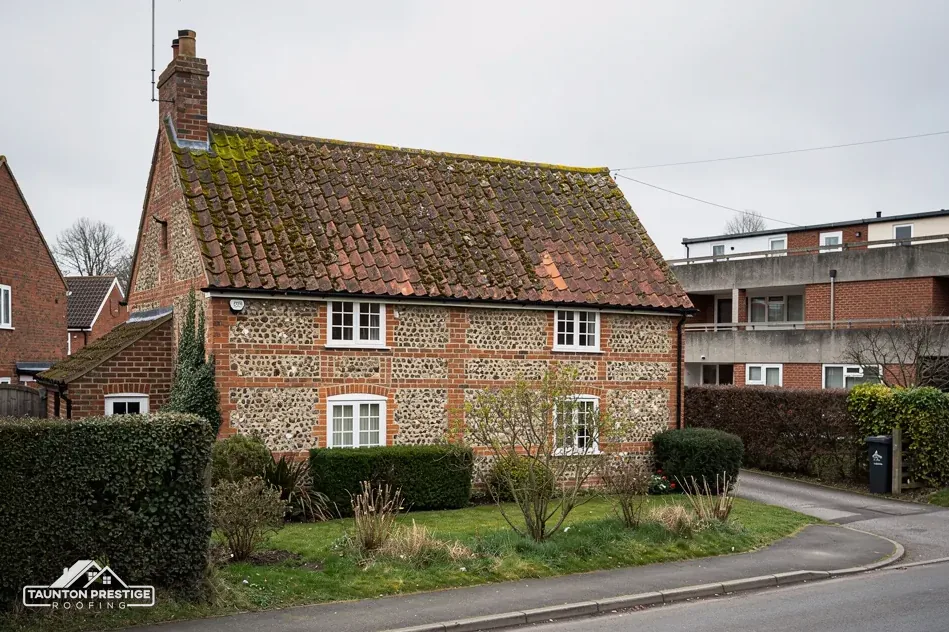
A South West Heritage Trust survey (2018) covered older buildings visible from the street or a footpath, all from before the First World War. Pickwell Down Sandstone made up 82% of the building stone recorded in Wiveliscombe, and Permo-Trias sandstone 14%. That is a statement about walls, not roofs. It matters to a roofer because flashings, copings and abutments are fixed into those walls, and stone can be damaged by careless raking out.
That junction is a joint between two materials that move differently. Lead is tucked into a mortar joint, and when the pointing around it fails, rain gets behind the flashing. A stain on the inside of an outer wall, or a green streak on the stone below the roof edge, points to the junction or to a gutter that has been spilling. We find which before anything is cut, and a spilling gutter gets fixed in the same visit, because water streaming down stone stains it and keeps it wet. A repair that rakes out old pointing and re-sets the lead in the existing joint is gentler than cutting a new chase into the stone itself.
Our lead work page covers the flashing detail. Lead can last for over 80 years according to MyJobQuote, which makes careful re-use of sound lead worth considering on a listed building.
Town-centre roofs mean pavements, parked cars and neighbours close by. Under section 169 of the Highways Act 1980, scaffold standing on the highway needs the highway authority's licence, and in Wiveliscombe that authority is Somerset Council. Only accredited contractors are given permits, and Somerset Council expects the appointed contractor, not the owner, to put in the application. Notice of 10 working days or more is required, and the fee is £124.60 for each 28-day period (April 2026). A job that runs over its dates needs a paid permit extension.
Wiveliscombe sat in Somerset West and Taunton until 1 April 2023, when that council and the other districts were abolished and Somerset Council became the sole principal authority. The planning team, the highway team and Somerset Building Control now sit under one council. Building control is on 0300 303 7790.
It need not. Neighbours and nearby shops hear about the plan early, we agree where materials and skips will sit, and the licence is applied for ahead of the start date so the scaffold arrives with its paperwork in place. Weather can still move the dates, and we tell you when it does.
Area, covering, height and access come first, then scaffold and what stripping out reveals beneath the old covering. Cost guides give national ranges only: Replacing ridge tiles, for example, runs from £225 to £550 in MyJobQuote's typical UK range (Oct 2026). When two quotes look far apart, check first whether both include VAT and scaffold.
Once we have been up, you receive photographs and one total in writing, and our waste leaves with us. Send your Wiveliscombe address and say which building the roof belongs to, and we book the visit.
What decides the price
Walked the roof?
When you have read the checks, we walk the roof and show you the photos.
Not by itself. Restoring the same covering seldom changes the look planners care about. A dormer, a new material or roof windows facing the street are different, so check with Somerset Council's planning team before any of them is chosen. Listed buildings need listed building consent for work affecting their character.
Each list entry describes its own building. 5 and 7, the Square is Grade II*, and 1, the Square and 10, Silver Street are Grade II. A neighbouring roof is only caught if it falls inside an entry or the conservation area. Somerset Council can confirm both for your address before any plan is made.
No. Somerset West and Taunton was abolished on 1 April 2023, and Somerset Council now handles planning, highways and building control. Somerset Building Control covers the former district area on 0300 303 7790. Exmoor National Park is a different authority altogether, and its planning team has no say over a roof in the town.
Probably not for the shop roof. In HSE's words a domestic client is a private individual having work done to their own home or a relative's, with no business in the picture. Work on business premises makes you a commercial client with duties under CDM 2015. If part of the building is your home, ask your adviser how the work divides between the two.
Send your Wiveliscombe address and which building the roof belongs to, and we will arrange the visit.