The ridge is the capping that runs along the highest line of a pitched roof, where two slopes meet. It takes the full force of wind, it has no shelter from rain, and for most of the last century it was held in place with nothing but a bed of mortar. Somerset weather tests that arrangement hard. Westerly gales arrive over open ground, and driving rain finds every hairline crack in an old mortar joint.
When a ridge tile slips, rocks or drops into the garden, the first instinct is to blame the storm. Often the mortar had been failing for years and the storm simply showed it. This post looks at how a ridge comes loose, what the standards now say about relying on mortar alone, which checks are safe from the garden once the wind drops, and how re-bedding compares with a dry ridge system. It belongs with our dry ridge and verge work.
What holds a ridge tile in place
A ridge tile is a curved or angled capping piece that covers the join between two slopes. Traditionally, each one sat on a bed of mortar that also filled the gap at each end, and the mortar did two jobs. It stopped rain blowing in, and it was meant to hold the tile down. The ends were pointed neatly, and the whole line looked tidy for a few years. Beneath it, the tiles also covered the top of the underlay and the ventilation gap, so a failure there lets weather straight into the loft.
Why does mortar let go?
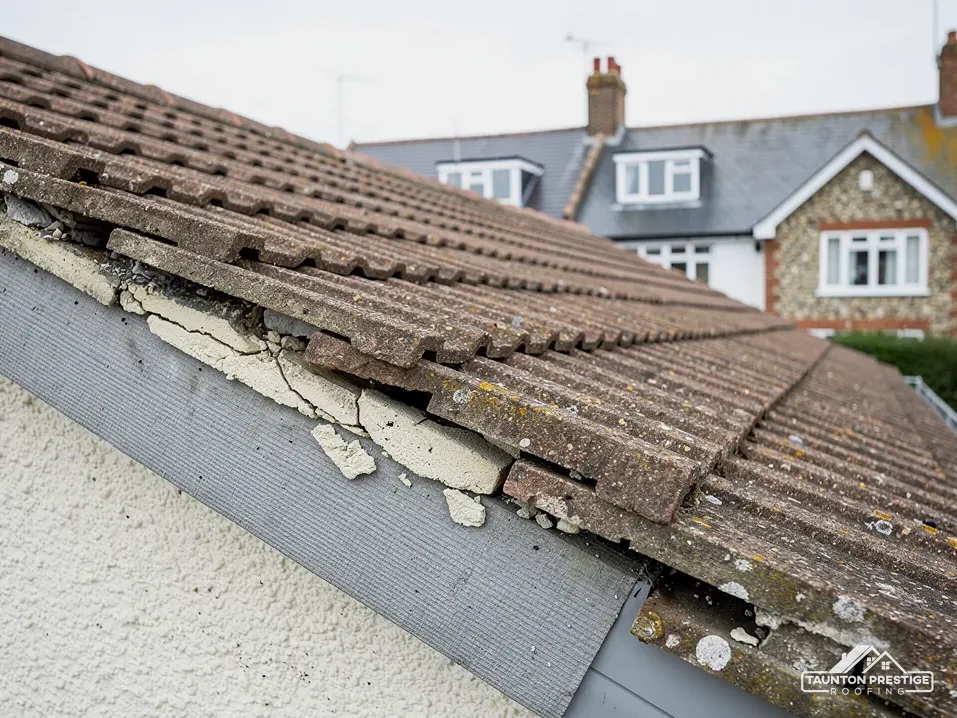
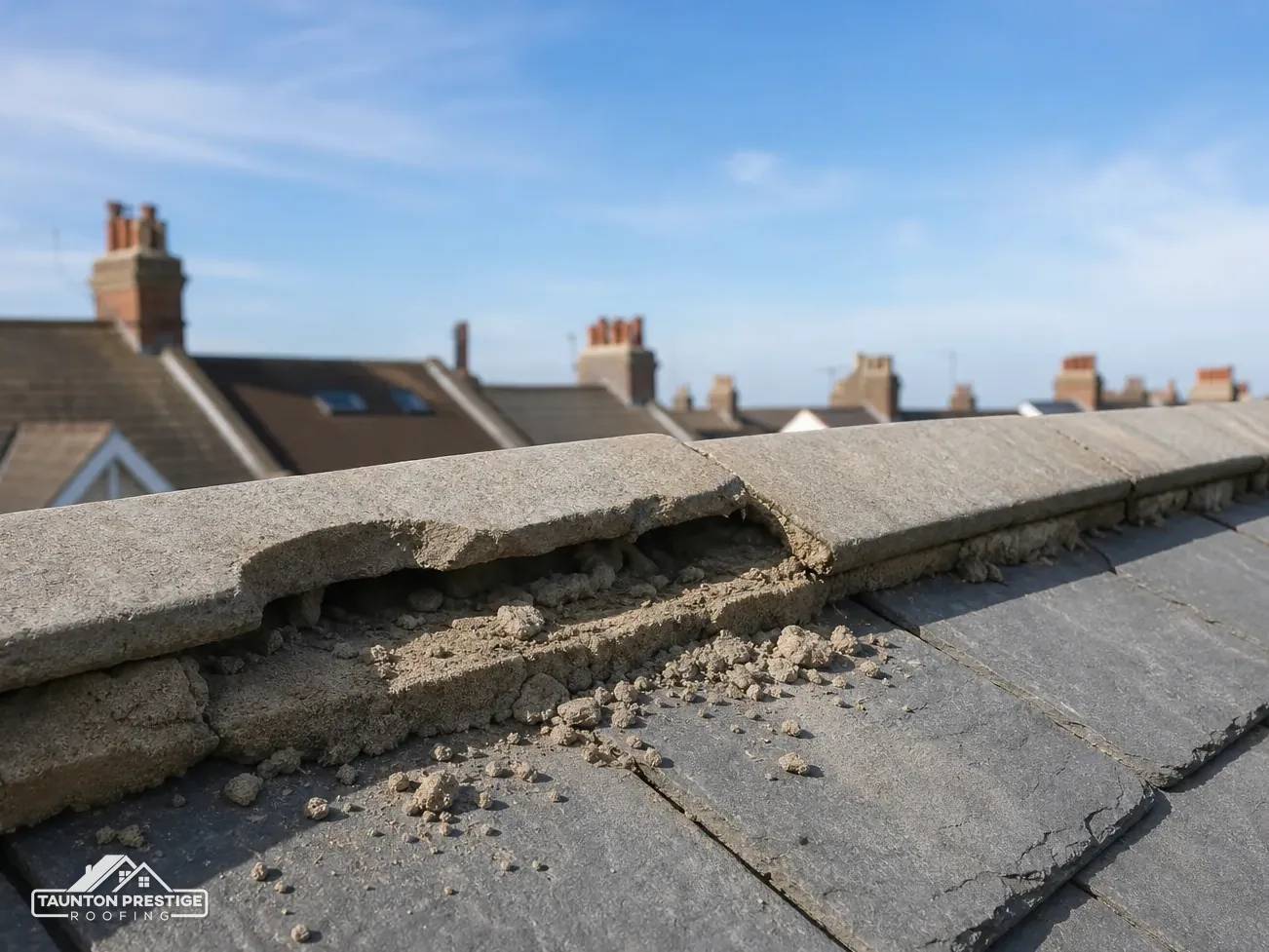
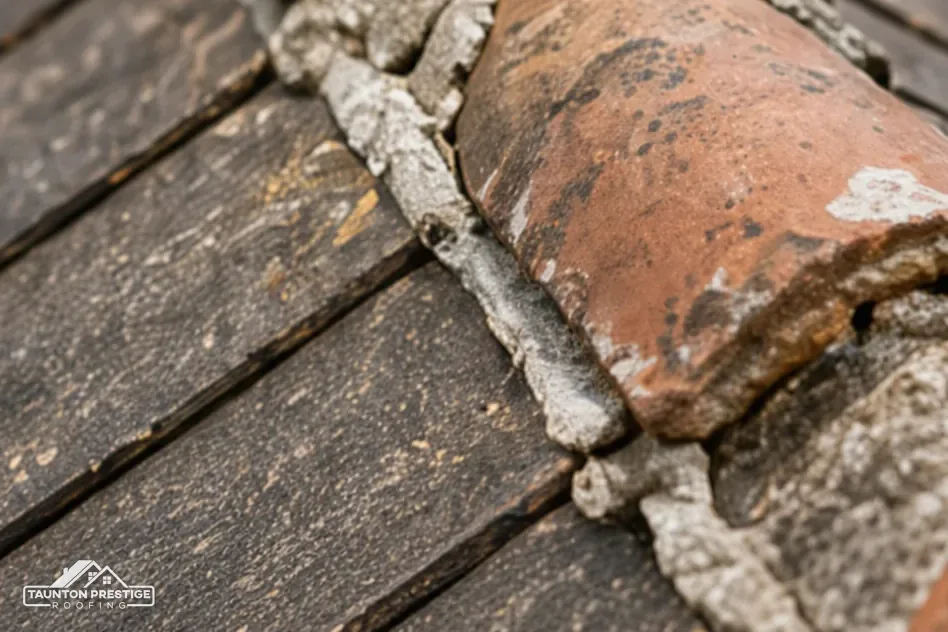
Mortar shrinks as it cures and hairline cracks open at the edges. Frost then gets into the cracks, wet mortar swells, and the cycle repeats winter after winter. Wind rocks each tile a fraction every time a gust passes over, which wears the bond further. Moss and lichen hold moisture against the joint and speed things along. In time the bed crumbles at the edges, and a tile that looks solid is sitting on very little.
What else keeps a ridge in place?
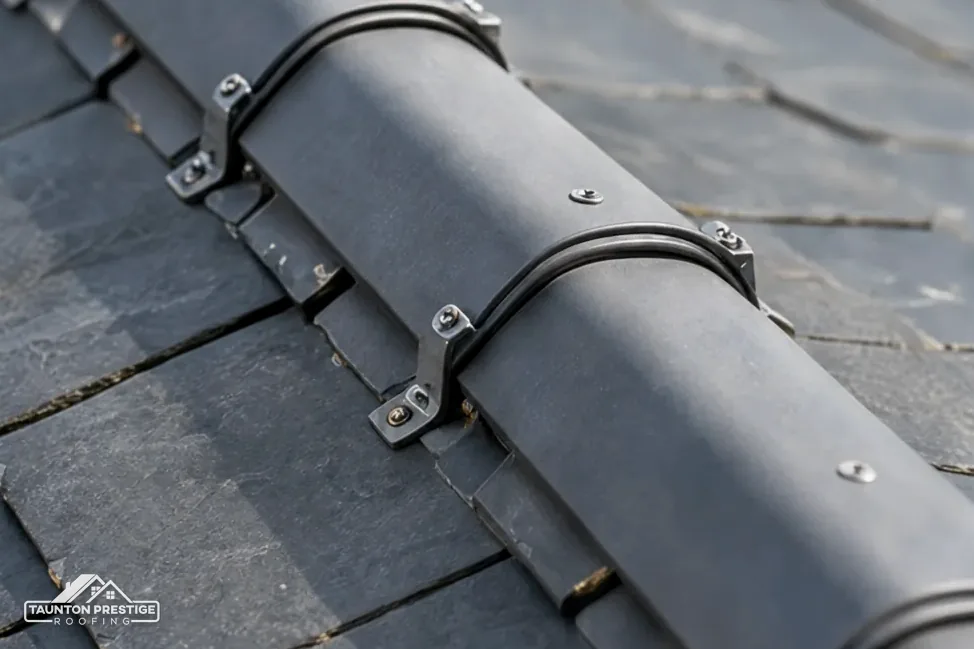
Where a ridge is held mechanically, the tiles are secured with fixings such as clips, brackets or screws, so they stay put even if the mortar cracks. A dry ridge system holds ridge tiles with a clipped batten and fixings instead of mortar. The hip, the sloping corner where two roof slopes meet on the outside, is built the same way and fails in a similar manner.
Understanding these two ways of holding a tile on explains most of what follows. Mortar relies on a bond that decays. Fixings rely on metal and timber that can be inspected.
Wind and driving rain on a Somerset roof
Ridge tiles meet wind at its worst. Air squeezed over the roof speeds up as it crosses the top, which creates suction and uplift right where the tiles sit. A south-westerly gale does not hit a roof evenly; it works on one slope, one end or one exposed corner, and the ridge nearest that edge takes the beating first.
Why does rain find the ridge?
Because it can be pushed sideways and upwards. Driving rain is carried by the wind, so it can reach under a ridge tile that would stay dry in a vertical shower. If the mortar has cracked, water gets onto the top of the underlay, then into the loft along the rafters. A stain on the ceiling can then sit a long way from the ridge it came from.
Does location matter?
It does, as exposure changes how hard a roof is tested. A house on a hill edge, an open field boundary or the Somerset Levels meets stronger wind than one in the middle of a sheltered terrace. That does not mean a sheltered roof is safe, only that the weak points show up sooner on exposed ones. Tall chimneys, trees and neighbouring gables all change how the air swirls round a ridge, which is why two houses on one street can fare differently.
Wind direction counts as well. Note which side of the house the weather came from. When a storm brings one ridge tile down, the neighbouring ones on that slope are the ones to look at closely, since they have taken the same battering and are probably loosened.
Why a mortar bed is not trusted alone
This is where many older roofs fall behind the standard. Since the 2014 revision of BS 5534, the slating and tiling code, Marley says a mortar bed cannot resist uplift alone where ridge and hip tiles are concerned, so bedded tiles also get mechanical fixings. BS 5534:2014+A2:2018 is the edition BSI lists as current.
Is mortar banned?
No. Mortar is not banned, and a well-made mortar bed still has a place, particularly on older roofs where a traditional look matters. The change is that mortar is no longer the only thing holding the tile down. Marley adds that BS 5534 is not a legal requirement. It is a code of practice, the yardstick builders and manufacturers use for good work, so a roof laid earlier is not unlawful for lacking fixings.
What does that mean for your roof?
If the ridge on your house was bedded years ago in mortar alone, the bond is the only thing between the tile and the wind. A repair now should include mechanical fixing, not simply a fresh bed of mortar. Our answer on why ridge mortar cracks goes through the causes, and the page on dry ridge against mortar compares both approaches.
Ask any roofer repairing a ridge how the tiles will be fixed and what they are held to, so you know before work begins. Ask too whether the verge and hip tiles beside it get the same treatment, because they share the same weaknesses and are often missed.
What to check after a storm, from the ground
Stay off the roof. Ridge work on a wet or windy day is how people get hurt, and a ladder against a wet gutter can slip, and a roof that has just taken a battering is not a safe place to find out what moved. Almost everything you need can be seen from the garden or the pavement, with a pair of binoculars and your phone.
What can you see from below?
Scan the ridge line against the sky. Look for a tile that sits crooked, a missing tile, a white or grey line where the mortar has fallen away, or pieces on the ground, in the gutter or on a lower flat roof. On a gable, check the verge too, the sloping edge where the tiles meet the end wall. Photograph anything odd from a safe place.
What can you see from the loft?
With a torch, on boarding or joists only, look near the ridge for daylight, wet timber, fresh drips or a streak of damp on the underlay. Debris on the loft floor, such as grit or crumbs of mortar, is also a clue, as is a patch of insulation that has turned dark or flat.
Is it urgent?
A loose tile above a path, drive or door is a risk to people, so keep the area clear and cordon it off if you can. Under Somerset Building Control's dangerous structures guidance, loose or falling roof tiles are a listed example, and whoever owns the building pays for making it safe. If you are unsure, its number is 0300 303 7790. Our answer on whether a slipped ridge tile is an emergency helps you decide how quickly to act, and a loose tile over a doorway or a drive goes to the top of the list.
Dry ridge or re-bedding: choosing the repair
Once a ridge has failed, there are two sensible routes. One is to lift the tiles, clean them, re-bed them on fresh mortar and add mechanical fixings. The other is to fit a dry ridge system, which holds the tiles with clips, a fixed batten and ventilated sealing strips instead of a mortar bed.
When does re-bedding suit?
On an older or traditional roof where the existing tiles are worth keeping, such as handmade clay or a particular local profile, and where mortar suits the look. A good re-bed, with proper fixings, can last, and the roof keeps its original appearance. It needs skilled hands and a decent day, since mortar will not set properly in heavy rain or hard frost.
When does dry ridge suit?
Where the ridge is long, exposed or has failed more than once, or the tiles are modern concrete ones. There is no mortar to crack, the system can be fitted in a wider range of weather, and it can be inspected. Dry-fix systems of that kind are tested to BS 8612.
What does it cost?
For ridge tile replacement, MyJobQuote's guide quotes £225 to £550 (Oct 2026); for a dry verge system it quotes £500 to £2,000 (Oct 2026). Those are typical UK ranges, not a Taunton Prestige price. Roof length, access and the state of the tiles move the figure, and a long, exposed ridge costs more to reach than a short one on a bungalow.
Neither route is better in every case. Sometimes the lowest-cost sound answer is a handful of re-set tiles, and the survey will show whether that is true of yours.
Insurance, evidence and your next step
If a storm has damaged your ridge, your insurer comes first. Report it to them before anything permanent is arranged, put a temporary fix over the gap to stop more water getting in, and keep your photos and receipts together. IStructE calls photographs vital, as they show the damage as it was.
Will the insurer pay?
That depends on your policy and the cause. Which? reports that only 32% of storm-related claims made in 2024 resulted in a payout, and the Financial Ombudsman Service gives its own view of what counts as a storm: violent wind, often with rain, hail or snow. A ridge that failed through age and decay may be treated differently from one hit by a gale. We cannot promise an outcome, and the claim stays between you and your insurer. Should you and the insurer reach a stalemate, a complaint to the Ombudsman costs you nothing.
What should you do next?
Arrange a survey of the whole ridge, not just the tile that fell. A single loose tile often means its neighbours are on the same failing bed. The survey records the state of the mortar, the fixings and the tiles, and you get photos from your own roof to look at beside us.
For a loose or slipped ridge, send us a few photos from the ground, your address and which side the weather came from.
Loose ridge, quick answers
Can I just push a loose ridge tile back into place?
Please do not climb up. A tile that has moved is sitting on a failed bed, so pressing it back only hides the problem and puts you at risk. A roofer can re-fix it properly, check its neighbours and decide whether the whole ridge needs re-bedding or a dry system.
Do I need a new ridge if only one tile has gone?
Not always. If the rest of the bed is sound, a single tile can be re-set and fixed. The survey tells you which case you have. Look for cracked mortar, rocking tiles and gaps at the ends, because a ridge that has lost one tile often has more tiles loosening nearby.
Is dry ridge a legal requirement after BS 5534 changed?
No. Marley says BS 5534 is not a legal requirement, and mortar has not been outlawed. What shifted is the view of a mortar bed working alone: ridge and hip tiles now also need mechanical fixing, or a tested dry-fix system can go on instead.
More on this subject: Dry ridge and verge repairs in Taunton