Ask three people what is wrong with a leaking chimney and you may get three different answers: the pot, the pointing, the flashing. They are all possible, and the confusion comes from the fact that nobody explains the parts. A chimney looks like one solid object from the road. In practice it is half a dozen separate pieces, built by different trades in different materials, and each fails in its own way and at its own speed.
Knowing the names helps you follow a survey, read a quote and ask better questions. It also stops a patch repair going on the wrong part. Water from a failed flashing can run down inside the house and look like a damp chimney breast, while a cracked crown can send rain down the flue. This guide walks down the stack from the top, then through the lead at the roof line, the damp-proof tray inside, and finishes with a table of what each symptom usually points to. It belongs to our chimney repairs service for Taunton and Somerset homes.
Pots, cowls and the top of the stack
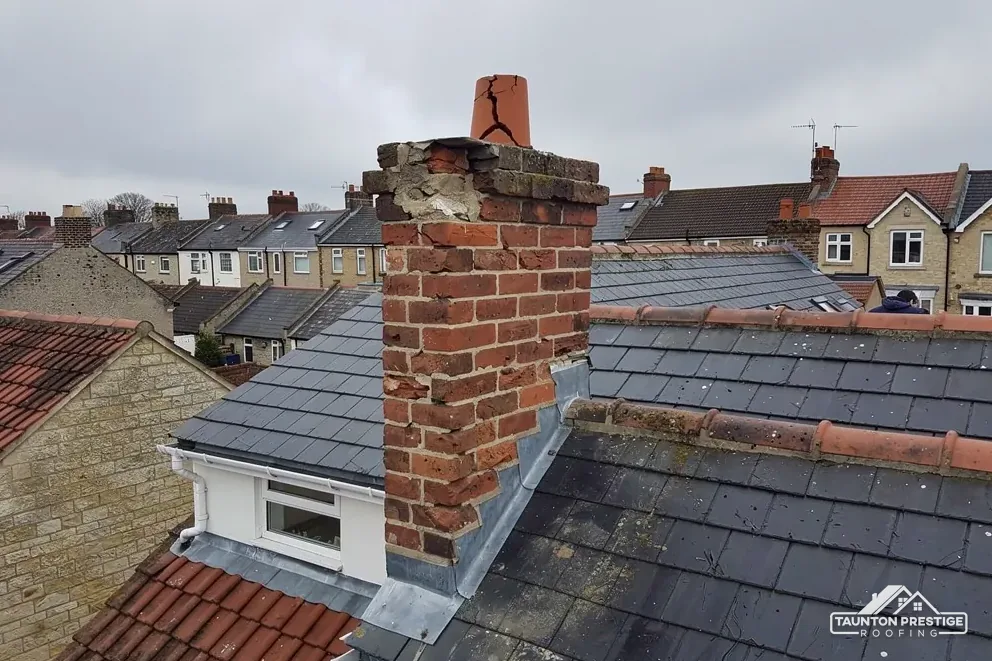
The chimney pot is the ceramic or clay pipe at the top of the stack. Its job is to extend the flue above the masonry and help the smoke clear the roof. Pots come in many shapes, from plain round ones to tall decorative types, and on older houses each flue usually has its own.
A cowl is a cap that sits on or in a pot. Cowls keep out rain, stop birds getting in, and some help with downdraught. If a flue is not in use, a cowl or cap can keep it ventilated while keeping the weather out.
Why does a pot come loose?
Each pot sits in a bed of mortar on the crown of the stack, and that bed has to stand wind, frost and heat for years. When the bed cracks or erodes, the pot can rock or lean. A loose pot is a falling hazard for anyone below, so it should be looked at promptly. A page on a loose chimney pot goes through the options, and replacing one is covered under replacing a chimney pot.
You can usually see pot problems from the ground: a lean, a chip, a missing piece, or mortar crumbs on the roof below. Birds also build in open pots, which is one reason caps are fitted. If you find a nest, our answer on birds nesting in a chimney explains what to do, because nests with birds in them are protected by law.
The pot, then, sits on the next part down: the crown, which is called flaunching.
Flaunching: the crown that holds the pot
Flaunching is a sloping collar of mortar that fills the space around the base of the pot, on top of the stack. Some trades call it the crown. It has two jobs: it holds the pot firmly in place, and it sheds rain clear of the flue and the brickwork underneath.
It is meant to slope down from the pot to the edge of the stack, with a small overhang so water drips clear of the face of the masonry. When it is sound, rain runs off it. When it cracks, shrinks away from the pot or breaks up, water gets between the pot and the mortar and runs down inside the stack.
How do you tell if flaunching has failed?
From the ground, look for visible cracks, gaps between the pot and the mortar, pieces missing from the edge, or green staining below it. Indoors, damp marks high on the breast, or on the stack where it passes through the loft, can start here. Because the damage is out of sight, flaunching is often neglected until the pot loosens.
Renewing it means chipping off the old mortar, checking the top course of brickwork, resetting the pot and forming a new crown. The price depends on the access and the state of the brickwork beneath it, and our guide to chimney flaunching explains the method in more detail.
The shaft: brickwork or stone, and the joints
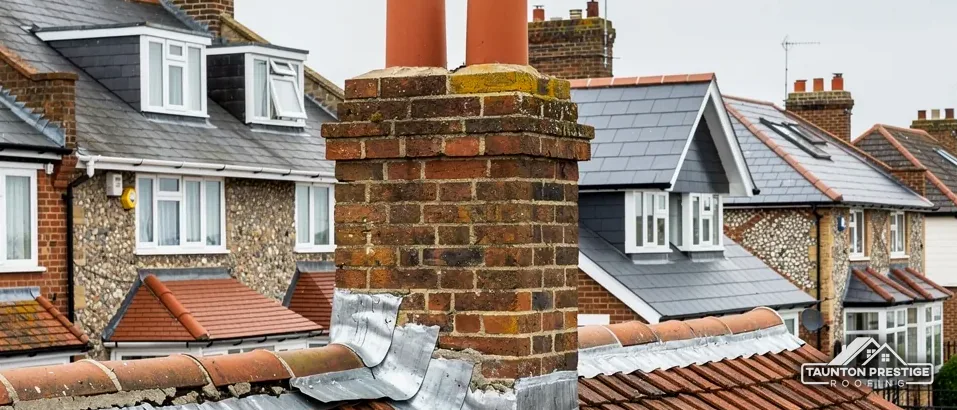
Below the crown is the shaft, the main body of the stack, made of brick or stone with the flue running up through the middle. Older shafts may be a single skin with flue liners added later, or be built with corbelling, which is a set of courses stepped outward at the top for strength and appearance.
The shaft is held together by its mortar joints, and the joints take the weather. As they erode, sand and crumbs fall away and the masonry loses its bond. If you want to know how the mortar choice affects an older stack, our guide to lime mortar on chimneys covers it.
What is the difference between repointing and rebuilding?
Repointing replaces the outer layer of eroded mortar and leaves the masonry in place. Rebuilding takes the stack down course by course and builds it again, usually because the brickwork is loose, cracked right through or leaning. A rebuild is a bigger job with more scaffold, and our guide to a chimney rebuild explains when it is the better choice.
Crumbling bricks are another sign. Frost and old flue gases can attack a brick from the inside, and a face that peels away in layers is not a joint problem. The answer on crumbling chimney bricks covers what to do about them.
MyJobQuote gives a typical UK range of £450 to £1,200 for repointing a chimney (MyJobQuote, Oct 2026). The size of the stack, the number of faces and the scaffold needed decide where a job lands in that range.
Flashing, soakers and the back gutter
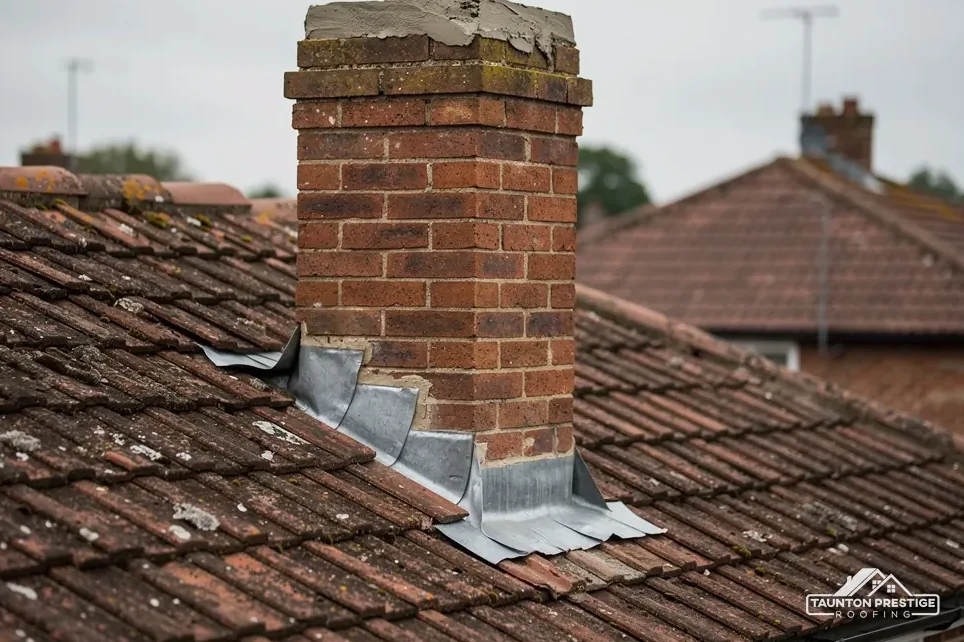
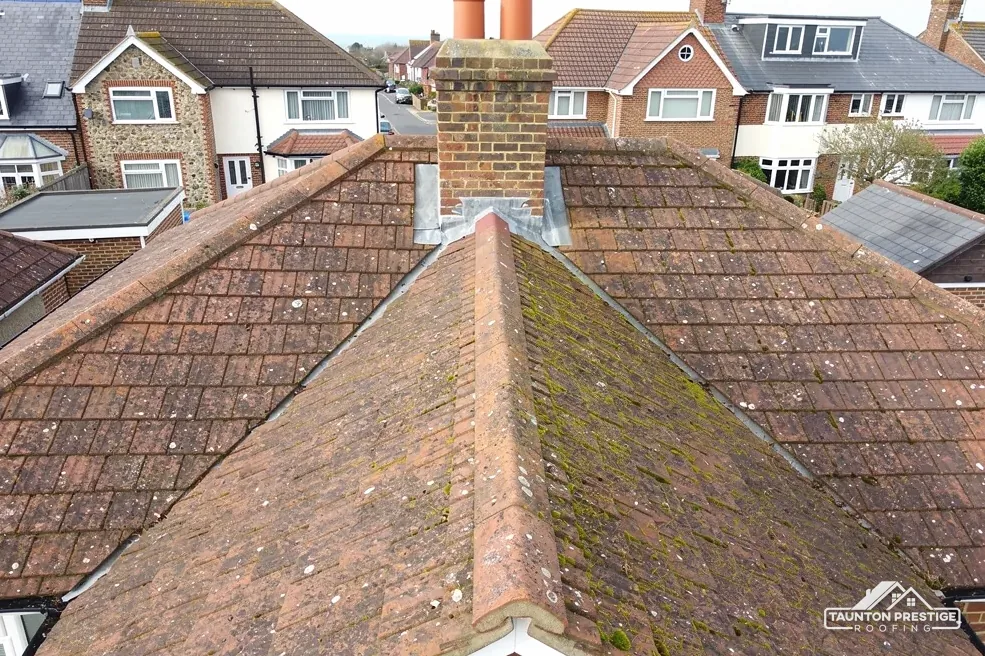
Where a chimney comes through the roof, the gap between the masonry and the slates or tiles has to be sealed. That seal is made of lead, and the parts have names. Flashing is the lead strip that covers the joint: one edge sits in a groove chiselled into the brickwork, and the rest is dressed down over the roof covering. Soakers are small, pre-bent lead pieces that sit under each slate or tile along the side of the stack and carry water back onto the roof. The apron is the flashing across the front, and the back gutter is a small channel behind the chimney that carries water round it, since a stack on a sloping roof dams rain coming down the slope.
Why is the back gutter the usual leak point?
Because it takes the most water and is hardest to see. Leaves, moss and debris can collect behind the stack, and a blocked or split back gutter overflows into the roof. Our answers on a chimney back gutter and a chimney apron flashing cover each in turn.
In Royston Lead's cast-lead brochure, flashings are listed in code 4, 5 and 6 sheet and soakers in code 3 and 4. Lead flashing "can last for over 80 years" according to MyJobQuote, so a sound run is worth keeping, while a split or lifted one is not.
MyJobQuote (Sep 2026) gives £350 to £920 for a full set of chimney leadwork and £150 to £250 for a patch repair, typical UK ranges in each case, with scaffold making the difference. Surface sealants are not a long-term fix for failed flashing, because they lift and crack when the roof and the stack move at different rates.
The damp-proof tray and the breast below the loft
Inside the house, the lower part of the chimney is called the chimney breast. It is the thick wall that projects into a room around the fireplace. In the loft it continues up to the roof as a separate mass of brickwork, called the stack, which stands alone because the rest of the roof is built around it.
A damp-proof tray is a membrane or lead tray built into the stack at roof level. It catches water that has soaked into the upper brickwork and steers it out through weep holes to the outside, so it does not run down the inside of the chimney. Without one, or where it has failed, moisture can travel down into the breast and show up as stains, blistered paint and salt marks on the wall of an upstairs room.
Is the stain on my chimney breast a roof problem?
Sometimes, but not always. Tray problems, flashing leaks and a damaged crown can all produce the same patch indoors, and so can condensation in a cold flue that is no longer used. A roofer can tell them apart by working down the stack from the top, checking each part in turn and ruling it in or out. Our page on the chimney damp-proof tray and the guide to a damp chimney breast go into the detail.
One point about taking a breast out: the Planning Portal treats it as structure, so Building Regulations approval comes into it, even for a breast that looks unused.
A breast shared with next door can also fall under the Party Wall etc. Act 1996, where the notice is served two months before the work begins.
Which part is leaking? A quick guide
The table below sets out the usual suspects for common symptoms. It is a starting point for a conversation, not a diagnosis, because a leak often combines two causes.
| What you see | Likely part | Who should look |
|---|---|---|
| Pot leaning or rocking | Flaunching | A roofer with safe access |
| Sand and crumbs in the gutter | Mortar joints in the shaft | A roofer or builder, from the ground first |
| Damp patch near the ceiling beside the breast | Flashing or back gutter | A roofer, after checking the loft |
| Brown staining lower down the breast | Damp-proof tray or flue | A roofer first, then a sweep if the flue is in use |
| Stack leaning or cracked through | Masonry itself | A roofer or builder straight away |
Do I need a roofer or a chimney sweep?
A sweep cleans the flue and checks it inside. A roofer deals with everything outside, from the pot to the flashings. A page on the roofer or chimney sweep question explains how the two jobs differ.
Whichever part is the culprit, a sealant brushed over the top is rarely the answer, because the movement between lead, mortar and brick breaks it again. Finding the part first saves paying twice. Once the cause is clear, the repair can be sized to match: a new crown is a small job, a fresh set of flashings a larger one, and a leaning shaft the biggest of all. Knowing the names of the parts lets you follow that conversation and ask what each one needs.
Chimney parts, in plain terms
What is the cement collar that sits at the foot of a chimney pot?
That is the flaunching, sometimes called the crown. It bonds the pot to the stack and slopes outward so rain runs off. If it cracks or shrinks away from the pot, water gets in down the flue and the pot can work loose over time.
Can I check a chimney's flashing myself?
From the ground you can look for lifted lead, gaps along the brickwork joints and stains below the stack. Going up to look closer is a job for someone with proper access, since chimneys are high, exposed and often have loose masonry close by, and lead dressed over slates is easy to damage underfoot.
Why does my chimney breast stain when it rains?
Water is getting past a part higher up, most often the flashing, the back gutter, the damp-proof tray or the crown. A roofer follows the water path from the top of the stack downward, which is quicker and cheaper than guessing and repairing the wrong part first.
More on this subject: Chimney repairs in Taunton