Lead has covered roofs in Britain for centuries. Zinc is the newer arrival, sold as rolled sheet that a roofer folds into standing seams. If a bay window roof has started to leak, or a dormer needs recovering, you may be offered either one, and the sales talk on both sides can be loud.
The useful comparison is narrower than the talk suggests. Each metal has a published lifespan figure, each has a weight, each looks different on the building, and each is easier to detail in some places than others. Neither is a cure for poor workmanship underneath: a metal roof laid over a rotten deck or a flat with no fall will fail whatever it is made of. We have set out what the published figures say, what they do not say, and how the choice changes between a bay, a dormer and a flat roof. The wider picture is on our lead work page, and the techniques are explained in our guide to what leadwork is.
How long does each metal last?
The two published figures are not the same kind of claim, so they need a careful reading. For lead, MyJobQuote's guide to chimney leadwork says it "can last for over 80 years". The wording matters: it is a lower bound, a floor and not a ceiling. Old lead that is still weathertight on an old building says little about the lead that was replaced long ago, so the quoted floor is the safer guide.
For zinc, VM Zinc's FAQ says "The BRE Environmental Product Declaration states 100 years." An Environmental Product Declaration is a standard document in which a manufacturer reports the life-cycle data for a product, and the BRE is the building research body that published this one. It is a manufacturer-supplied figure for the product, not a promise about your roof.
So does zinc simply outlast lead?
Not on the published figures. One figure is a minimum, the other is a declared service life, and the two are not like for like. The honest reading is that both are long-lived metals that can outlast several roof coverings under them. What shortens either is usually the detail around it: a blocked outlet, a split joint, a fixing that let the sheet move, or foot traffic across thin metal.
The reverse is also true. A neat, well-made lead roof with sensible falls can easily carry on for decades beyond a poor zinc one, and the same is true the other way round. When you compare quotes, compare the workmanship plan, not the brochure number.
Our guide to how long lead flashing lasts goes into the signs that lead is reaching the end of its life.
Weight and what the roof beneath can carry
Lead is a heavy metal. In the Royston Lead brochure, code 4 weighs 20.41 kg for every square metre, code 5 weighs 25.40 kg and code 6 weighs 30.05 kg. A flat bay roof covered in code 5 therefore adds a real load, which the joists and the deck beneath have to carry, along with the people who step onto it to clear leaves.
Zinc is sold in different thicknesses by different makers, and its weight per square metre depends on the product chosen. The maker's data sheet gives the figure, and your roofer should read it out beside the lead code being compared.
Does the lighter metal always win on an old roof?
Not automatically. Weight is one input. A bay built decades ago may have a deck that is sagging, damp or fixed to rotten joists, and then the covering is the least of the worries. We look from below and above before suggesting any metal, because a new covering laid on a failing deck is money wasted.
If a replacement covering is 15 per cent or more heavier than what it replaces, the Planning Portal says Building Regulations approval is needed and advises a structural check first.
That rule is aimed at coverings such as slate replacing a lighter tile, but it shows the principle: weight is checked, not assumed. Whichever metal goes on, the code or gauge, the deck and the fixings are agreed at survey.
Looks and fit with the building
This is where owners often have the strongest view, and it is a fair one. The two metals do not look the same, and they do not look the same over time. Rather than describe colours in words, we suggest looking at a finished example of each on a house in good daylight. Ask your roofer for a sample, or for photos of recent work on a similar bay or dormer, taken in different light.
What you are judging is how the metal meets the rest of the building. Lead is soft and dresses into curves, cheeks and awkward corners, which is why you see it on bays, around chimney stacks and over older timberwork. Zinc is sold as flat sheet with seams that run the length of the roof. That straight-lined look suits modern extensions and clean, simple shapes, and it is the reason zinc is often chosen where the new work is meant to read as new.
What if the house has listed status or sits in a conservation area?
Then the existing material often decides the answer. A listed house keeps its Class B and C permitted development rights, but listed building consent is also required where the work would alter its character, and a change of metal can do that. For Taunton addresses that is Somerset Council's planning team. Inside Exmoor National Park, it is Exmoor National Park Authority.
If you are replacing lead on a listed bay or a church roof, expect the conversation to start with matching what is there. Our page on lead on bay windows and dormers covers that route in practice.
Which suits a bay window roof?
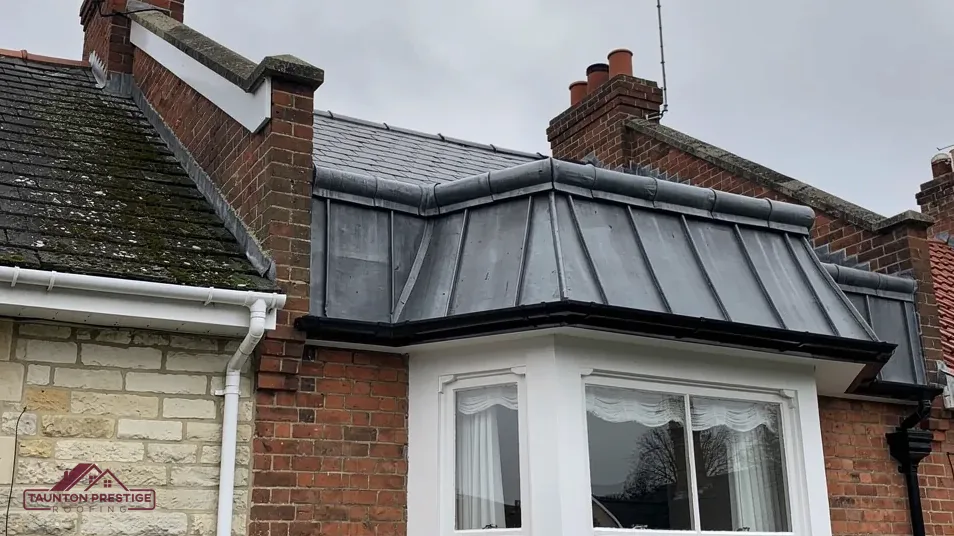
A bay window roof is small, often awkwardly shaped and usually low in pitch. It meets the main wall at one edge, wraps around three or five sides and has to shed water off at the front. The corners are the hard part. Flashings must turn through angles that rarely sit at ninety degrees, and the sheet has to hold its shape under rain and sun.
Lead handles that well, because the metal can be bossed, hammered over a block of wood into a shape, and tucked tight. For that reason it is the traditional choice on older bays, and many Victorian and Edwardian houses still carry lead there. If the bay is part of a period frontage, matching it keeps the street looking right.
Can zinc be used on a bay?
Yes, where the bay is regular and the roofer can lay straight seams. A cleaner outline helps; a heavily curved or irregular bay makes zinc harder, and more joints means more places to fail.
The questions that matter more than the metal are the same on either: is the deck dry and level, is there a fall towards the front, where does the water go off and what happens to the joint against the wall? A bay roof with water pooled in one corner will fail early in either metal.
Before you decide, ask for the layout of seams or rolls, the fall of the deck and the lead code or zinc gauge written into the survey notes. Those three details tell you whether the roofer has actually read your bay.
Which suits a dormer?
Think of a dormer as a small structure that sticks out of a pitched roof, with its own roof, two side walls (the cheeks) and usually a front face with a window. It has more edges per square metre than almost anything else on a house, and every edge is a place for water to find a way in.
Lead is listed against dormers across the whole code range from 4 to 8 in the Royston brochure, because the different parts of a dormer need different thicknesses. The flat or low-pitched top might take a heavy code, while the cheeks and soakers use a lighter one. Zinc can clad a dormer cheek or roof too, and on a new-build or modern dormer the result can look sharp. Where the main roof is slate with a lead-lined valley, matching the lead keeps the work in keeping.
What goes wrong on dormers?
The weak points are the junction between the dormer and the main slope, the apron below the window and the gutters behind. Metal does not fix a leak that starts because a slate was left loose or the window frame was poorly sealed. Water that gets behind the cheek can rot the timber frame, so a dormer leak is worth acting on early.
Planning is a separate question. Permitted-development dormers are not available in a conservation area, inside Exmoor National Park or in the Quantock, Blackdown and Mendip Hills National Landscapes, so building or enlarging one there starts with a call to the planning team. Recovering like for like is a different matter, and Class C normally covers re-roofing a house.
Which suits a small flat roof?
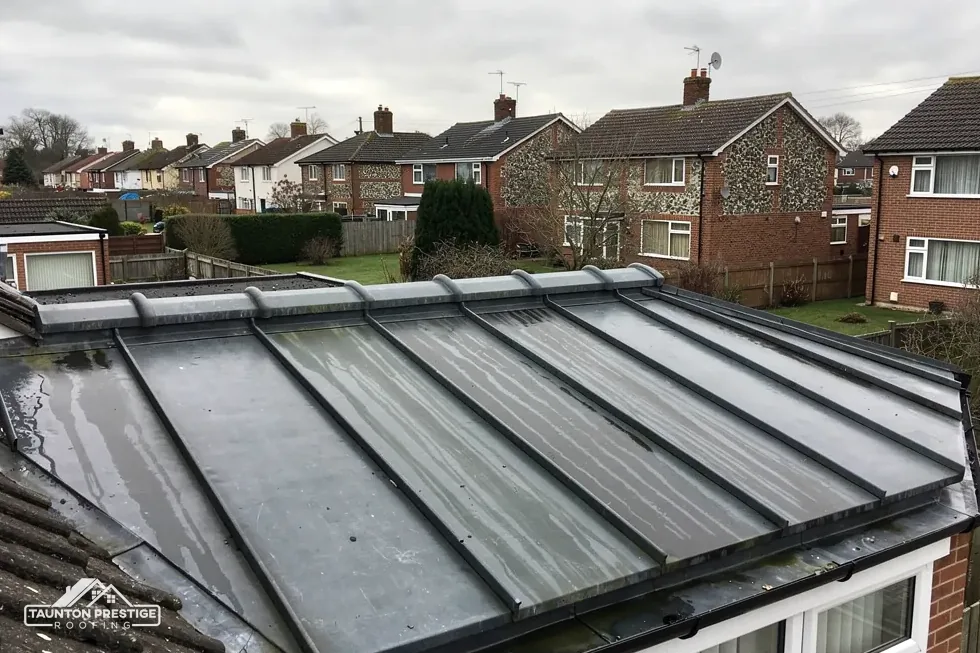
On a flat roof the metal has to be the whole waterproof layer, with no tiles above it. It is laid on a deck with a fall, so water runs off rather than sitting on the sheet. Rolls or seams join the sheet and let it expand and shrink with the temperature.
Flat roofs can also be covered in a membrane such as EPDM, a single rubber sheet, or in GRP, glass-reinforced plastic. The cost of a metal roof depends on area, thickness and access, so ask for a single written price after the survey. Metal earns its place where the building is period, where the roof is small and has awkward edges, or where it will be seen from above, from a bedroom window for instance.
Does BS 6229 apply to metal roofs?
No. BS 6229:2025 covers flat roofs with continuously supported flexible waterproof coverings, and it keeps a minimum 1:80 finished fall for membrane roofs. It does not cover lead. That does not mean falls do not matter for metal; it means the specification comes from the maker's guidance and the roofer's craft, not from that standard.
Is a flat roof in lead or zinc worth the cost?
It can be, over a long life, and the price is set by the size, the thickness chosen and the access and scaffold needed. A metal flat roof is a long-term choice, so a good survey of the deck and the falls comes first.
Lead and zinc questions
Is zinc cheaper than lead for a bay window roof?
It depends on the roof, because the price of both turns on area, thickness, the number of corners and the scaffold. The metal is only part of the bill. The better step is a survey of your bay, followed by one written price for whichever metal suits it.
Can I swap lead for zinc on a period house?
Sometimes, but it is a planning question before it is a roofing one. A listed house needs listed building consent for work that alters its character, and a conservation area adds its own scrutiny from the planning team. Check with Somerset Council's planning team first.
Which metal needs less upkeep?
Both need the same care: clear leaves from gutters and outlets, look for splits at joints and keep boots off thin sheet. Neither is a fit-and-forget material. A yearly look from a safe position, and a closer check after storms, will catch most problems early.
More on this subject: Lead work in Taunton