A chimney is the most awkward thing on a roof. It rises through the slope, so the covering has to stop short of it on every side, and lead has to span each of those gaps. Four sides, four different jobs, and each one is a place where rain can get in. When a ceiling next to a stack starts to stain, the lead is the first thing we look at.
Many homes in and around Taunton have a chimney with some history: a Victorian terrace with a stack on the party wall, a farmhouse with a tall brick stack, or a cottage whose chimney has been repointed more than once. The lead around them was fitted at different times and by different hands, and some of it was repaired with a tube of sealant. This post names each piece of the flashing set, shows how each one fails, and explains why smearing mastic over the join is a poor repair. It also gives typical UK costs for leadwork and repointing, and says what is worth checking from the loft before you call anyone.
How a chimney is sealed to the roof
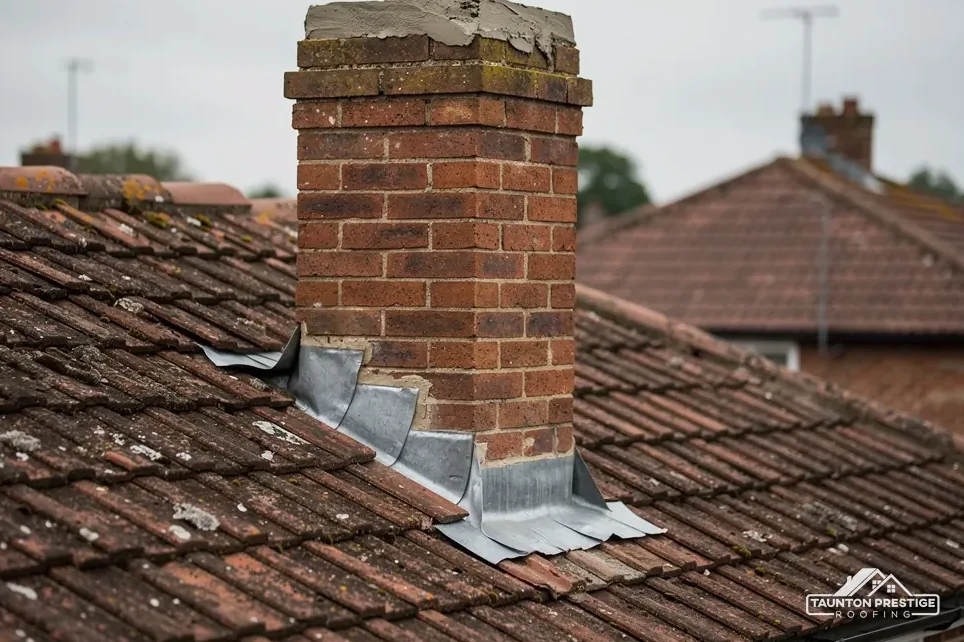
Think of the lead around a chimney as a set of collars, each fitted to one face of the stack. They are all fixed on the same principle: the upper edge of the lead goes into the brickwork, and the lower edge laps over the roof covering at the bottom, so water runs down and out instead of in.
What are the four parts?
On the downhill face is the apron, a wide piece of lead that lies over the roof covering and turns up the front of the stack. On the two sides are the step flashings, which are cut in a staircase shape so each step follows a course of bricks. Behind the stack, on the uphill side, sits the back gutter, a small channel that carries water around the chimney instead of letting it pile up behind. Beneath the side flashings on a tiled or slate roof there are usually soakers, small folded sheets of lead slipped under each row of tiles or slates. Our guide on soakers, steps and aprons goes through each shape.
Why is the back gutter the weak spot?
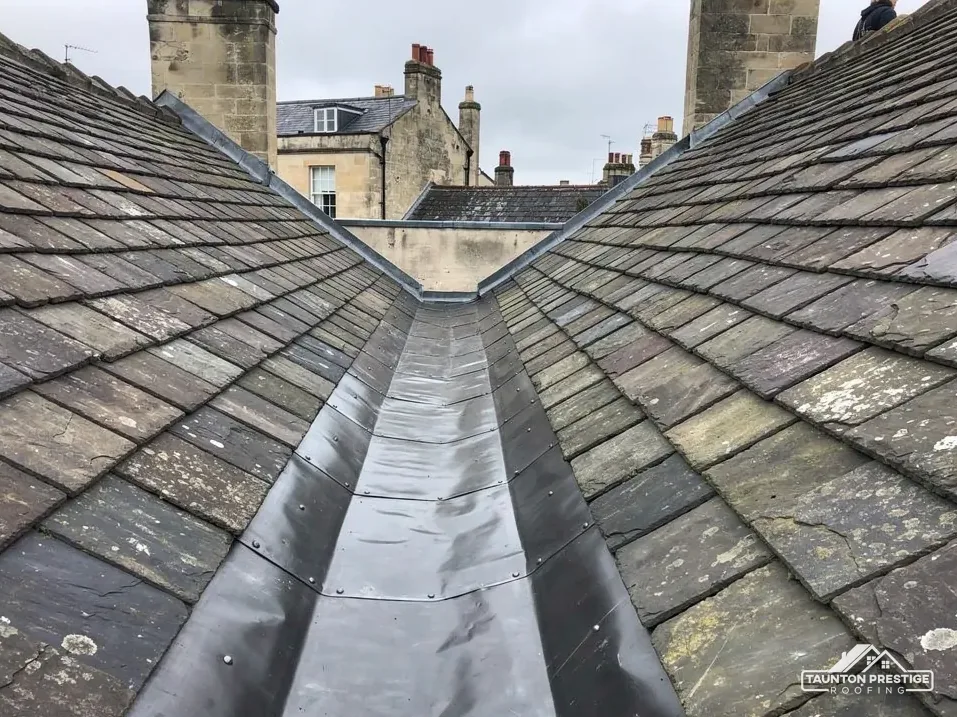
Because it faces more water than any other part. Everything running down the roof behind the chimney hits the back gutter first. If it is undersized, split or full of moss, water backs up and pushes under the tiles on either side. Our answer on what a chimney back gutter is shows how it is shaped.
Where the lead meets the brick, it is usually tucked into a cut groove in a mortar joint, called a chase, and held with wedges, then pointed over. That makes the mortar part of the waterproofing, which is why the pointing matters as much as the lead.
Where lead flashings fail
Lead is long-lived. MyJobQuote says leadwork on a chimney can last for over 80 years. Treat that as a floor for a well-fitted job. Plenty of failures have little to do with the metal itself.
What goes wrong with the lead?
Lead moves as the weather warms and cools, and over the years it can split along a fold or crack where it has been bent repeatedly. A piece cut too thin for its job, or fixed in one long run with no allowance for movement, fails sooner. Lead is graded by code, which tells you its thickness, and the grades matter: Royston Lead lists code 3 for soakers only, and code 4 and above for flashings. A flashing laid in a lighter code than the job needed is a repair waiting to happen.
Does lead just wear out?
Sometimes the problem is below the lead. Underside corrosion can eat a hole in a sheet laid on damp timber, damp mortar or a bed of wet debris. White powdery staining can point to lead sitting in constant moisture. Our answer on lead corroding from underneath covers that case.
A flashing that looks fine from the ground can have a split at the back that you cannot see from the garden. This is the reason a roofer goes up and takes photographs along the whole length of each piece, front, sides and back, and shows them to the homeowner. A single drip mark on the ceiling can come from the top of a step flashing that is two metres away from where the water finally falls.
Mortar joints and flaunching
A chimney has two kinds of mortar working for the roof. Joints in the brickwork hold the lead's top edge. At the very top, the flaunching is the mortar fillet bedding each pot, sloped so rain runs off it and clear of the pot.
Can pointing alone cause a leak?
Yes. Cracked, hollow or washed-out joints let rain into the stack, and that water goes down the flue wall, through the brick or round behind the lead. If the chase is open, the top edge of the flashing can sit loose in its slot, so a gust or a downpour drives water behind it. Repointing the stack is often needed at the same time as lead repairs, and it is far cheaper to do both on one visit when access is already in place. MyJobQuote puts chimney repointing at between £450 and £1,200 (Oct 2026), a typical UK range.
What does failing flaunching look like?
Look for hairline cracks that run across the collar, gaps between collar and pot, and crumbs of old mortar lying in the gutter. Water getting into the stack from the top shows as damp patches that spread on the chimney breast inside, often on the coldest and wettest days. Our guide to chimney flaunching explains how the collar is rebuilt.
Lime or cement? On older chimneys, a mortar that is stronger than the brick can trap moisture and chew the brick faces. Our piece on lime mortar on a chimney covers when a softer mix is the better choice. For listed buildings, works that change a chimney's character need listed building consent from the council, so check before anything is altered.
Why sealant fails on a chimney
Reaching for a tube of black mastic is a natural first move when water shows. It rarely holds, and it can make the next repair more expensive.
Why does sealant not last?
Lead expands and contracts with temperature, far more than brick does. A bead of sealant bonded to both has to stretch every day, and sooner or later it tears away from one side. UV and weather harden it, so it cracks along the joint. Meanwhile it covers the very place a roofer needs to see. Water that gets behind it cannot dry out, so the timber and mortar underneath stay wet and the damage spreads.
What does the sealant hide?
Everything that matters. A flashing that has worked loose, a split at a fold, a back gutter that needs relaying: all of it sits under the bead until someone cuts it off. That means a roofer has to clear away old mastic first, and that adds time to the job. Our guide to why sealant will not fix failed lead flashing sets this out step by step.
There are occasions when a temporary seal is a sensible stopgap, for example in a storm when nobody can safely go up. In a downpour we begin by making the leak safe, then return for the proper repair. A patch of that kind lasts days or weeks, not years. If you have already used sealant, mention it when you ring, because it tells us where water has been entering.
The same goes for flashing tape and bitumen strip. They are quick, and they are not a substitute for lead dressed into the wall.
Tracing the leak from the loft
You can learn a lot before anyone gets on the roof. Pick a day soon after heavy rain, take a torch, and only stand on joists or a boarded section. A foot placed between joists goes through the ceiling.
What should I look for around the stack?
Check the sides and back of the chimney breast where it passes through the loft. You are looking for tide marks on timber, damp patches in the brickwork, a darkened rafter next to the stack, or flattened insulation. Rust on nail heads near the chimney is another sign. Photograph what you find and mark where it is, because the evidence guides us to the right face of the stack.
Could it be condensation instead?
It could. A chimney that is no longer used and has no cowl can draw damp air into a flue, so a stain may appear without a leak. Our answer on chimney cowls explains how a cap changes that. Condensation tends to show in cold, still weather; a flashing leak follows the rain and the wind direction. Note which of the two you see.
A damp chimney breast inside the house can also come from a missing damp-proof tray inside the stack, a detail covered in our answer on the chimney DPC tray. A roofer can sort out which it is, usually in a single visit. When we go up, we also look at the cap and the pots, since a cracked pot lets rain straight down the flue.
Repair, relay or rebuild: what it costs
What is right for your stack depends on what the survey turns up. A short crack in an otherwise sound flashing is a small job. A chimney surrounded by a set of old, split and mismatched pieces is better relaid in one go.
What do typical chimney leadwork costs look like?
MyJobQuote gives a typical UK range of £150 to £250 for a leadwork patch, and £350 to £920 for a complete set, where the need for scaffold moves the figure (Sep 2026). A repointing job adds to that, using the £450 to £1,200 figure above. These are third-party guides, not Taunton Prestige prices. Access, how many faces of the stack need lead, the roof pitch, and whether the pointing needs doing are what set the figure for your chimney.
Do I need scaffold?
Often, yes, for a stack that sits high on a steep roof, because working safely at the ridge means a stable platform. A frame on the public pavement or road needs a licence from the highway authority (Highways Act 1980 s169); we sort the paperwork with the scaffolder. Our answer on scaffolding for chimney repairs goes into this.
If the chimney is no longer used, some owners consider taking it down. That is a bigger job with its own rules, including a party wall notice where the chimney sits on a shared wall. Look at our pages on chimney repairs before deciding. The lead itself, in all its shapes, is covered under our lead work service.
Whichever route you take, the finished lead should be dressed neatly, tucked into clean chases, with the back gutter falling the right way. Ask to see photographs of the new work before the scaffold comes down, and keep them with the house papers.
Questions on a chimney that leaks
Can I use lead replacement tape on my chimney flashing?
Tape is a short-term cover, never a lasting repair. It does not allow for the way lead and brick expand at different rates, and it hides the underlying fault. A proper job dresses new lead into clean chases and pointed joints, so water runs over it and away, which tape cannot copy however well it is pressed down.
Is a stain on the chimney breast always a flashing problem?
No. It can come from failing flaunching, open joints, a cracked pot, a missing damp-proof tray or condensation in a disused flue. The pattern gives clues: a stain that follows rain and wind points to water coming in, while one that appears in still, cold weather points to condensation.
Do I need permission to replace chimney lead on a listed house?
A repair that matches what is there may leave the building's character alone, yet work that alters it needs listed building consent. Ask Somerset Council's planning team before anything is ordered, and mention a conservation area if the house sits in one. Photographs of the existing lead help that conversation.
More on this subject: Lead work in Taunton