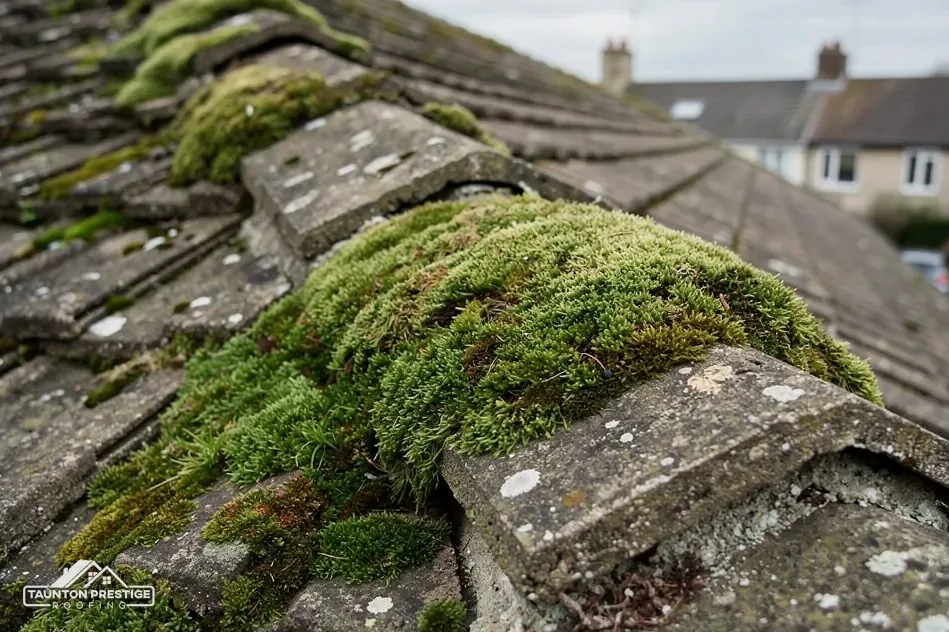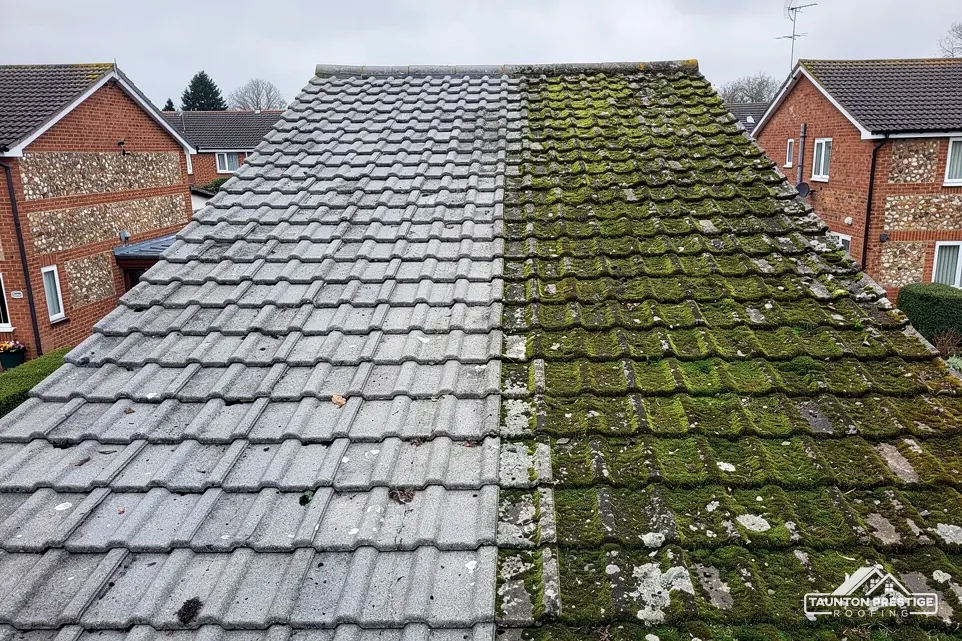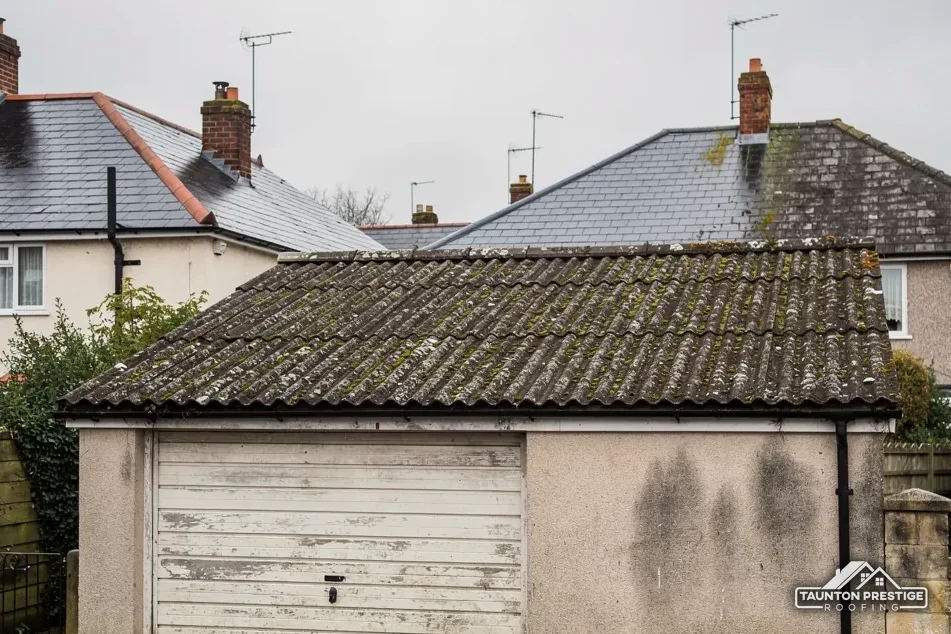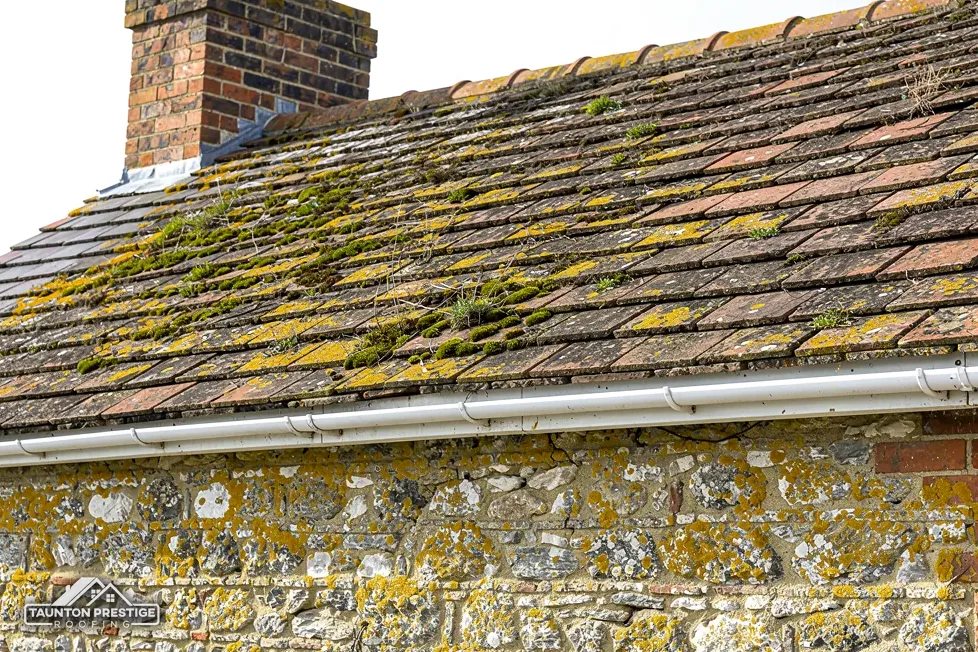
A roof that has been green and shaggy for years looks like it needs a good blast. On modern concrete tiles, a clean is a fairly simple job. On older clay tiles and natural slate, it deserves more thought. The surface of a hand-made clay tile is softer than it looks, and its outer skin is part of what keeps water out. Slate splits along its grain, and the nail holes are small points of weakness. Pressure applied in the wrong way can strip a skin that took a century to form.
This guide is for people who own an older home in Taunton, the Quantock and Blackdown villages or the towns around, and who want the moss off without paying for damage. It covers why a jet wash is not suited to these materials, what gentler methods do, what the rules say about biocides, the checks to make before disturbing a roof that may hold bats or nests, and the extra care that conservation areas and listed buildings call for. It sits with our roof cleaning and moss removal service.
Why old clay and slate need a lighter touch
Clay and slate are both long-lived. The Confederation of Roofing Contractors, known as CORC, describes well-kept natural slate as a covering that can reach 100+ years. A life that long relies on the surface staying whole, and any cleaning method that wears it away works against the roof.
What is different about an older roof?
Hand-made clay tiles vary in density and in glaze. Some are hard-fired and dense. Others are softer and more porous, so water gets in more easily and a hard blast pushes it deeper. The buildingconservation.com guide to clay tile warns that the usual 60-year figure for clay is clearly not a reliable guide on old peg tiles, because individual tiles vary so much. A tile that has already lasted a century may have little margin left.
Slate is a layered stone. Its edges can flake and its surface can lift in thin sheets, especially where earlier repairs used the wrong fixings or where nails have corroded. Many older slate roofs are also fixed with nails alone, so a tile or slate that has loosened can slide under the force of a wand.
There is a practical reason as well, and it is easy to overlook from the ground. Old roofs often carry old repairs, bedded ridges, mortar fillets and lead flashings. Water forced under any of these can drive into the building where it never went before. A cleaning method has to respect the whole roof, not only the tile surface. Our page on moss on a slate roof shows how that looks on the ground.
Why not to jet wash an old roof
Pressure washing is the method many owners picture, yet manufacturers do not endorse it. Marley, which makes clay and concrete tiles, advises owners not to use high-powered jet washes. Its guidance warns that a strong jet can harm the finish and reduce the working life a tile was expected to have.
What damage does a jet wash do to a tile?
A jet leaves the nozzle fast enough to strip moss, but it also strips the thin weathered skin on the tile, and the roof loses something it cannot regrow. On clay, that skin protects the softer body beneath. On slate, the jet can lift edges and open hairline cracks. Water driven sideways at that speed also passes under the laps, wetting the battens (the timber strips the covering hangs from) and the underlay, and can push loose mortar from the ridge and verge, meaning the crest and the gable edge of the roof.
It also sends moss and spores into gutters and downpipes, so the work moves the problem from the roof to the drainage, where a blocked outlet can cause overflow against the walls. And the pressure that clears the moss quickly can leave a visibly paler, scoured finish that is hard to reverse. Once the skin is gone, new growth takes hold faster, so the roof can need cleaning again sooner than it did before.
None of this means a cleaned roof is a mistake. It means the method matters, and the same reasoning rules out a hose with a hard nozzle in the garden.
Gentler methods that suit old roofs
The gentler options are slower and rely on patience and judgement. For many old roofs, that is exactly what is wanted.
Which methods are kinder to clay and slate?
The first is plain hand work. A roofer using a soft brush or a plastic scraper takes the bulk of the moss off by hand, section by section, working with the lap of the tiles and not against it. It is slow and it leaves the tile surface alone, which is the point. A day spent on one slope is better than an hour that scars it. Our guide to hand-scraping roof moss explains the technique.
The second is soft washing, which uses low-pressure water with a treatment applied to the surface. The treatment does the work of killing the growth, and the water only rinses. Because the pressure is low, the tile skin is left intact. The soft wash roof cleaning page explains how it differs from pressure washing, which can damage the surface.
A third is to leave the treated growth to die and fall away over several weeks, not scrubbing it off at all. The roof looks patchy for a time, then clears with the next rain, which many owners find an acceptable trade for keeping the surface whole. This approach suits roofs where access is hard or the tiles are too brittle for a roofer to kneel on.
The right choice turns on the tile, its age, the depth of the moss and the state of the laps and fixings. We look at the roof and show you photos before choosing, and we tell you if a roof is too fragile to clean without repair first. Sometimes a few tiles need replacing, or a flashing needs resealing, before any treatment can safely begin.
Biocides, the law and what homeowners can buy
Moss killers are biocides, and they are regulated. That surprises many people, because shelves in garden centres carry products that look much like the ones professionals use.
Can I use any moss killer on my roof?
No. The Health and Safety Executive is clear that nobody outside the trade should use a biocidal product made for professional users only. Under the biocides rules in force in Great Britain, a product must be applied exactly as its authorisation allows, and that authorisation says what it is for, how it is applied and what precautions apply. The HSE's separate guidance on pesticide control makes using, storing or selling a non-approved product an offence.
For you, the sensible conclusion is straightforward. Read the label on anything you buy, follow it exactly, and do not decant, mix or strengthen it. Do not spray from a ladder. Keep it away from ponds, water butts and drains, because a treatment that runs off the roof carries into the gutter and from there into the ground.
A professional should be able to tell you the product name, how it is applied, how long it takes to work, and what it means for pets, plants and rainwater harvested in a butt. Ask for that in plain terms before work starts. We explain what is going on the roof and why.
Leave anything professional-only to professionals, and keep children and pets clear of a freshly treated area.
Taunton's conservation areas and listed roofs
Some older clay and slate roofs in and around Taunton sit in protected areas, and some belong to listed buildings. That does not forbid cleaning, but it raises the standard of care.
Which parts of Taunton are conservation areas?
Somerset Council's table lists several in the town: Castle Green and Bath Place (designated 15 Jan 1975, revised 26 Apr 2007), Park Street and Wellington Road (15 Jan 1975, revised 12 Nov 1998), St Mary and St James (15 Jan 1975, revised 26 Apr 2007), Staplegrove Road (15 Jan 1975, revised 12 Nov 1998), and Haines Hill and Trull Road (designated 14 March 2023). Mount Street and Vivary Park is also designated. Wellington has its own conservation area too. Somerset Council also lists an Article 4 direction for Staplegrove Road in Taunton, and one for Wellington. The planning team can say what a direction covers, so ask them.
For a listed house, section 7 of the Planning (Listed Buildings and Conservation Areas) Act 1990 asks whether works would alter the building's character. A gentle clean may not, but a method that changes how the roof looks might, so ask the council's conservation team before work starts. Within Exmoor National Park the body to ask is Exmoor National Park Authority, which is the planning authority there, and not Somerset Council.
Our guide to conservation areas in Taunton and our page on listed building roof consent explain the routes.
Bats, birds and access before anyone starts
Old clay and slate roofs have gaps, laps and cavities that animals can use, and the older the roof, the more of them there tend to be. Disturbing a roost or a nest by accident is something a careful cleaner works to prevent.
Do bats and nests change how a roof is cleaned?
They can. GOV.UK guidance on bats says every species of bat, along with its roosts, is fully protected, and it names work on a roof as one activity that can have an effect. Bats come first, because roofs suit them. Section 9(4) of the Wildlife and Countryside Act 1981 applies when a person intentionally or recklessly disturbs one using a roof for shelter, or obstructs access to it. Regulation 43 of the Habitats Regulations goes further on roosts, because harming a resting place needs no proof of intent. For wild birds, section 1 of the same Act applies where a nest being built or lived in is intentionally taken, damaged or destroyed.
In practice, a careful cleaner looks before brushing: for droppings under the eaves, nesting material, birds flying in and out of the gaps, and fresh staining at gaps. If anything suggests a roost, the work pauses and advice is taken first. Our page on roof cleaning, bats and birds goes further.
Access is the other early question. Old slate and clay should not be walked on if it can be avoided, so a safe cleaning job on a tall house may need a tower or scaffold. Scaffold or a tower is arranged before the cleaning starts, and any scaffold licence is sorted out with the scaffolder.
Questions on cleaning older roofs
Is it safe to clean a slate roof myself?
It is risky. Old slate breaks underfoot and the nail fixings are easily disturbed, so the safest view of a slate roof is from the ground. Household moss killers must also be used exactly as the label says, and professional-only ones are off limits to the public.
Will moss killer harm old clay tiles?
A product used as its authorisation allows should not, but a stronger mix or a wrong product can mark or stain the surface. That is one reason we look at the tile first, and why the label and the method matter more than how quickly the moss dies.
Does cleaning a listed roof need consent?
Not automatically. The question for listed building consent is whether the works would alter the building's character. A light, careful clean may not, while a harsh method might. Ask the council's conservation team before work starts, and keep their reply in writing so that it can be shown to a buyer or surveyor later.
More on this subject: Roof cleaning and moss removal in Taunton