Type the question into a search bar and you will find one tidy number, usually attached to a high-pressure blast. That number is a useful starting point and a poor finishing one. The method behind it is not recommended by slate and tile makers, and it says nothing about how high your roof is, how much of it is covered in growth, or whether the gutters and valleys need clearing as well.
This guide gives the typical UK figure with its source, explains why it needs a caveat, and then walks through the things that decide what you are actually asked to pay: how big and how steep the roof is, the scaffold or access, the covering, the type of growth, the treatment and what the cleaning uncovers. It belongs to our wider roof cleaning and moss removal work across Taunton and Somerset, and if you want to understand the method before the money, start with our guide to soft washing and biocide treatments.
The typical figure, and what it measures
MyJobQuote gives the average cost of pressure washing a roof as around £475 for a semi-detached house (MyJobQuote, Sep 2026), a method Marley does not recommend for slate or tile, as the next answer shows. That is a typical UK figure from a national cost guide, not a price from us or a quote for your roof, and the guide does not say which postcodes or house sizes sit behind the average.
Why is that figure only half the story?
Because the guide is pricing a method, and the maker of your roof covering may not welcome that method. Marley, one of the biggest tile makers in the country, advises against high-powered jet washes: the blast can damage slates and tiles and take years off their expected life. A cheap clean that shortens the life of the covering is poor value, however low the starting price looks.
So treat the headline number as a rough marker for a small, easy job and nothing more. It does not tell you what a gentler method costs, what a three-storey terrace costs, or what a long farmhouse roof with a steep pitch costs. Those depend on the factors below, which is why a sensible roofer looks at the roof before naming a sum. The factors are the roof's size, its pitch, the access, the covering, the growth, the method and whatever the clean uncovers.
It also helps to know what a quote is quoting for. Ask whether it covers the roof surface only, or the gutters, valleys, ridge and any bird-proofing too, and whether the treatment is a single application or something that needs a return visit. Two prices that look far apart are often pricing different amounts of work.
Roof size, pitch and the number of storeys
Area is the obvious driver. A bungalow with a single slope on each side is less work than a long Victorian terrace with a front and back slope, a rear extension and a bay. Cleaning is priced on the surface to be treated and the time it takes, so more square metres means more hours.
Pitch matters nearly as much. On a shallow pitch a roofer can often work from a roof ladder and a safe standing position. On a steep slate roof, or one with a hip, a valley and a dormer, every move needs more setting up, and the work goes slower. Slower work costs more.
Does a taller house cost more to clean?
Usually, yes, and the reason is access rather than the roof itself. A single-storey outbuilding can be worked from a ladder or a low tower. A three-storey house in a street with parked cars and no front garden may need a scaffold, a licence for part of the road, or a mobile platform. We cover that in the next section.
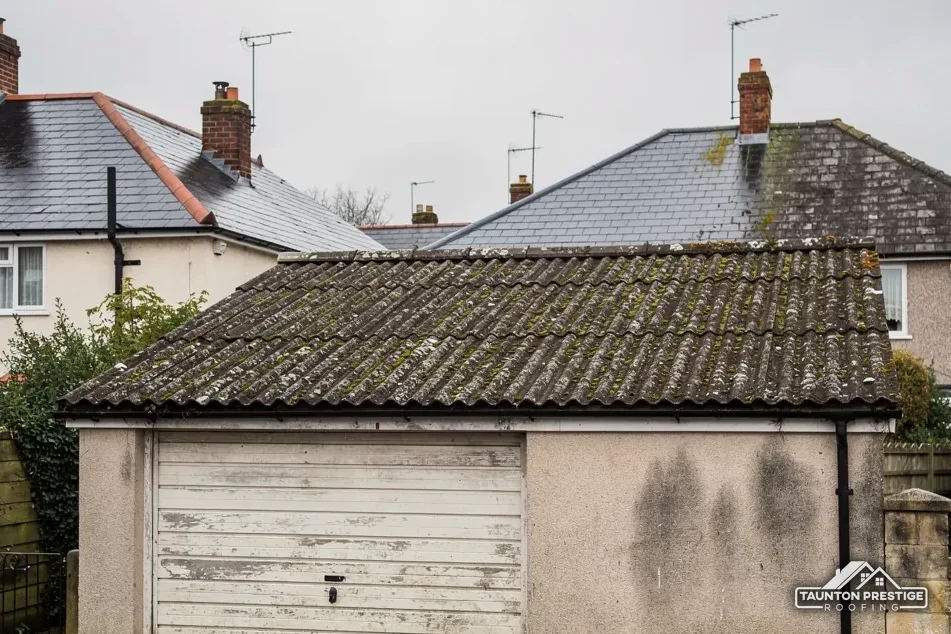
The roof covering matters too. Hand-split slate, old clay pantiles, interlocking concrete tiles and a corrugated cement sheet roof are all different surfaces to treat and to walk on. Brittle or aged coverings are slower and more careful work, and anything fragile needs boards or a platform so nobody puts a boot through it. Asbestos cement sheets are a separate matter altogether, and are covered in our wider notes on asbestos roofs.
Scaffold, access and the highway
Access is the line that surprises people most. A roof that can be reached with a ladder and a roof ladder costs far less to clean than one that needs a tower, because the cost is mostly the time and kit rather than the cleaning itself.
For scale, MyJobQuote puts a front-elevation scaffold at £550 to £750 for a week-long hire (MyJobQuote, Oct 2026), and HomeBuilding gives approximately £1,000 for a three-bed semi, with the permits counted in (HomeBuilding, Sep 2025). Both are typical UK figures for scaffolding in general, and a roof clean will not always need a full scaffold. Where it does, it is likely to be the biggest single factor in the price.
Does scaffold on the pavement need a licence?
If the scaffold obstructs the highway, yes. Section 169 of the Highways Act 1980 puts that under the highway authority's control. In Taunton that authority is Somerset Council, and its published rules restrict the permits to accredited contractors: the form is completed by the firm appointed to the job. The fee is £124.60 for each 28-day period (Somerset Council, April 2026) and wants at least 10 working days' notice. Devon County Council and North Somerset Council have their own rules, so the answer depends on which side of the boundary the house sits, and it is fair to ask who applies when you are quoted.
Other things that add time at the door: a narrow side access, a steep or sloping garden, a neighbour's conservatory in the way, a shared drive, or a roof that backs onto a wall with no walkway. Ask the person pricing the job how they plan to get up there, where the ladders or tower will stand and who is responsible for any highway licence. A vague answer is a reason to ask again. Our page on roof cleaning and scaffolding goes into when a tower is enough and when a full scaffold is the safer choice.
How bad the growth is, and what it is
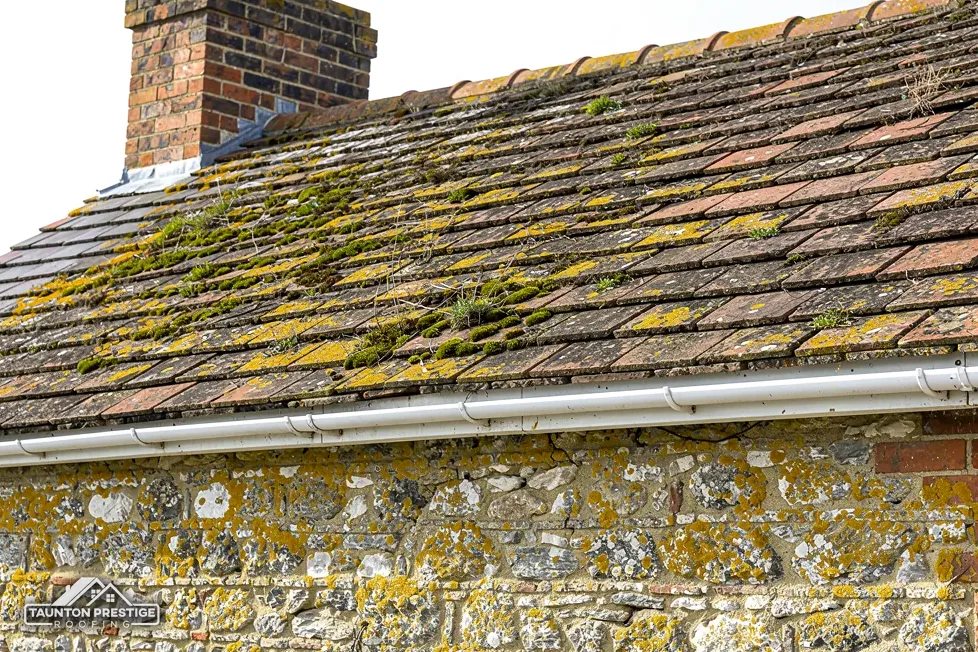
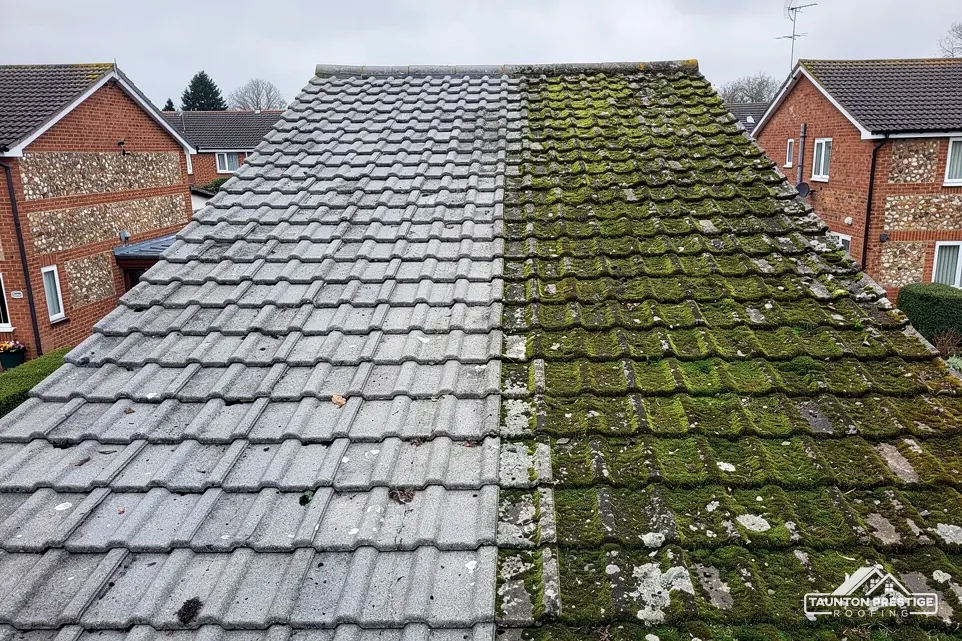
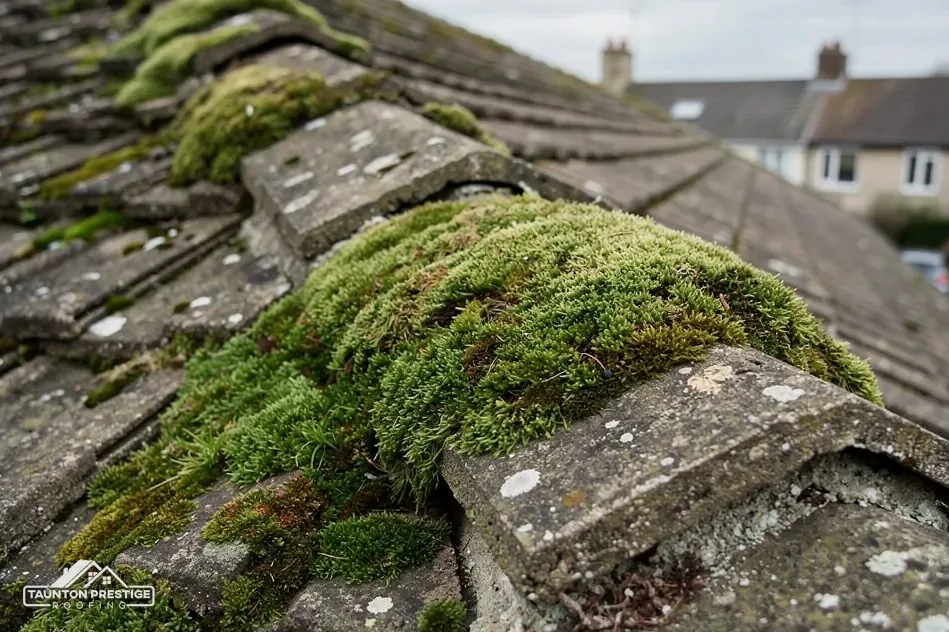
A light dusting of algae on a north slope is a different job from a thick moss mat that has spread into the valleys and gutters. The first is a surface treatment. The second means removing a good deal of material, bagging it up and clearing channels that the moss has half blocked.
Moss, lichen and the dark streaks that look like soot are not the same thing, and the right treatment differs. Our guides to black streaks on a roof and to lichen on roof tiles explain the differences. Lichen in particular grips tightly, and a quote that treats it like moss is likely to need a second visit.
Why does a thick mat cost more to deal with?
Hand scraping a heavy mat takes time and care, and you cannot rush it on old tiles. The debris comes down into the guttering, which then needs clearing, or into the garden, which needs protecting. If the work involves a treatment that has to be applied and left, there is also the matter of keeping it off plants, ponds and water butts. Our notes on garden damage during roof cleaning and water butts cover that side.
Birds may be nesting, and bats may use gaps under tiles. A careful roofer checks before work starts and, if either is present, plans around them. That can add a visit or a delay, and the wait is worth it, because disturbing a nest or a roost is the kind of mistake a clean should never make.
The method and the treatment
Method changes the price because it changes the labour, the materials and the risk. Jet washing is quick, but it can damage the covering. Soft washing, which applies a cleaning treatment at low pressure and lets it do the work, takes a different approach and a different kit. Hand scraping takes the longest and is often the gentlest on fragile covering.
The treatment itself is a regulated product. Under article 17(5) of the Biocidal Products Regulation, a treatment must follow the terms laid down when it was authorised. HSE adds that householders should steer clear of any biocide made only for trade users. So the product on a professional job is not the bottle from a garden-centre shelf, and it carries a cost of its own. We explain this in more depth in our guide to soft washing and biocide treatments.
Is a roof cleaned once and then left?
Not necessarily. Growth returns where the conditions suit it: shade, trees, damp air and slow drying. A clean resets the roof, and the treatment is meant to slow regrowth, but a quote that promises permanent results should make you cautious. Our page on whether moss grows back after cleaning sets out what to expect.
When you compare prices, compare the method and the treatment first. A figure that looks low may price a blast-clean that can harm the covering, and one that looks high may include gutters, valleys and a follow-up treatment. Asking what is included is not rude. It is the quickest way to see what you are buying.
What the clean uncovers and the final price
A clean roof tells you things a green one hides. Slipped tiles, cracked slates, a failing ridge or a rusted flashing often appear once the cover of moss is gone. Some of that is minor, and some of it needs repairing before the roof is treated or the result will not last.
That is the reason we look first. A survey on the roof shows what the cleaning will meet and what sits underneath, and the photos let you see the same thing. It also means the price covers what the roof needs and not what a template assumed. If repairs turn up, you see them on the screen before you agree to anything, and you decide whether they are done together with the clean or kept for later. Our guide to whether roof cleaning is worth it helps you weigh a clean against a repair.
What should a good quote include?
Look for the roof area or the slopes covered, the method and the treatment, the access, how the debris and the wash-off are handled, the gutters and valleys, and whether VAT and scaffolding are in the total. Citizens Advice suggests collecting at least three written quotes ahead of choosing a trader, which is sensible on any job. Compare like with like, though, because one figure may leave out the scaffold another has included, or the gutters, or the follow-up treatment.
You will not get a reliable number from a phone call about a roof nobody has seen. Once we have looked at yours, the price comes as one written total covering the whole job. And if the roof needs a repair, a different treatment, or simply to be left alone, we tell you that plainly and say what we would book next.
Roof cleaning price questions
What is a fair price for a roof clean?
A typical UK figure for pressure washing a semi is around £475 (MyJobQuote, Sep 2026), and Marley does not recommend that method. Your own price depends on roof size, access, the covering, the growth and the method. Ask what is included, check whether scaffold and VAT are in the total, and be wary of a price given unseen.
Is a cheap roof clean ever good value?
Only when the method suits the covering. Marley advises against high-powered jet washing on slate and tile, since it can damage the surface and cut the covering's life. A low price for that method can cost more later, so set a gentler method with a proper treatment beside it when you compare.
Why does scaffold change the cost of cleaning a roof?
Because getting safely onto a tall or steep roof takes equipment and time that the cleaning itself does not. A tower or ladder may do on a bungalow, while a three-storey house can need scaffold and a highway licence, and that can become the largest part of the bill.
More on this subject: Roof cleaning and moss removal in Taunton