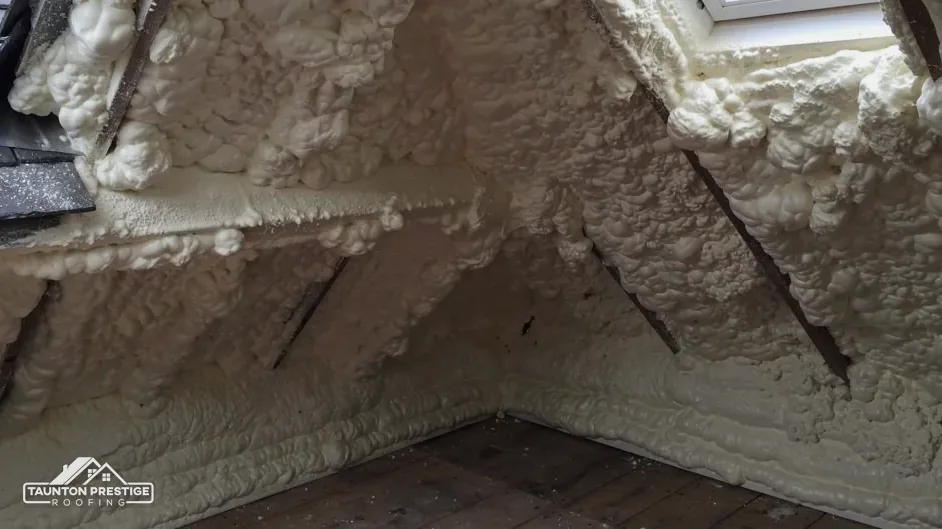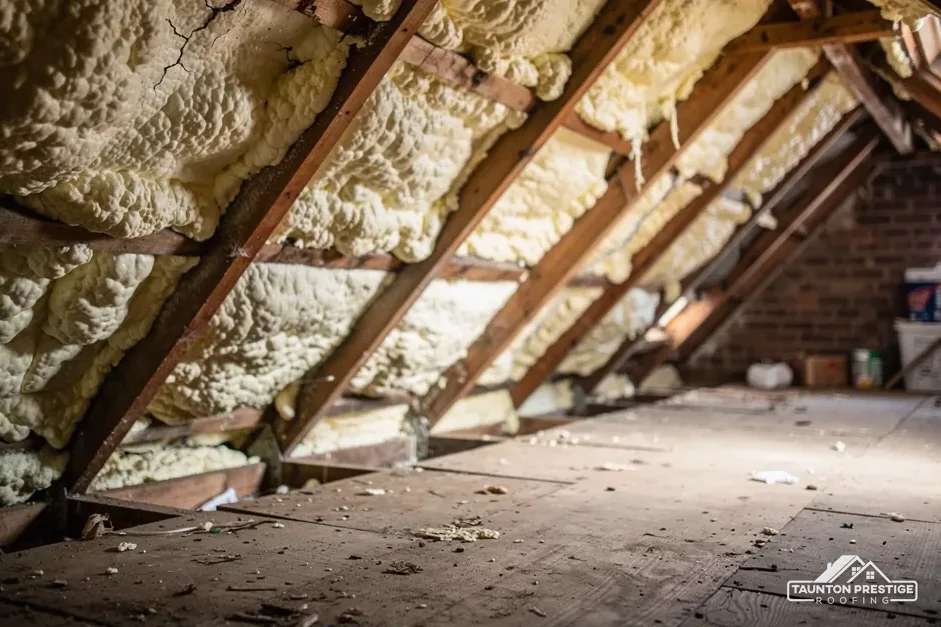
Taking spray foam out is only half the story. The other half begins when the last bag leaves the loft and the rafters, the angled timbers the roof is built on, come back into view. For a lot of owners that is the moment of truth, because the foam has been hiding whatever was happening behind it.
Sometimes the answer is reassuring: clean timber, sound underlay, nothing to do but tidy up. Sometimes the foam has been covering soft battens, a torn membrane or slipped tiles, and those need repair before the roof can be called finished. Either way the loft then needs insulating again, and that has to be done with ventilation and Building Regulations in mind. Below we cover the timber inspection, the underlay and battens, ventilation to BS 5250, new insulation and Part L, and the paperwork a buyer or lender may ask for. It follows on from our main spray foam insulation removal page for Taunton and Somerset.
The first look at bare timber
When the foam comes off, the roof gets its first proper inspection since the day it was sprayed. This is the part many homeowners want most, because it answers the question that started the whole job: what was under there?
What do we look for on the rafters?
We work along each rafter and look for dark staining, softness, splits, and the pale, crumbly surface that decay leaves behind. Rot needs moisture, so we look hardest wherever water could have reached the timber: the eaves, the area round chimneys, the line under a valley and the ridge. A moisture meter gives a reading on damp wood, and a firm probe shows whether the surface is sound. The wall plate, the timber that sits on top of the wall and takes the foot of the rafters, gets the same attention.
Does the roof need mending once the bare timbers show?
That depends on what the foam was covering, and nobody can tell from the hatch. If the timber is dry and firm, the answer is no. If a few lengths are soft, they can be repaired by cutting out the bad section and fixing a new timber alongside, sometimes called a sister rafter. Until the foam is off, a prediction is a guess. For the leak and rot side of the question, see our guide on spray foam and timber rot.
Every finding is photographed. You see the same pictures we see, so there is no guesswork about which timbers were sound and which were not, and the set of photos stays with you if the house is sold.
Underlay, battens and the tiles above
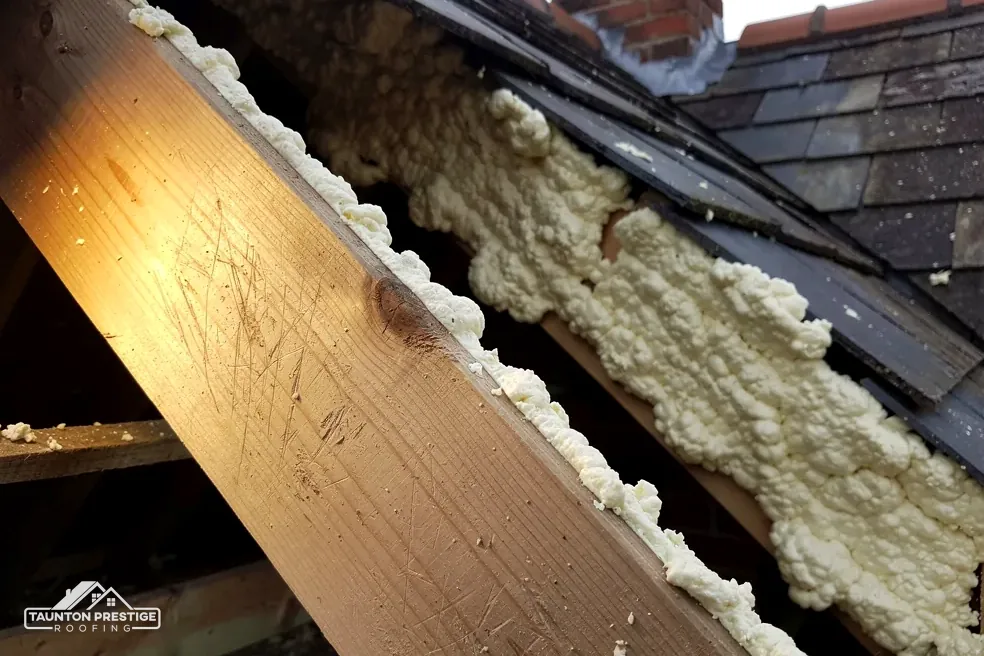
Above the rafters sits the next layer: the underlay, the felt or membrane sheet that deals with rain and snow blown past the tiles, and the battens, the strips of timber fixed across the rafters that the tiles or slates hang from. Foam sprayed straight onto these layers can bond to them, and taking it off may mark or tear what lies beneath.
What condition is the underlay in?
Old felt can be brittle at the best of times. Foam stuck to it makes it more fragile, and peeling the two apart can leave holes. If the underlay is torn, the roof is no longer protected against wind-driven rain, so the answer is to renew it over the affected area. That means lifting the tiles, fixing a new sheet and putting the covering back. Where the felt was damaged in one place, the repair is local. Where it is torn across a whole slope, the sensible route is to re-roof that slope.
Are the battens still sound?
Battens can be marked or split by cutting. If the foam has gripped them, some may need renewing. Replacing a few is part of a repair; replacing many on one slope is the start of a re-roof, and the price changes accordingly. The deciding factors are how much of the slope is affected, how easy the access is, and whether the tiles can be reused. Our page on spray foam and a re-roof explains where that line usually falls.
Foam that was bonded to the tiles themselves is a harder case, because lifting the tile may crack it. We tell you before work begins if that is likely, and the survey photos show why.
Airflow once the foam is gone
This is the section that turns a tidy loft into a healthy one. Spray foam on the underside of a roof changes how it handles moisture, and once the foam is gone, the roof reverts to what it was designed to be: a ventilated roof. That only works if the ventilation is there and not blocked.
What does BS 5250 say?
BS 5250:2021 is the BSI standard dealing with moisture control in buildings, listed as current and under review. The figures that matter come from Marley's guidance on cold roofs. Where the underlay is HR, which is non-breathable, Marley gives 25mm of ventilation along the eaves for pitches of 15 degrees or less, and 10mm above that pitch. With LR breather underlay and a tightly sealed ceiling, ventilation that arrives by chance through ordinary eaves construction, about 3mm, may be enough if third-party certification supports it.
Why does it matter after foam removal?
During the removal, eaves vents and gaps can get blocked with foam or debris. We clear them, and check that air can move from the eaves up into the roof space. If the underlay type has changed during repairs, the ventilation is checked against it. A non-breathable sheet with blocked eaves is a recipe for condensation, and condensation brings the timber decay that was the worry in the first place. Eaves trays or vents that were crushed or sprayed over are replaced at this stage, not left for later.
The principle is to restore a path for air and then insulate around it.
Putting insulation back in the loft
Yes. A loft without insulation loses heat, so putting it back is part of finishing the job properly. What you choose, and how it is fitted, matters more than before, because the roof has just been through a lot.
What goes back in the loft?
The usual route is mineral wool rolled out across the ceiling joists, the flat timbers that hold up the ceiling of the room below. It sits at the level of the rooms you heat, leaves the roof space cold and ventilated, and keeps the rafters visible for any future inspection. Because the loft is cold, the ventilation described above does its job. That arrangement is called a cold roof.
Should I spray foam the roof again?
We would not. The Energy Saving Trust (page updated 8 May 2026) advises against putting foam on a roof that leaks, and the reasoning is easy to follow. Insulation hides the surface it sits on, so a roof should be watertight and dry before anything covers it.
If you want to use the loft as a room, that is a loft conversion with its own design needs, and insulation levels are set by that design. The right order is always the same: stop any leaks, repair the timber, restore ventilation, then insulate.
Before any new insulation goes in, we show you photos of the bare roof, so you have a record of its condition on the day the loft was closed up again. Wires, pipes and downlighters in the ceiling are checked before anything is laid over them, because insulation should never smother them.
Insulating to Part L
Part L of the Building Regulations deals with the conservation of fuel and power, and sets how well new and renovated parts of a house must hold heat. It matters here because fresh insulation after foam removal can count as work on a thermal element, a part of the building that divides warm from cold.
Which figures apply?
Approved Document L Volume 1 gives values in W/(m²·K), where a lower number means less heat escapes. Until 24 March 2027, the 2021 edition applies in England. For existing elements being renovated, such as a roof in a loft conversion, Table 4.3 gives a threshold of 0.35 and an improved value of 0.16. Paragraph 4.13 gives a way out where the full upgrade is impractical or would not pay for itself within 15 years: the work is taken as far as is feasible while still paying back inside 15 years. From 24 March 2027 the 2026 edition applies, with the tables renumbered 3.2 and 3.3, and the payback rule at paragraph 3.14.
Do I need building control?
That is a question for your building control body, because it depends on the work. When a re-roof or insulation upgrade is notifiable, Somerset Building Control charges it as work on a thermal element of a single dwelling, so the job can fall inside the rules. Its number is 0300 303 7790. For a re-roof, the Planning Portal's test is that no application is normally needed where under 25 per cent of the building envelope and under 50 per cent of the roof is touched.
At the survey we flag whether the repairs and insulation look likely to be notifiable, so you can make that call early.
Paperwork for buyers, lenders and the future
The reason some owners remove foam in the first place is a surveyor's note or a lender's question, so what you keep afterwards matters. A clean loft with a record of what was found is worth far more than a loft that simply looks tidy, and the record costs nothing extra to keep.
What should I keep?
Ask for photos of the bare roof timbers, taken once the foam is off, together with any photos of repairs made. Keep the written price and any notes on what was renewed, because the questions from a buyer may arrive months later. If a buyer's surveyor asks about the history, you can show the roof as it was found and as it was left, which answers the question before it becomes a delay. If new insulation or ventilation work was done, keep the details of what was fitted.
What about my lender?
The RICS consumer guide has a plain instruction here: ask your mortgage provider whether spray foam sits within its policy. If you are remortgaging or selling, make that call before the work is booked, so you know what evidence the lender wants. Nobody can promise a lender's decision in advance, and our job is to leave the roof in a state that can be inspected and recorded.
What does the work cost?
The cost of repairs and re-insulating depends on what the bare timber shows, how much underlay and batten needs renewing, the access and scaffold, and the insulation chosen. All of that is settled by the survey, and the airflow side is explained further in our guide on roof ventilation.
After-removal questions
Once the foam is gone, will the roof need repairs?
Not always. If the rafters, battens and underlay are dry and firm, the roof needs tidying and new insulation, nothing more. If foam has hidden soft timber, a torn membrane or slipped tiles, those are repaired. We photograph the bare roof, so you see the real position.
Can you add new insulation after removal?
Yes. Mineral wool laid at ceiling level keeps the roof space cold and ventilated, with eaves airflow cleared and checked against BS 5250. Foam on a leaking roof is not advised by the Energy Saving Trust. Insulation work is judged against Part L, so ask your building control body whether it is notifiable.
Does taking out spray foam need building control approval?
Taking foam out is one thing; the repairs and new insulation that follow can be another, because a re-roof or insulation upgrade may be notifiable. Your building control body can confirm that before work starts, and at survey we explain what your roof is likely to need.
More on this subject: Spray foam insulation removal in Taunton