A damp patch on the ceiling and a loft that is hard to keep warm can look like one problem with one answer. Some householders were told exactly that: spray the underside of the roof and the leak, the draughts and the heating bills would all be dealt with together. It is a tidy idea, and it does not work, because water does not get into a roof through the underside. It gets in through the covering on top, and foam applied from below leaves the covering exactly as it was.
This guide sets out why foam is not a repair, what the Energy Saving Trust says about spraying a leaking roof, where leaks really start, what hiding a leak under foam can do to the timber, and the order in which to do things. If foam is already over a leak in your roof, the last sections cover what to do next. It sits within our spray foam insulation removal work across Taunton and Somerset, where a roof that is letting water in gets sheeted over first and examined closely afterwards.
Why foam cannot stop water getting in
Follow the water. Rain lands on the tiles or slates, and the covering sheds nearly all of it into the gutters. A small amount gets past, driven by wind or finding a gap, and the underlay beneath the covering is there to catch it and send it down the slope. A leak starts when something on top gives way: a slipped tile, a cracked ridge, a failed flashing or a blocked valley.
What does foam do to the path of the water?
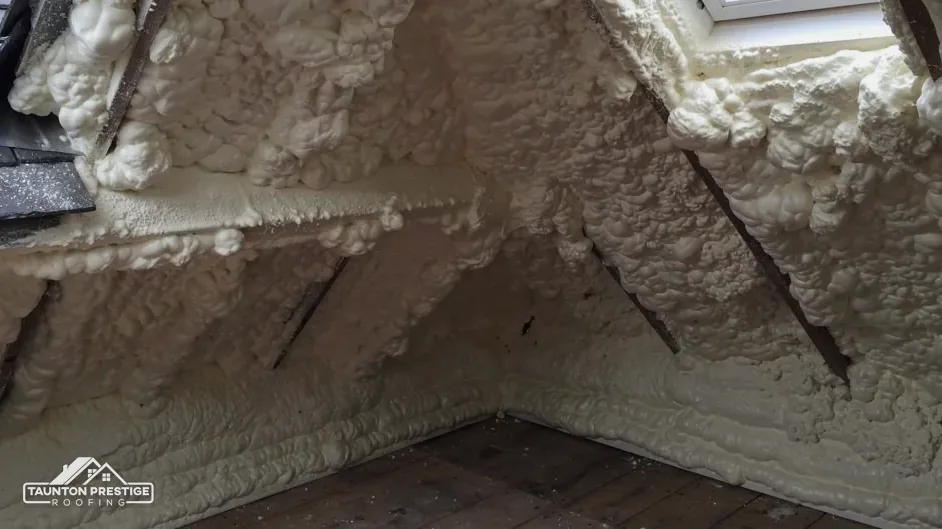
Nothing useful. Foam is an insulation material sprayed against the underside of the roof. It does not seal a broken tile or replace lead that has lifted from a chimney, and it does not change where the rain comes in. What it does change is where the water goes once it arrives. Instead of showing as a drip or a stain you can find and trace, the water soaks into the foam or runs along behind it and appears somewhere else, if it appears at all.
That is the real trouble with the idea. The leak has not been repaired, the covering above is still failing, and the evidence that would have led you to it has been covered up. The next storm brings the water in again, with a lot less to tell you where it is going.
Two trade terms are worth knowing. Flashing means the lead or metal strip that weatherproofs the line where roof and chimney or wall come together, and a valley is the channel at the inside corner where two roof planes meet. Leaks often begin at both, and foam inside the roof leaves both exactly as they were.
What the Energy Saving Trust advises
The Energy Saving Trust publishes advice on roof and loft insulation. On the question of spraying foam onto a roof that is leaking, its page (last updated 8 May 2026) is short and clear: it does not recommend doing this. The advice is to deal with the leak before insulating, and anyone who tells you otherwise is working against the guidance of a body whose purpose is to cut household energy use.
Why would an advice body say that?
Because insulation placed over a fault makes the fault harder to find and harder to fix, whatever the product is. Wet insulation also works less well than dry insulation, and damp that cannot dry out may rot the timber or damage the plasterboard below. An advice body whose job is to help people save energy has no interest in steering anyone towards a roof that fails, so its message is straightforward: repair first, insulate second.
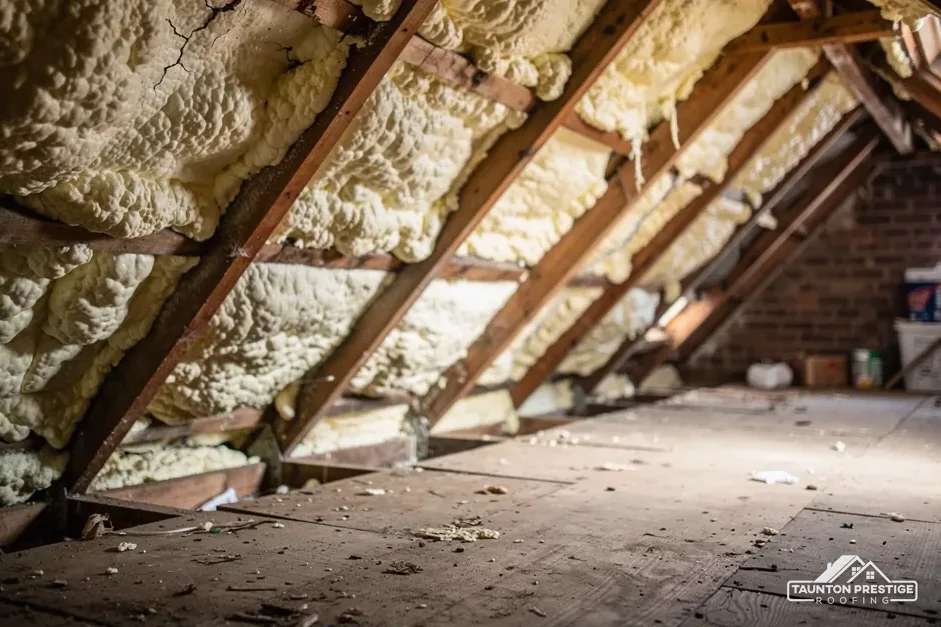
The point holds for any insulation, not only foam, but foam makes it sharper. Mineral wool laid on a loft floor can be lifted to look underneath. Foam bonded to the rafters and felt cannot be lifted, and checking behind it means cutting it away.
If you were told that foam would cure a leak, treat that as a promise that did not hold. Keep any paperwork, and read our guide to spray foam mis-selling and your rights, which sets out the consumer rules for work sold at home. The Citizens Advice consumer helpline on 0808 223 1133 gives free advice to individuals.
Where roof leaks really start
A leak nearly always has a cause that can be named once someone has looked at the outside of the roof. The usual suspects are the same on Taunton terraces, Quantock cottages and estate houses alike.
Which faults let rain in?
Broken, slipped or missing tiles and slates top the list, since they open a direct gap. Ridge tiles, the capping bedded along the apex of the roof, can crack or lose their bedding. Lead flashings at chimneys and walls lift or split. Valleys clog with moss and leaves, and gutters that overflow send water over the eaves where it can be driven back under the first course. The covering can also simply wear out.
Repairs to these faults are modest in scale compared with a re-roof. Typical UK figures from MyJobQuote (Sep and Oct 2026) include an average of around £650 for a general roof repair, £225 to £550 for ridge tile replacement, around £540 for a full valley replacement, and £150 to £250 for a patch of chimney leadwork. They are national averages and not our prices, and your roof may need less or more.
The point is the comparison. A repair on the outside deals with the cause, whereas foam on the inside deals with nothing the water cares about. Roof inspections help here; the key is to find the source of the water from outside as well as from inside.
Not every damp patch is a roof leak, either. Condensation and plumbing can cause similar marks, which is another reason to look before spraying anything.
What foam over a leak does to the timber
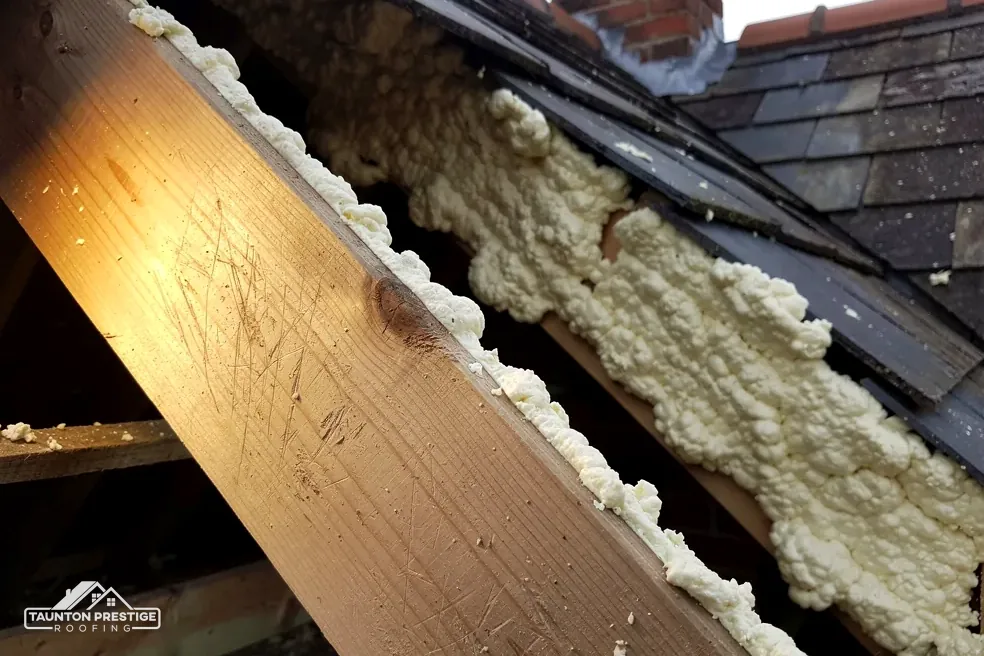
Once the roof is foamed, any water that gets in has two places to go: into the foam, or along the surface between the foam and the roof. Neither is good for the wood. Timber that stays wet is the starting point for rot, and rot needs time, moisture and little else.
Can you see wet timber under foam?
Not directly. The foam covers the rafters, which are the sloped beams the roof is built on, and the battens fixed across them, so the loft offers nothing to look at. The first signs tend to be indirect, and they are easy to put down to something else: a stain on the ceiling that keeps returning, a musty smell, or tiles that begin to slip because the fixings have loosened in softened wood. By then the damage may be well advanced.
Our guide to spray foam and timber rot explains how hidden damage is found, and our short answer on spray foam hiding roof problems covers the wider pattern.
Closed-cell foam, the hard, dense kind, tends to leave less room for water to escape than open-cell. Either kind can trap moisture against timber if the covering above it keeps leaking.
A survey can check whether the wood is sound. Where the loft allows, we lift or probe whatever can safely be reached, photograph the timber, and show you what we find, so that you know whether the roof only needs its covering mended or whether wood has been affected as well.
Fixing the roof before anything else
The order of work matters more than any single job. Start by making the leak safe. Our first job on a roof that is letting water in is to stop it, using sheeting or a quick fix to keep rain out, so the damage stops spreading while the proper repair is planned.
What does the proper sequence look like?
First, find the source from outside as well as inside. Second, repair the covering, ridge, flashing, valley or gutter that let the water in, using the right material for the roof, so a slate roof is mended in slate and a clay one in clay. Third, let the timber and plaster dry and check that they are sound. Only then think about insulation, and choose a type that suits a roof which may need to be inspected in future.
Access has its own requirements. Repairs at height need safe working platforms, and scaffolding that takes up public highway falls under a highway authority permit (Highways Act 1980 s169), and it is sensible to ask the scaffolder who applies for it. Bats can also roost under tiles, and official guidance warns that roof work may disturb them, so a roofer should look for signs before lifting anything.
Keep the receipts and photographs from any temporary repair. If an insurance claim is possible, tell your insurer first. Our separate guide on whether home insurance covers spray foam problems covers the order of events, and no payout is ever certain.
If foam is already over a leak
Many homeowners come to this having already had the foam fitted. The leak may have been there before, or it may have started since, and now it is hidden. Do not panic, and do not start pulling foam off yourself. Scraping at it from a loft ladder risks the ceiling below, the timber beneath and your own safety.
What should you do next?
Photograph any stains, drips and marks on ceilings, with dates. Note when they appear, particularly after rain or wind. Then arrange a survey. We examine the roof from outside for the faults described above and look at the foam from the loft hatch. Where a leak is suspected, we may cut a small inspection opening, with your agreement, to see what lies behind the foam.
The outcome tends to fall into one of three groups. The covering may need a repair and the foam can stay while the timber is checked. A section of foam may need removal so a damaged area can be mended. Or the foam and covering may be so tangled together that a new roof is the sensible answer, which our guide on removing the foam or re-roofing sets out.
In every case the roof is dealt with first and the insulation question comes after. The price depends on the foam, the faults found, the access and the repairs, and a written total follows the survey. Arrange the visit, and the photographs will show you where the water has been getting in.
Leaks under spray foam
Will spray foam stop my roof leaking?
No. Water enters through the covering on top, such as a slipped tile, cracked ridge or failed flashing, and foam on the underside leaves those faults untouched. It tends to hide the evidence. The Energy Saving Trust does not recommend spraying a leaking roof, so repair the leak first.
How can I tell if foam is hiding a leak?
Look for ceiling stains that keep coming back after rain, a musty smell in the loft or upper rooms, and tiles that slip or sit unevenly. None of these proves a leak, but together they justify a survey. Foam stops you seeing the timber, so photographs taken at the hatch matter.
Should I remove the foam or mend the roof first?
Mend the cause of the leak first, since the covering is where the water gets in. Whether foam then needs to come off depends on what the survey shows about the timber and the bonding. A partial removal around a damaged area is sometimes enough, and sometimes a re-roof turns out to be the sounder choice.
More on this subject: Spray foam insulation removal in Taunton