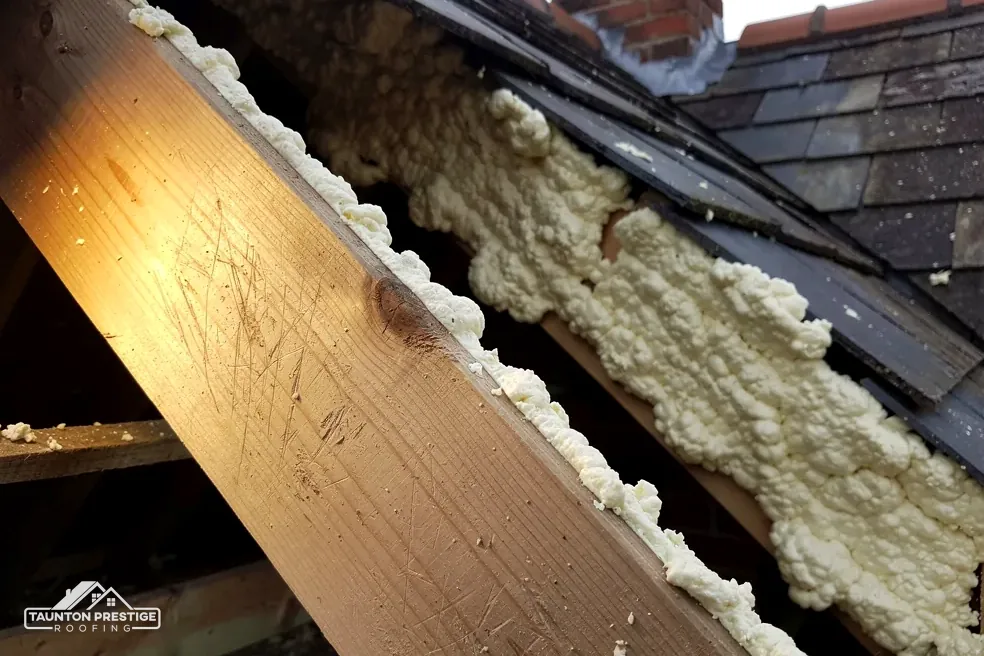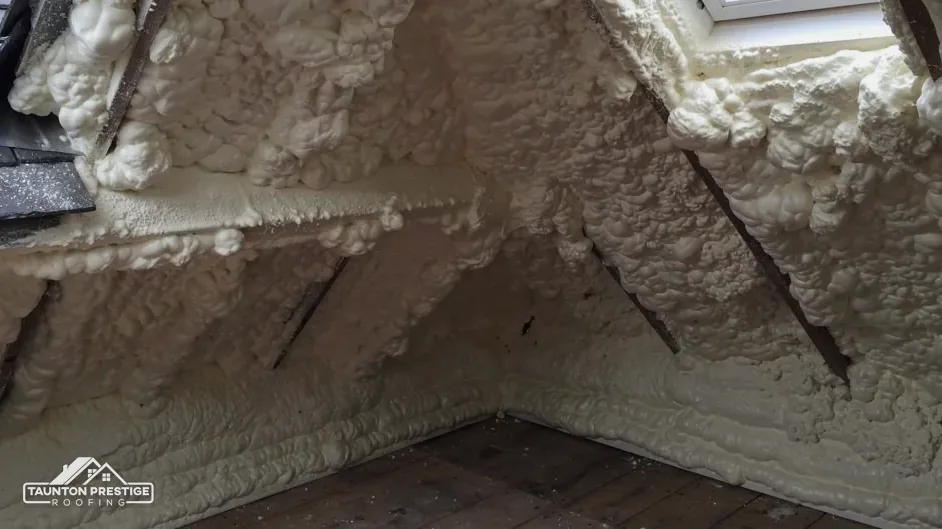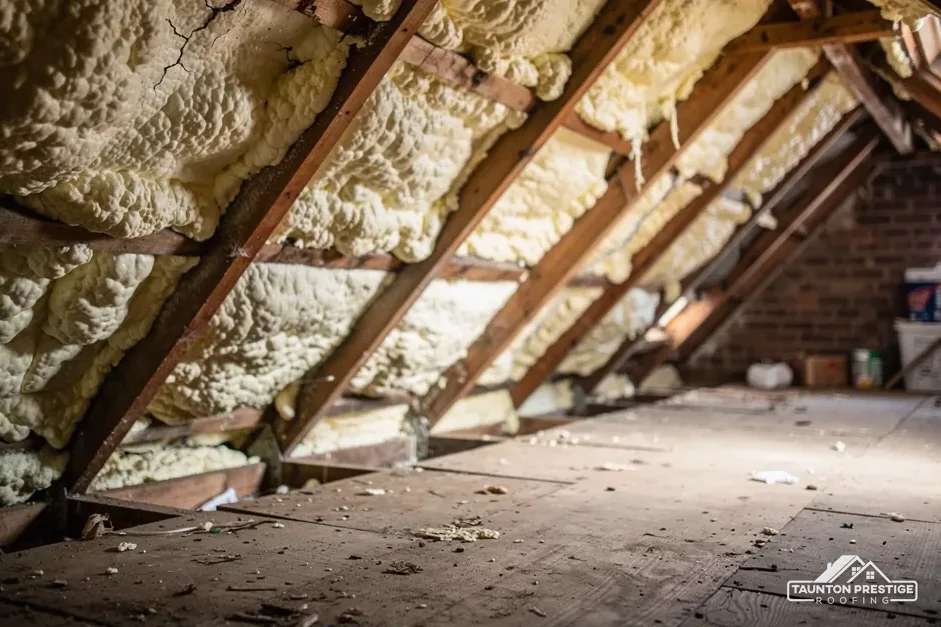
A roof is a timber frame with a covering on top. The frame is made of rafters, the sloping beams that carry the weight of the covering, and fixed across them are battens, the thin strips that every slate or tile hangs from. Timber copes well with the weather as long as it can dry out. Rot starts when it stays wet, and in a roof that usually means a slow, steady source of moisture rather than one dramatic leak.
Spray foam changes how a roof deals with moisture. It sticks to the underside of the covering and to the timbers, so the wood is no longer open to the loft air where a torch and a thumb can check it. If the foam is sound and the roof was dry when it went on, there may be nothing wrong at all. If it sealed in damp, or if water has crept in since, the damage can build for years out of sight. This guide covers how condensation reaches roof timber, why foam hides it, what you can see yourself and what a survey adds. It sits within our spray foam insulation removal work across Taunton and Somerset, where each job starts with reading the roof.
How condensation reaches roof timbers
Condensation is simply water vapour turning back into drops of water. Cooking, showers, drying washing and breathing all put vapour into the air of a house. Warm air holds more of it than cold air, so when that air drifts upwards and meets something cold, some of the vapour drops out as water. In a roof, the cold surfaces are the underside of the slates or tiles, the underlay (the sheet that sits beneath the battens) and the timber itself.
Why does the loft normally cope?
A conventional loft is ventilated. Air moves in at the eaves, and moisture that reaches the cold space is carried away before it can soak the wood. The British Standard for managing moisture in buildings, BS 5250, is the code of practice behind this thinking, and BSI lists the 2021 edition as current, under review. Marley, the tile maker, gives one example of the detail: with a non-breathable underlay, the eaves need 25mm of ventilation along their length on roofs pitched at 15 degrees or less, and 10mm on steeper ones.
Foam works on a different idea. Instead of moving air past the timber, it fills the space and tries to stop warm air reaching the cold side at all. That can work, but only if the seal is complete. A gap, a crack or a patch where the foam has pulled away gives vapour a route in, and the timber behind it becomes the coldest, dampest thing it meets.
Why foam makes timber hard to inspect
Before foam, checking roof timber was straightforward. You went up into the loft with a torch, looked for dark staining or tide marks, and pressed a likely patch with your thumb. Sound wood feels hard. Wood that has started to rot feels soft or flakes away.
Foam takes all of that away. Once the rafters and battens are coated, you can see the foam and nothing else. A surveyor looking for rot has no way to press the wood, check the nail heads, or see whether the underlay behind has torn. Even a damp reading taken from the loft side says little, because the foam sits between the meter and the timber.
Can foam trap a problem that was already there?
It can. If the roof had a slow leak or damp timber when the foam went on, the foam can seal that moisture in. The Energy Saving Trust, in its advice on loft and roof insulation, advises against covering a roof with foam while it is already letting water in. The reason is plain enough. Insulation does nothing to stop water getting in, and it makes the source harder to trace afterwards. A neat foam finish on a damp roof is simply a tidy cover over a fault that carries on.
Foam hides the timbers rather than protecting them. A roof that looks neat from the loft hatch can still have soft wood underneath, and only a closer look will tell you which it is.
Our page on how spray foam hides roof problems goes into the faults that tend to go unnoticed.
Wet Somerset weather and your roof
Taunton and the villages around it sit in the wetter south west of England, and a roof here spends a lot of the year being rained on. That has two effects worth keeping apart. The first is leakage: rain finds a cracked slate, a tired valley or a loose ridge tile and gets under the covering. The second is condensation from inside the house. Cold, damp days push more water into the air indoors, because windows stay shut and washing dries inside.
Is it a leak or condensation?
The two leave different traces. Water coming through the covering appears soon after heavy rain and tends to stain a patch below the damaged spot. Condensation builds slowly and shows in a wider area, often along the colder parts of the roof such as the eaves or the sides near the gables. Both can soften the same rafter, and with foam in the way you cannot always tell which one you have by looking at the surface.
That matters for the repair. Fixing a slipped slate will not cure a condensation problem, and adding ventilation will not stop a leak. A roofer reading the roof needs to work out the cause before suggesting a cure, which is why a survey of the whole roof comes before any price.
Weather also affects how quickly a damp roof can recover. In a dry spell, a ventilated loft lets timber release moisture. Under foam, that release is blocked, so a wet autumn followed by a damp winter can leave the same patch of wood wet for months, and the longer wood stays wet, the more likely fungal decay becomes. Wet weather does not cause the problem on its own. It gives any weakness more time to do harm.
For water around the building itself, such as flooding from rivers or the ground, the GOV.UK checker is the right place to look. It tells you nothing about your roof timbers.
Signs that timber may be failing
You can learn something from the loft and from the ground without touching the foam. None of these signs proves rot, but each is a reason to ask for a proper look.
- Dark patches, tide marks or a bloom of mould on the foam surface or on bare timber at its edges.
- A musty, earthy smell in the loft that gets stronger in damp weather.
- Foam that has shrunk, cracked or come away from the wood, leaving gaps.
- Bare rafter ends or wall plates, the timber beams that sit along the top of the wall, that look dark or crumbly.
- Rusty nail or screw heads showing through the foam.
- Stains on bedroom ceilings below the roof slope.
What can you see from outside?
Stand across the road and look along each slope. Slipped or missing slates and tiles, courses that dip, a sagging ridge line or a roof that looks wavy all suggest the frame beneath is moving. Wet patches on the roof that stay dark long after the rest has dried can point to damp underneath.
Take dated photos of anything you find. They help a roofer understand how the problem has changed, and they are useful if you later talk to your insurer or lender about it.
What a roof inspection adds
A survey does what the foam stops you doing. The roofer looks at the roof from outside and from the loft, notes where the foam is sound and where it has failed, and checks the covering for the faults that let water in. Where a closer look is justified, a small area of foam can be cut back so the timber behind it can be seen and tested, and the hole is made good afterwards.
What do you get at the end?
The photos in your report come from your own roof and show what was found and where. They let you see for yourself whether the timber is sound, damp or soft, instead of taking a word for it. From that comes a clear recommendation: leave the foam and keep an eye on it, repair a local fault, remove foam from one area, or strip it more widely and renew the timber that has failed.
The price comes as a single written total once the survey is done. What decides it is the size of the area, how the roof is reached, the type of foam, how well it is bonded to the timber and the covering, and how much timber has gone. Our roof inspection for spray foam page explains the visit in more detail.
The survey also gives you something to hold up against the timeline. A roof that has been wet for one winter and a roof that has been wet for ten are very different jobs, and the photos help show which one you have. A cautious first step, such as one opened-up patch, often answers the question without disturbing the rest of the roof.
It is better to find out while the timber is only damp than after it has rotted through. Damp wood can dry out once the cause is fixed, while rotten wood has to be cut out and replaced.
If rot is found, what happens next
Finding soft timber is not the end of the road. How much work it means depends on how far the damage has spread. A single rafter foot or a short run of batten can be cut out and replaced with new timber, spliced or fixed alongside sound wood. Widespread damage across a slope means the foam, covering and underlay all come off that slope, the frame is repaired, and the roof is put back together.
Does the foam have to come off?
Where the timber needs work, the foam over it has to be removed to reach it. Whether the rest comes off is a separate decision, and it depends on its condition. Our guide on how spray foam is removed sets out the methods,.
Who else should you tell?
If you are thinking of a claim, tell your insurer before work begins, take photos and keep receipts for anything you have to pay for. What the policy pays, if anything, is for the insurer to decide from its wording. On the mortgage side, the RICS consumer guide points owners to their own mortgage provider to ask whether the lender allows foam installations, so raise it with them early. Our page on spray foam and home insurance covers the insurer side.
Once the timber is sound, ventilation matters again. If the covering is renewed, we plan eaves and ridge airflow to suit the underlay going on, rather than assuming the old arrangement will do. The aim is for you to see in photos what the foam is hiding before any decision gets made.
Foam and timber questions
Can roof timbers rot under spray foam even if the roof never leaked?
Yes. Warm, damp air from inside the house can pass through a gap in the foam and condense on cold timber behind it. The wood then stays wet slowly, with no leak at all. Gaps, cracks and edges where the foam has pulled away are the usual routes in.
Will a damp patch on the ceiling mean the timbers are rotten?
Not necessarily. A ceiling stain may come from a leak, from condensation or from something unrelated such as a pipe, and staining alone cannot tell you the wood is soft. It is a reason to arrange a survey so the roof, the foam and the timber can each be checked.
Can a small section of foam be cut away to look at the wood?
Yes, and it is often the most useful step. A small area is cut back, the timber behind is checked and photographed, and the section is made good again. It gives you evidence about the real condition of the frame before you decide whether to remove more.
More on this subject: Spray foam insulation removal in Taunton