Anyone asking about the cost of removing spray foam wants a number, and a fair question deserves a fair answer. The honest one is that the cost follows the roof. A thin layer of soft foam on open rafters in an easy loft is one afternoon's careful work. A thick, hard layer that has set around battens, felt and tiles is a different job altogether, and it can run into days of hand work followed by repairs.
So instead of naming a figure that would be wrong for many houses, this guide shows you what the price is built on. It looks at the foam itself, the footprint and shape of the roof, the access, the repairs that may follow, and the other costs that sit around the job, such as scaffold and VAT. It also explains what to ask any roofer before agreeing, so you can judge a quote on its substance. It is part of our spray foam insulation removal service across Taunton and Somerset.
Why one roof costs more than the next
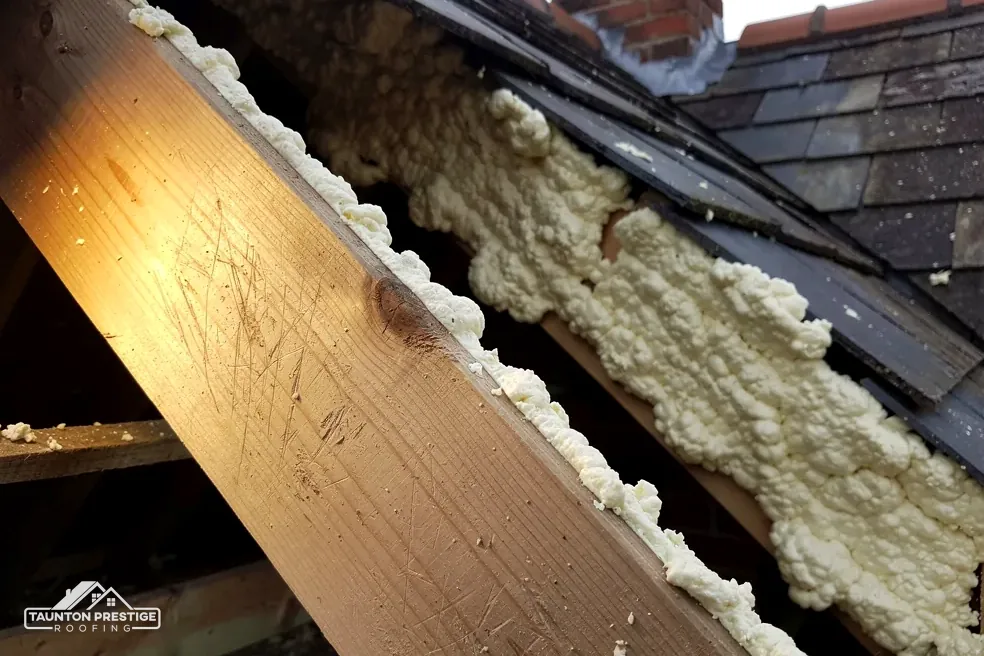
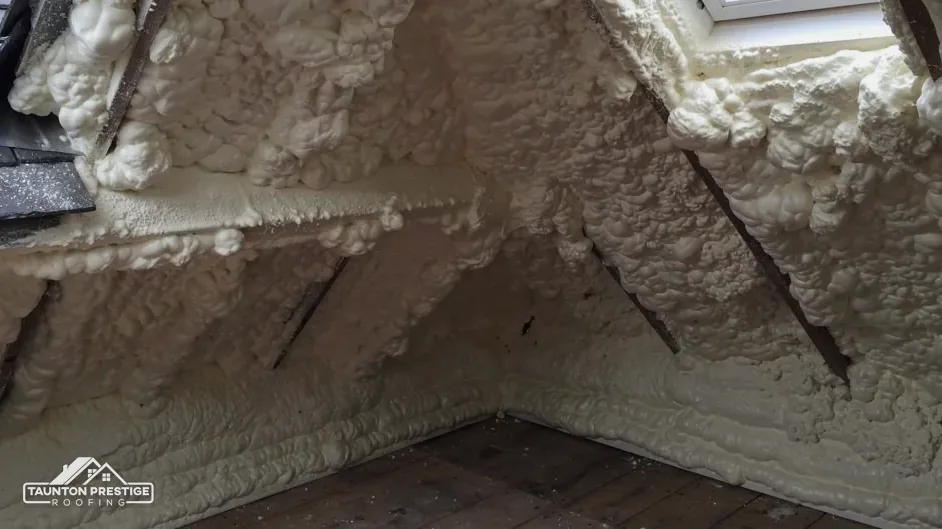
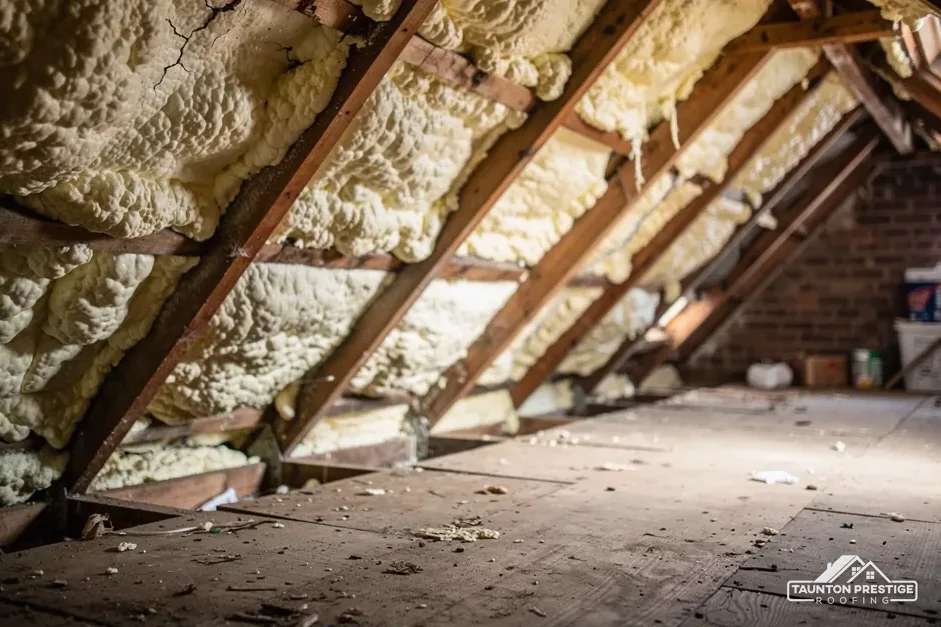
Foam is applied to a roof in a way that suits the installer, not the person who later has to take it out. Depth varies from a thin skin to a mass that fills each rafter bay. Foam may sit on timber alone, or it may be pushed into felt, around battens and onto the backs of tiles. Every one of those differences changes the time on site.
How much does it cost to get spray foam insulation removed?
It costs whatever the roof demands, and the demand is hard to see from the ground. That is why the sensible way to find out is to have the loft looked at in person. From the hatch we photograph the foam, noting which kind it is, how deep it lies and what it has bonded to. Only then is there a basis for a price.
Published cost guides for roofing work do exist, and some are quoted further down this page for related jobs. They cover repairs, re-tiling and scaffold, and they are a handy way of sizing the work that may follow removal. Removal itself depends on too many details of the individual roof to be captured in a national average.
Be wary of anyone who names a firm price for foam removal over the phone without seeing the loft. Unless they know the type, depth and bonding of the foam, the number is a guess, and a guess tends to move once work starts. A visit and a set of photographs cost far less than a surprise halfway through, and they give you something to refer back to if a question comes up later.
The foam: type, depth and what holds it
Foam comes in two broad kinds, open-cell and closed-cell. Open-cell is soft and spongy, and it is generally easier to cut and scrape. Closed-cell is hard and dense, and it can grip timber and felt much more firmly. Our guide to how spray foam is removed describes the hand methods used on each, and why neither is quick.
What makes the work slower?
Three things stand out. The first is depth: a layer three centimetres thick is a different task from one that fills the full height of the rafters. The second is continuity. Foam that forms an unbroken sheet along a slope takes longer than separate patches, because there is more of it to detach. The third is bonding. Foam resting on bare rafters comes away cleanly, foam that has soaked into old felt tears it, and foam that has flowed behind tiles can lift them as it goes.
That third point also decides whether the roof covering survives the job. Where it does not, the foam work becomes part of a re-roof, and the guide on removing the foam or re-roofing explains when that happens.
Each hour on the roof adds to the labour, which is the largest share of a hand-work job like this one. More depth, more bonding and more continuity mean more hours, and more hours mean more cost. The same logic works in reverse: a thin, patchy layer on clean timber is the lowest-cost case there is, and the survey photographs show quickly whether yours is one.
Roof area, access and scaffold
The next factor is the roof itself. A small bungalow loft has less foam than a large farmhouse, and every square metre has to be dealt with by hand. Shape matters too: a roof with many hips, valleys and dormers has more awkward corners than a plain pitched one. Hips and valleys are the angled lines where two slopes meet, and foam gathers in both.
Do the hatch and the loft floor affect the price?
They do. A small hatch limits what can be carried in and out. A loft with little headroom slows everyone down. Boarded floors, stored belongings and low eaves all take time to protect or clear. Waste is bagged and carried out, so the route from loft to vehicle counts as well.
Scaffold comes into it when the covering has to be lifted or the roof is reached from outside. For a three-bed semi, HomeBuilding (Sep 2025) allows approximately £1,000 with permits in the sum, and MyJobQuote (Oct 2026) quotes £550 to £750 for hiring front-elevation scaffold for seven days. Poles that obstruct the carriageway or pavement need a licence from the highway authority, so ask early who applies and who pays.
Access also affects safety. On a steep or fragile roof, working platforms and edge protection go in before anyone steps onto a slope, and that setup belongs in the price. It is not something to trim to save money. A tidy, safe site is a standard worth paying for, because the alternative is damage to your ceiling, your roof or someone's back.
What the roof needs once the foam is gone
Removal reveals what the foam was hiding, and the repairs that follow often decide the final bill. Some roofs come out clean. Others have felt torn in places, a few cracked tiles, or timber that is stained or soft.
What will the repairs add?
That total is the removal plus whatever repairs the roof needs, and it can only be known after the survey and, in some cases, once the foam is off. National guides help you see the scale of typical repairs. MyJobQuote (Oct 2026) gives an average of around £650 for a general roof repair, £150 to £200 for replacing five tiles, and £225 to £550 for replacing ridge tiles. A full re-tile of an 80m² roof comes in at £3,000 to £8,000 as a typical UK range.
Those figures show why the repairs matter. A handful of tiles is a small addition, whereas a section of battens and underlay is a larger one, and a full re-roof is a different order of cost. The sensible approach is to learn early what shape the roof is in, and the survey photographs do that.
If timber has rotted, replacing it adds both materials and labour. Weighing that cost against what the foam is doing to the house is the question of whether removal is worth it, and the survey pictures answer it.
Ventilation may need restoring, too, so that the roof space can breathe again after the foam has gone. That is a small item next to rot, but it is part of leaving the roof in working order.
Surveys, VAT and weighing up quotes
Think of the survey as the first step of the price. MyJobQuote (Oct 2026) reports an average of around £300 for a roof survey, with drone surveys at £200 to £350. A roofer who looks at your loft and photographs it is doing the work that makes an accurate price possible, and the pictures remain useful to you whoever does the job.
What should a good quote cover?
It should say what work is included, in plain terms: foam removed from which parts of the roof, what happens to the waste, what state the timbers and felt are left in, and whether scaffold is included. It should say whether VAT is on top, because work on an existing house, repair or re-roof, carries the standard 20 per cent rate. And it should say what happens if something unexpected turns up, such as rotten timber, before any extra work begins.
Citizens Advice recommends collecting written quotes from three or more traders before you settle on one. When you do, ask each what is included and read the answers side by side. A low total that leaves out scaffold or waste disposal is not low at all once the omissions are added back.
Different firms may also assume different methods. One may plan to cut the foam by hand and another to strip the covering. Ask which method is assumed and why, because that is often where the gap between two totals comes from.
Hold back on a large deposit until you have a written price, a clear scope and an idea of the dates.
Who pays, and the next step
Many owners ask who might meet the cost. Three possibilities are worth checking. If the foam was sold on promises that fell short, consumer rights may apply, and our guide to spray foam mis-selling and your rights explains the cancellation and complaint routes. If damage has followed, your home insurance may or may not respond, depending on its wording, and the insurer should hear first. And if a sale or remortgage is on the horizon, RICS advises asking your mortgage provider about foam, which can affect timing.
Are there grants for spray foam removal?
A grant for a new roof does not exist at national level. The Warm Homes: Local Grant is aimed at installing insulation, with household income usually £36,000 a year or less, so do not count on it paying to take foam out. Eligibility is for the scheme to decide, not for us.
The practical step is the survey. We go into the loft, move nothing that is unsafe to move, and photograph the foam, the felt and the timber. After that you receive one written total price for the work we have seen and talked through with you, so the decision rests on facts rather than guesses.
Nobody has to commit to anything at the survey stage, and the pictures are yours to keep. If you want to see the process first, read how the work is done step by step, then arrange the visit when you are ready.
Spray foam removal pricing questions
Why can't a foam removal price be given over the phone?
The price turns on things that cannot be seen from a description: the foam type, its depth, what holds it, the roof area, how we reach it and the state of the roof below. A survey with photographs gives a firm basis, and a written price follows from it.
Does a quote for removal include repairs to the roof?
Only if it says so. Removal and repair are different jobs, and the repairs depend on what is revealed once the foam is off. Ask the roofer to state what is included, what happens if timber or felt needs renewing, and how any extra work would be agreed before it starts.
Is scaffold needed to remove spray foam?
Not always. Foam cut from inside the loft may need none, whereas stripping the covering or reaching a steep roof usually does. Where the scaffold stands on the road or footway the highway authority must license it, so check with your roofer who applies and whether that cost sits in the quote.
More on this subject: Spray foam insulation removal in Taunton