The Lamb and Flag Inn
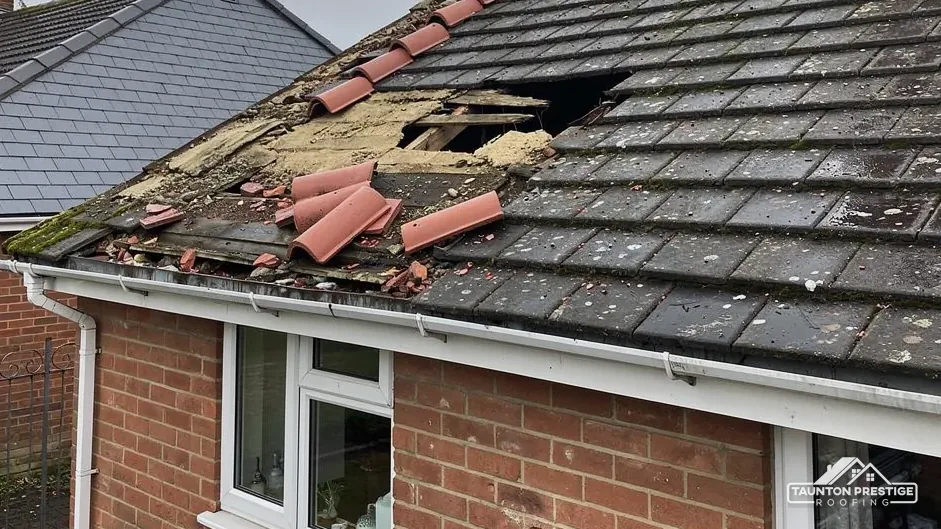
A 17th-century Grade II inn with a half-hipped Bridgwater patent tile roof, so any re-cover has to match that profile.
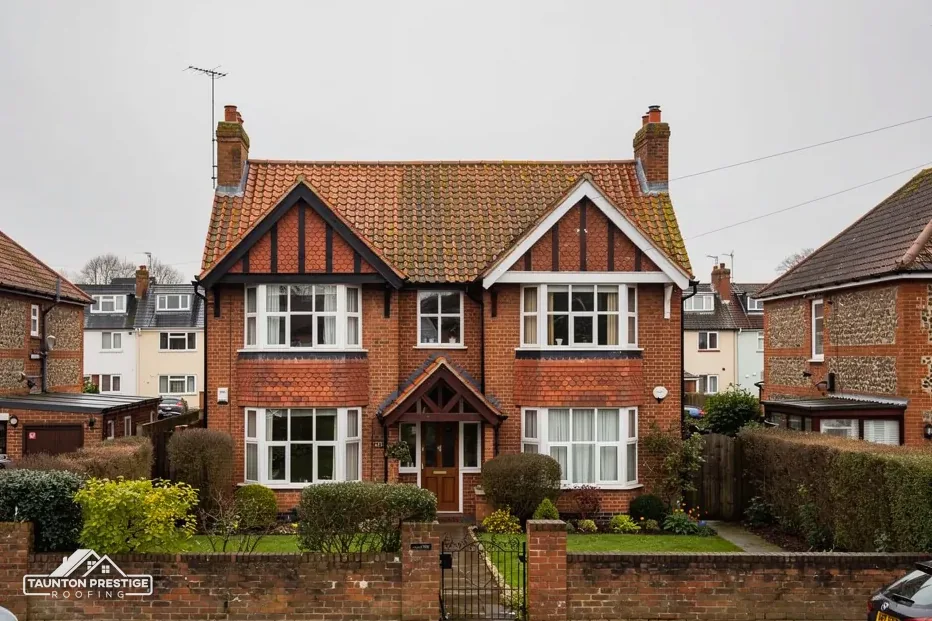
A Bridgwater tile inn roof and a cottage with two pitches
Blagdon Hill is a village in Pitminster parish below the Blackdown Hills scarp, where the Lamb and Flag Inn carries a half-hipped Bridgwater patent tile roof.
A 17th-century Grade II inn with a half-hipped Bridgwater patent tile roof, so any re-cover has to match that profile.
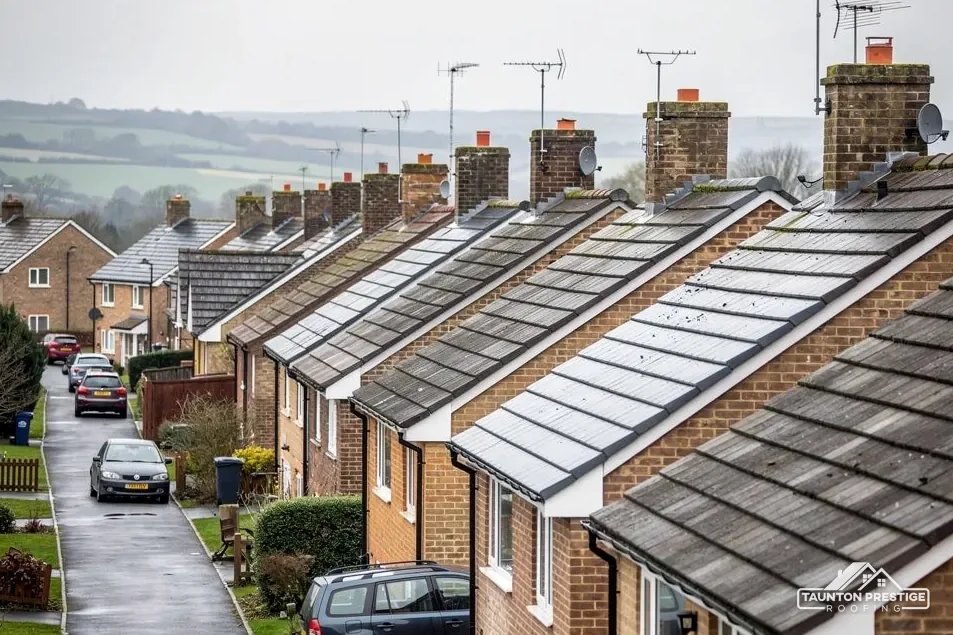
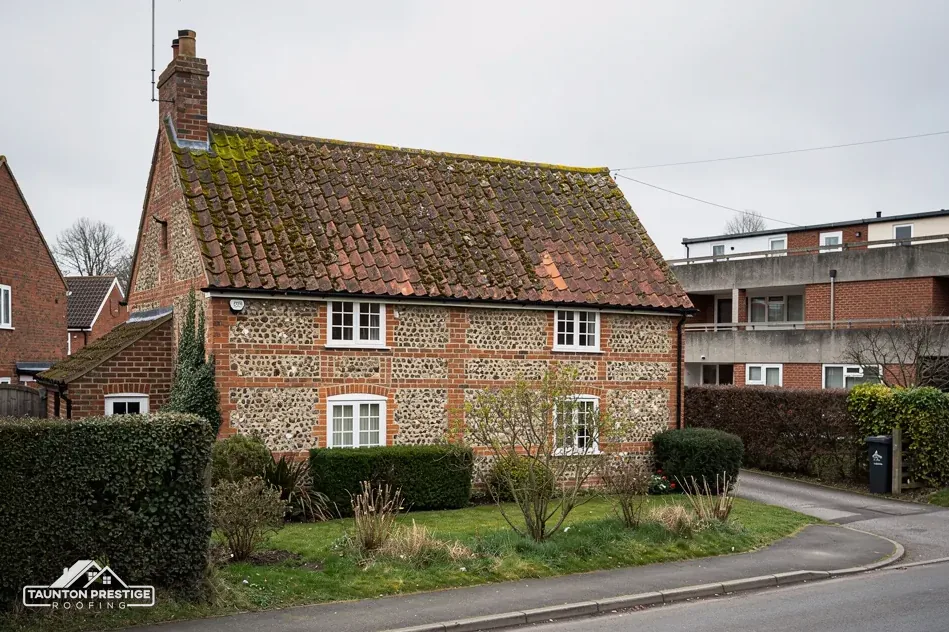
A steeply pitched tile roof covers the original farmhouse part, and a shallow slate roof covers the later chert-rubble end.
Both are listed Grade II, and four list entries stand within 500 metres of the village centre.
Street map of Blagdon Hill with Pitminster, Angersleigh, Corfe, Burnworthy marked around it, and Taunton.
Pitminster lies to the north-east of Blagdon Hill and Angersleigh just to the west, with Corfe further north-east, while Trull sits to the north.
About 4 miles south of Taunton, Somerset Council (unitary).
A walk under the scarp
Four checks for a farmhouse, cottage or outbuilding near Blagdon Hill, and what each can do to the price once the survey is done.
The Lamb and Flag Inn is a 17th-century building, possibly a rebuild of an older dwelling, and its roof is described as a half-hipped Bridgwater patent tile roof. Half-hipped means the top of the gable end is clipped back into a short hip, so the ridge stops before it reaches the wall. The tile takes its name from Bridgwater, and the South West Heritage Trust credits the town's brick and tile yards with giving many Somerset towns their look.
Often, with patience. Matching means size, colour, camber and surface finish, and sound reclaimed pieces fill gaps where a new tile would stand out. A listing makes the care more important. The inn is Grade II, so a change of covering needs listed building consent, whereas a repair that puts back the same tile leaves its character alone. Our pitched roofing page covers repairs of this kind.
The BRE gives clay tiles a minimum life expectancy of 60 years, a figure Marley applies to clay alone, and a building conservation article calls it an unreliable guide for old peg tile. So a tile roof is judged by its condition, not its date. Cracked tiles, a slipping ridge and moss in the valleys are what we record, slope by slope.
The half-hip is the part to watch. The ridge and the short hip meet there at an angle, and the capping has to be cut and bedded to suit. When we survey a roof like this we note the angle, the condition of the cut tiles and the state of the timber beneath them, since a joint that has opened at the top lets rain onto the wall head and into the gable.
A pub roof is also somebody's livelihood. If you run a business from a building like this, tell us at the first call, because the work is planned around opening times and deliveries and not only around the weather.
Look for
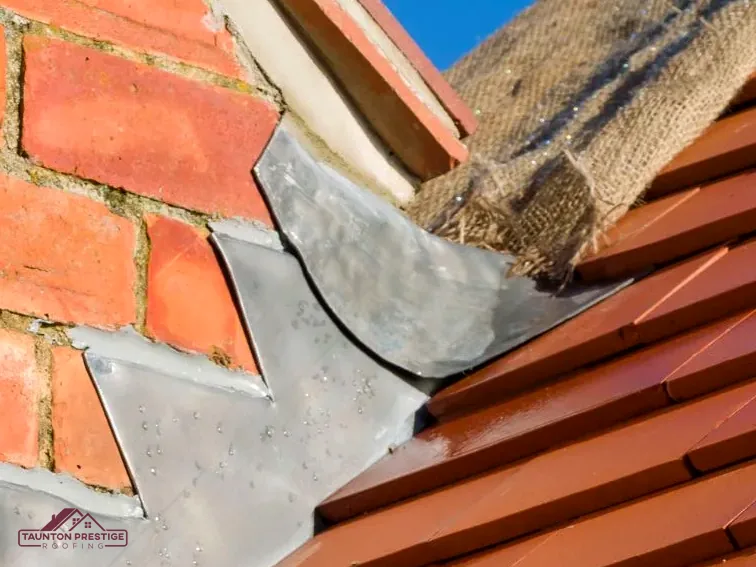
Wardour Cottage began as a late 16th- or early 17th-century farmhouse and was enlarged in the early 19th century. The original part has a steeply pitched tile roof, while the later double-pile end, built of chert rubble with brick dressings, has a shallow-pitched slate roof. Two coverings at two angles means two sets of rules, and a join between them that has to cope with both.
Sound or needs work
What decides the price
Where a lower slate roof meets a higher tile wall, a flashing has to seal the line, and in a stepped abutment that flashing is cut into the wall in short steps. Lead is the usual choice. Royston Lead's brochure lists codes 4 to 6 for flashings, and the sheet's life depends on how it was dressed and whether the wall joint behind it is sound. Cracked pointing lets water behind the lead whatever its thickness.
It can. Cupa Pizarras reports the BS 5534 minimum pitch for natural slate as 20 degrees, with hook fixings avoided below 25 degrees. A shallow roof sits near those limits, so the pitch is measured before slate is chosen or reused. A steep tile roof next door has no such limit, but it throws water harder at the join below. We check both at the survey, with photos of the abutment taken at roof level for you to check.
The cottage shows why one written price for a whole building needs a careful survey first. The two ends age at different rates, and a repair to one may leave the other for later. We tell you which is urgent and which can wait, so you choose the work with the facts in front of you.
Blagdon Hill sits below the Blackdown Hills scarp, on the edge of the Blackdown Hills National Landscape. For this village the centre point falls outside the boundary, yet more than half of the search area around it falls inside, so addresses differ. The old Area of Outstanding Natural Beauty became a National Landscape in November 2023, a change the Blackdown Hills team notes on its website. Ask Somerset Council's planning team about your own address before changing the look of a roof.
A roof cleaned over cracked tiles looks better for a season and no longer than that.
Marley advises against jet washing at high power, which can damage the surface of slate or tile and cut its working life. HSE's position is that biocides sold only to professionals are not for householders to buy or apply. A hand brush from a safe position and gutters kept clear are the cautious steps. Our roof cleaning and moss removal page explains what a cleaner can do.
Moss holds water against the covering, and a heavy patch can lift a tile edge or block a valley. It also shows where a roof stays damp, which is worth knowing before you decide between a clean and a repair. We note the worst areas on the survey and say whether cleaning is enough, or whether the covering beneath has already given way. A cleaned roof that is cracked beneath only looks better for a season.
Cleaning is also a chance to look properly. With the growth off, slipped slates, hairline cracks and failed pointing show clearly, and the survey photos become far more useful. So the clean comes before the repair, with debris cleared from the gutters on the same visit.
The 1838 tithe map shows a patch of small enclosures at Blagdon Hill, a few with houses, which suggests smallholdings that were being given up by the middle of the 19th century. Their echo today is the number of small outbuildings, sheds, stores and garages around older plots. Many carry sheet roofs of corrugated or flat panels, and an older sheet may be asbestos cement.
Outbuilding roofs are easy to forget because nobody sees them from the road, yet a garage roof that fails soaks whatever is stored beneath it. A sheet roof can sometimes be repaired with new fixings and sealing strips, while an old sheet that has gone brittle may mean replacing the whole slope. The survey tells you which you have.
What decides the price
HSE advises treating any building built or refurbished before 2000 as one that contains asbestos, and describes roofs made of asbestos cement as fragile in every case. You cannot tell by eye, so a sample or a competent survey decides. Please do not walk on a roof of unknown sheets. Our garage and asbestos roofs page explains the options for garage roofs.
HSE treats careful removal of asbestos cement, handled without breaking it up, as non-licensed work. If the sheets are substantially broken up, the work becomes notifiable non-licensed work. Where the survey points to licensable material, such as asbestos insulating board in a soffit, we tell you before a price is given. Waste from asbestos work goes into two wrapped, labelled layers and travels on a consignment note, and an ordinary skip is out of the question.
When you are ready, send us your Blagdon Hill address with a description of the outbuilding, and we will visit, photograph the roof and follow with one written price.
Walked the roof?
When you have read the checks, we walk the roof and show you the photos.
Only with care. The Lamb and Flag Inn is Grade II, and its roof is described as a half-hipped Bridgwater patent tile roof. Putting back the same tile is the simple route. A change of covering alters its character, so it needs listed building consent, which is a matter for Somerset Council and not for the roofer.
Each covering has its own life and rules. Well-maintained slate can last 100+ years, according to the Confederation of Roofing Contractors, whereas Marley puts concrete tile at around 60 years, with no guarantee, and clay has its own figure. We repair each roof on its own terms and pay special attention to the join between them.
Parts of it may. The village centre point is outside the National Landscape, yet more than half the search area around it lies inside, so the answer depends on your address. Check with Somerset Council's planning team before altering how a roof looks, and ask for a survey either way, since a repair deserves the same close look wherever the line falls.
If the scaffold needs to go on the highway, Somerset Council licenses accredited contractors only, and the firm doing the work applies. It wants at least 10 working days' notice and charges £124.60 per 28-day period (April 2026). Scaffold inside your own boundary is not on the highway, and we plan the start date around the answer.
Tell us whether it is the house, the inn or an outbuilding, and we will arrange a survey visit.