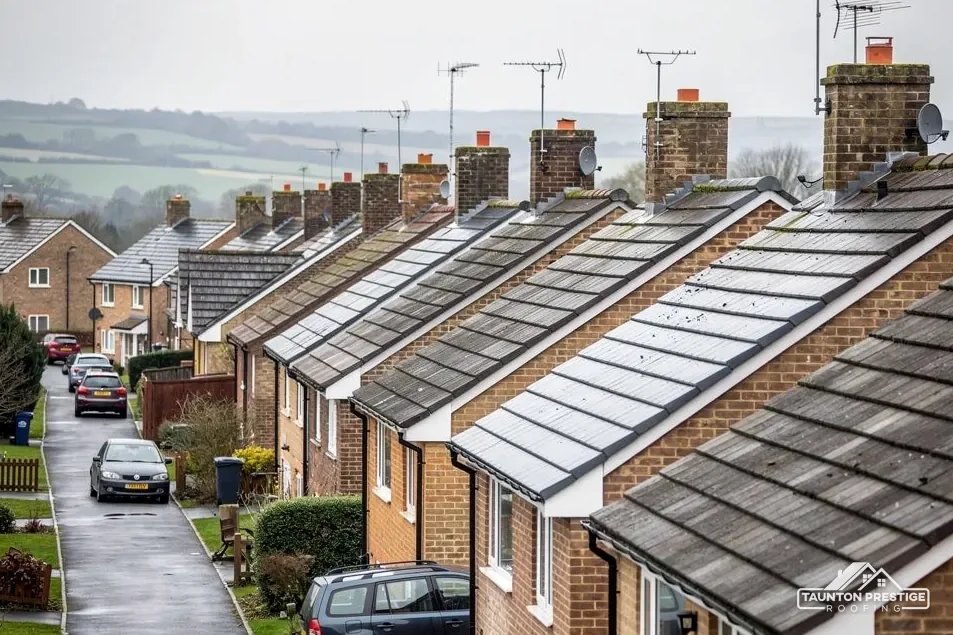
The parish church
Mentioned around 1150, tower from about 1300. Listed Grade I, so roof work follows its denomination's consent route.
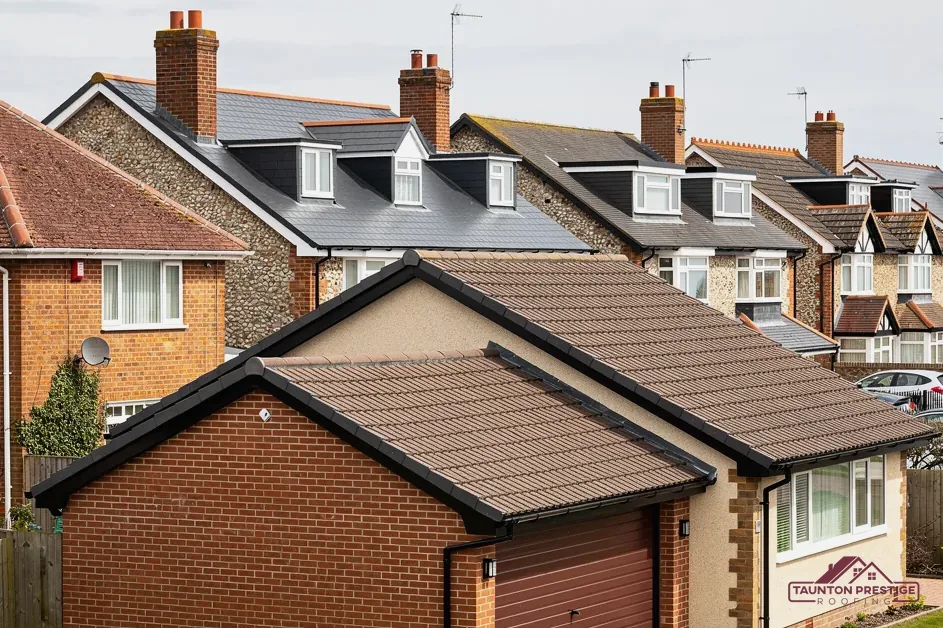
Grade I church, farm barns and the edge of the Blackdown Hills
Pitminster has a Grade I church, a conservation area and the Blackdown Hills National Landscape at its edge. We survey each roof first and price it after.
Mentioned around 1150, tower from about 1300. Listed Grade I, so roof work follows its denomination's consent route.
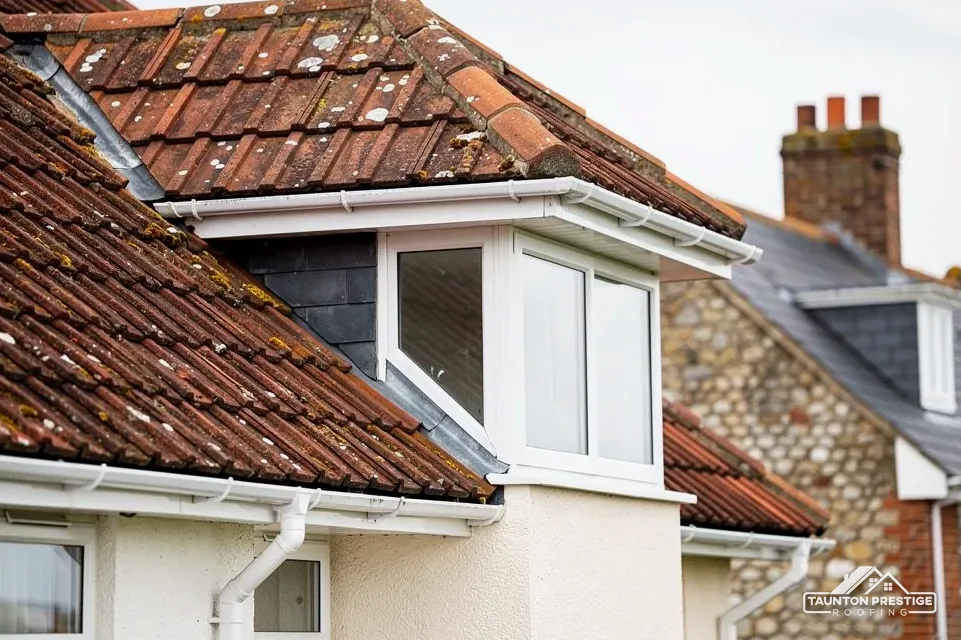
The barn and outbuilding at the farmhouse's west end carry Grade II listings, and altering their character needs listed building consent.
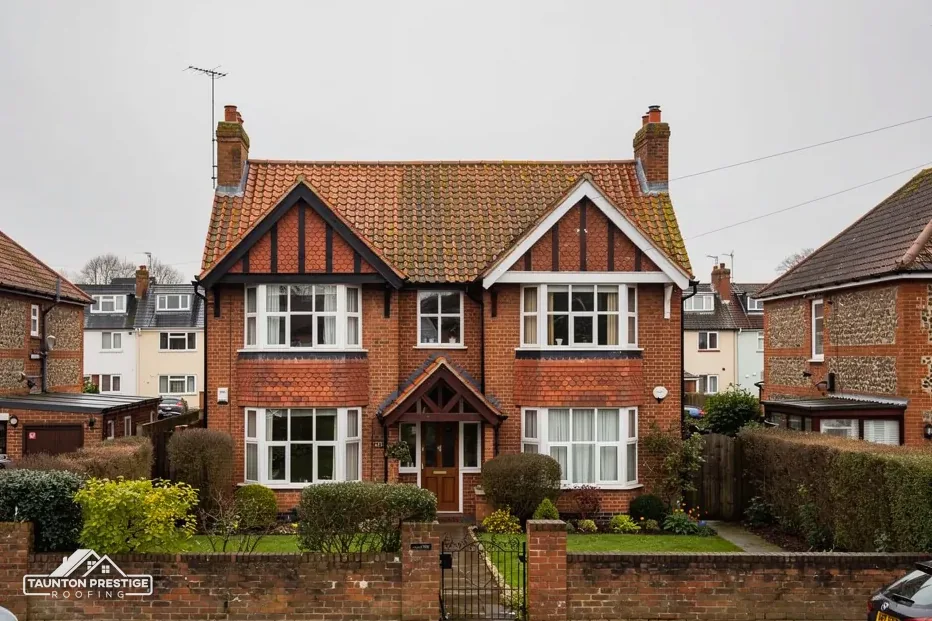
It reaches within about 0.75 km of the village centre, so ask Somerset Council whether your house falls inside it.
Street map of Pitminster with Corfe, Blagdon Hill, Angersleigh, Duddlestone marked around it, and Taunton.
Corfe lies just east of the village and Blagdon Hill to the south-west, while Duddlestone sits to the north-east, with Angersleigh further west and Trull to the north.
About 3 miles south of Taunton, Somerset Council (unitary).
A Pitminster roof, read in four parts
Four checks for a village with a medieval church and a National Landscape close by, covering the work involved and what sets the price.
Pitminster's church of St Andrew and St Mary is mentioned around 1150. The Somerset Historic Environment Record dates its tower and parts of the south arcade to about 1300, and a 19th-century restoration destroyed much of the ancient work. The church is listed Grade I, the Pitminster conservation area lies within about 0.75 km of the village centre, with 19 Historic England list entries inside 500 metres of it. Those designations decide who has to be asked before a roof changes, so they come first when we survey.
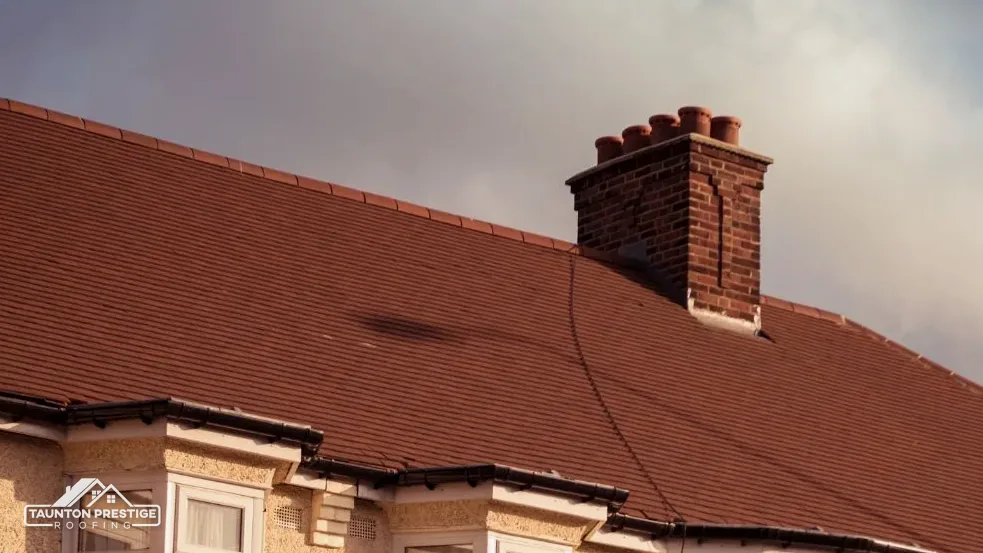
Renewing a covering like for like usually keeps the village looking as it did. Questions begin once something visible alters: another material, a new ridge profile, a roof window facing the lane, or a dormer. Our guide to planning permission for roof work covers the national rules, and Somerset Council's planners will confirm if your address sits inside the boundary and what needs an application there.
An Anglican building still in use goes through a faculty. Catholic, Methodist, United Reformed and Schedule 1 Baptist buildings answer to their own bodies, and closed churches or converted chapels turn to the council for listed building consent. The parochial church council or congregation holds the approval, and the roofer builds to what was granted. So for a church or a listed barn, we plan the job around that paperwork.
A listed house in the village keeps its ordinary permitted development rights, yet any work that changes its special character needs listed building consent as well. Our photos of each slope give an application an accurate picture of what is on the roof today.
Look for
A village of farmhouses and barns has plenty of roof space where birds and bats settle. Pitminster has a listed barn and outbuilding beside its farmhouse, and older roofs of every kind have gaps under ridge tiles, behind fascias and inside soffits, the boards that close the underside of the eaves. Wildlife law applies to any roof, whether it covers a barn or a bungalow, and the survey looks for signs before a start date is set.
Look for
What decides the price
Under section 1 of the Wildlife and Countryside Act 1981, nobody may intentionally take, damage or destroy a wild bird's nest during building or occupation. GOV.UK is clear that construction work is not a licensable purpose. If we find an active nest under the ridge, that stretch of the job waits. An old, empty nest is a different matter, and the survey tells the two apart.
GOV.UK lists a roof repair or replacement among jobs that can affect bats, and every bat species is fully protected by law, which covers the places where it breeds and rests. Section 9(4) of the same 1981 Act covers anyone who, intentionally or recklessly, troubles a roosting bat or closes off its route in, and the Habitats Regulations 2017 separately treat harm to a bat roost, meaning a breeding site or place of rest, as an offence. Where droppings or staining hint at a roost, work stops until proper advice is in hand. A roof inspection ahead of the repair is the lowest-cost moment to find out.
Old timber barns and stone outbuildings often need their ridge and hips re-bedded or fixed dry, and each of those jobs alters the gaps that bats and birds use. The written price describes how we plan for that, so nothing is a surprise on the day.
On the Environment Agency's flood map for planning, the mapped centre of Pitminster sits in Flood Zone 3. That map judges ground rather than buildings, and for your own house the right lookup is the GOV.UK service for long-term flood risk. The roof's own part is to pass rainwater to the drains cleanly, and where the ground around the walls is soft, the gutters, the downpipes and the gullies they empty into carry the load.
Rain with nowhere clean to go will find the weakest board on the house.
Overflow at one point is usually down to a blockage, a split joint or a run that has dropped out of line. Brett Martin's fitting guidance asks for a fall of 1mm for every 600mm of gutter, meaning one sagging bracket, out by only a few millimetres, can hold a pool of water. Gutters hang from the fascia, the board that runs the length of the eaves, and one soaked by months of overflow loses its grip on the brackets. We check the board, then the downpipe, then the gully at its foot, because a clear gutter that empties into a blocked drain still sends water down the wall. Cast-iron and aluminium runs get the same look as plastic ones, since the fall matters whatever the material.
Stains below the eaves and damp patches on an upstairs ceiling can come from either. A slipped slate or a failed valley, the trough formed where two slopes join, sheds water onto walls just as a leaking joint does. We trace the water back to its source before suggesting repairs, and our gutters, soffits and fascias page sets out the replacement options.
Leaves and moss collect in the same places year after year, so a run that has been cleared and re-aligned once is easy to keep working when the falls are right. If a section is past saving, we fit new lengths to the old line rather than hang them on a rotten board, and the price says which.
Blackdown Hills Area of Outstanding Natural Beauty became Blackdown Hills National Landscape in November 2023; the rename has no statutory force and changes nothing in law. Pitminster's own centre point lies just outside it, though roughly a third of a 1.5 km box centred on the village lies within the boundary. For some houses the protected landscape applies and for others only the conservation area does, and an address check settles which.
Ask before anything is drawn. The national position on dormers and roof windows is set out in our planning guide, Somerset Council's planners will advise for your own address, and a listed house needs listed building consent in addition.
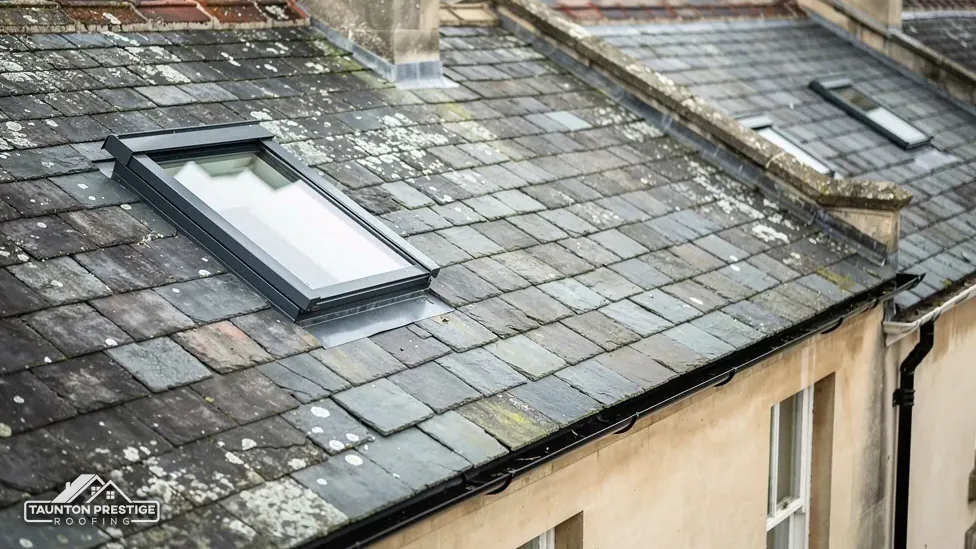
A rooflight, the glazed unit let into a flat roof, has a limit of 2.2 in Approved Document L (2021 edition). A roof window, the opening unit set into a pitched slope, must reach a U-value of 1.4, or a Band B rating from the Window Energy Rating scheme. A loft conversion adds the renovation figures: an existing roof worse than 0.35 is improved to 0.16, subject to feasibility and payback.
A roof window needs a properly trimmed opening: the rafters are framed round it and the underlay is lapped into the flashing, so water runs over the joint and not into it. Swapping a window in an existing opening is a smaller job than cutting a new one, and the price shows which you have.
We fit roof windows with flashings that suit the covering, and the written price states what the opening needs. Mention any listing, or a conservation area address, and the survey starts from that answer.
What decides the price
Walked the roof?
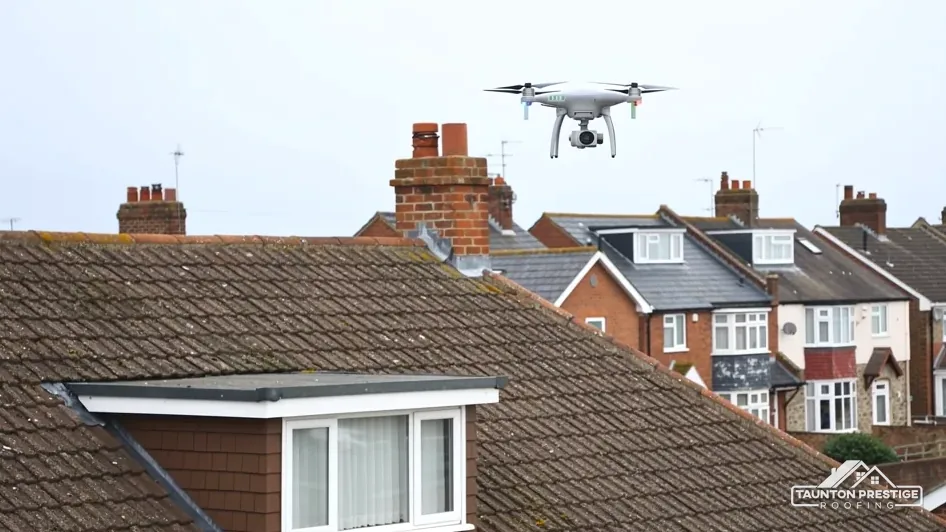
When you have read the checks, we walk the roof and show you the photos.
Check first. On GOV.UK, a roof repair or replacement is named as an activity that may affect bats, and every species of bat is fully protected. If we see them, work waits for proper advice, since troubling a roosting bat, or blocking its route in, intentionally or recklessly, breaks the law.
Repairs in matching materials go ahead as usual. The designation matters when something visible changes, and dormers are one example. Because only part of the area around the village lies inside the boundary, confirm your address with Somerset Council's planning team before ordering materials. Listed and conservation area houses carry their own extra rules on top.
Marley says high-powered jet washes are not recommended, since they can scuff slate or tile and wear down its life expectancy. A gentler clean with a suitable product, applied from a safe position, is kinder to the covering. HSE warns the public never to use biocides meant only for professional users, so leave those to a roofer.
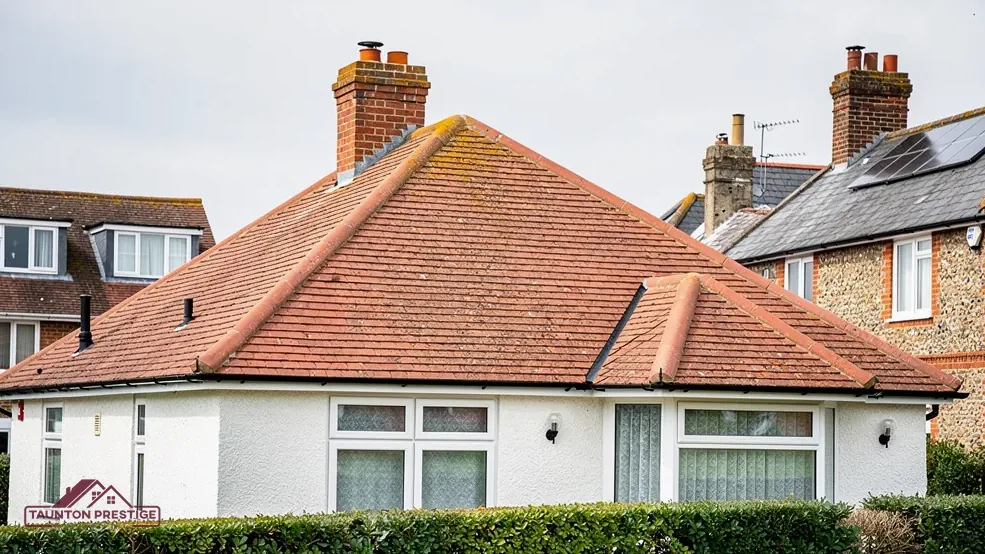
Look at why it is failing. A few slipped tiles on sound battens are a repair. Brittle underlay, rotten battens or fixings failing across a whole slope make a patchwork of repairs poor value. The survey separates the two, with photos of what we find, and the written price covers whichever job suits the roof.
Name your lane and describe what the roof is doing, then we book a visit.