Three listed entries
Within 500 metres of the centre the list holds two bridges and the churchyard's north gate.
A small Devon parish with three listed entries near its centre
Burlescombe is a Devon village of 974 residents, with three listed entries within 500 metres of its centre. Every roof gets a survey and photos ahead of any figure.
Within 500 metres of the centre the list holds two bridges and the churchyard's north gate.
The 2021 Census counted 974 usual residents in the civil parish, each household with its own roof to read.
Land within about 250 metres of the centre partly lies in Flood Zone 3 on the Environment Agency's planning map.
Street map of Burlescombe with Uffculme, Culmstock, Sampford Peverell, Rockwell Green marked around it, and Taunton.
Uffculme lies south of Burlescombe, Culmstock and Hemyock to the south-east, Sampford Peverell to the south-west, and Rockwell Green and Langford Budville to the north-east.
About 11 miles south-west of Taunton, Mid Devon District Council and Devon County Council.
Four checks for a Devon village roof
Which council answers your questions, what slipped tiles mean, how the flood map relates to gutters, and how scaffold is licensed on this side of the border.
Burlescombe is in Devon, and that changes who you call. Planning decisions here sit with Mid Devon District Council, while Devon County Council looks after the roads. Neither is Somerset Council, so Somerset's fees and rules for scaffold and planning do not apply to a Burlescombe address. The National Heritage List has three entries within 500 metres of the centre: Fossend Railway Bridge, Fossend Canal Bridge and the north gate of St Mary's churchyard with its wall, all Grade II. Houses further out may carry listings of their own, so the address is what settles it. We can tell you which questions to settle, but the answers come from the council, and it pays to ask them before a start date is fixed. A phone call to the right office at the beginning is far cheaper than a stop-work conversation halfway through a job.
Put the question to Mid Devon District Council's planning team with your full address. A neighbour's experience is a poor guide, because one house in a lane may be listed while the next is not, and a conservation area boundary can cut through a street. If either applies, putting back what was there is the simple route, and a change of covering needs a conversation first. Dormers and new roof windows are the usual surprises, so mention them early. Our planning permission for roof work page covers the national rules, which we do not repeat here.
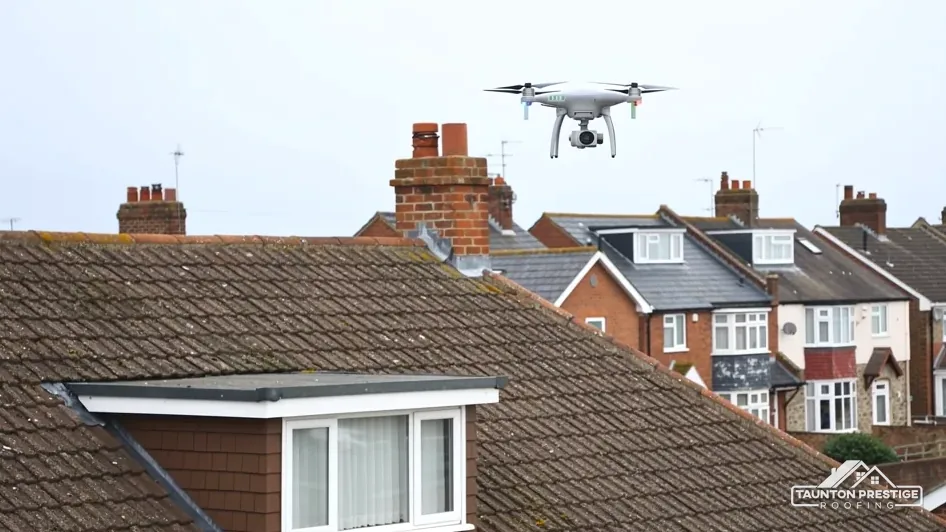
We survey the roof and write down what is on it: the covering, the ridge, the verges and the flashings. Each slope gets its own photos alongside the notes, so when you speak to the planning team you can describe the roof exactly and not from memory. A good record makes the council's answer quicker, and it gives any later repairer a starting point too.
Look for
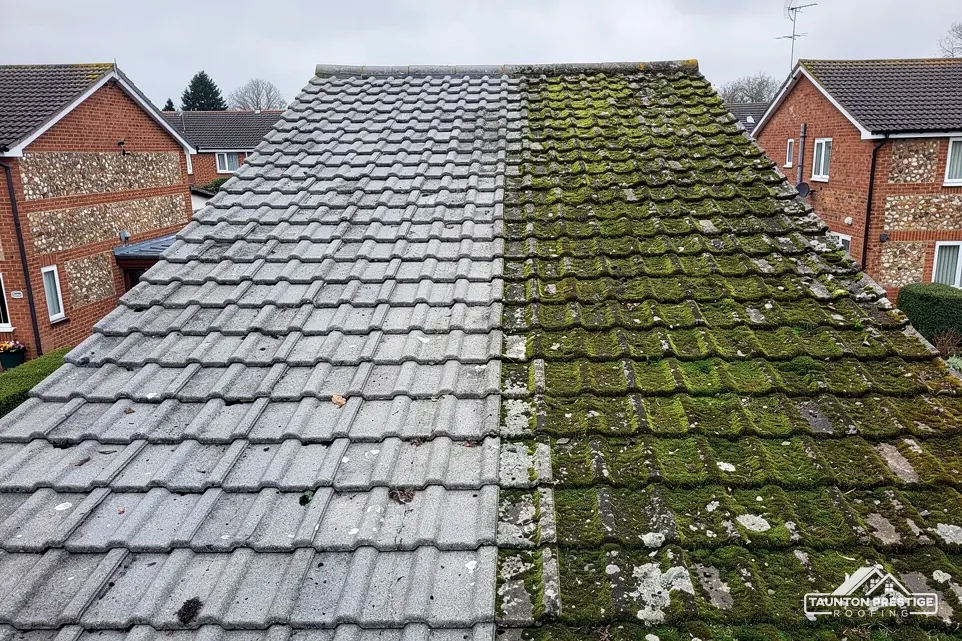
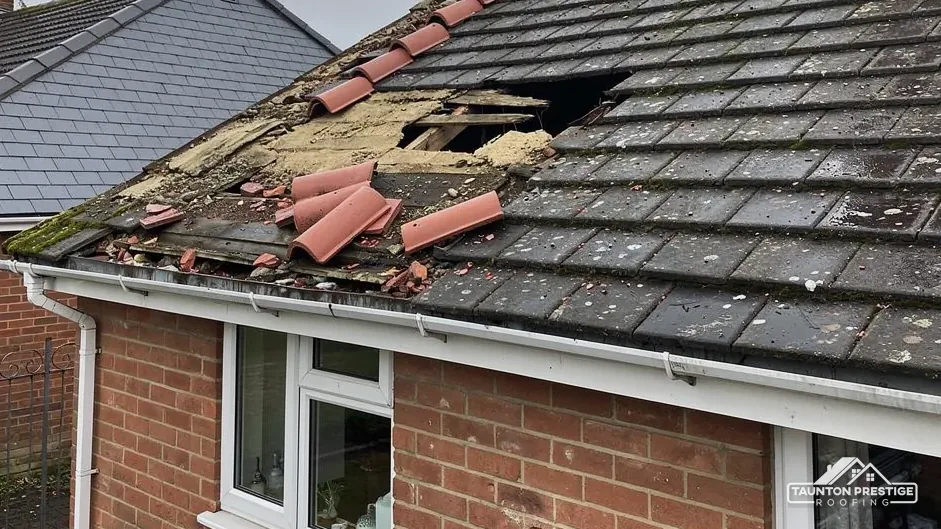
A tiled roof sheds water the way fish scales do: each tile overlaps the one below, and the fixings hold them to the battens, the timber strips running across the rafters. When one tile cracks, water finds its way down the gap to the underlay, the waterproof layer under the battens. Look from the garden for a tile that sits lower than its row, a pale scar where a piece has broken away, or a mossy patch on a slope that stays damp longer than the others. Binoculars from the lane show more than you would expect, and a phone photo zoomed in on the slope is a handy record to send us.
Look for
What decides the price
Marley puts the expected life of concrete roof tiles at around 60 years, with the warning that this is no guarantee. The BRE minimum of 60 years applies to clay tiles only, and for old peg tile that figure is described as not a reliable guide. So an age on its own settles nothing. What we look at is how many tiles are failing, whether the battens and underlay are sound, and whether the fixings are holding. We also lift a tile or two in the middle of the slope, where the nails and clips tell the story that the surface hides. A few isolated breaks are a repair; failure spread across a slope is a case for relaying it.
MyJobQuote gives a typical UK range of £150 to £200 for replacing five tiles and £200 to £275 for 10 to 20 tiles, and £3,000 to £8,000 for a full re-tile of around 80 square metres (all Oct 2026). Our pitched roofing page sets out the options in more detail, and the survey tells us which one fits.
Parts of the land within about 250 metres of the centre of Burlescombe lie in Flood Zone 3 on the Environment Agency's Flood Map for Planning. The map exists for planning decisions about land, so it tells you nothing about a particular roof or house. To see how your own address fares, put it into the GOV.UK flood risk checker. A roof has a more modest job: to get rain off the building and into the drains without delay, and that makes the gutters and downpipes matter more than usual where the ground is wet.
The flood map describes the ground around the house, and the gutters decide where the roof's water goes.
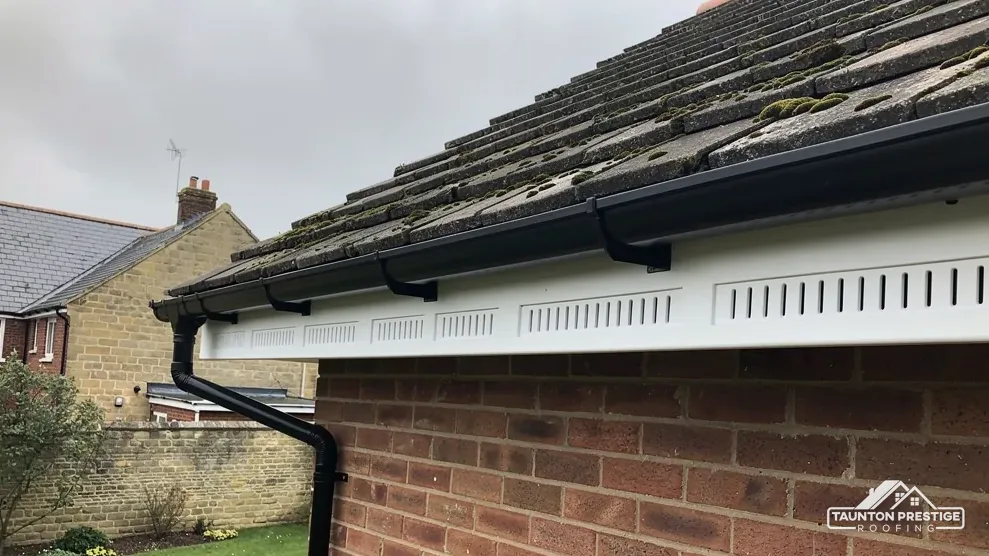
Into a gully or drain, not onto a path or against a wall. A downpipe that discharges at the foot of a wall soaks the masonry, and in wet ground the water has nowhere quick to go. We trace each pipe at the survey, noting where it ends and whether that end is clear. Brett Martin's guidance is a fall of 1mm for every 600mm of gutter, so a gutter that has sagged between brackets holds water instead of moving it on.
It rarely improves, and in wet weather the drip becomes a stream down the same patch of wall. A weeping joint wets the fascia, which is the board running along the eaves that the gutter hangs from, and over a few winters the timber goes soft. By then the repair has grown from a bead of sealant to a new board. Our gutters, soffits and fascias page explains when a joint can be resealed and when a run should be replaced. For replacing guttering, MyJobQuote's typical UK range runs from about £1,000 to £1,600 (Oct 2026), and the number of corners and the height of the eaves push a quote one way or the other.
Where a frame has to go up on the road or pavement in Burlescombe, the licence comes from Devon County Council. Under Devon County Council's rules the paperwork is lodged by the scaffold firm, acting for you, so the scaffolder files it, and we keep you informed of the date it is granted. Devon asks for a minimum of 10 working days' notice, the licence costs £158.00, and it runs for the works dates with a maximum of 12 weeks. An extension or amendment is £100.00. A frame standing on a private drive or a lawn is off the highway altogether.
A joint service run by North Devon Council and Mid Devon District Council provides it for Burlescombe, and its own contact details are on the Mid Devon website. The national test for a re-roof still applies: the Planning Portal says you do not normally need to apply to building control where less than 25 per cent of the building envelope and less than 50 per cent of the roof is touched. Any replacement 15 per cent heavier or more needs Building Regulations approval, and the Planning Portal advises checking the structure with an engineer or surveyor.
By the area, the covering, what lies under it and how we reach it. Standard VAT is 20 per cent on repairs and re-roofing, so read any quote you receive for a line on VAT and on scaffolding, and keep it in writing. The standard rate is on the GOV.UK VAT rates page, and we are happy to talk through how it applies to your job. The quote you get from us after the survey is one total price for the whole job, set out in writing. Send your Burlescombe address and what you have seen, and after the survey comes the one written price for the job.
What decides the price
Walked the roof?
When you have read the checks, we walk the roof and show you the photos.
Yes, when the damage is isolated and the battens and underlay beneath are sound. A broken tile is lifted out and a matching one fixed in its place. We check the rows around it first, because a run of loose tiles points to failing fixings, and then a patch buys little. Matching is the harder part, and can mean reclaimed tiles.
Ask Mid Devon District Council's planning team, giving your full address. The three entries within 500 metres of the village centre are two bridges and a churchyard gate, but houses elsewhere in the parish can be listed, and a listing changes the consent route, so it is worth confirming before any roof work is planned or materials are ordered.
Not the roof itself. Flood Zone 3 is a planning map of land, and GOV.UK's long-term flood risk checker will give a result for your address. Where the ground is wet, we pay more attention to gutters, downpipes and where the water ends up, since the roof's job is to get rain away quickly.
Usually, yes. A contract made at your home gives a 14-day cancellation right, but that right does not cover an urgent repair visit you specifically requested. If you are unsure of your position, the Citizens Advice consumer helpline is on 0808 223 1133. Ask for the cancellation terms in writing before you sign anything.
Tell us the lane and what you have noticed up top, and a survey visit will be offered.