St John's, consecrated 1259
Early English in red sandstone conglomerate with Beerstone and Hamstone detail, and listed Grade I since 5 April 1966.
A village split by the Grand Western Canal, with a 1259 church
Sampford Peverell sits either side of the Grand Western Canal in Mid Devon, with a conservation area designated in March 1990. Each roof is surveyed, then priced.
Early English in red sandstone conglomerate with Beerstone and Hamstone detail, and listed Grade I since 5 April 1966.
A priest's house of the early 16th century, built of red sandstone ashlar and roofed in slate.
6, 10 and 12 Higher Town, plastered stone and cob, were once thatched and are slated now.
Street map of Sampford Peverell with Halberton, Willand, Uffculme, Burlescombe marked around it, and Taunton.
Halberton lies to the south-west and Willand to the south, with Uffculme to the south-east and Burlescombe to the north-east of Sampford Peverell.
About 13 miles south-west of Taunton, Mid Devon District Council and Devon County Council.
Four checks beside the canal
Four checks for a Mid Devon house: the conservation area, slate on old walls, water from above and below, and Devon's own rules.
Mid Devon District Council designated the Sampford Peverell conservation area in March 1990. Its 2008 appraisal describes a village in two halves, Higher Town and Lower Town, divided by the Grand Western Canal, whose arrival called for a bridge to carry the turnpike road across. The National Heritage List has 16 entries within 500 metres of the centre, among them 19-23 Lower Town, 6, 10 and 12 Higher Town, and Challis House, all Grade II. Devon addresses fall to the district council for planning, not to Somerset, so whenever a consent question comes up we send you to Mid Devon District Council's planning team.
A repair restores the roof as it stood, whatever it was made of. A change alters the look: another covering, a window set into the slope facing the road, a ridge in a new style. In a conservation area the change is where you ask first. The detail sits in our guide to planning permission for roof work, which we link instead of repeating. Photographs from the survey show the planning officer exactly which slope you mean, and that saves a round of letters. If the answer is that consent is needed, you will know before a single tile has been ordered.
Yes. 19-23 Lower Town was listed Grade II only on 11 March 2022, so it is a recent addition to the list. A listed house keeps the permitted development rights any house has, and it also needs listed building consent where work would change its special character. St John the Baptist's, consecrated in 1259 and listed Grade I, holds Church of England services, which places its roof inside the faculty system and outside the council's consent process.
Look for
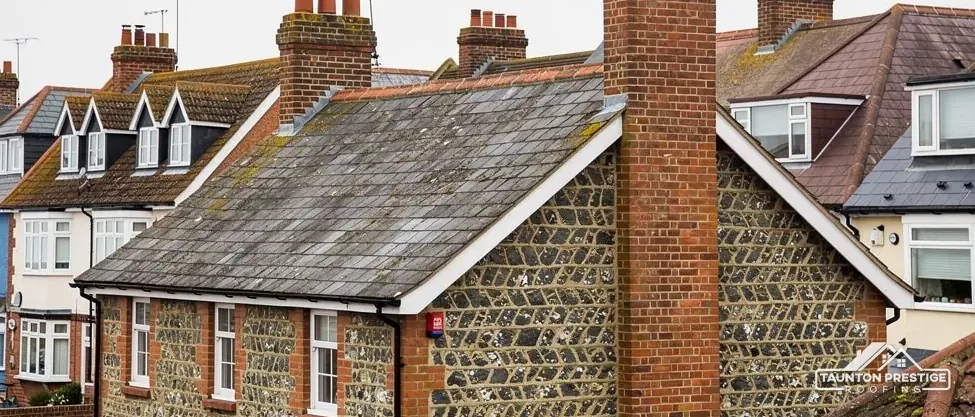
The cottages at 6, 10 and 12 Higher Town, once a single house of plastered stone and cob, were originally thatched and now carry slate. The Old Rectory, a Grade II* priest's house of the early 16th century, wears a slate roof over red sandstone ashlar. That history matters when a slate roof tires. A change of covering on an old frame raises fresh questions about pitch, weight and fixings, which is why we look at the structure before we put a price on the covering.
The Old Rectory shows what a good slate roof can do on a stone building: it has covered a house of the early 16th century and still reads as part of the village. A cottage roof will not be as old, but the same logic applies. Keep what works, repair what fails, and match with care wherever the street can see it.
What decides the price
Cupa reads BS 5534 as indicating a minimum pitch of 20 degrees for natural slate, and on anything shallower than 25 degrees it says hooks are the wrong fixing. On a slope close to those limits a roofer has to choose the headlap, the overlap between courses, and the fixing method with care. A low pitch can make a slate roof look as if the slates are at fault when the real limit is the design. A shallow slope is a design fact, not a defect, and no amount of re-fixing changes it.
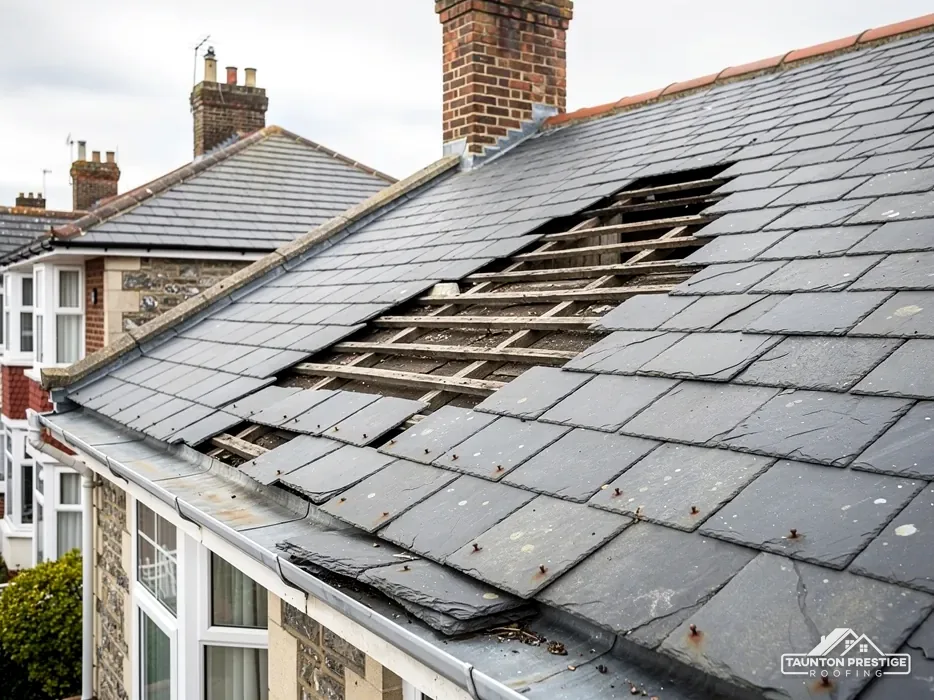
Slipped slates go back on with new fixings, or a matching slate takes their place, and failed nails or hooks are one reason slates slide. If many have gone, the slope may need stripping and relaying on fresh battens, the cross-timbers under the courses. Cob walls dislike water, so we also check that the eaves, the gutters and the base of the wall move rain away from them. Heavier coverings are checked first, because Building Regulations approval applies once a new covering adds at least 15 per cent to the weight. Our slate roofing page shows how the work is priced.
The Environment Agency layer on planning.data.gov.uk puts Flood Zone 3 within about 250 metres of the centre of Sampford Peverell. It is a planning layer for the land, and it tells you nothing about one roof. To see the picture at your own address, use GOV.UK's flood risk checker. The roof's contribution is plainer: shed the rain quickly and send it where it is meant to go, which means the gutters, the downpipes and the gully at the bottom.
Flood zones are drawn on maps, but the gutter that fails is the one you can see.
Check three things: blockages, open joints and loose brackets. Gutters need a slight fall to the outlet, and 1mm in every 600mm is the figure in Brett Martin's fitting guidance, so even a small dip lets water stand and soak the fascia behind. A gutter that has overflowed for a few winters can leave a green streak on the wall and a soft board at the eaves. Our gutters, soffits and fascias page lays out the repairs.
Inside the house, the loft gives the earliest warning. After heavy rain, look at the felt or boards along the eaves for dark staining, and at the ceilings below for a tide-mark that grows. Both tell you that water is finding a way past the gutter line, which is a cheaper problem to fix in autumn than in a January downpour. A downpipe should end over a gully or a soakaway, not against a wall, and a spill beside the wall keeps the base of it wet.
Carefully, and by hand. Marley advises against powerful water jets on slate or tile, as the force can mar the surface and cut expected life considerably. The survey tells you whether the moss is only a surface matter or a sign that tiles are failing underneath, and gentler hand methods are what our roof cleaning and moss removal service uses instead.
Sampford Peverell is in Devon, so the rules differ from Somerset's. Section 169 of the Highways Act 1980 puts scaffold on the highway under a licence, and here the issuing body is Devon County Council. Its applications come from the scaffolding company, filing for its customer, with at least 10 working days' notice. The licence costs £158.00 and follows the dates of the work, to a ceiling of 12 weeks, and an extension or amendment costs £100.00. The scaffolder and ourselves divide the licence work, so the date you are given already allows for the wait.
What decides the price
Mid Devon District Council links to its joint building control service with North Devon. Under the Planning Portal's test, building control is normally not involved while the work touches under 25 per cent of the building envelope and under 50 per cent of the roof. Separately, approval is needed for any covering 15 per cent or more heavier, whatever the area. Our roof replacement page explains when a whole roof is the sensible route.
It leaves you knowing what the roof is covered with, what has failed and what the job needs. Photographs of the roof itself are included, along with a single written total for the work. The site is kept tidy, waste goes with us, and each day's plan is explained before work starts. A roof near the canal gets no special treatment from us, only the same close reading as any other. Send your Sampford Peverell address and the first thing you noticed, and a survey date follows.
Walked the roof?
When you have read the checks, we walk the roof and show you the photos.
Usually, if the pitch and structure suit. Cupa's reading of BS 5534 is 20 degrees at the least for natural slate, with hooks unsuited to anything below 25. We check both at the survey. For a listed cottage, or one inside the conservation area, put the question to Mid Devon District Council's planning team first.
St John's is Grade I, consecrated in 1259, and Church of England worship continues there, so its repairs go through the faculty system, not listed building consent from Mid Devon District Council. The parish makes that application, and the roofer works only to the specification which comes back approved. Plan for the approval to take time.
Under Devon County Council's rules the scaffolder makes the application on the customer's behalf, and we coordinate it. The licence costs £158.00, needs at least 10 working days' notice and can run for up to 12 weeks. Your start date already allows for that wait.
Yes, should the work change its special character. 19-23 Lower Town was first listed Grade II on 11 March 2022. Listed houses keep ordinary permitted development rights, but listed building consent from Mid Devon District Council covers changes to their character. Like-for-like repairs are the easy case; ask before anything else.
Name the Sampford Peverell roof worrying you, and we will book a survey and send photos once it is done.