All Saints' red sandstone church
Designed by J. H. Spencer in 1888, with a south porch tower added in 1908 and brickwork showing inside.
A red sandstone church, Exeter Road listings and an old woolroom
Rockwell Green lies on the Exeter Road beside Wellington, with a church of 1888 and a former woolroom sold for housing in 2003. Every roof is surveyed first.
Designed by J. H. Spencer in 1888, with a south porch tower added in 1908 and brickwork showing inside.
31 and 32 Exeter Road are Grade II, as are 79 to 82 Rockwell Green and both of a pair of water towers.
Thought to be the original woolroom on Exeter Road, it was sold for housing development in 2003.
Street map of Rockwell Green with Wellington, Langford Budville, East Nynehead, Blackmoor marked around it, and Taunton.
Wellington lies just to the north-east, with East Nynehead beyond it, Langford Budville to the north-west, and Blackmoor and West Buckland to the east.
About 7 miles south-west of Taunton, Somerset Council (unitary).
Along the Exeter Road, one roof at a time
Four places to look on a village house, extension or church building, and the effect each finding has on the quote.
All Saints' church was designed by J. H. Spencer in 1888 in the Early English style, with a red sandstone exterior and exposed brickwork inside. A south porch tower followed in 1908. Buildings from that period reward a close look at their joints: the lead where a tower roof meets a wall, the gutters tucked behind any parapet, the ridge and the pointing between the stones. Sandstone takes water into its face over many winters, so a damp patch on a wall below a roof joint deserves an early look.
All Saints' belongs to the Church of England and holds a Sunday Eucharist each week, so roof work there is authorised through the faculty system, which the parish applies for, and not through the council. Catholic, Methodist and United Reformed churches in use have procedures of their own, while a redundant church or a chapel now lived in needs the council's listed building consent where listed. Once the parish has its faculty, the roofer builds to that approved scheme and to nothing else.
Mostly the flashing, the coping stones on top of the wall, the gutter, the downpipe and the stonework underneath for tide marks. Towers attract nesting birds as well. Under section 1 of the Wildlife and Countryside Act 1981 it is an offence for anyone to intentionally damage or destroy a nest in use, so the start date waits for the birds.
Our survey photographs each of those joints from a ladder or from inside the tower, so that a church council can read the roof for itself before it commits to a plan. You also get a few written lines on what was found, ready to pass to an architect or the parish committee.
Look for
Four National Heritage List entries fall inside 500 metres of the village centre. 31 and 32 Exeter Road have been Grade II since 1 July 1976, and 79 to 82 Rockwell Green and both of a pair of water towers carry the same grade. Listing is applied building by building, so a neighbour's entry does not list yours, but it is worth asking about before anyone touches the roof. Raise it at the survey and the answer goes in the report.
What decides the price
The national dataset names Nynehead and Wellington as the closest conservation areas, within about 2.5 km of the village point, and does not place the point inside either. Somerset Council is the body that can confirm the position for your address. It also lists an Article 4 direction for Wellington, so check with its planning team whether that direction applies to your street and what it includes. Our guide to conservation areas around Taunton sets out what to ask.
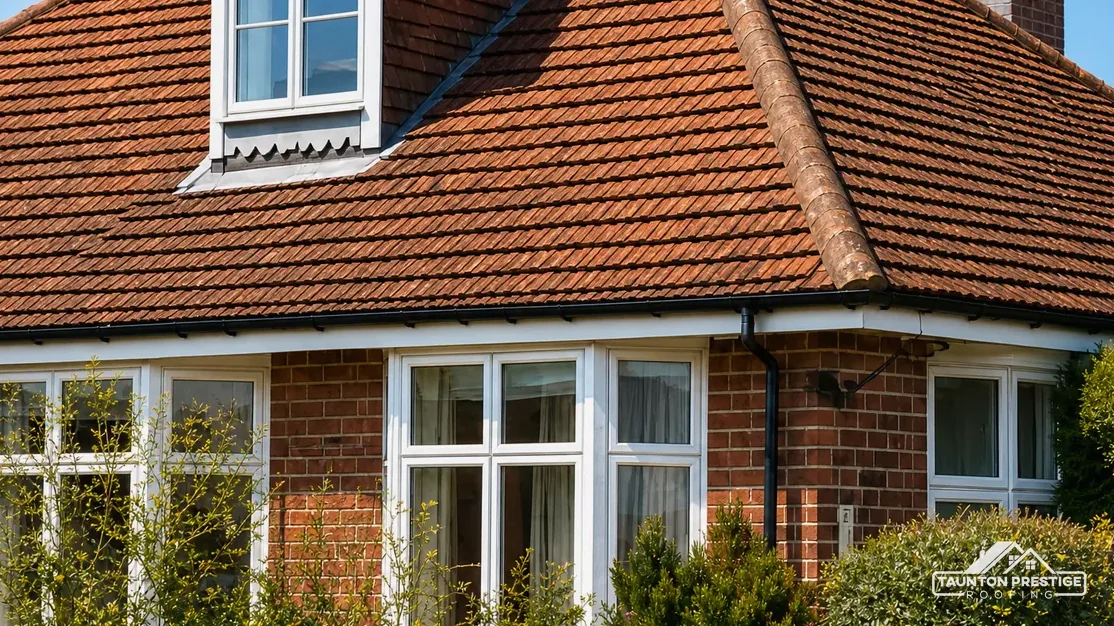
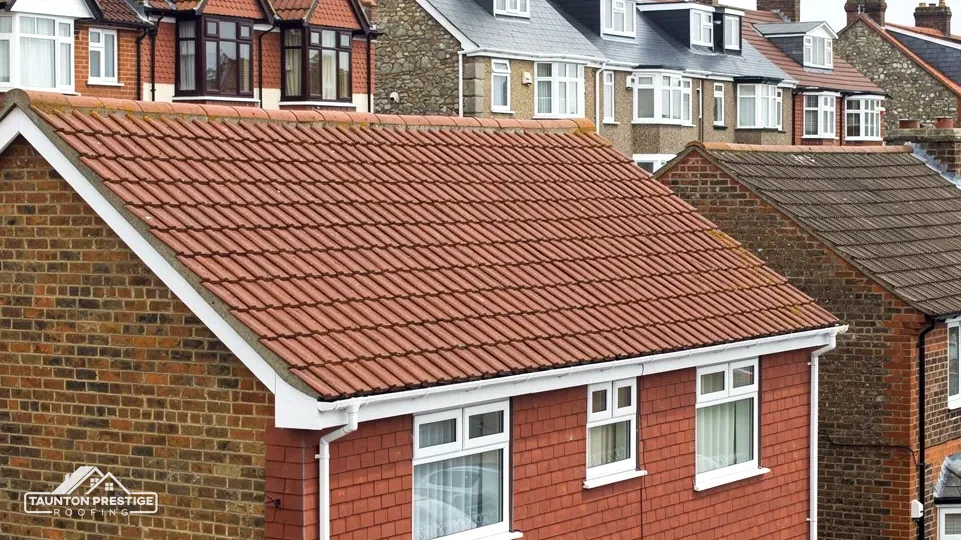
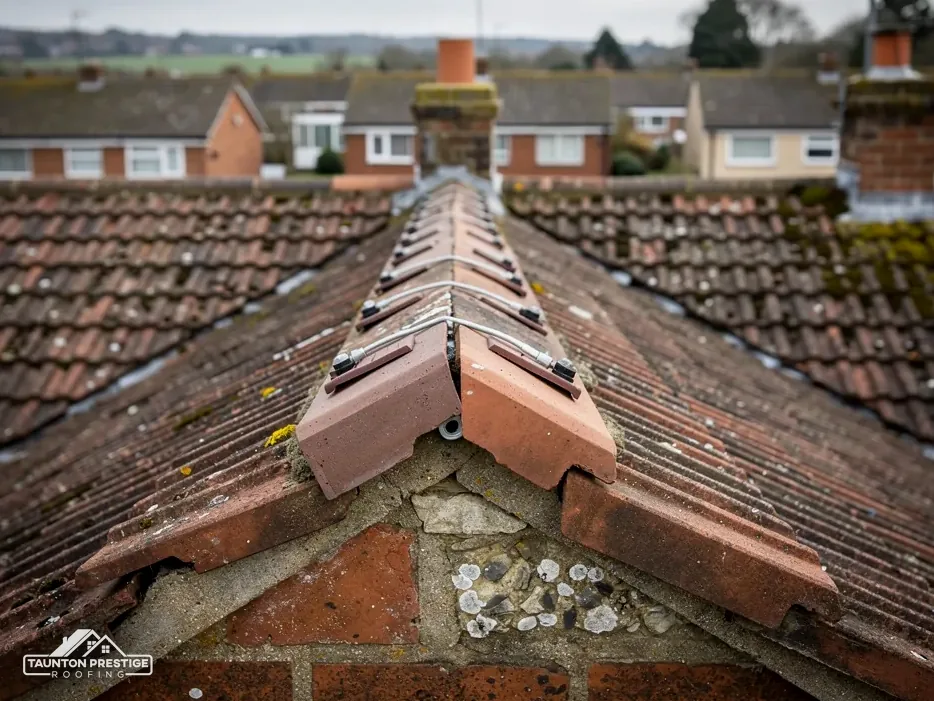
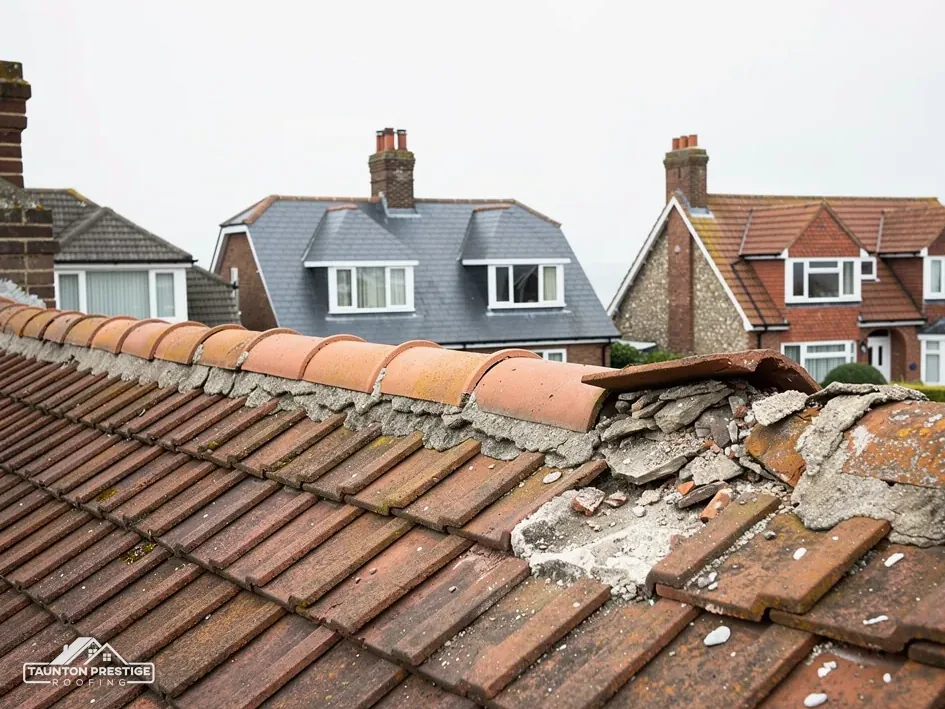
Along the apex, a line of capping tiles seals the meeting of the two slopes. Marley says the 2014 revision of BS 5534 made it clear that mortar alone cannot be trusted to hold the capping on ridges and hips, which is why a bedded ridge also needs a mechanical fixing. That standard guides good practice without being law, and mortar is still allowed. It simply should not work alone. On a listed house the colour and profile of the new ridge matter as much as the fixing, so you are shown samples before anything is ordered. A mismatched ridge is the first thing a passer-by notices on a street of older houses.
For wider repair and re-laying work, our pitched roofing page is the place to begin.
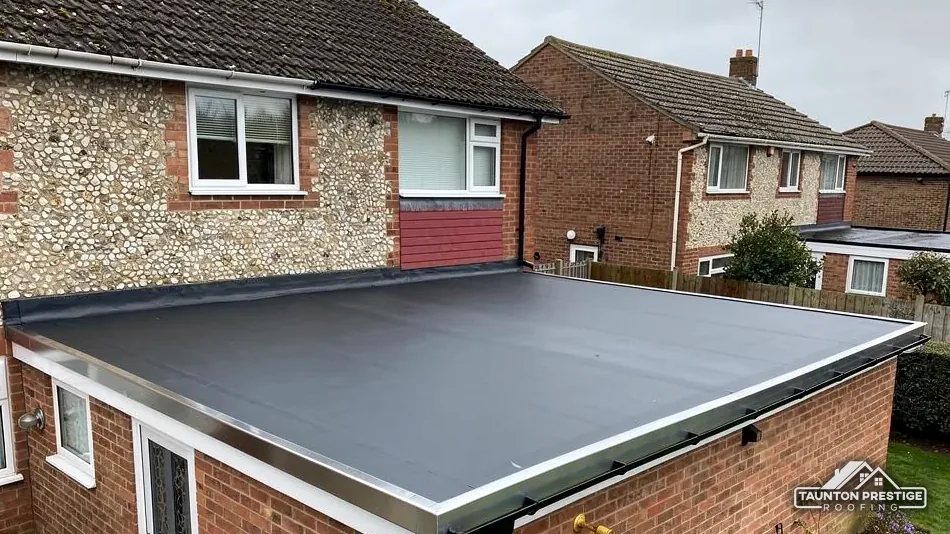
Flat roofs sit on porches, bays, garages and rear extensions of houses of every age, in Rockwell Green as anywhere. The Elworthy woolroom site was sold for housing in 2003, and a newer or converted building anywhere in the village deserves a look from the same angle, because rain landing on a flat roof has one way off it and that route has to stay open. A single leaf-choked outlet can undo a good membrane within a winter.
Rain has to leave a flat roof somewhere, and the fall decides where it goes.
Rain needs a way off, so a flat roof is built with a slight fall towards its outlet. BS 6229:2025 sets a minimum finished fall of 1:80, and IKO suggests aiming for 1:40 on the drawing so that the finished roof still clears. A puddle that stays long after the rain stopped tells us the slope has gone, the drain is clogged or the boards underneath have dipped. The covering suffers first, then the ceiling beneath.
EPDM comes as one large rubber sheet, and it is given 20 to 30 years by GreenSpec and 30 to 50 years by Less. GRP is fibreglass and resin cast over the deck, and Less puts it at 25 to 40 years. Torch-on felt is the shortest-lived at 10 to 20 years, again according to Less. These are published ranges and never promises. Our flat roofing page explains which covering suits which job, and the survey checks the deck before any covering is chosen.
If the leak proves to be one split at a lap, a patch can be the sensible buy, and you will hear that from us before we mention a full recover. A flat roof does not always need replacing outright; sometimes the failure is confined to one corner while the remainder is still good.
The Environment Agency's flood-zone mapping shows Flood Zone 3 within about 250 metres of the village point. That planning map deals with ground, and says nothing about the condition of any roof. For a single address, use GOV.UK's long-term flood risk service. In wet weather a roof's task is simpler: send water briskly to the drains.
What decides the price
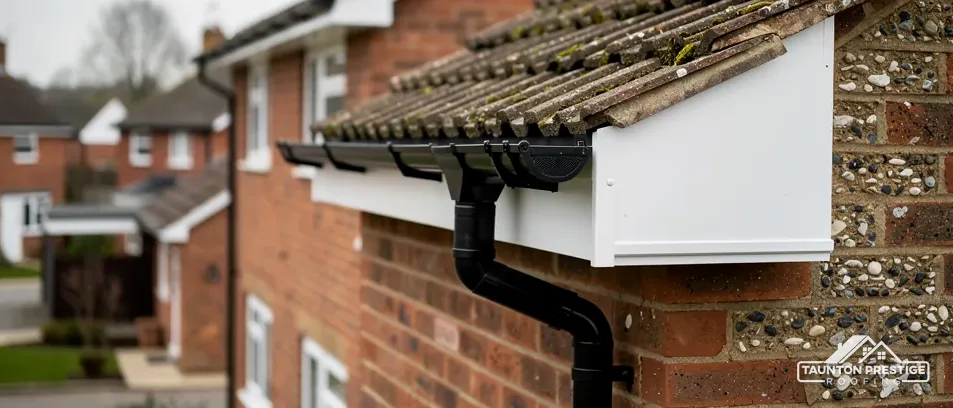
The usual suspects are leaves, a joint that has come apart, or a run that no longer slopes. Brett Martin gives 1mm for every 600mm as a fitting fall, so a single dropped bracket can leave water lying. The fascia is a board running beneath the lowest tiles, and the gutter brackets are screwed to it; the soffit closes off the underside of the eaves. Spill that soaks the fascia for a few seasons softens the timber, and the brackets lose their bite.
Any scaffold standing in the footway or carriageway requires a licence under the Highways Act 1980, section 169. The village used to be in Somerset West and Taunton, and the licensing body is now Somerset Council, which wants the appointed contractor to apply, charges £124.60 per 28-day period (April 2026) and asks for 10 working days of notice. Scaffold that stays on your drive or in your garden does not count as highway.
Somerset Building Control, on 0300 303 7790, covers the area. For a new covering the Planning Portal's test applies: with under 25 per cent of the building envelope and under 50 per cent of the roof involved, an application is not usually required.
When the survey is done, photographs of your own roof arrive with the written price, which is one total for the whole job. Tell us the house and what looks wrong from the pavement, and we will agree a survey date.
Walked the roof?
When you have read the checks, we walk the roof and show you the photos.
Not by itself. Listing applies to each building on the list, so a neighbour's entry does not list yours. Look for your house on the heritage list yourself, and put any conservation area question to Somerset Council's planning team. Where your house is listed, swapping the material or ridge style needs consent first.
The national dataset names Wellington and Nynehead as the nearest areas and does not place the village point inside either. Only Somerset Council can say for your address. The council should hear about any work that changes how the roof looks, particularly a new covering, a dormer, or a roof window on the side facing the street.
Not while the nest is in use. Anyone who intentionally harms an active nest commits an offence under section 1 of the Wildlife and Countryside Act 1981. The survey looks along the eaves, then we arrange the gutter swap for after the birds have finished, and the new run goes up once the nest is empty.
Sometimes. Marley cautions that powerful jets abrade slate and tile and cut short its working life, so we brush and treat instead. HSE also tells householders to leave professional-only biocides alone. The survey shows whether brushing, a treatment or a repair is the better route for your moss.
Tell us the house and what looks wrong from the pavement, and we will book the survey in.