St Andrew's Grade II* church
Listed Grade II* on 8 May 1967 and in Church of England use, so roof repairs go by faculty.
A Grade II* church and inn inside the Blackdown Hills National Landscape
Chardstock lies inside the Blackdown Hills National Landscape, with a conservation area and 22 list entries within 500 metres of its centre. Every roof is surveyed before it is priced.
Listed Grade II* on 8 May 1967 and in Church of England use, so roof repairs go by faculty.
The George public house and its outbuilding are listed Grade II*, which makes roof work there a listed-building matter.
Chardstock lies inside the Blackdown Hills National Landscape, which was an area of outstanding natural beauty until the 2023 rename.
Street map of Chardstock with Tatworth, South Chard, Chard, Axminster marked around it, and Taunton.
Tatworth lies to the north-east and South Chard to the east, with Chard to the north and Axminster to the south of Chardstock.
About 14 miles south-east of Taunton, East Devon District Council and Devon County Council.
Four checks in the Blackdown Hills
Four checks for a Devon village on the Somerset border: protected-landscape rules, a listed inn, roof windows and Devon's own paperwork.
Chardstock sits inside the Blackdown Hills National Landscape. The planning.data.gov.uk boundary data shows that around two-thirds of a 1.5 km square centred on the village falls within it, and a conservation area boundary lies within about 0.75 km of the centre. The National Heritage List has 22 entries within 500 metres. Planning here is handled by East Devon District Council, with Devon County Council as the highway authority. Roof work in the village sits among several layers of protection, so we map them for your address at the survey.
The practical effect is time. A question raised with the council early gets its answer before the roof is stripped, not after. Hill-country sites add one more factor: a steep drive or a narrow lane decides whether a job is reached by ladder, by tower or by scaffold, and that is settled on the day of the survey.
No. In November 2023, alongside every other AONB in England, the Blackdown Hills area took the name Blackdown Hills National Landscape. GOV.UK guidance describes the new name as non-statutory, and the law itself still says AONB in full. What counts for a homeowner is the same as before: protected landscapes and conservation areas narrow the changes that can be made without an application.
Ask East Devon District Council's planning team three things: is your address in the conservation area, does the house carry a listing, and is the change you want a repair or an alteration? Our guide to planning permission for roof work sets out the national rules in full. Matching what is there is the simple case. Swapping the covering, changing the ridge or cutting openings into the slope are the points to raise. The survey photos give the officer something to look at.
Look for
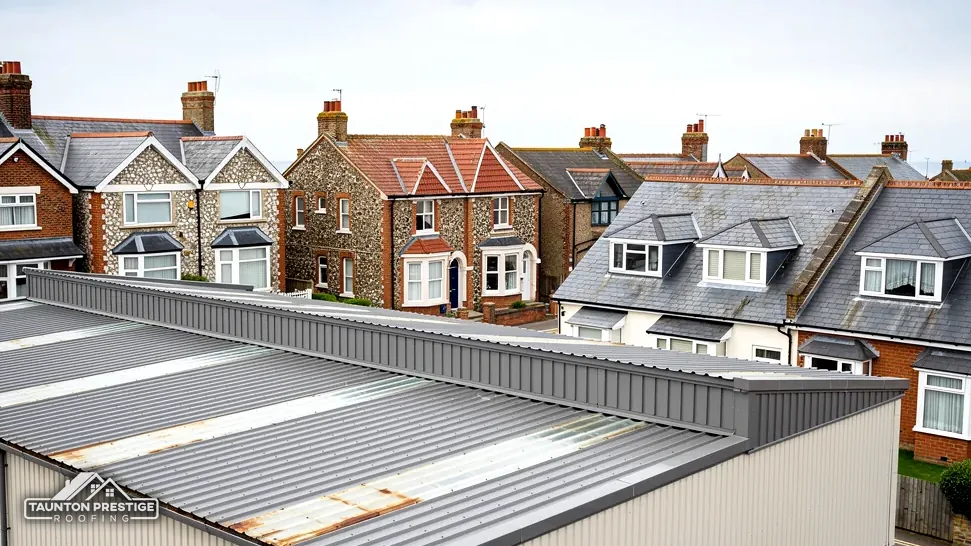
The George public house, with its outbuilding adjoining to the north-east, is listed Grade II*. A roof like that carries two sets of concerns at once: the heritage of the building and the needs of a business that has to go on trading. Shops, pubs and workshops share the same difficulty. Access, noise and customer safety all shape how and when the work happens.
A pub also has more holes in its roof than a house does, which is part of why its survey takes longer. Chimney stacks, kitchen extract ducts and cellar vents each pierce the covering, and each is a place where water can find a way in. The survey follows every one of them, and a flashing that looks dry from the road can be failing at the back.
What decides the price
Any work that would affect the special character of a listed building needs listed building consent from the local planning authority, East Devon District Council here, on top of any planning permission that may be needed. Like-for-like repairs are the simplest case, and a new covering is not. A sound survey record of what is up there, slope by slope, is what a consent officer wants to see before any decision.
Often it can, if the work is planned around opening hours and the scaffold leaves a safe route for customers. We talk through that at the survey and set out the access plan with the single written price. Commercial roofs vary widely, from pitched slate over a bar to a flat deck above the kitchen, so our commercial roofing page describes how we approach them. Our roof inspections service is a good first step when the question is only what condition the roof is in.
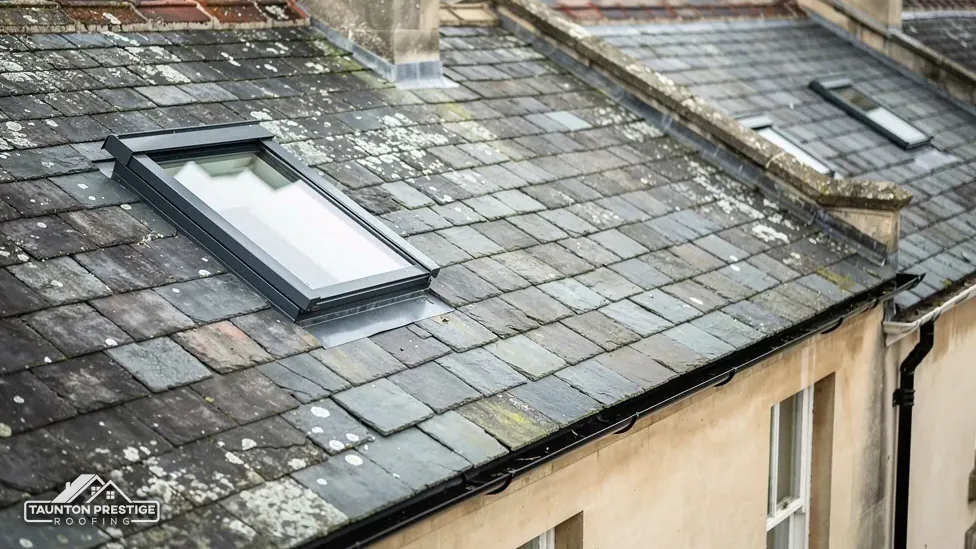
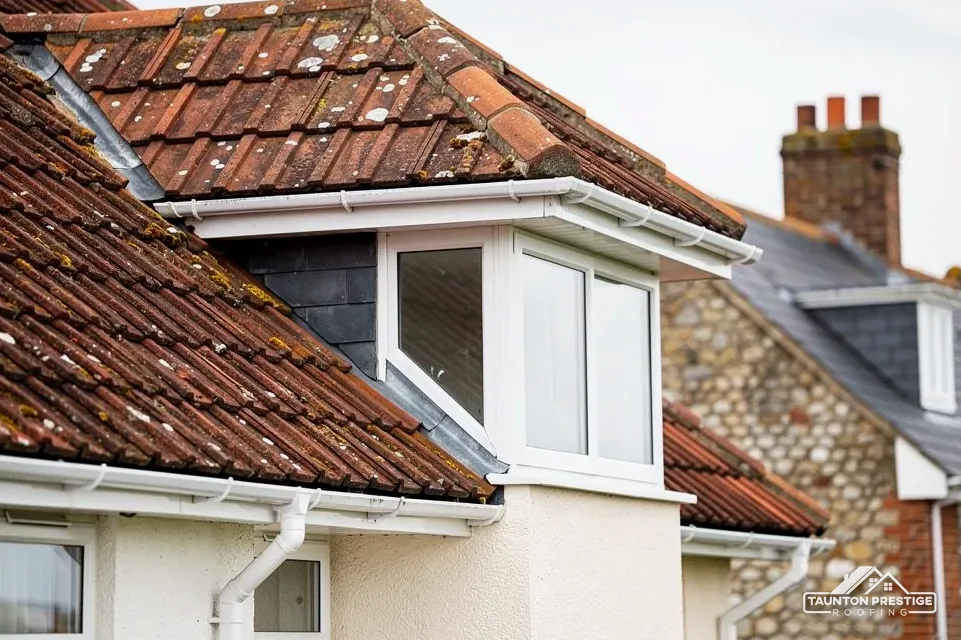
A roof window set into a loft slope can turn a dark storage space into a usable room, and in Chardstock it can also raise questions. The village lies in a conservation area and a National Landscape. A window on the slope facing the street is the sort of change that deserves a conversation with East Devon District Council before anything is ordered.
A roof window brings in daylight, and in a protected village it also brings in the planning team.
Approved Document L, Table 4.2, gives roof windows a figure of 1.4 or Window Energy Rating Band B minimum, and rooflights, the flat glazed units, a separate figure of 2.2. The two are not interchangeable, so a supplier's quote for a rooflight does not answer the question for a roof window. If you are converting a loft, the renovation figures differ again: a threshold of 0.35, upgraded to 0.16, and the best that is feasible where that is not practical.
Turning the roof space of a house with two storeys into a room normally means a protected stair, although Approved Document B also allows alternatives, such as sprinkler protection to the open-plan areas. An escape window counts only for storeys within 4.5 m of the ground, with an openable area of at least 0.33 m2 and a clear height and width of 450 mm. These are matters for building control, and we raise them at the survey so that the plan for the roof and the plan for the stairs agree.
MyJobQuote gives a typical UK mid-range price of £1,100 for a roof window, and around £100 less for a straightforward swap (Sep 2026). Roof, flashing and finishing inside change the total. A new opening in a slope needs a new frame and flashings, and we explain on our roof window installation page what the survey checks for.
Chardstock is in Devon, so scaffold on the highway is licensed by Devon County Council under section 169 of the Highways Act 1980. Devon County Council wants every application filed by the scaffolding firm for its customer, and it needs a minimum of 10 working days' notice to process one. A licence costs £158.00 and runs for the works dates, to a maximum of 12 weeks. An emergency application, with under 10 working days' notice, costs £238.00, and a further charge of £103.95 applies if a site visit takes place.
For East Devon addresses, ask your building control body before work starts on a larger job. On the Planning Portal's test, building control is normally not needed if the work stays under 25 per cent of the building envelope and under 50 per cent of the roof. A covering weighing at least 15 per cent more needs approval, and the Planning Portal says to involve a structural engineer or surveyor beforehand.
From the survey. You see photos of your own roof, we explain what each job involves, and one written price follows for the whole piece of work. Waste leaves the site with us. Send your Chardstock address and a note about the roof, and we will fix a date. Photos of every slope reach you after the visit, so that any talk about the work begins from the roof as it actually stands.
If water is already coming in, we make the roof safe first. A temporary repair from a ladder can avoid the need for an emergency scaffold application, and that matters in Devon, where an application with under 10 working days' notice costs more than a standard one. The permanent repair is planned and priced afterwards, once you have seen the photos and talked through the choices with us.
What decides the price
Walked the roof?
When you have read the checks, we walk the roof and show you the photos.
Possibly, but ask first. The village lies in a conservation area and inside the Blackdown Hills National Landscape, and a window facing the street changes the look of the roof. Put the question to East Devon District Council's planning team with photos of the slope. The window itself must meet 1.4 or Window Energy Rating Band B.
St Andrew's is listed Grade II* and is a working Church of England parish church, with regular services listed on the Church of England's A Church Near You directory. That puts its roof under the faculty system, which the parish applies for, and not under the council's listed building consent. The roofer then works to whatever the faculty approves.
If the work would affect its special character, yes. The George and its outbuilding are listed Grade II*, and East Devon District Council handles listed building consent. Like-for-like repairs sit at the easy end. A different covering, or a new opening in the slope, should go to the planning team first, ideally with photos.
No. The Blackdown Hills area became a National Landscape in November 2023, but GOV.UK describes the new name as non-statutory, and the law itself still says AONB in full. The limits on roof alterations are tied to the designation, not to whatever label it carries, so plan as you always would have.
Tell us the Chardstock address and the roof you are weighing up, and we will arrange a survey with photos.