St Andrew's church
Grade I listed in 1961, and an Anglican church in regular use, which puts roof repairs under the faculty system.
A Grade I church, a Market Cross and the old Yeo factories
Cheddar sits at the mouth of its Gorge, with a Grade I church and 26 listed entries within 500 metres of the centre. We look before we price.
Grade I listed in 1961, and an Anglican church in regular use, which puts roof repairs under the faculty system.
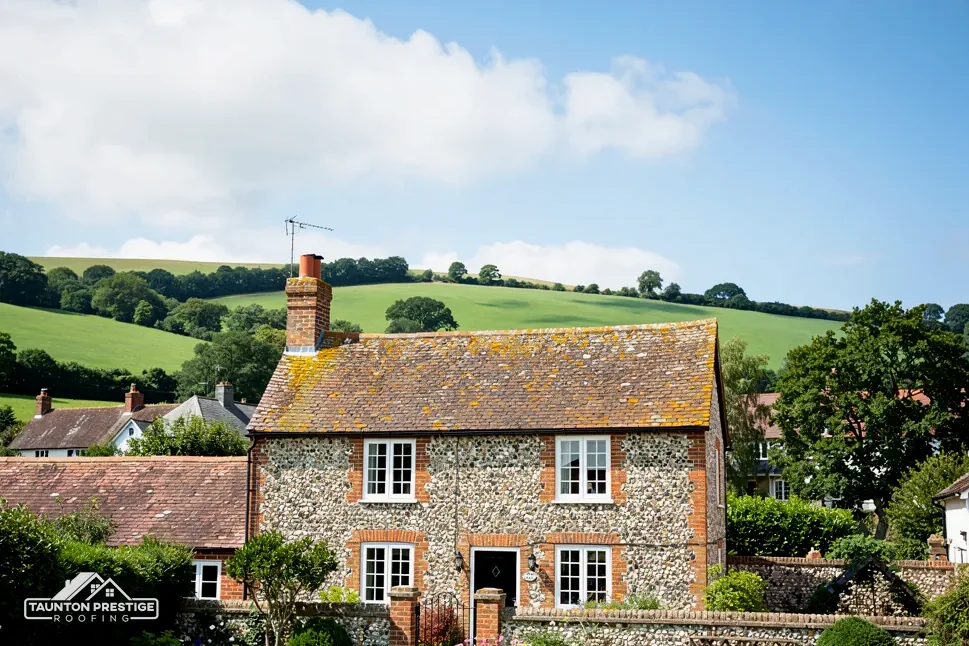
Listed Grade II*, so a change to the roof's character needs listed building consent before work starts.
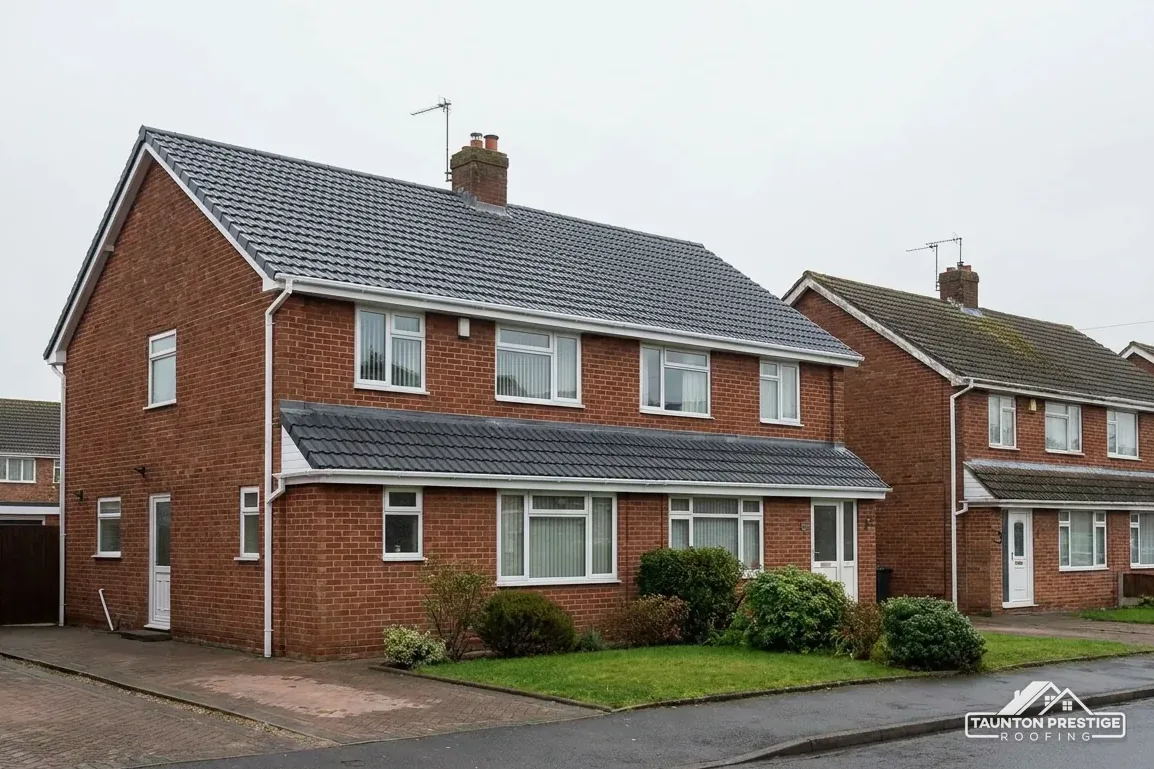
Arundel House is Grade II and the Market Cross Grade II*, so nearby roofs are judged against them.
Street map of Cheddar with Axbridge, Winscombe, Wedmore, Sandford marked around it, and Taunton.
Axbridge lies just north-west of Cheddar, with Winscombe and Sandford further the same way, Wedmore to the south-west and Wookey to the south-east.
About 23 miles north-east of Taunton, Somerset Council (unitary).
Four checks below the Gorge
From listed stone to riverside units, these are the four checks we run on a Cheddar roof and the way each one moves the price.
Cheddar's old centre carries more listings than a roofer can ignore. The National Heritage List has 26 entries within 500 metres of the centre, and the conservation area reaches to within about 0.75 km of it. Somerset Council is the planning authority and also takes listed building applications, so one call to its planning team settles most consent questions. Our part is to arrive at that call with facts about your roof, not guesses.
The Church of St Andrew is Grade I, first listed on 9 February 1961. Church Farm House and Church Farmhouse share a Grade II* entry dated 9 February 1961, and the Market Cross is Grade II* as well. Arundel House is Grade II. On a listed house, anything that would change the building's character needs listed building consent, and our page on consent for listed building roofs walks through the steps.
St Andrew's serves as an Anglican parish church, which sends repairs through the faculty system rather than to the council for a decision. The parish obtains the faculty, and a roofer works to the specification it approves. Houses and outbuildings around the churchyard are a different matter: those belong to their owners, and the council has the say.
It changes what a sensible repair looks like. Beside a listed neighbour a new slate has to resemble the old one for size, tone and texture, so we reuse sound pieces where we can and keep the ridge and eaves detail as it was. None of that is exotic work. It simply means a patch does not shout from the road, which is what planners and neighbours notice first.
Tell us at the start if your house is listed or close to the cross, and the survey notes will record what covers each slope before any application begins.
What decides the price
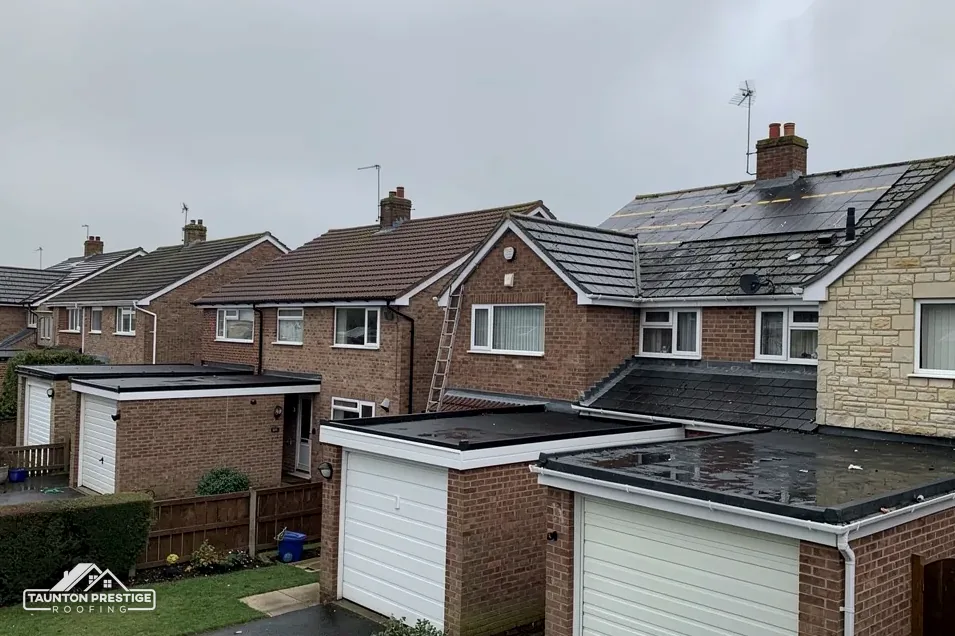
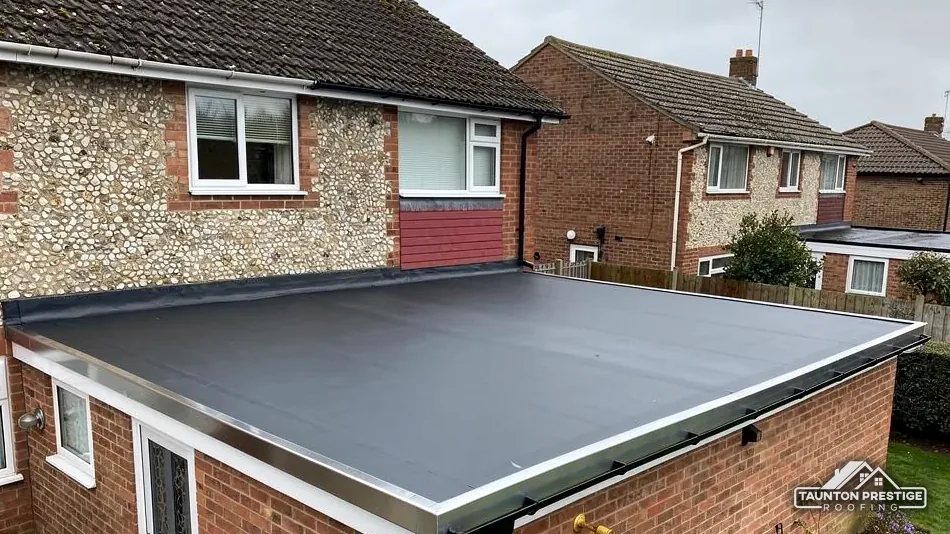
Cheddar's heritage records note that factories powered by the fast-flowing Cheddar Yeo once stood along its banks. Those buildings are history now, but the village still has workshops, units, garages and house extensions with flat roofs, and a flat roof is judged on one thing above all: whether the water leaves it.
Look for
Because the fall has gone. BS 6229:2025 sets a minimum finished fall of 1:80, and IKO advises designing for 1:40 to leave margin once the roof is built. A deck that has sagged, an outlet that has silted up or a membrane laid hard against a rising wall can each leave a pond. Ponding that is still there a day after rain is a sign to act.
EPDM comes as one synthetic rubber sheet that is rolled across the deck whole. GreenSpec gives it a life of 20 to 30 years, while Less says 30 to 50, so the sources disagree and neither is a promise. Less gives 25 to 40 years to GRP, which is glass-reinforced plastic laid over matting while still wet, and 10 to 20 to torch-on felt. For a flat roof replacement the typical UK range is £1,500 to £6,000 (MyJobQuote, Oct 2026). Our flat roofing page shows the options, including for units and workshops.
The outlet is where a flat roof's history shows. Silt, leaves and old sealant gather there, and a partly blocked outlet turns a roof that drains slowly into one that ponds. Clearing it is the first job at survey. If the water then runs away, the fall may be fine and the fault is housekeeping. If it still sits, the deck has moved and we measure by how much.
For a unit or workshop the survey also records each penetration, such as a vent, a flue or a rooflight, because every cut through a membrane is a place where water can get in. We check the outlet, the upstands and the edge trims on every flat roof, because those small parts fail before the sheet does.
Sound or needs work
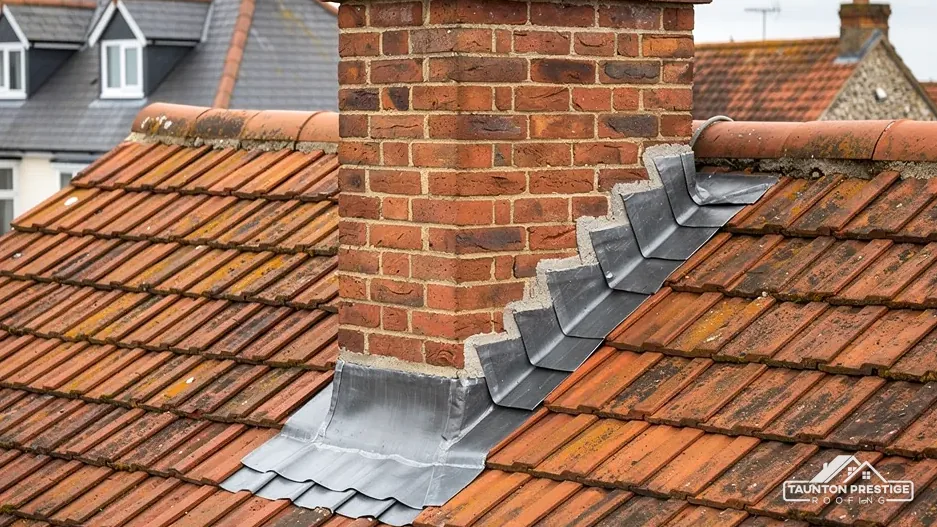
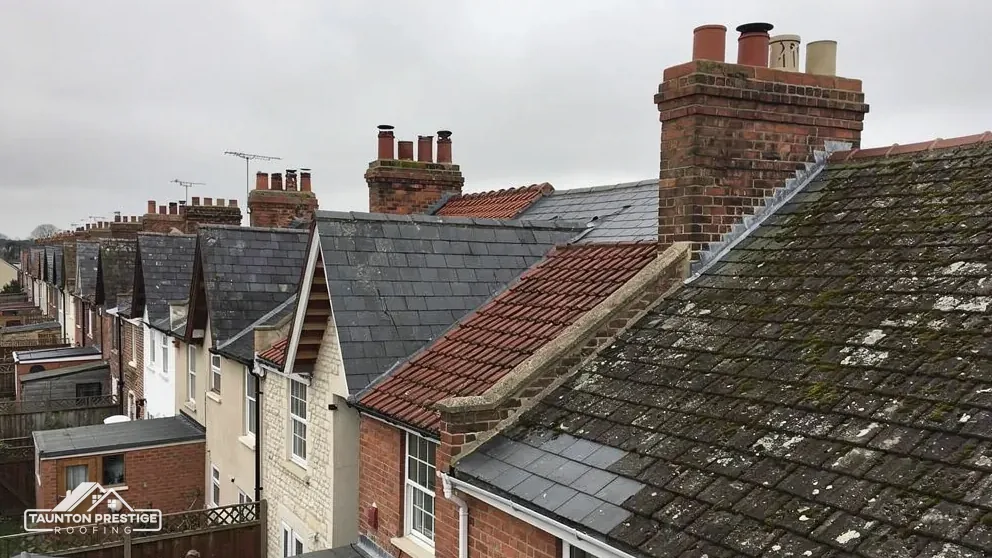
On an old stone house the chimney stack is among the most exposed parts of the roof. Rain gets in through three places: the mortar joints of the stack, the flaunching and the flashing at its foot. Flaunching is the mortar bed around the pots that fixes them and throws water off the top. The flashing is a lead strip dressed up the stack and over the covering to seal that junction.
Rain finds a chimney in three places, and lead alone does not protect all of them.
Usually, yes. Sound brick or stone only needs its joints raked out and filled with a matching mortar. A typical UK range for chimney repointing is £450 to £1,200 (MyJobQuote, Oct 2026). A stack that leans, or has loose stones at the top, needs rebuilding, and on a listed house that is the point at which listed building consent comes in. Whenever a chimney breast is removed, Building Regulations approval is needed, since it forms part of the building's frame.
MyJobQuote's figure for lead flashing is over 80 years, a floor, not a promise. What shortens it is poor fixing: lead that is nailed through the face or left unsupported will split at the folds. Replacement leadwork on a chimney has a typical UK range of £350 to £920 (MyJobQuote, Sep 2026), and the upper end depends on scaffold. Our chimney repairs and lead work pages show how the parts fit together.
The stack is often the reason scaffold appears in a quote at all. A low stack on a single-storey extension may be reachable by ladder or low tower, while a tall one on a ridge needs access that holds a person safely and lets lead be dressed properly. MyJobQuote notes that the upper end of its leadwork range depends on scaffold.
At the survey we photograph each stack from the roof side so you can see the joints, the collar and the lead for yourself.
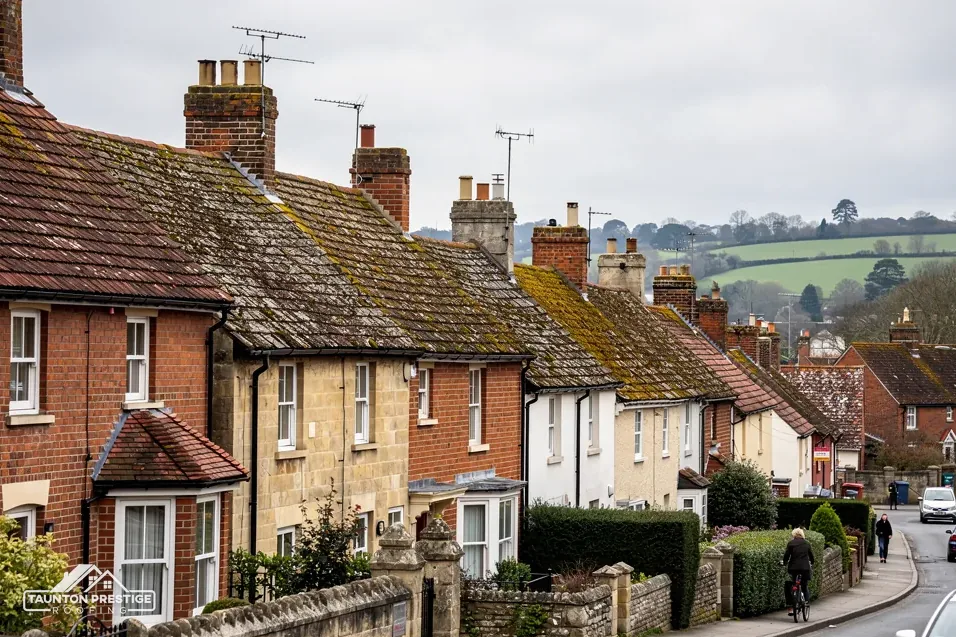
Putting scaffold on the pavement or the carriageway calls for a scaffold licence, issued by the highway authority under section 169 of the Highways Act 1980. In Cheddar that is Somerset Council, which grants scaffold licences to accredited contractors only, and it is the appointed contractor who makes the application. The fee is £124.60 for each 28-day period (April 2026), and the council asks for at least 10 working days' notice, so the date we give you for the start already allows for that wait.
For a full re-roof that falls under the Building Regulations, Somerset Building Control covers Cheddar, now that the former Sedgemoor district has been folded into Somerset Council. You can reach it on 0300 303 7790. Part of the edge of Cheddar also touches the Mendip Hills National Landscape, which can affect loft work on that side of the village, so we ask early where your house sits.
Somerset Building Control lists three dutyholders on every application, a principal designer, a principal contractor and the client, and says that without a principal designer or agent you become the principal designer by default. We explain that before the application goes in, so the paperwork does not surprise you.
Often the scaffold, sometimes the VAT, and now and then the tidy-up. Ask whether the total covers scaffold, VAT and the removal of waste. All waste leaves with us when the job ends, and we keep you posted day by day on what is under way, so nothing comes as a surprise.
A repair that can be reached from inside your own boundary may need none of this. We say which applies once we have seen the house.
Once we have surveyed, you are sent photos of your roof together with one price, in writing, for the entire job. Give us the Cheddar address and say which stack, flat roof or slope is worrying you, and the survey is booked from there.
Look for
Walked the roof?
When you have read the checks, we walk the roof and show you the photos.
Any change that affects the character of a listed house: a new covering in a different material, a rebuilt stack, a different ridge or a new roof window on a visible slope. Like-for-like repairs are a different matter. If you are unsure, we record what is on the roof and you can put those photos to Somerset Council's planning team before deciding.
No. St Andrew's serves as an Anglican parish church, which sends roof work through the faculty system instead of the council's listed building consent. The parish obtains the approval and the roofer follows the agreed schedule, so any roofer asked to quote should ask for that schedule first. Houses and outbuildings nearby follow the council's route.
Look for water still lying on it a day after rain, tide marks round the edges, or damp stains on the ceiling beneath. BS 6229:2025 sets the finished minimum fall at 1:80. A roofer can check the fall with a level during the survey and photograph any pond so you see exactly where it sits.
We lift the failed flashing, check the stack and flaunching beneath, and dress new lead over the joint in sections so it can move with the weather. The old lead may last a long time, as MyJobQuote says lead can last for over 80 years, so a split usually points to the fixings, not the metal.
Point us at the stack, the flat deck or the slope worrying you and a visit will be arranged.