St Andrew's Grade I church
Grade I, listed in 1959, and still in Anglican use, so its roof work follows the faculty route.
A Grade I church, Grade II* listed buildings and Drayton's conservation area
A Grade I church, 21 listed entries within 500 metres and the Drayton conservation area close by give Curry Rivel plenty to check. We survey before pricing.
Grade I, listed in 1959, and still in Anglican use, so its roof work follows the faculty route.
Both are listed Grade II*, and Coombstock House is Grade II, so repairs there start with the consent question.
The Drayton conservation area lies within about 0.75 km of the centre, and 21 listed buildings stand within 500 metres.
Street map of Curry Rivel with Wiltown, Langport, Huish Episcopi, Fivehead marked around it, and Taunton.
Langport and Huish Episcopi lie a few miles east of Curry Rivel, Fivehead sits to the south-west, Kingsbury Episcopi to the south-east and Stoke St Gregory to the north-west.
About 10 miles east of Taunton, Somerset Council (unitary).
Four roof checks, Drayton to St Andrew's
Consent near the conservation area, the ridge, the chimney stacks and the scaffold: four checks, and what each one does to the job.
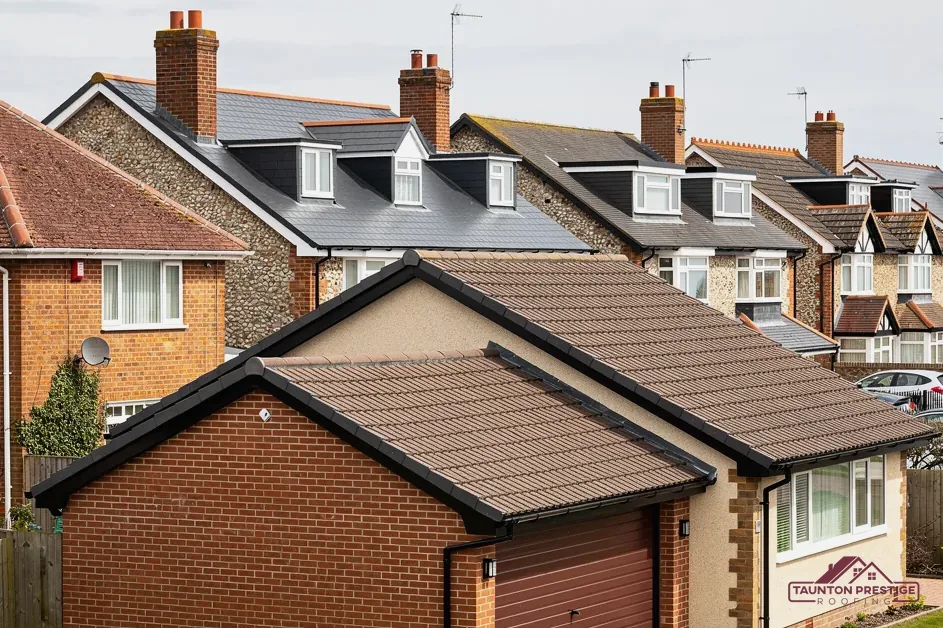
Start with the map, not the ladder. The Drayton conservation area reaches to within about 0.75 km of the middle of Curry Rivel, and the National Heritage List has 21 entries inside 500 metres. St Andrew's church is Grade I, Middlethorpe House and The Limes are Grade II*, and Coombstock House is Grade II. On a roof job, two questions come ahead of any slate or tile: is the address inside the conservation area, and is the house itself listed? Those two answers decide whose approval the job needs, and how closely the new covering has to follow the old one.
The national rules are laid out on our planning permission for roof work page, so we leave them there. The local point is that a conservation area gets more sensitive the moment the roof looks different from the road. A new type of covering, a ridge finished another way, or roof windows turned towards the lane would all be worth a phone call to Somerset Council's planning team first, and the call costs nothing beside the price of ordering the wrong materials. A neighbour's recent roof is not proof that the same change is allowed at your address, because each case turns on its own boundary line.
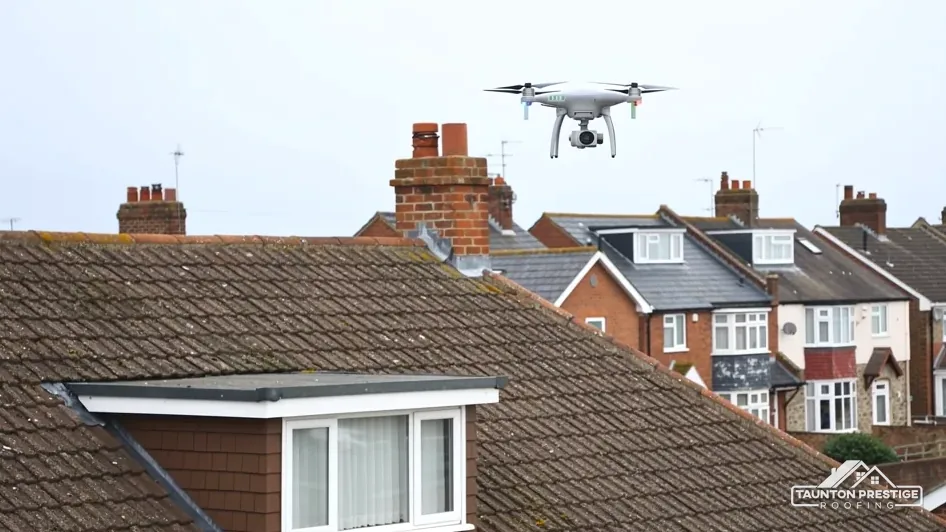
Listed status adds a second layer. Work that touches the character of the building calls for listed building consent, and that includes some changes that look trivial from the garden gate, such as replacing a clay ridge with a dry-fix one, where clips and screws hold the tiles and no mortar is used. Before anyone applies for anything, our survey logs what is on each slope today, with photos, so the application starts from fact and not from memory.
Look for
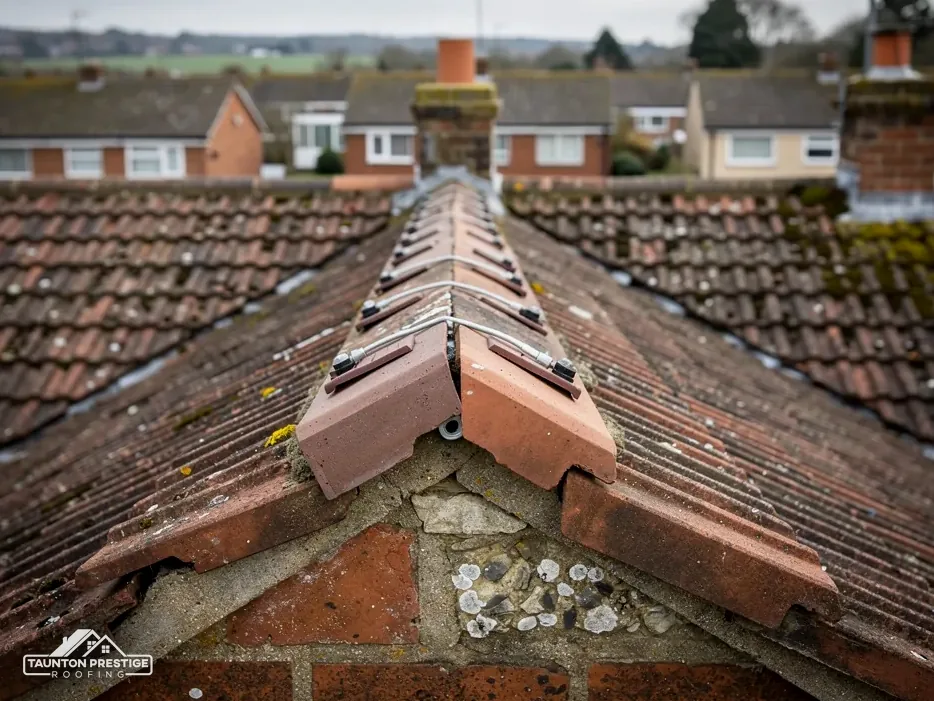
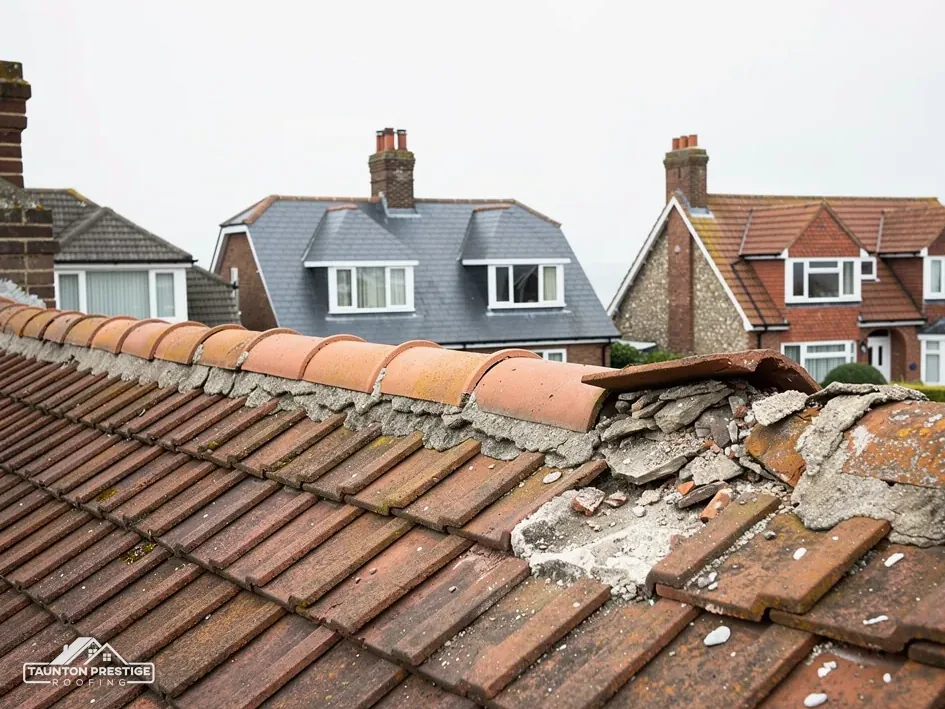
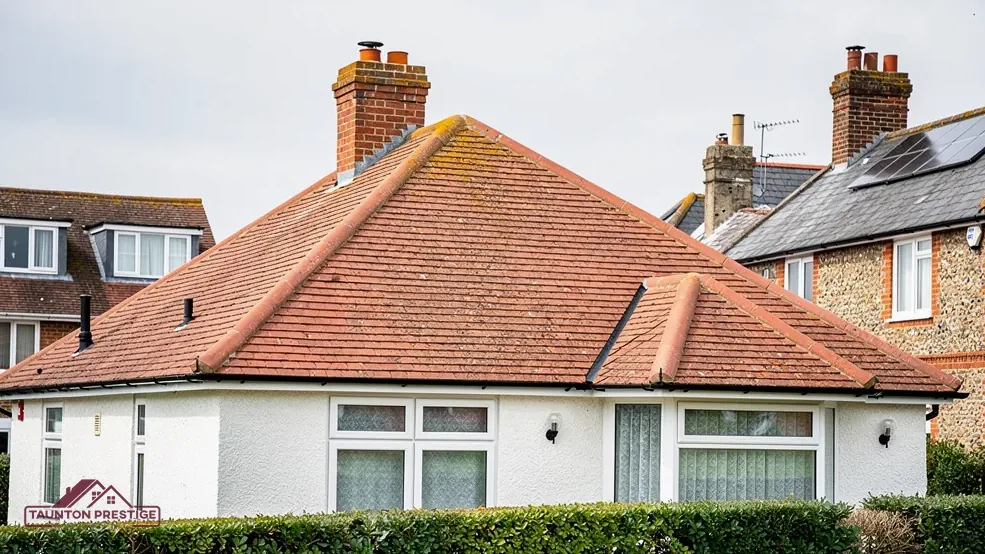
Look up at the very top of a pitched roof and you will see a line of curved caps where the two slopes meet. Those are ridge tiles. A hip is the angled run down from the ridge to the eaves at each outside corner of a hipped roof, and it gets the same caps. These are the exposed edges of the roof, so wind works at them before anything else. A cap that rocks when pressed, a crack in the mortar underneath, or a chink of daylight visible from the loft tells us the bedding has given up. On a long ridge, the second tile that rocks is usually a hint that the third and fourth are close behind, which is why we inspect the full length of the ridge instead of one spot. Wind-driven rain gets under loose caps and soaks the top of the wall plate, the timber the rafters sit on, long before a stain shows indoors.
What decides the price
Marley's account of BS 5534 is that its 2014 revision settled the point: mortar by itself cannot be trusted with the caps on a ridge or hip, so a bedded ridge is fixed mechanically as well. Marley also notes that working to BS 5534 is not a legal requirement, so ask any roofer what actually holds the tiles on. The dry-fix alternative uses clips and screws in place of wet mortar, and BS 8612 is the test specification written for those systems.
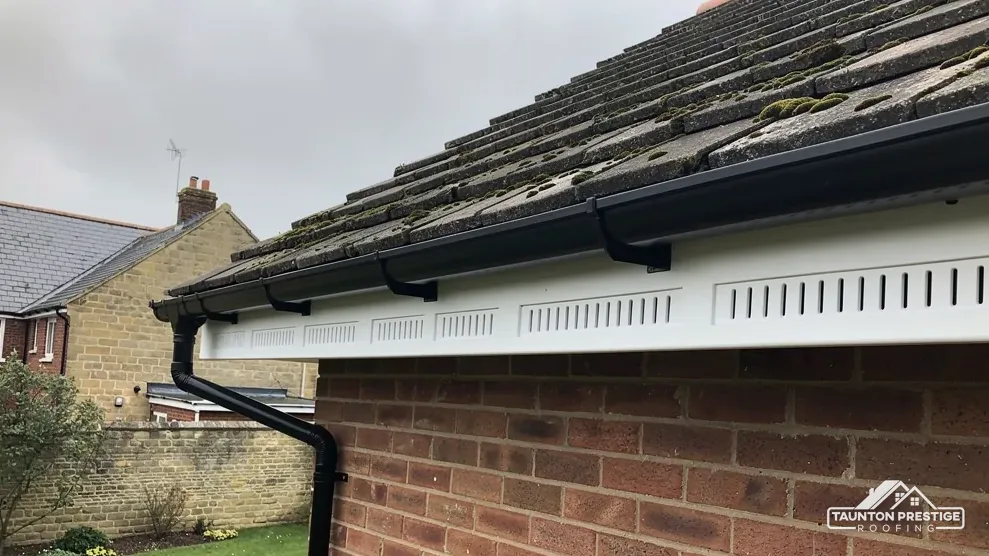
MyJobQuote gives a typical UK range of £225 to £550 for replacing ridge tiles (Oct 2026), and £500 to £2,000 for a dry verge system (Oct 2026). The verge is the sloping side edge, where the roof covering meets a gable wall. Our dry ridge and verge page shows where each system suits, and the survey tells us which one your roof can take.
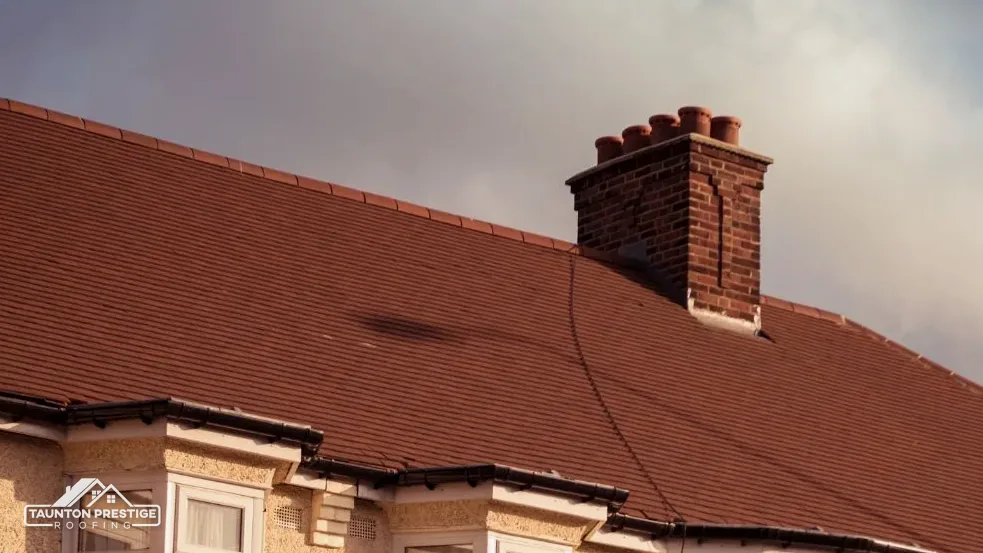
Of everything on a house, the chimney stack stands highest into the weather, and three small details decide whether the loft stays dry. Flaunching is the cement collar bedding the pots at the top of the stack. Flashing is the lead that bridges the join between the stack and the slope beside it. Pointing is the mortar between the brick or stone. Let any of the three fail and rain finds a way in; the usual first sign is a brown stain on the ceiling of the bedroom next to the stack, and it often appears weeks after the damage began.
Lead flashing, MyJobQuote says, can last for over 80 years, a minimum rather than a guarantee. Lead fails early where it has been prised away from the brick, or where a poor patch has left a path behind it. We examine how it is dressed into the stack before we suggest replacing any of it, because sound lead should be kept and only the failed part replaced. The same goes for the pots: a cracked pot is cheap to swap, and one that wobbles in loose flaunching is worth resetting at the same visit.
Frequently, yes. MyJobQuote gives a typical UK range of £450 to £1,200 for repointing a chimney (Oct 2026), and £350 to £920 for full chimney leadwork (Sep 2026), with the figure moving with scaffold. A stack can look fine from the road and still hide open joints on the side you cannot see. If the brick has gone soft or the stack leans, new pointing is money wasted and a rebuild is the straight answer. Anyone taking out a chimney breast, the section inside the house, needs Building Regulations approval first. Our chimney repairs page walks through each option, from a patch to a rebuild.
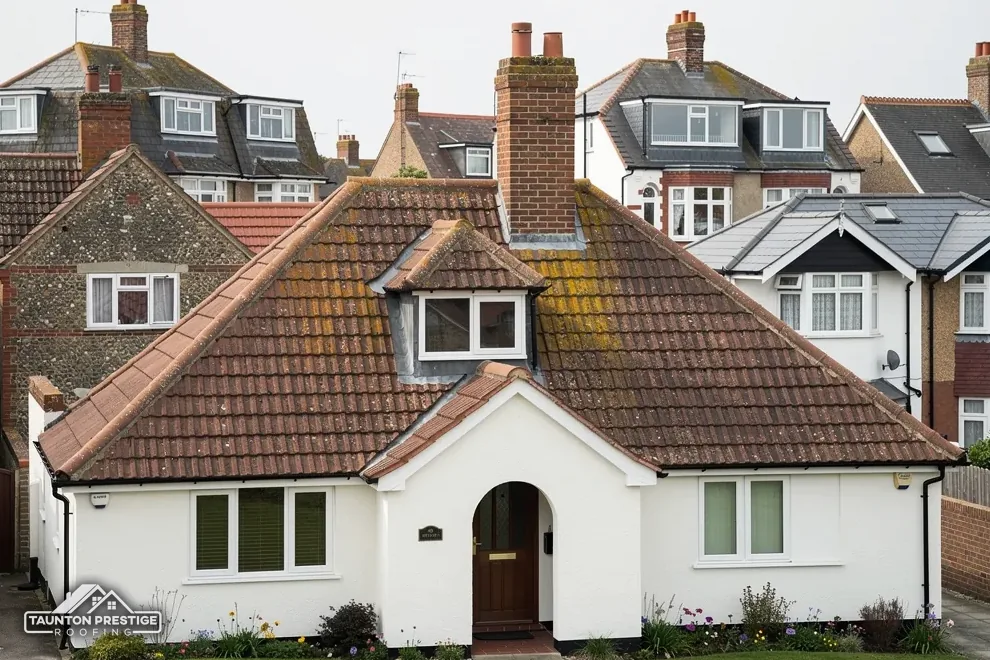
Small repairs often need nothing more than a ladder or a low tower, but a full re-roof usually wants scaffold. If the frame has to stand on a pavement or a road, section 169 of the Highways Act 1980 means applying to the highway authority for a licence. For Curry Rivel that authority is Somerset Council, which grants scaffold licences to accredited contractors alone; the contractor named on the job is the one who applies. A frame on your own drive or lawn sits inside your boundary and is a different matter, and we settle which setup suits the roof when we see it. Cutting corners on access is how tiles get broken and gutters get bent, so it is worth getting right.
What decides the price
Somerset Council asks for at least 10 working days' notice, and the fee is £124.60 for each 28-day period (April 2026). A job that runs on needs an extension, and an extension needs more paperwork. We allow for that notice when we offer a start date, so the first day on site does not slip while the roof waits and the weather turns. When you weigh up any quote, ask who applies for the licence, how long it runs and whether VAT and scaffolding are inside the price.
It comes first, and it is how the scaffold question gets answered properly: height, eaves, the ground below and the neighbours' boundaries all go into it. Photos of your own roof come back to you alongside a single written figure covering everything, and the scaffold decision rests on what the photos show. Send your Curry Rivel address with a note on what you have seen up there, and the survey gets booked for a day that suits you.
Walked the roof?
When you have read the checks, we walk the roof and show you the photos.
Sometimes. If a single cap has come away from sound bedding, it can be re-bedded and fixed mechanically. If the mortar along the run is cracked and crumbling, that loose cap is a symptom, and redoing the whole ridge works out cheaper than repeat visits. We test the neighbouring tiles by hand and tell you which case you have.
St Andrew's is listed Grade I and still in Church of England use, so repairs to its roof need a faculty under the Church of England's own system, not listed building consent from the council. The parish arranges the faculty, and afterwards the roofer follows the specification it approves, so the roofer has to wait for that approval before ordering materials.
Repointing, or renewing flaunching or lead flashing in matching materials, is generally a repair. Rebuilding or lowering a stack, or changing how it looks from the road, can alter a listed house's character and need listed building consent from Somerset Council. Taking a chimney breast out is never exempt from Building Regulations approval, so ask before changing anything.
Catch the water, move belongings clear and take photos of the stain. Tell your insurer and keep every receipt for a temporary repair. Making the leak safe comes first on our side, and then we survey the whole roof so the lasting repair is priced on what we find and not on the drip alone.
Point us to the ridge, stack or slope you are unsure of, and a survey date follows.