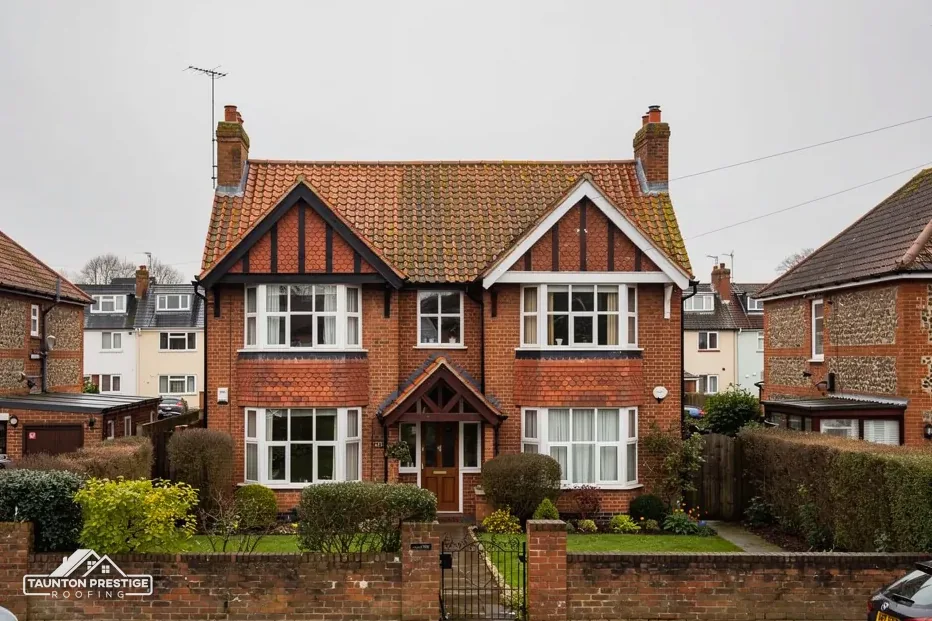
St Martin's Grade I church
On the list since 17 April 1959. It holds Church of England services, so roof repairs follow a faculty.
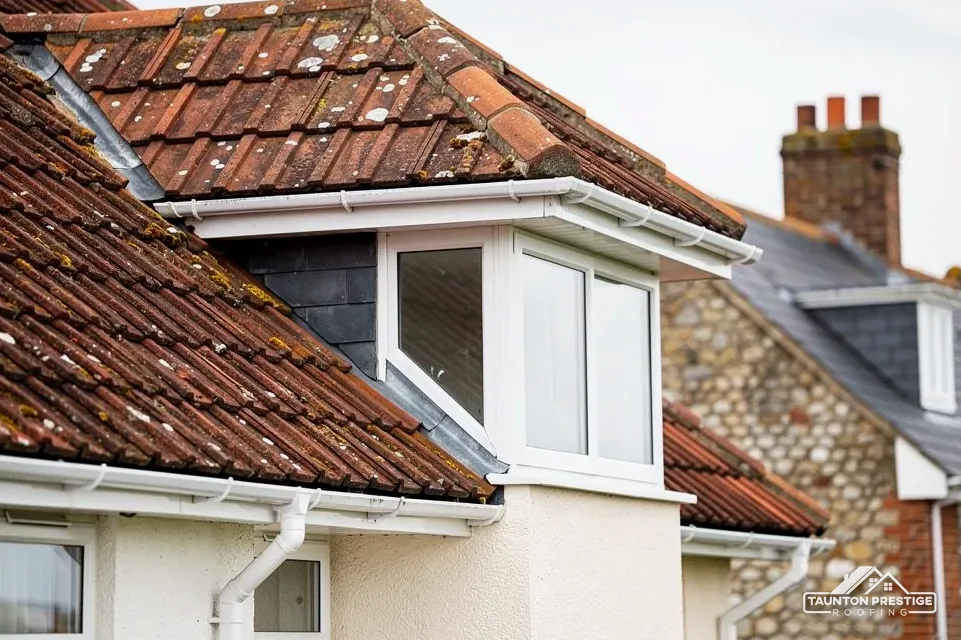
St Martin's Grade I church and 27 list entries near the centre
Kingsbury Episcopi has a conservation area, a Grade I church and 27 list entries within 500 metres of its centre. We read your roof and show you photos first.
On the list since 17 April 1959. It holds Church of England services, so roof repairs follow a faculty.
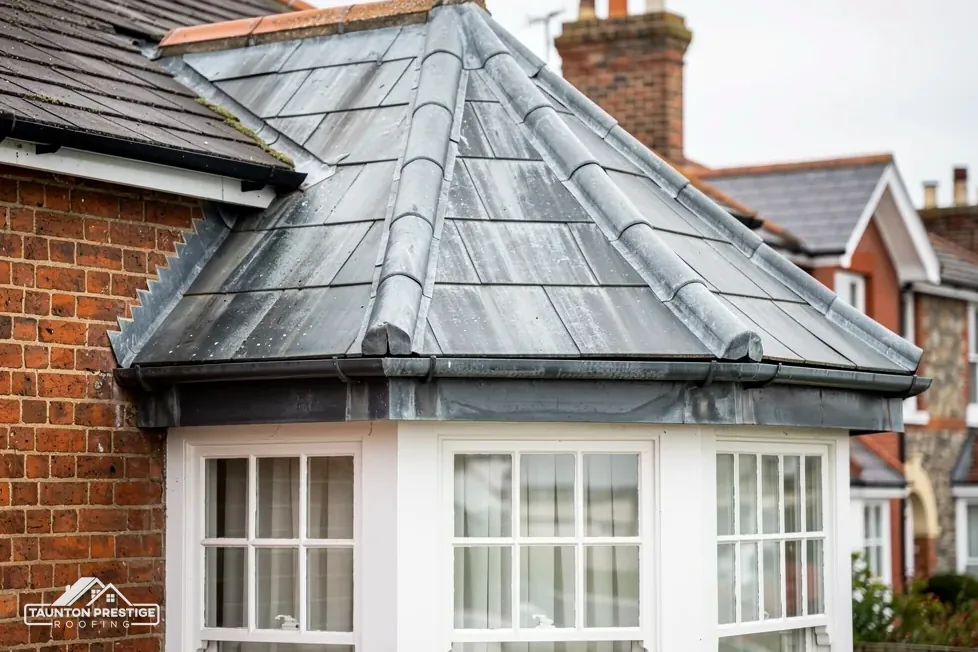
The roadside barn east of Home Farmhouse is listed Grade II, so a modest repair needs the right consent route.
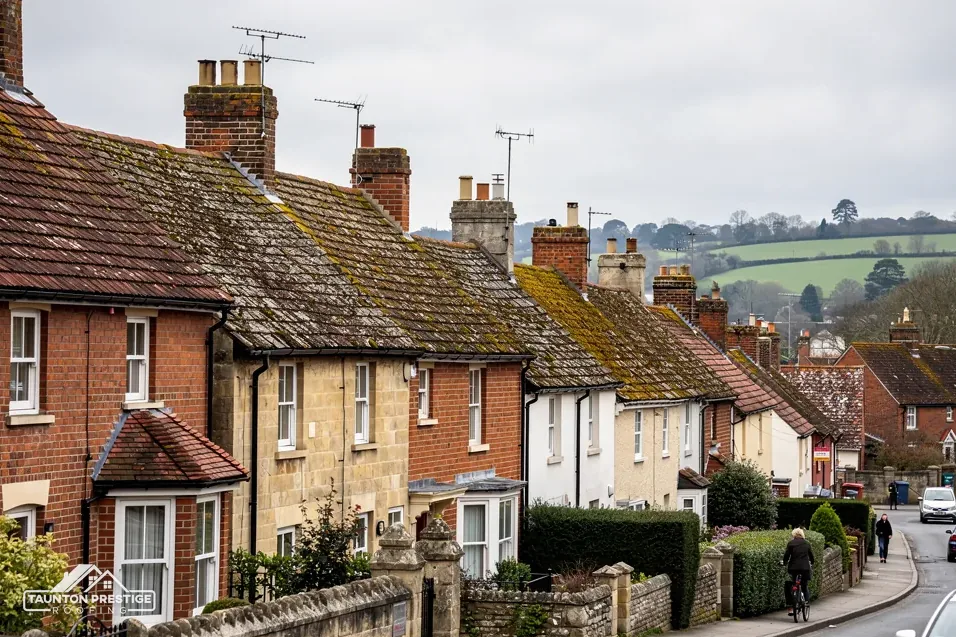
Chimney Cottage and a cottage by West End Farmhouse are listed Grade II, so stacks get a careful look.
Street map of Kingsbury Episcopi with Martock, South Petherton, Shepton Beauchamp, Stoke-sub-Hamdon marked around it, and Taunton.
Martock lies to the south-east and South Petherton to the south, with Huish Episcopi to the north and Long Sutton to the north-east of the village.
About 13 miles east of Taunton, Somerset Council (unitary).
Four checks beside St Martin's
Four things worth checking on a house or barn here, and how each one shapes the work and the price.
Start with the map. The planning.data.gov.uk conservation-area layer puts a boundary within about 0.75 km of the middle of Kingsbury Episcopi, and the National Heritage List shows 27 entries inside 500 metres. Neither says anything about your particular house, so at the survey we look your address up against both. The result changes the order of play: who must agree, what the new covering has to look like, and how long the paperwork takes before a ladder goes up. Inside the conservation area, the smoothest route is matching what was there. A change of material, or a roof window facing the street, is the moment to ring the planning team.
The church is Grade I and still holds services as a Church of England church. That puts it in the faculty system run by the church itself, so the council's listed building consent does not apply there. A closed church, or a chapel sold off as a home, falls outside that arrangement and comes back under the council.
Chimney Cottage carries that grade, as does a cottage near West End Farmhouse. A listed house can still have like-for-like repairs, yet any alteration that touches the building's special character needs listed building consent. The ridge is a sneaky example. Lifting a mortar-bedded run and fitting dry-fix, where the ridge tiles are held by clips and screws, with no mortar at all, alters how the skyline looks and feels. Our guide to planning permission for roof work sets out the rules. Where a doubt remains, Somerset Council's planning team can answer it before any material is ordered.
Photos of every slope go into your file at the survey, so an application starts from fact. Planners and church officers can see what is on the roof now, and nobody has to guess from the ground.
Look for
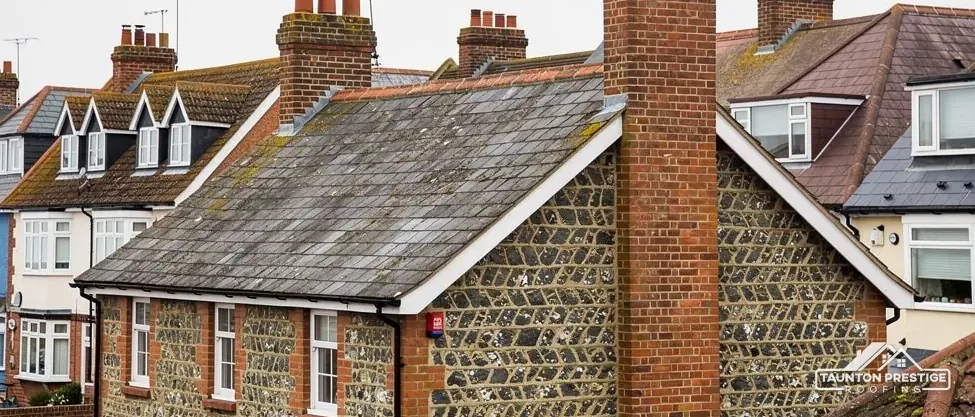
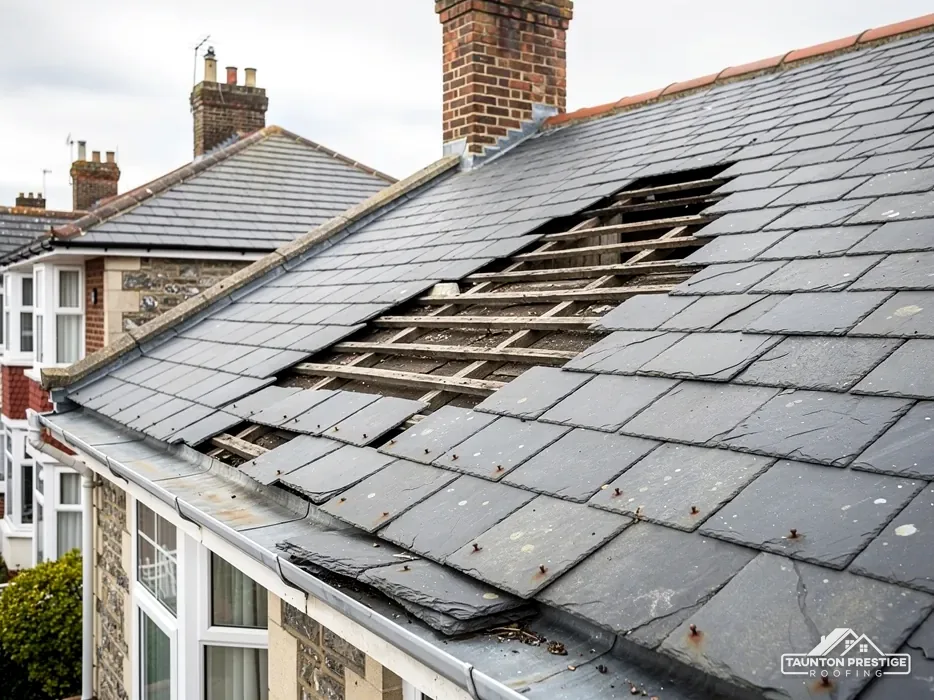
Barn roofs show their faults early because they are bare. No ceiling hides a stain, and one open joint soon lets the weather in. The barn on the road beside Home Farmhouse is listed Grade II, so it gets the care a house would. The usual trouble spots are the ridge, the capping that runs along the top, the verge, where the slope meets a gable wall, and the battens, the narrow wooden strips nailed across the rafters that slates or tiles hang from. Battens rot where water has crept in for years.
What decides the price
Count them. A scatter of slipped tiles across a sound slope is repair work: each one is eased back and clipped, or replaced with a close match. A tight cluster, or tiles dropping along one line, tells us the nails or hooks have corroded, and patching becomes a run of repeat visits. That is when stripping the slope and relaying it on new battens works out cheaper. The survey photos show which of the two you have.
Figures in print are typical lives, never pledges. The Confederation of Roofing Contractors reckons natural slate in good order can last 100+ years. The BRE's 60-year minimum, as Marley quotes it, belongs to clay tiles alone. For concrete tiles Marley offers a separate estimate of around 60 years, which it stresses is not a guarantee. The fixings and battens underneath can wear out before the covering does.
It is possible. GOV.UK warns that mending or renewing a roof can affect bats, and says each species and its roosts have full legal protection. So we scan for droppings and staining at the survey, and a find reshapes the programme. For the coverings themselves, see our slate roofing page.
On the planning.data.gov.uk Environment Agency layer, Flood Zone 3 lies within roughly 250 metres of the middle of Kingsbury Episcopi. Read that as a map of land, not a verdict on your roof. To see the picture for a specific address, use GOV.UK's long-term flood risk checker. The roof's part is smaller and more practical: get water off quickly and into the drainage, by way of gutters, downpipes and any flat section.
A flood zone describes the ground; a working gutter describes this roof.
Joints, outlets and brackets, in that order of suspicion. A parted joint drips onto the wall below. An outlet clogged with moss and grit sends water over the lip. A bracket that has pulled out lets a length sag, so water pools instead of running. Brett Martin's fitting guidance asks for 1mm of fall per 600mm. Timber suffers when overflow keeps soaking it: the fascia carries the gutter, the soffit closes the underside of the eaves, and we prod both before quoting. Our gutters, soffits and fascias page lays out the options.
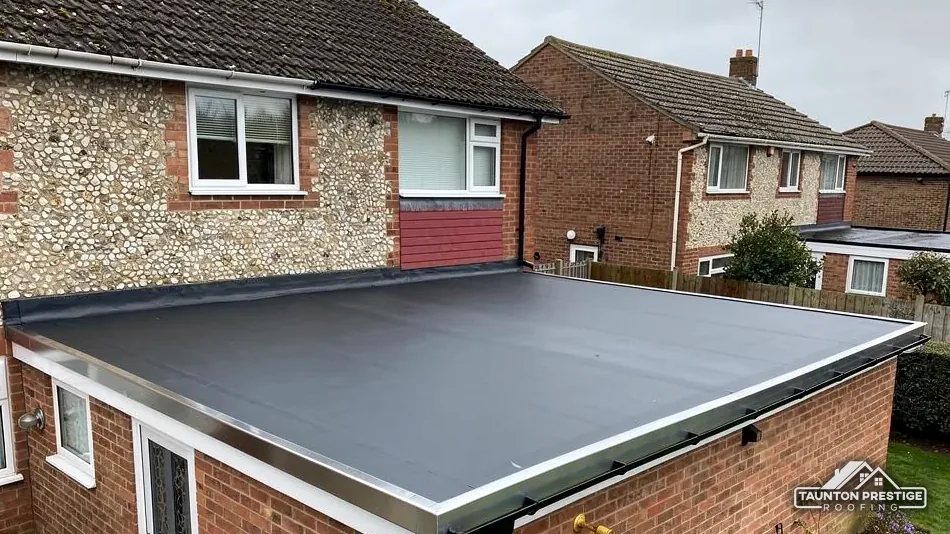
A flat roof is laid to a gentle fall on purpose. BS 6229:2025 asks for at least 1:80 once finished, and IKO says to design for 1:40 so that settling does not erase it. Water still lying a day or two after rain usually means the fall has gone, an outlet is blocked or the deck has sunk. Sometimes the cure is a new outlet, and sometimes the deck needs relaying to a better fall. We look for it when the roof is dry, because old tide-lines of dirt show where the pool sat, and we measure the drop to the outlet. If the covering has to go, EPDM, rubber sheeting laid as one piece, is rated 20 to 30 years by GreenSpec and 30 to 50 by Less. Less rates GRP (glass-reinforced plastic) at 25 to 40 years.
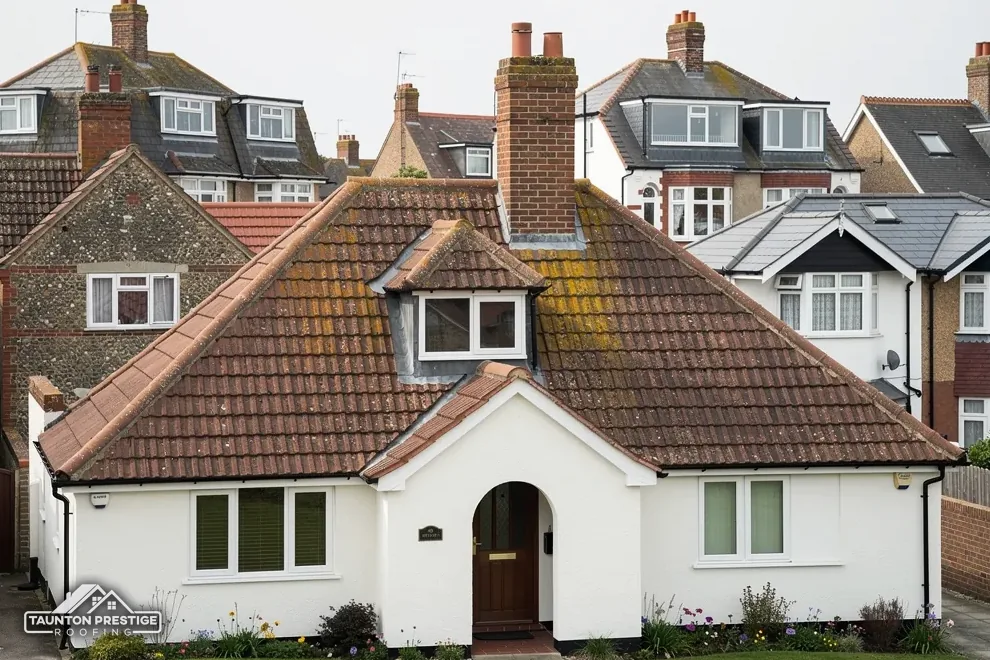
Not every roof needs scaffold. A single slipped slate may be reachable from a ladder, a stack on a bungalow may need a tower, and a full re-roof almost always wants a scaffold lift around the building. The legal part begins when scaffold stands on the public highway. Section 169 of the Highways Act 1980 demands a licence from the highway authority. At Kingsbury Episcopi that authority is Somerset Council. Under its rules accredited contractors alone hold scaffold licences, and the appointed contractor files the application. Scaffold inside your own boundary, on the drive or the lawn, never touches the highway.
What decides the price
Somerset Council asks for 10 working days' notice before the poles go up, and £124.60 buys each 28-day period (April 2026). If the work runs over, the permit must be extended. Our start dates already allow for the wait, which keeps the roof closed up while the paperwork is settled.
The Planning Portal sets the yardstick: no building control application is normally needed while under 25 per cent of the building envelope and under 50 per cent of the roof is touched. Approval under the Building Regulations is needed if a new covering adds 15 per cent or more to the weight, so the structure gets a check first. Somerset Building Control can be reached on 0300 303 7790, and a call before the survey does no harm. If the whole roof is tired, our roof replacement page explains how we decide between patching and starting again.
You leave the survey with photos of your roof and one price on paper, and the site stays tidy. Send your Kingsbury Episcopi address with a line on what has changed up there, and a survey date follows.
Walked the roof?
When you have read the checks, we walk the roof and show you the photos.
Sometimes. Sound reclaimed tiles can match an aged roof better than new ones, which stand out for years in colour and surface. At the survey we sort the tiles worth keeping from the tired ones. Where the barn is listed, or sits in a listed farmhouse group, ask Somerset Council's planning team before the covering changes.
St Martin's is listed Grade I and holds Church of England services, so repairs go through the Church of England's own faculty system and not through listed building consent from the council. The parish arranges the faculty, and the roofer follows the approved specification. Work on site starts only once that approval is in place.
Often it can, and sometimes it must. A nest with birds using it is protected: the Wildlife and Countryside Act 1981 makes intentional damage or destruction an offence, and GOV.UK says building work cannot be licensed to do it. Eaves get a look on survey day, and the start date is fixed around any nest.
Chimney Cottage is listed Grade II, so a rebuilt or removed stack can alter its character and need listed building consent. Renewing the flaunching (the mortar ring that holds the pots) or replacing lead flashing like for like usually counts as repair. Lead can last for over 80 years. Ask the planning team first if you are unsure about a stack.
Name the slope, gutter or stack worrying you, and we will fit a Kingsbury Episcopi survey around you.