Holy Trinity church
Listed Grade I on 7 February 1986, with a nave roof of carved tie-beams and supporting angels.
A Grade I church, lias-stone houses and a village conservation area
Long Sutton has a Holy Trinity church listed Grade I, 28 listed buildings near the centre and a conservation area, so we look hard before we price.
Listed Grade I on 7 February 1986, with a nave roof of carved tie-beams and supporting angels.
A 1959 listing at Grade II* (17 April) means changes to its character need listed building consent.
Brook Farmhouse is Grade II, and a cottage with outbuildings north-east of Vale House is listed as well.
Street map of Long Sutton with Somerton, Huish Episcopi, Langport, Kingsbury Episcopi marked around it, and Taunton.
Somerton lies north-east of the village, with Huish Episcopi and Langport to the west. Kingsbury Episcopi is south-west, Ilchester south-east and Martock to the south.
About 15 miles east of Taunton, Somerset Council (unitary).
Four checks from church to licence
The consent route, the stone walls, the drainage in wet weather and the access licence, each with what it means for the job.
The National Heritage List records the Church of the Holy Trinity at Grade I (entry 1236060, first listed 7 February 1986) and the Manor House at Grade II*. Between them they set the tone: this is a village where the oldest roofs are the ones people notice. Long Sutton also has a conservation area, and 28 listed buildings stand within 500 metres of the centre. Whether you own a farmhouse or a small cottage, our first question on the survey is which of those designations, if any, touches your roof.
Holy Trinity's nave roof has carved tie-beams, the horizontal timbers that hold opposite walls together, with angels beneath them, and its aisle roofs are 17th-century replacements, the north one dated 1691. Old timber under a covering is exactly why survey photos matter on buildings like these.
For a church in use by the Church of England, permission comes through the diocese's faculty system, not from the council. Other denominations follow other routes. Converted chapels, closed churches and Quaker or Unitarian buildings all need ordinary listed building consent. The Court House here was vested in a trust by the Society of Friends, and a Quaker building has no exemption of its own, so if one is listed the council's consent applies.
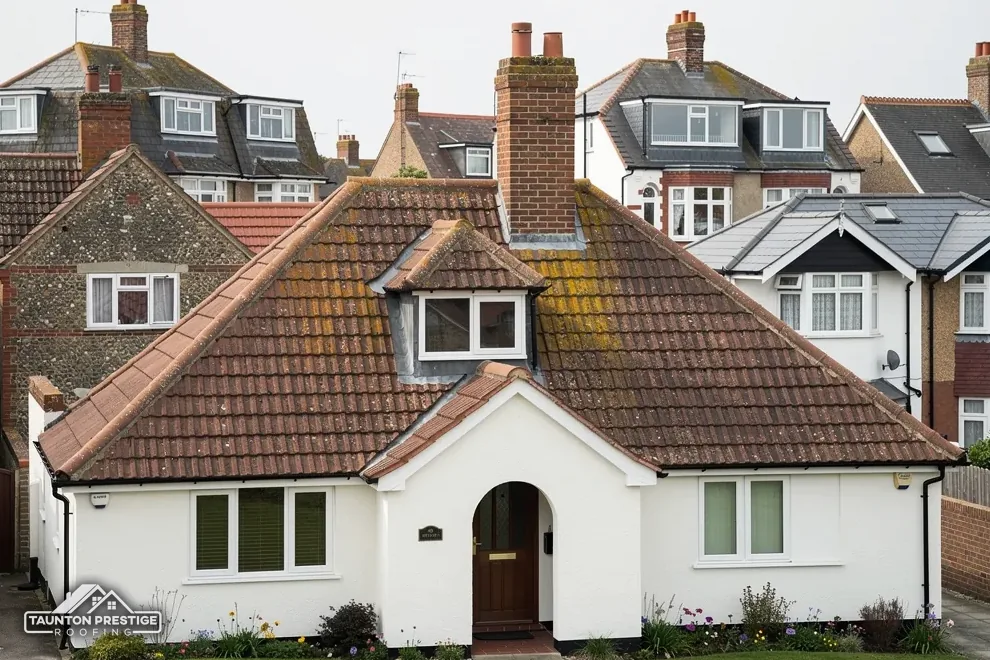
Brook Farmhouse is Grade II, and so is a cottage with outbuildings north-east of Vale House. Listing adds a duty to obtain listed building consent for anything that alters a house's character. The Court House keeps a smoke-blackened open hall roof with base-cruck principals, timberwork thought to belong to the late 13th and 14th centuries. Our guide to planning permission for roof work lists the questions to put to Somerset Council's planning team.
Look for
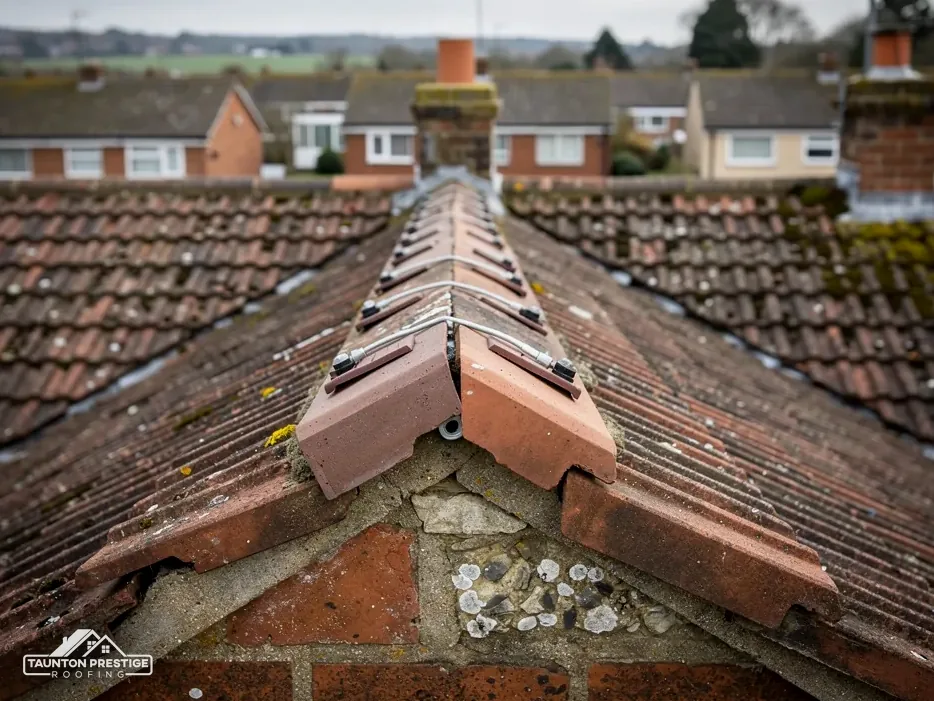
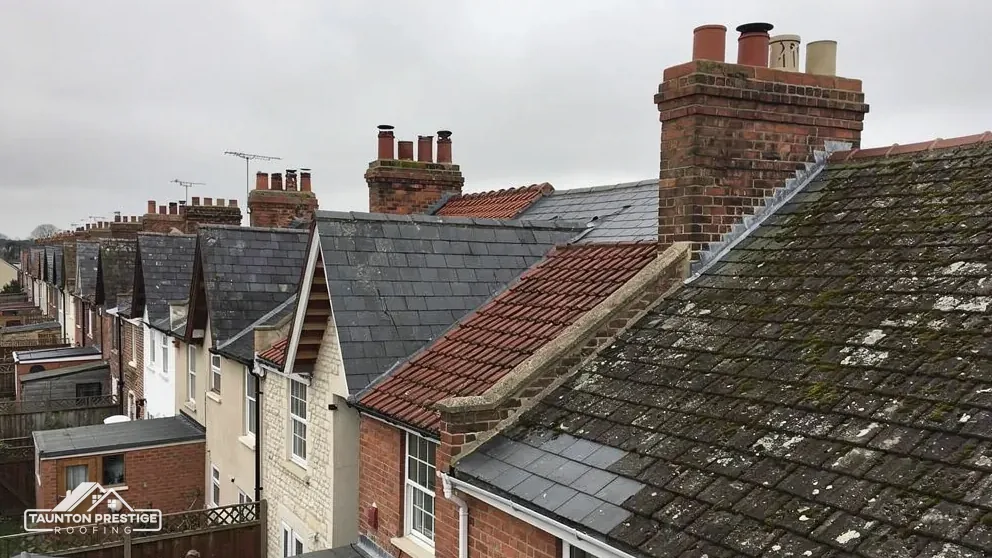
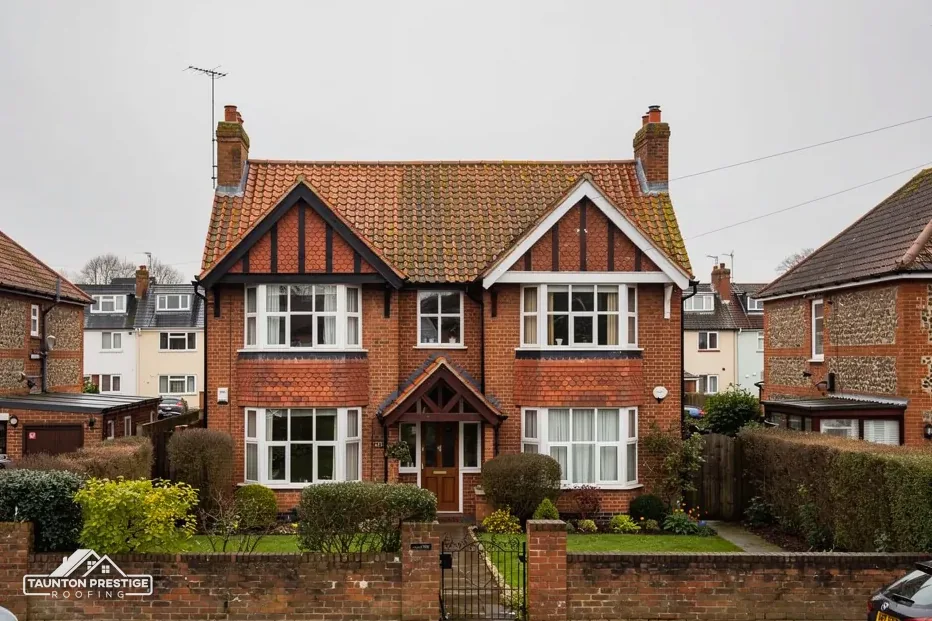
In 1974 the Victoria County History recorded that almost all the houses in Long Sutton and Upton were built of local lias, the older and grander ones with Ham stone windows and dressings. Holy Trinity follows suit, in lias with Ham stone dressings. Lias is a grey limestone, and the village quarried it, first in shallow workings and then systematically from the 1890s until 1939. Stone walls matter to a roofer because the roof has to meet them well: at the verge, where the roof ends against a gable wall, along the ridge, and at any flashing where a slope butts a wall.
What decides the price
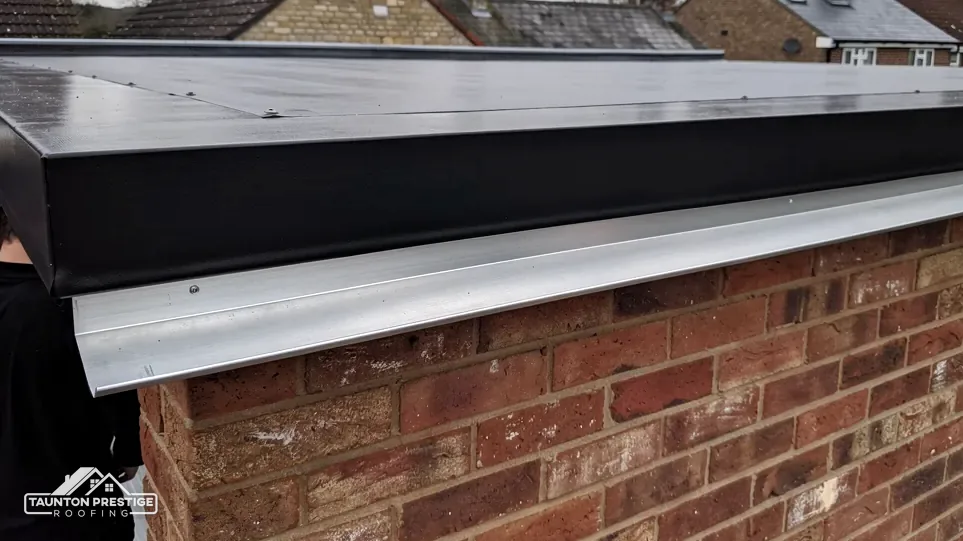
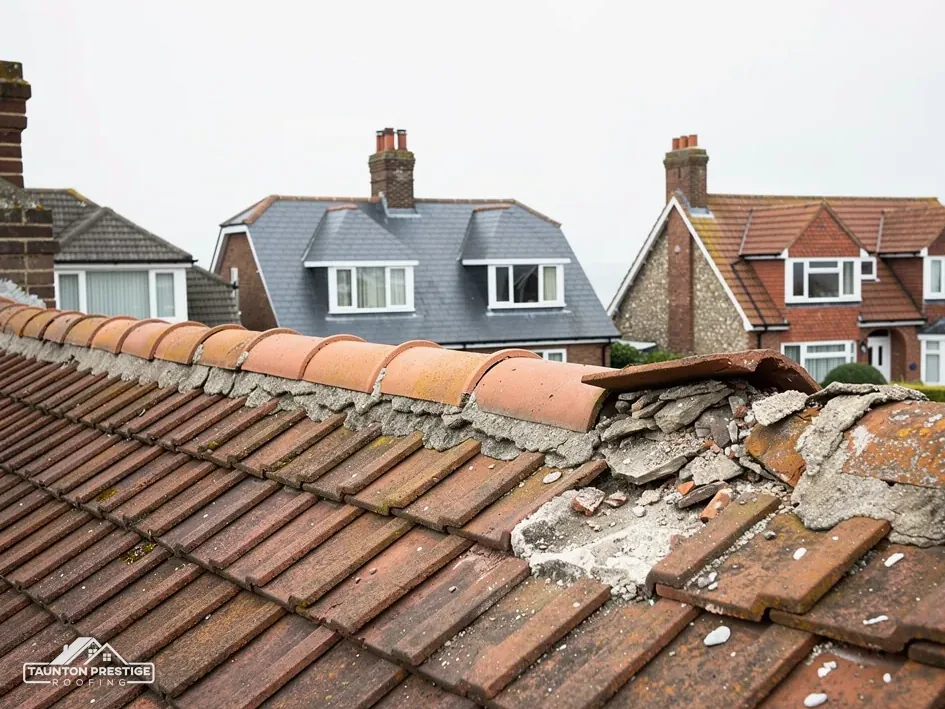
The join between roof and wall is where weather finds a way in. A gable edge laid in mortar cracks and sheds pieces, and a ridge bedded the same way loosens at its joints. A coping, the stone cap on top of a gable wall, can crack too, letting water in behind the roof edge. Repair belongs at the join, not in the middle of a sound slope. Marley's note on the 2014 revision of BS 5534 is blunt about mortar: on its own it cannot be trusted to hold ridge or hip tiles, and any ridge bedded afresh now also takes clips or screws. Dry-fix systems, tested to BS 8612, hold the tiles down with no mortar bed at all.
Often it can, though where the house is listed or inside the conservation area the change of look may decide whether consent is needed. We photograph the existing edge, compare it with the system proposed, and tell you plainly which route is cleaner for your wall. Our dry ridge and verge page describes how the systems differ.
On the Environment Agency's flood map, Flood Zone 3 land lies within about 250 metres of Long Sutton's centre point. That describes land, not any single roof, and your own address can be checked on GOV.UK's long-term flood risk service. What the roof can do is practical: clear rain fast and deliver it to a drain well away from the footings.
Rain reaches the footings by the route you leave it; the gutter should choose a better one.
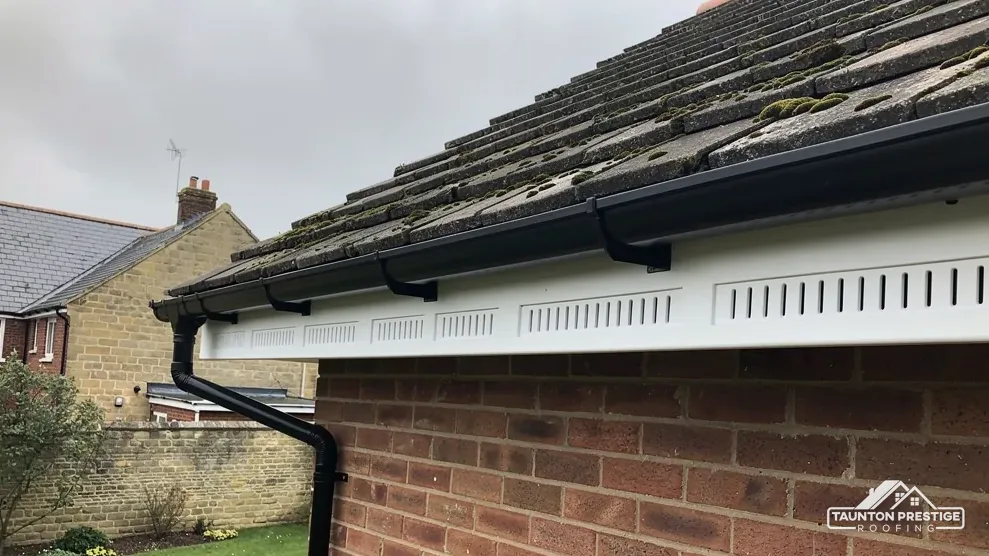
Usually the joint has opened, a bracket has slipped or leaves have packed the run. Brett Martin advises 1mm of fall in every 600mm of gutter, so a length that has sagged will hold a pool and overflow. Left alone, the overflow soaks the fascia, the timber that closes the roof edge, until it softens. We check that board and the soffit, the panel beneath it, before a quote, and our gutters, soffits and fascias page explains the repair choices. Look from the ground after autumn leaf fall and after any storm, because a gutter packed with leaves spills long before it rots.
That turns on the covering. Less gives GRP (glass-reinforced plastic) 25 to 40 years and torch-on felt 10 to 20, while GreenSpec puts EPDM (a rubber sheet) at 20 to 30. These are published ranges, never promises. BS 6229:2025 keeps a finished minimum fall of 1:80, so a flat roof that ponds for days has lost its slope somewhere. Look at the outlet first: an outlet blocks far more readily than it fails.
Downpipes should finish over a gully, not hang in mid-air. A pipe that ends against the wall throws water onto the stone below, and over a winter that shows as a dark stain and a damp patch indoors.
Section 169 of the Highways Act 1980 covers scaffold on the highway, meaning the pavement or the road, and the highway authority licenses it. In Long Sutton that is Somerset Council, which accepts licence applications only from accredited contractors, so the appointed contractor applies. Scaffold on your own drive or in your garden is private ground. A tower or a ladder serves a short job, and we say at the survey which access suits yours. Where the road is the only place a scaffold can stand, we measure the footway then, because the licence, the dates and the cost all follow from that one fact.
What decides the price
Somerset Council charges £124.60 for each 28-day period (April 2026) and asks for at least 10 working days' notice. An overrun needs an extension. The start date we give you already allows for that wait, and each day on site you are told what is happening next.
Sometimes. A new covering 15 per cent or more heavier needs Building Regulations approval and a structural check. The Planning Portal's test is two-part: under 25 per cent of the building envelope and under 50 per cent of the roof. Somerset Building Control (0300 303 7790) covers Long Sutton. Old stone buildings can hold bats, which the law protects together with their roosts, and GOV.UK includes repairing or replacing a roof in its list of activities that may affect them. We look for signs before a slate is lifted.
Once the survey is over, you have photographs and the whole job's price in writing, and we take the waste away. Send your Long Sutton address with a note of the problem, and we will suggest dates for the visit.
Walked the roof?
When you have read the checks, we walk the roof and show you the photos.
If the building is still a place of Church of England worship, the faculty system applies, not the council's listed building consent. The building is Grade I, and its nave roof carries carved tie-beams and angels. The parish arranges the faculty, and the approved specification then governs the work. Ask the parish before anyone books scaffold.
Yes. Marley says the 2014 revision of BS 5534 stopped mortar alone being relied on, so new bedding is backed by mechanical fixings. In the conservation area or on a listed house, keep the same look and ask Somerset Council's planning team before changing the style of the ridge.
Only when scaffold stands on the highway, such as the pavement or the road. Somerset Council charges £124.60 per 28-day period (April 2026), asks for at least 10 working days' notice and takes applications only from accredited contractors. Scaffold on your own ground sits outside that system, though we still set it up carefully and tell you where it will stand.
Anything built or refurbished before 2000 should be presumed to contain asbestos, says HSE, and its A14 guidance treats every asbestos cement roof as fragile. HSE puts careful, unbroken lifting in one class of work and breaking the sheets up in another, stricter class. We identify the sheet at the survey, and the waste moves on a consignment note.
Tell us what you noticed on your Long Sutton roof, and we will offer a survey day.