St Mary's church
Grade II* listed, with worship continuing, so roof repairs are cleared by a faculty and not by the council.
Two Grade II* listings and a conservation area at the village centre
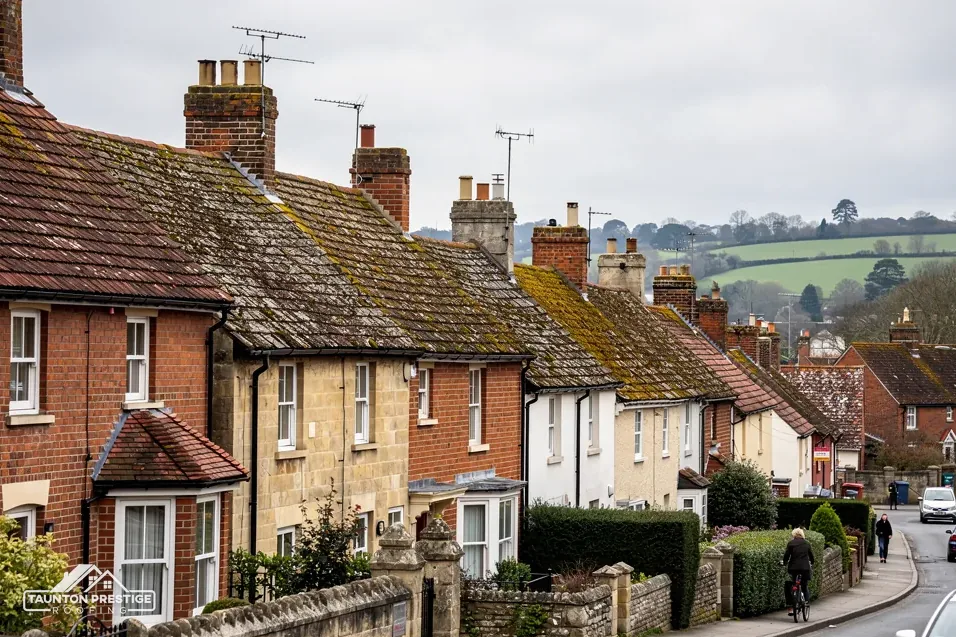
Whimple has a conservation area close to its centre and 27 list entries within 500 metres, so every roof here starts with a check of what is protected.
Grade II* listed, with worship continuing, so roof repairs are cleared by a faculty and not by the council.
Grade II* since November 1982, so a new covering or altered chimney likely needs listed building consent.
Jessamine Cottage and a barn north of The White House are listed Grade II, so check before changing a roof.
Street map of Whimple with Rockbeare, Cranbrook, West Hill, Feniton marked around it, and Taunton.
Rockbeare and Cranbrook lie south-west of Whimple, with West Hill to the south-east. Ottery St Mary is east, Feniton and Payhembury north-east, and Broadclyst west.
About 20 miles south-west of Taunton, East Devon District Council and Devon County Council.
Round the church in four checks
Whimple homes near the church or the centre: four checks, and what each could do to the work and its price.
Whimple's conservation area reaches within about 0.75 km of the centre, and 27 National Heritage List entries fall inside a 500 metre radius. That is a dense cluster, so the listing check comes first at every survey, ahead of slates, gutters or chimneys. Our survey sheet has a line for it, filled in before anyone climbs a ladder. A roof that looks ordinary from the lane may belong to a listed house, and a roof that looks old may not.
The entries include Fordton Farmhouse, listed Grade II* in November 1982, 1 and 2 Jessamine Cottage, and a barn about 20 metres north of The White House and Little Orchard, both Grade II. Historic England publishes the full List, searchable by address, and we check it alongside the survey. A listing takes in the entire building, so a barn roof or outhouse can sit under the same controls as the house itself. If the answer is yes, the written survey says so and names the likely consent route, and you decide whether to apply before any price is fixed. If the answer is no, the conservation area may still shape the covering.
Slipped slates replaced with a match, or a failed ridge bedded again as it was, are repairs. A different covering, a restyled ridge, new roof windows or an altered chimney change the building. On a listed house, listed building consent is needed for changes that affect its character, and our page on planning permission for roof work sets out the routes. Inside the conservation area, put any change to the roof to East Devon District Council's planners first, and order nothing until they reply. St Mary's church is Grade II* and worship continues there, which puts its roof under the faculty system, with the parish applying.
Look for
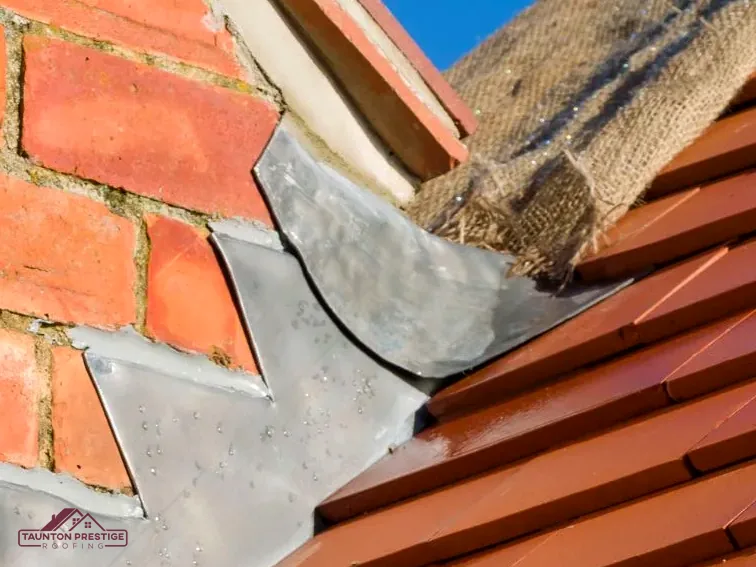
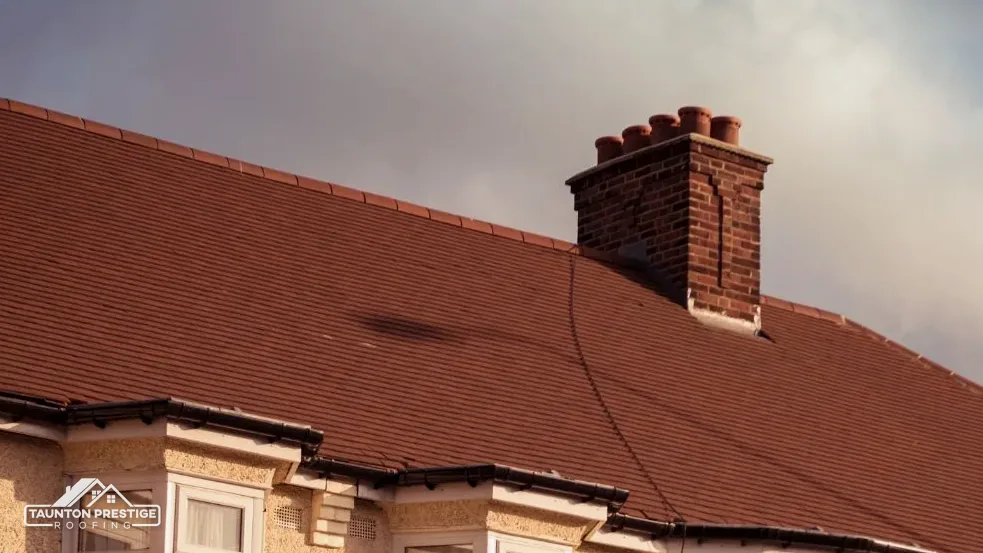
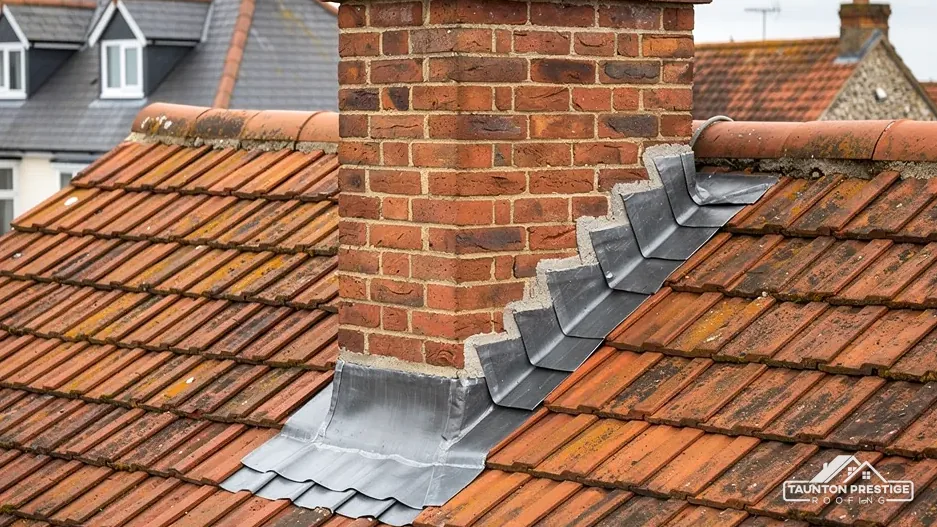
Standing proud of the slope, a chimney stack takes wind and rain from every side, so a ceiling stain upstairs may well lead back to it. Four places give trouble. The pointing is the mortar between bricks or stones. The flaunching is the sloping mortar bed that holds the pots and sheds water outward. The flashings are lead strips that seal the stack to the slope. And the pots or cowls on top can crack or work loose. A damp patch below the stack could come from any of the four, and mending the wrong one wastes money, so we trace the water first. We photograph the top of the stack from a ladder or tower, because a stack that looks fine from the road may have a pot split from the rim down. Pots, flaunching and flashings all get a photograph, so you can see each one for yourself.
Sound or needs work
What decides the price
MyJobQuote says lead can last for over 80 years. Treat that as a floor and not a promise: failure is nearly always at the fixings or the joint with the masonry, not in the metal. Soakers, the small folded lead sheets tucked under each course of tile or slate against the stack, are the part nobody sees from the ground. Thickness comes as a lead code, and our lead work page explains which code suits which detail.
They can, and then the timetable bends. Active nests are protected under the Wildlife and Countryside Act 1981, whose section 1 targets anyone who intentionally damages a nest being built or used. We look at the pots before we plan the work, and a fitted cowl keeps birds out once the stack is sound. The chimney repairs page covers pots, cowls and rebuilds.
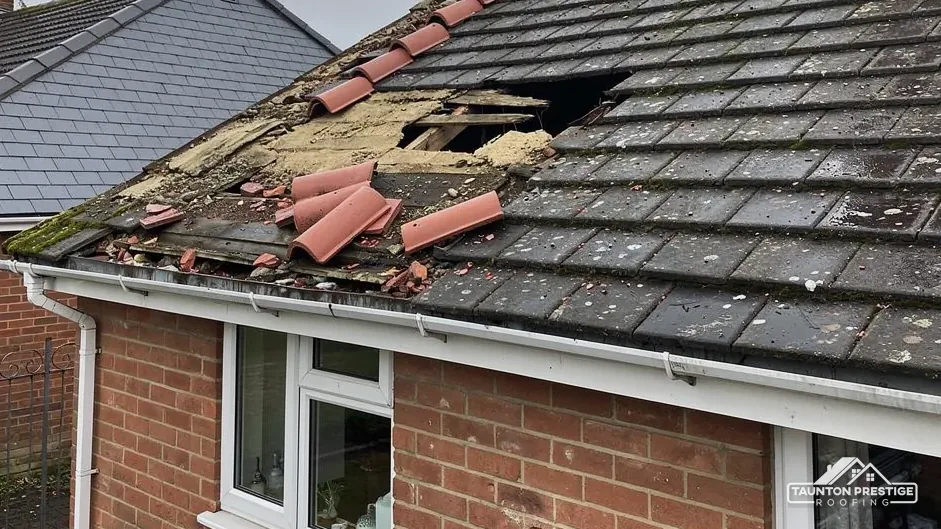
On the Environment Agency's planning map, Whimple's mapped centre falls in Flood Zone 3. A flood zone is about land, so for your own address ask GOV.UK's flood risk service. A roof's storm problems are different and more immediate: slates lifted by wind, gutters overwhelmed, a chimney flashing peeled back. Slates thrown across a garden are the obvious sign; less obvious are cracked ridge tiles, a gutter pulled away from the fascia, or a ceiling stain that appears days later. On a leaking roof our first step is a stop-gap repair that keeps the water out until a proper job can be planned. Wind lifts the edges, ridges and hips first, because suction builds along those lines, so after a gale we check them before the middle of any slope.
Phone the insurer before you throw anything away, and photograph the damage before you cover it.
Phone the insurer first, before anything is thrown away. Then arrange a stop-gap repair and file the receipts. IStructE calls photographs vital to an insurance claim: record the damage from where you can stand safely, and the repair afterwards. Insurers decide claims on their policy wording, and the outcome is theirs to give. What we can do is leave a clear record of the damage, the temporary repair and the work involved, which makes the conversation with the insurer simpler.
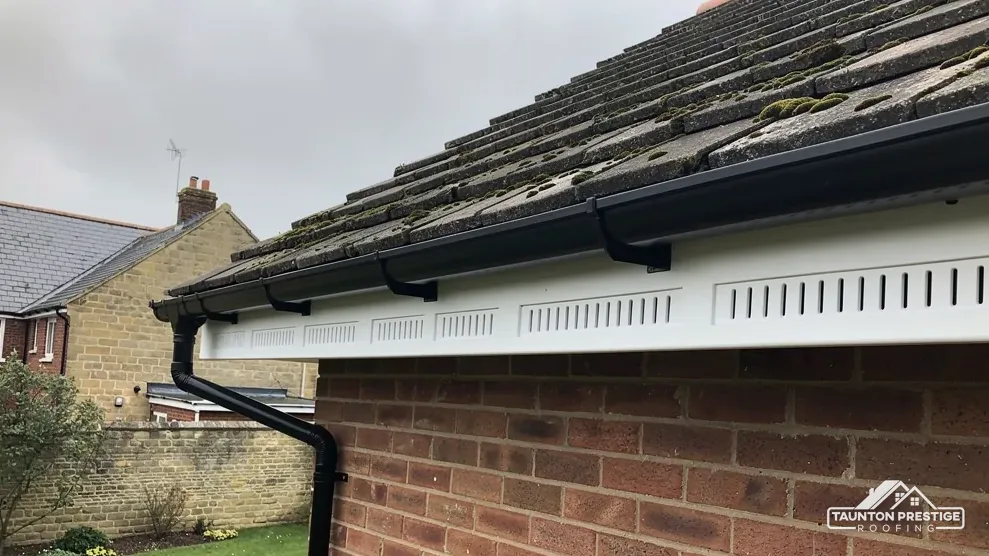
A gutter has to fall gently to its outlet, and Brett Martin gives 1mm of fall for every 600mm of run, and it is worth watching the gutters during the first heavy rain after any repair to confirm they carry the water. A dropped bracket, a split coupling or a mat of debris will beat that in a downpour. The fascia is the board the brackets fix to, and rain that overflows behind the gutter rots it. Our gutters, soffits and fascias page covers the options for the gutter and the boards behind it.
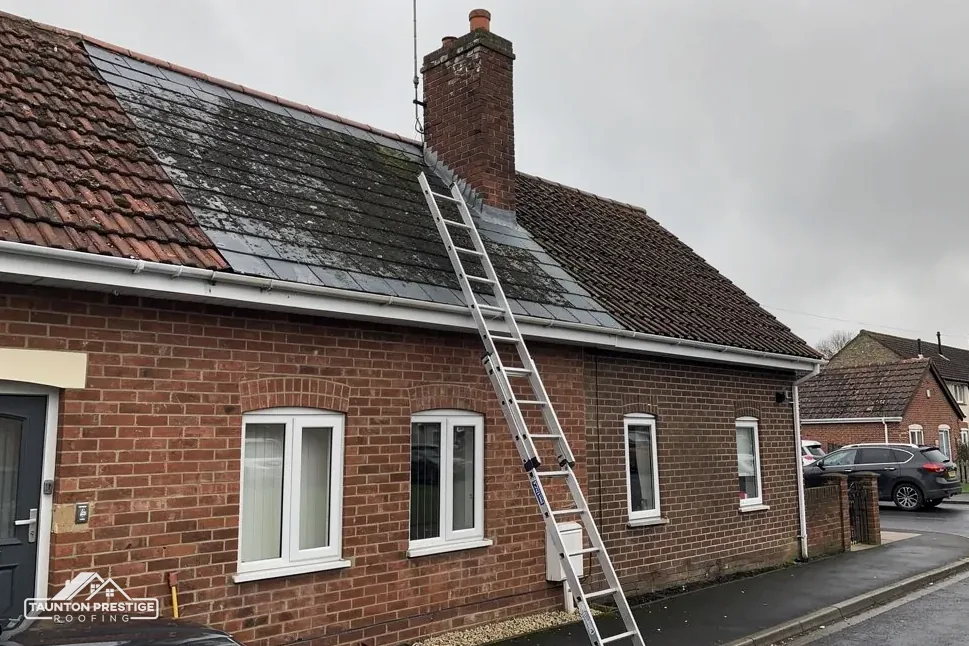
Whimple's highway authority is Devon County Council. Its licence for scaffold standing on a road or pavement, required by section 169 of the Highways Act 1980, is applied for by the scaffolding company for the householder. The licence costs £158, and the council asks for at least 10 working days' notice; an emergency application with less notice costs £238. So a planned job is far kinder to the budget than a rushed one, and we use that when we set the start date. The days scaffold stands are the main cost driver, so we aim for one clean programme of strip, repair, re-cover and take-down. Wet weather can move the dates, and you will be told rather than left guessing. Inside your own boundary, scaffold is off the highway.
What decides the price
It can. For East Devon addresses the district council's building control team, or a registered building control approver, will say. The Planning Portal's guide sets two limits, under 25 per cent of the envelope and under 50 per cent of the roof, below which no application is needed; a covering 15 per cent or more heavier brings Building Regulations approval and a structural check.
We go over each slope, the chimney, the valleys (the inside angles where two slopes meet) and the gutters, and photograph what we find, including parts you cannot see from the ground, such as the slope behind the chimney. You then get a written price that covers the whole job in one figure, with the photographs beside it, and we clear the waste before we leave. Nothing is started until you have seen both, and the days on site are explained in plain terms.
Give us the Whimple address together with what has gone wrong, and a survey will be arranged.
Walked the roof?
When you have read the checks, we walk the roof and show you the photos.
Rebuilding or removing a stack can change a listed building's character, so listed building consent is likely to be needed, while Building Regulations approval is also required whenever a chimney breast comes out. Fordton Farmhouse is Grade II*. Repairs to pointing, flaunching or flashing in matching materials are normally repairs. Ask East Devon District Council's planning team before work is planned.
St Mary's is a Grade II* listed church where worship continues, so its roof repairs go through a faculty applied for by the parish, not listed building consent from the council. The roofer then follows what the faculty permits. We record the covering, lead and gutters at the survey so the parish can describe the roof accurately.
Under the Financial Ombudsman's rules, you can take a complaint to it if the insurer sends no final response within eight weeks, and with the final response letter in hand, six months is the window to refer it. The service is free. Keep photographs, receipts and the insurer's letters together from the outset.
Only after a check. The Planning Portal says a covering that increases roof weight by 15 per cent or more needs Building Regulations approval, and recommends a structural engineer or surveyor's opinion before the work starts. Older timbers carry loads differently, which is why we inspect rafters and wall plates at the survey before suggesting a covering.
Describe the chimney, slope or gutter that is causing trouble and we will set a date for a visit.