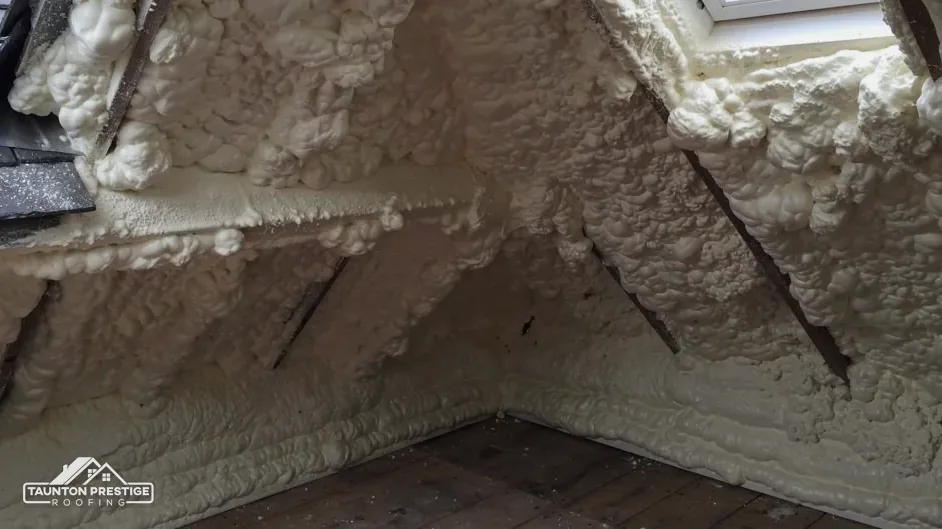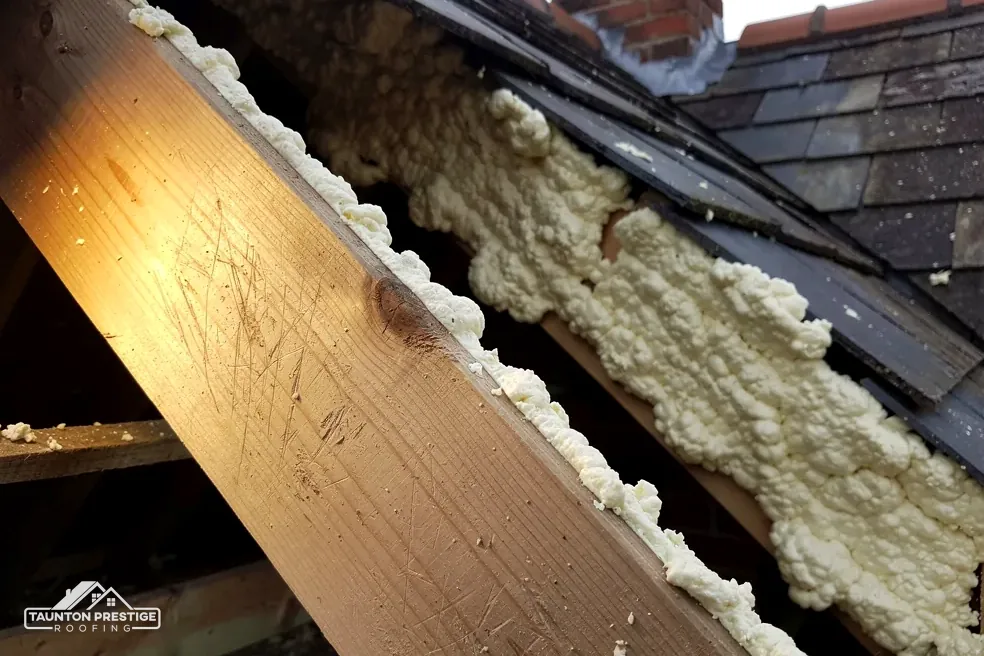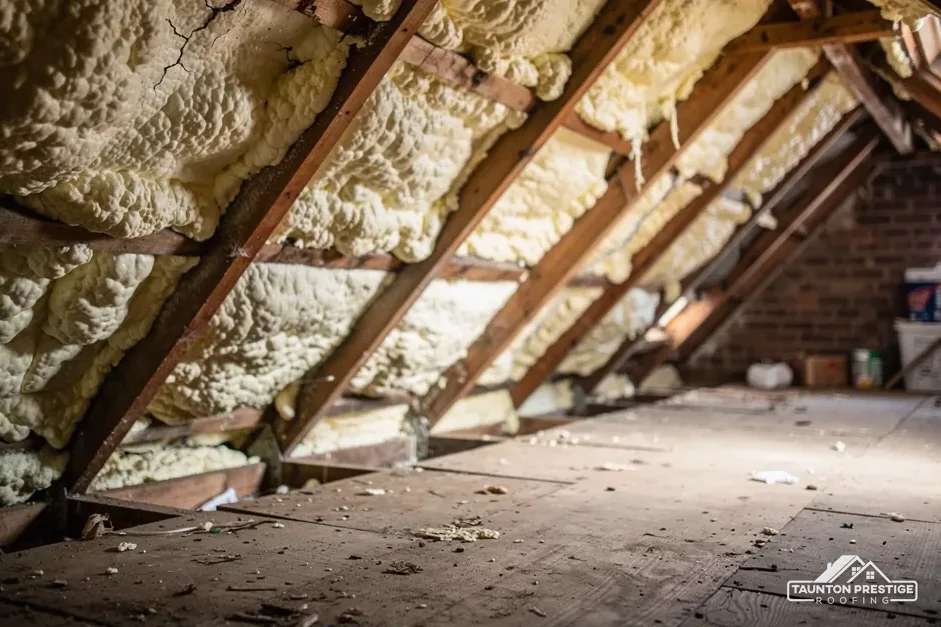
Spray foam is an insulation that goes on as a liquid, swells and sets hard against the slates, tiles, battens and rafters under the roof. Plenty of Somerset owners had it done because it was quick, it closed up a draughty loft and it was sold as a way to cut heating bills. Years later a buyer's surveyor, or the valuer for a new lender, spots it and the questions start. Can the house still be sold? Will the loan go ahead? What is the foam hiding?
Nobody can answer the first two from a distance, and this post does not try. Lenders set their own policies, and a surveyor reports on the house in front of them. What can be set out plainly is the advice from RICS, the Royal Institution of Chartered Surveyors, the reasons surveyors treat foam with caution, and the part a roofer plays: looking at the timbers and the covering behind it. We go through each in turn, with the questions to put to your lender before you spend anything on spray foam removal.
What the RICS guide tells owners
The RICS consumer guide on spray foam insulation is short. Its advice to owners is to ask the provider behind the mortgage whether lender policy permits these products to be installed at all. That is advice to ask a question, and it comes before any promise about what a lender will or will not do. Read it as a prompt to contact your own provider, in writing where you can, and not as a rule that applies the same way to every loan or every house.
Does the guide say foam stops a sale?
No, and nobody else can say so either without seeing your house and your lender's terms. Policies differ between providers, and one house can be treated differently depending on the product, the roof it sits in and who is lending. A surveyor's note about foam is a reason to find out more, and it is not a verdict on its own.
Who should you ask first?
Start with whoever holds your mortgage today, or the lender a buyer is using. Ask whether their policy allows the product, and whether they want anything extra, such as a specialist report on the roof structure. File the answer with your papers. If you are selling, the buyer's solicitor may ask what you were told, and a dated written answer saves a delay later. Our page on selling a house with spray foam covers the steps from the seller's side, and is worth a read before you list.
Why a surveyor flags foam in a loft
A surveyor works from what can be seen, and foam sprayed across the underside of a roof covers exactly the parts they most want to check. The sloping timbers holding up the roof are rafters, and the thin strips the slates or tiles hang from are battens, so both sit right where the foam goes. Once foam is stuck across both, a visual survey cannot look at them, and the surveyor has to say so in the report. That line in the report is often what starts a lender's questions.
What is the surveyor worried about?
Three things come up. The first is the timber under the foam: if damp has got in, rot can start where nobody can see it. The second is the covering, since a slipped slate or a failed flashing that leaks into foam may show nothing on the ceiling for a long time. The third is how long the product will last and whether a later buyer will accept it. These are reasons a report may ask for more investigation, and none of them says your roof is damaged.
Is the worry the foam or what it covers?
Often the second. A sound roof under foam can be perfectly well, but nobody knows until someone looks, which is why an inspection from a roofer helps. Our page on what to do when a surveyor flags spray foam sets out the next steps, and it is a good companion to this post if a report is already in your hands.
Questions to put to your lender
Before you pay for any work, get the lender's position on paper. A short email to the mortgage provider is enough, and the answers will show what you are dealing with and how much time you have. Ask which product is covered, because open-cell and closed-cell foams are different materials with different habits. Open-cell foam is soft and absorbent, and closed-cell foam is dense and rigid, and a lender or surveyor may treat the two differently.
What should you ask, and in what order?
Begin with whether the policy allows the product on your house at all. Then ask what evidence they want: a report from a surveyor, a roof inspection, photos of the timbers, or paperwork from whoever installed it. Ask whether they want the foam removed, or whether an inspection and a clean report would be enough. Finally, ask whether the answer applies to a remortgage as well as a sale, since those two can follow different routes inside the same company.
Who has the installation paperwork?
Look through the file from the original job: the invoice, any product data sheet, any certificate and the name of the installer. A lender or a surveyor may ask for them, and a missing document is easier to chase early than at the point of exchange. If the installer has closed down, say so in your email to the provider, and keep a note of every attempt to find the paperwork.
Do not agree to remove foam only because a report mentions it. Get the provider's position first, then decide.
What a roofer can see behind the foam
A roofer cannot answer a lender's policy question, but can tell you what condition the roof is in. That is the question a surveyor often cannot settle from a loft hatch. We begin with a survey, as on every job, and we send photos of your own roof so you see what we see and can pass them on.
Which parts of the roof do we check?
From the outside, the covering: slipped or cracked tiles, flaking slates, lifted ridge tiles and tired flashings. Flashing, the lead or metal strip that seals a chimney or wall junction against water, is another place where leaks start. From the inside, where the foam allows, the underside of the felt, the battens and the rafter ends at the eaves. Damp and rot tend to show first around valleys, chimneys, the eaves and any earlier leak.
Can a survey show whether the foam has to come out?
It tells you the condition of the roof, and that is evidence a lender can be shown. It does not tell you what the lender will decide. The Energy Saving Trust, in its loft insulation advice, says of putting foam onto a leaking roof that it does not recommend it. If a leak is already feeding into foam, fixing the leak comes first, whatever the lender says later.
Where foam sits on an older roof, for example slates on a Victorian terrace in Taunton, the covering may be fixed and bedded differently from a modern one, so the inspection is slower and the photos matter more. We would rather show you one clear picture of a damp batten than a page of general reassurance.
When removal comes into the picture
Removal is one route, not the only one. It makes sense when an inspection finds a problem under the foam, when your lender or a buyer's lender asks for it, or when you plan work on the roof and the foam is in the way. It is a bigger step than a survey, and worth being sure about before you start, because it cannot be undone.
How is spray foam taken out?
Foam bonded to timber and felt is cut, scraped and peeled away in sections, and then the timbers underneath are checked, repaired where needed and left clean. It is slow, dusty work, and a loft that has been foamed hard to the felt can mean lifting part of the covering. Sometimes only the problem area needs to come out, which is a smaller job and a different conversation with the lender.
What decides the price of removal?
The area of roof, how the foam was applied, how well it has bonded, whether the covering has to come off, the access and carrying the waste away. The written quote fixes one total after the survey. Our page on spray foam removal cost goes through what moves the figure.
Re-insulating afterwards is a separate decision. The loft will need insulating again after the foam has been removed, and the choice of material is easier to make with the roof open and the timbers dry. Ask your lender whether the new insulation also needs to meet any condition, so the second job does not raise the same question as the first.
A sensible order of steps for Somerset owners
If a survey or a valuer has flagged foam in your Taunton house, doing things in the right order counts for more than doing them quickly. Taking these steps in sequence keeps you from paying for work that no lender asked for, and it keeps the paperwork in one place.
What should you do this week?
First, read the survey wording and ask the surveyor exactly what they could not inspect. Second, write to your mortgage provider with the RICS advice in mind and ask what their policy says. Third, find the installation paperwork. Fourth, ask a roofer to survey the covering and, where access allows, the timbers, so you hold photos of the actual condition and not a guess.
Does it change anything if you are selling?
It changes who asks the questions. A buyer's surveyor and lender will raise the same points, so having the provider's reply, the installer's paperwork and a roof survey in a folder before the sale helps the solicitors move. No roofer can promise how a lender will respond, and we do not try.
If you let the house out, or the roof is shared with a neighbour, the same steps apply, and anyone with an interest in the building may want the report. The folder you build now will still be useful in five years, whichever way the foam question is settled.
When you are ready, send us the survey wording and the age of the house. We will book the visit, photograph the roof and give you a single total in writing for whatever it turns out to need.
Spray foam, surveys and lenders
Will my lender refuse a mortgage if my loft has spray foam?
Nobody can say that without your lender's policy and the details of your roof. RICS tells owners to speak to their provider first, so ask yours by email and file the answer beside the survey and the installation paperwork. It also helps to show them a roof survey.
Should I remove spray foam before putting the house on the market?
Not automatically. Removal is a large job, and a lender may not need it. Ask your own provider what evidence they want, and get a roof survey so you know the condition under the foam. Removal makes sense if the survey finds damage or a buyer's lender asks for it.
Can a roofer confirm that my spray foam is acceptable to a lender?
No. A roofer can report on the condition of the covering and the timbers, with photos, and that is useful evidence. Whether a lender accepts the product is the lender's decision, so ask them directly, and treat any roofer who promises a particular lender outcome with caution.
More on this subject: Spray foam insulation removal in Taunton