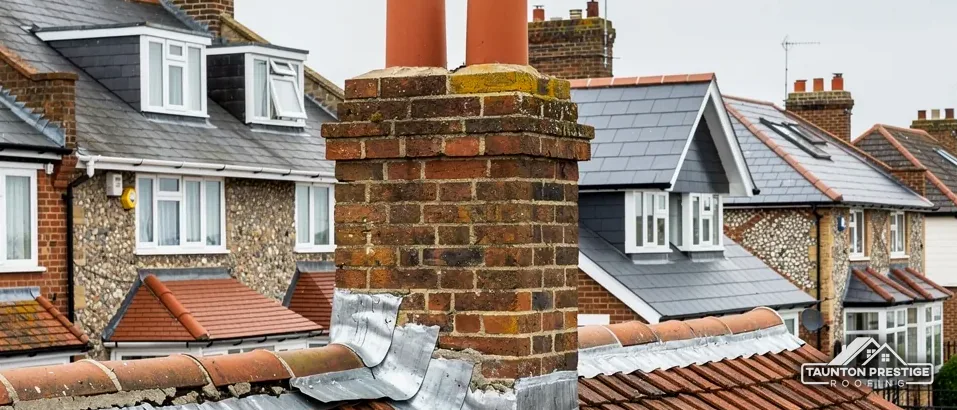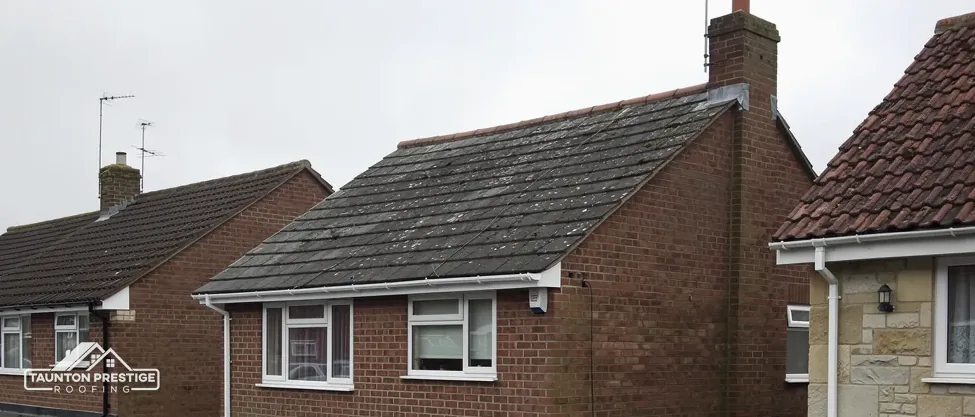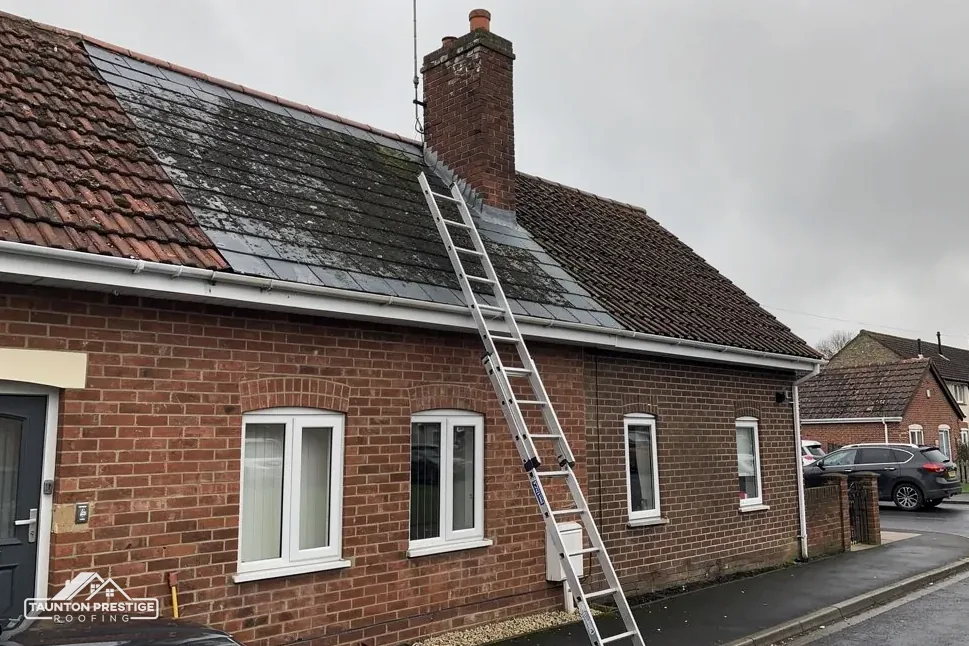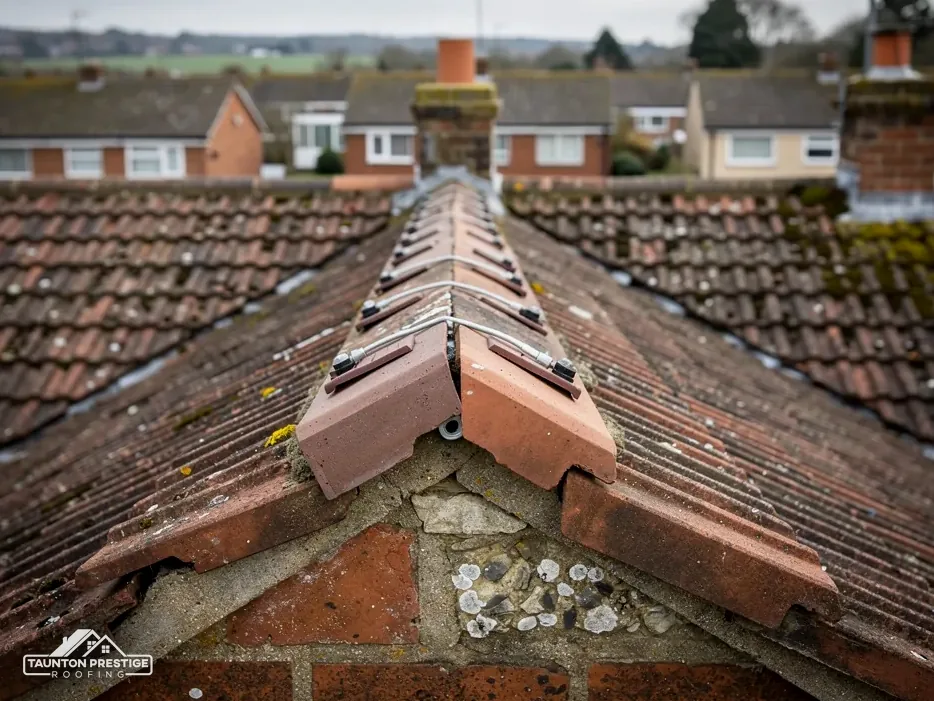
Ask a homeowner what their roof is made of and the answer is often "tiles", which covers at least five different things. Natural slate, fibre-cement slate, clay plain tiles, clay pantiles and Double Roman, and concrete interlocking tiles all look broadly like a grey or red roof from a car window. Up close they behave very differently. They weigh different amounts, wear in different ways, sit at different minimum pitches and cost different amounts to repair.
You can narrow it down without a ladder. A pair of binoculars, a phone zoom and a slow walk round the house will tell you the edge, the surface, the shape of each course and whether the ridge is bedded or clipped. This guide covers each covering in turn, the Bridgwater clay-tile story that explains many Somerset roofs, minimum pitches and typical lifespans from published sources, and what to do when you are not sure. It makes no claim about how common any covering is in Taunton, because streets differ and your own roof is the only one that counts. For the wider picture, start from our homepage.
Reading the roof safely from the ground
Stay on the ground. A roof is slippery, and some roofs are fragile as well, because HSE treats any asbestos-cement roof as fragile. Everything below can be done from a garden path, a pavement across the road or an upstairs window.
What should I look at first?
Start with the size of the units. Slates and tiles come in different sizes, and the number of courses you can count from eaves to ridge hints at the type. Then look at the edges and the surface. Do the pieces look hand-split and slightly uneven, or do they look identical, as if stamped from a mould? Does the surface shine, look rough and sandy, or show pale weathering on a darker base?
Next, look at the profile along a single course. A flat surface points to slate or plain tiles. A repeating wave points to a pantile or an interlocking tile. A wide roll with a flat panel beside it points to a Double Roman. Finally, look at the ridge. A row of half-round pieces bedded in mortar looks different from a dry-fixed ridge with a continuous line and clip-on ends.
What if my roof is a sheet material?
Large corrugated grey sheets on a garage, outbuilding or older farm building are a different case. HSE tells owners to assume asbestos is in any building constructed or refitted before 2000. Do not drill, scrub or walk on sheets like that. Our asbestos in roofs answer covers what comes next.
Natural slate or fibre-cement slate?
These are the two flat grey coverings people mix up most often. Natural slate is a split rock. Fibre-cement slate is a manufactured sheet cut to size. From the ground they can look alike, but a close look at the edges and the colour helps.
How do I tell them apart?
Natural slate varies. The colour shifts slightly between pieces, the thickness is uneven and the exposed edge often shows the layered grain of the rock. Fibre-cement slates tend to be regular in thickness, colour and shape, with a flatter edge. A fallen piece in the garden or the gutter makes it easier: a natural slate shows a layered edge, while fibre-cement has a more uniform grain. A roofer lifting one will know straight away. Our guide to natural versus fibre-cement slate compares them in more detail.
How long does slate last, and how low can the pitch go?
The Confederation of Roofing Contractors writes that well-maintained slate can last 100+ years. Treat that as an indicative figure, never a promise. Pitch matters as well. For natural slate, BS 5534 gives a minimum pitch of 20 degrees, and the supplier Cupa advises keeping hook fixings off any pitch under 25 degrees. A slate roof lower than that suggests a different covering or a specially designed roof.
Natural slate that has outlasted its fixings is often worth saving. Where it counts, a slate roof gets slate again, since the slates are often the part of the roof that lasts longest.
Clay: plain tiles, pantiles and Double Roman
Clay tiles are fired from clay, so each one varies a little in colour, and the roof has a warm, slightly speckled look. Three clay forms matter in Somerset.
What is the difference between a plain tile, a pantile and a Double Roman?
A plain tile is small, flat and slightly curved, laid in overlapping courses so each tile covers the joints below. A pantile has an S-shaped wave, and the waves interlock along the row. A Double Roman has a broad roll beside a flat panel, which gives the long, rolling pattern seen on many older houses and farm buildings across Somerset.
Where does the Bridgwater story fit?
The South West Heritage Trust names Bridgwater for its output of terracotta plaques, bricks, tiles and similar wares, and says that trade influenced the look of many Somerset towns. A local heritage leaflet adds that brick making was joined by plain tiles made by hand, plus ridge and pan tiles, and that the popular Bridgwater Double Roman tile arrived on the product list afterwards. That is why the profile is familiar around the county. It does not tell you what is on your roof, so judge the tile you can see and not the name.
For lifespan, the BRE sets a 60-year minimum life expectancy for clay tiles. A building-conservation source warns that, for old peg tile, a lifespan figure is plainly no dependable guide. Treat it as a floor for modern clay, never a promise, and remember that a covering which has lasted a long time may still be sitting on tired battens and nails.
Clay plain tiles are laid to a steep pitch: Marley lists 40 degrees for its Canterbury clay tile and 35 degrees for its Ashdowne, while its Lincoln pantile can go down to 15 degrees.
Concrete interlocking tiles
Concrete tiles are a modern covering that suits houses of many ages. They grip along their sides through interlocking ribs, and each is made in a mould.
How do I recognise a concrete tile?
The surface is often granular, with a sandy feel, and the colour tends to be even from tile to tile, sometimes with a painted or coated finish that fades as it weathers. The edges are crisp and consistent. Profiles vary: some are flat, some have a gentle roll, and some copy the Double Roman shape in concrete. A modern concrete Double Roman and a clay Double Roman can look similar from the road, though a close view usually shows the difference in surface and colour range.
What pitch and lifespan do they have?
Marley's published minimum pitches differ by profile: 22.5 degrees for its smooth Double Roman, 17.5 degrees for Edgemere and Modern-Duo, 15 degrees for Mendip and Wessex, 35 degrees for its concrete Plain tile and 25 degrees for Anglia. Marley expects its roof tiles to last for around 60 years and states plainly that this figure is neither a guarantee nor a warranty. That is the maker's own estimate for its tiles.
Find the manufacturer's data sheet that matches the very tile on your roof. Minimum pitch depends on the product, the exposure and the headlap, and a roofer measures the actual slope rather than relying on a table. Our roof tile profiles guide shows the shapes side by side.
Why the covering changes the repair
Knowing the covering changes the job in four ways, and each one shows up on the quote.
Can a repair match what is already there?
Slates and tiles weather and fade, so a new piece rarely matches an old roof straight away. Reclaimed slates and clay tiles are often the answer for a patch on an older roof. A concrete tile that is still in production is simpler to match, though even then the colour of a long-weathered slope will differ for a while.
Does changing the covering need consent?
It can. Class C normally covers re-roofing on a house, and a like-for-like swap that leaves the outside looking the same is not development. A change of material needs more care on a listed house or inside a conservation area, and our Taunton conservation areas guide covers the checks. Building Regulations come in as well: Building Regulations approval follows if the new covering is 15 per cent or more heavier than the old one, so a structural check comes before the order.
What does the covering do to the price?
MyJobQuote (Oct 2026) averages a new roof at around £5,250 and a new slate roof at around £7,800, as typical UK figures. HomeBuilding (Sep 2025) gives £10,000 to £15,000 for a semi-detached three-bedroom house in plain concrete tiles. The sources differ widely because they measure different things. What you pay turns on the roof's area, the access, the covering, how much can be reused and what the survey finds underneath. The written price follows the survey.
When you are still not sure
Some roofs defeat a ground-level look. Re-roofed slopes sit beside original ones, a side extension carries another covering than the main house, or years of moss and lichen hide the surface. In that case, photos are your best tool.
What photos help most?
Take them in even daylight from a safe spot. Try to capture a close shot of one section of the roof with a phone zoom, a wide shot that shows the whole slope, one of the ridge and one of the eaves where the edge of a single piece is visible. Any fallen piece in the garden or the gutter is worth keeping, along with a note of where it came from.
What happens at a survey?
On a survey we read the roof properly: the covering, the pitch, the fixings and the ridge. The photos shown to you are of your own slopes, so the identification is demonstrated and not just asserted. The survey notes the pitch against the minimum for the covering. It also notes how the roof is likely to age.
Does the age of the covering matter as much as the type?
Yes, though lifespans are typical ranges from published sources and never promises. A well-kept clay or slate roof can outlast a poorly installed newer one. So our survey covers the fixings, the battens and the underlay along with the surface.
If doubts remain after your own look, send your photos with the address, and the survey begins with naming the covering.
Telling one covering from another
How can I tell if my slates are natural or fibre-cement without a ladder?
Look at the edges and the colour. Natural slate varies in thickness and shade and often shows a layered grain on the edge. Fibre-cement is more regular. A fallen piece makes it simpler, and a roofer who lifts one will know at once. Never walk on a roof to find out.
Is a Double Roman tile always clay?
No. Bridgwater is known for its clay Double Roman, but Marley also makes a smooth concrete Double Roman with a 22.5 degree minimum pitch. The shape alone does not settle it. Surface, colour range and any marks on a spare tile show which material you have.
Does it matter if I mix up clay and concrete?
It matters for repairs, pitch and consent. Matching a worn clay slope takes more care, and a change of covering can alter the weight of the roof. A survey sorts out which you have before anything is ordered.
More on this subject: Roofers in Taunton