Winter brings the questions. A brown stain spreads on the bedroom ceiling after a cold snap, there is a drip in the loft on a morning with no rain, or a gutter hangs full of ice and water pours down the wall. Each can look like a leaking roof, and each has a different cause and a different fix. Spending money on slates when the problem is damp air, or ignoring a lifted flashing because you blamed condensation, are the two ways a winter repair goes wrong.
This guide starts with the loft. It explains how condensation differs from a leak, what frozen gutters and driving rain do to a roof, which checks you can safely make yourself, and how to read the weather pattern behind a drip. It also answers the question owners ask when the work cannot wait: can roofers work in winter? It belongs to our emergency and general roof repairs service for Taunton and Somerset.
Condensation or a real leak: the first test
The quickest question is when the water appears. A leak follows rain. It starts during or soon after a shower, it tends to be worst under the spot where the covering has failed, and it eases when the weather clears. Condensation follows cold and still conditions. It builds up overnight, shows as droplets under the felt or on nail points, and can be at its worst on a dry, frosty morning.
Condensation is warm, damp indoor air meeting a cold surface. In winter the temperature gap is widest and windows stay shut, so there is more of it. The roof is not letting water in. The house is putting water up.
How can you tell from the loft?
Condensation is usually widespread. It affects the whole underside of a slope or several rafters at once, darkens timber in an even way and leaves insulation damp across a broad area. A leak is local, with a clear tide mark running to one point. Look for a single stained rafter with a trail uphill, a wet patch below a chimney or a valley, or daylight at a gap.
A week's diary helps: note the date, the weather, whether the drip came with rain and how the loft felt. One caution: the two can happen together. A roof with condensation can also have a slipped slate, and the damp air makes the leak harder to read. If you cannot separate them, photographs from the loft help a roofer judge, and our guide to finding the source of a roof leak explains how water travels after it gets in.
What to check in the loft
Take a torch, keep to the joists or a plank spanning them, and treat the plasterboard between as unable to carry you. Do it on a cold morning, when condensation is at its most obvious, and again after rain, when a leak shows.
- Beads of water or frost on the underside of the underlay or on nail points.
- Black spotting or mould on rafters, particularly near the eaves and the ridge.
- Insulation that is damp, compressed or stained.
- Extractor fan ducts that end in the loft, not outside the building.
- A loft hatch that fits poorly, letting warm air up from the landing.
- Insulation packed into the eaves so tightly that it blocks the airway.
Why does the eaves detail matter in winter?
Because that is where air enters a cold roof. BS 5250:2021 is the code of practice on moisture control in buildings; BSI lists it as current, under review. Marley, a tile manufacturer, publishes cold-roof figures for HR underlay, which is non-breathable: an eaves gap of 25mm at pitches up to 15 degrees and 10mm above that. For LR, breather, underlay with a tight ceiling below, it relies on the 3mm that ordinary eaves construction leaves, subject to third-party certification.
If the eaves are blocked, moisture sits in the roof void and shows up each winter. Looking along the eaves with a torch shows daylight where the gap is open and darkness where insulation has closed it. If insulation is pushed to the edge, pulling it back a little often restores some air movement. Our page on ventilated dry ridge covers the outlet end.
Frozen gutters, ice and meltwater
Gutters carry rain off the roof edge. When the water in them freezes, the channel blocks. The next rain or melting snow has nowhere to go, so it spills over the front, runs down the wall, or backs up under the first row of tiles at the eaves. If the lowest course has no proper tilting fillet or eaves tray, which is the strip that guides water into the gutter, water can run behind the fascia, the board fixed along the edge of the roof, and into the wall head.
Ice can also load a gutter. A full, frozen length of plastic or cast iron is heavy, and brackets that were already loose can pull away from the fascia.
What should you do about an iced-up gutter?
Do not climb a ladder in the cold to chip it clear. Ice on rungs and a wet slope is a bad mix. Pouring boiling water on gutters can crack old plastic and cast iron. Often the best move is to wait for a thaw, then clear the leaves and moss that held water in the first place. Check afterwards that the gutter runs to the downpipe with no sag, since a dip holds water and freezes first. If the gutter is overflowing onto a wall and you can see damp inside, a roofer can clear and check it from a safe platform.
Meltwater from a snow load behaves like a very slow downpour. It can seep under tiles that shed ordinary rain with no trouble, and it keeps arriving for as long as the thaw lasts, so a small gap can pass a surprising amount of water. Stopping the water comes first, and the permanent repair is planned once the roof is no longer taking it in.
Driving rain and wind
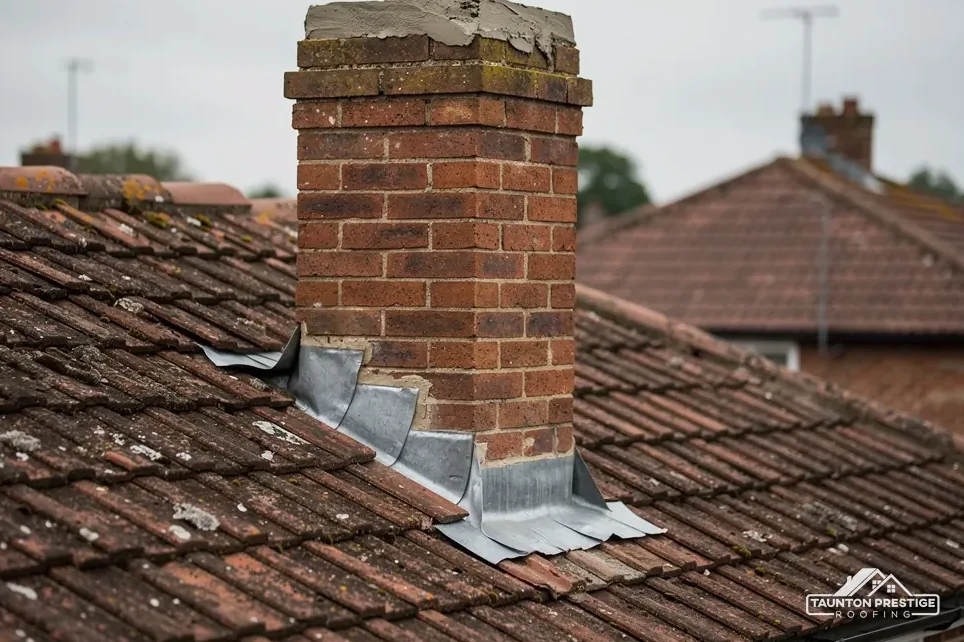
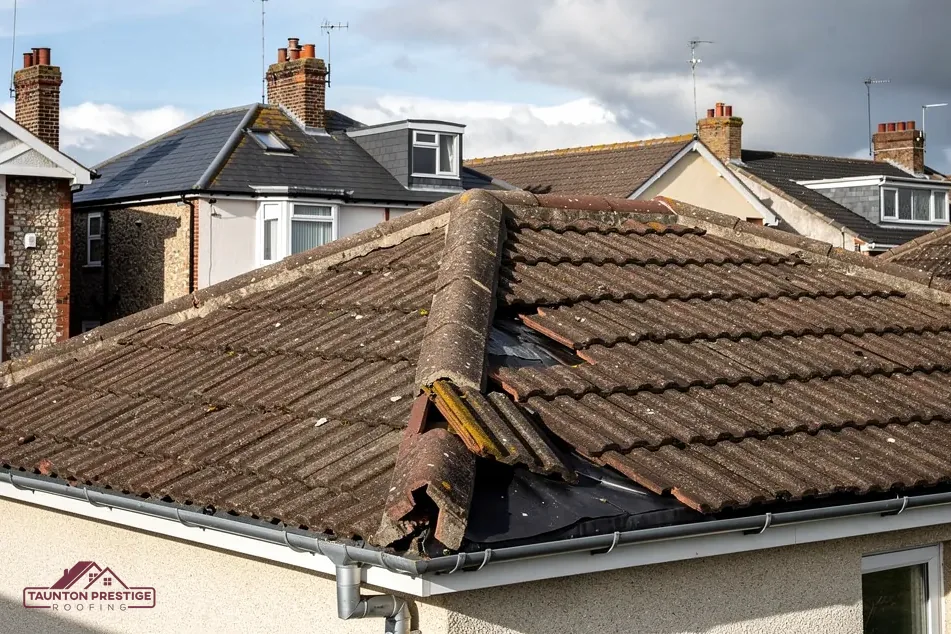
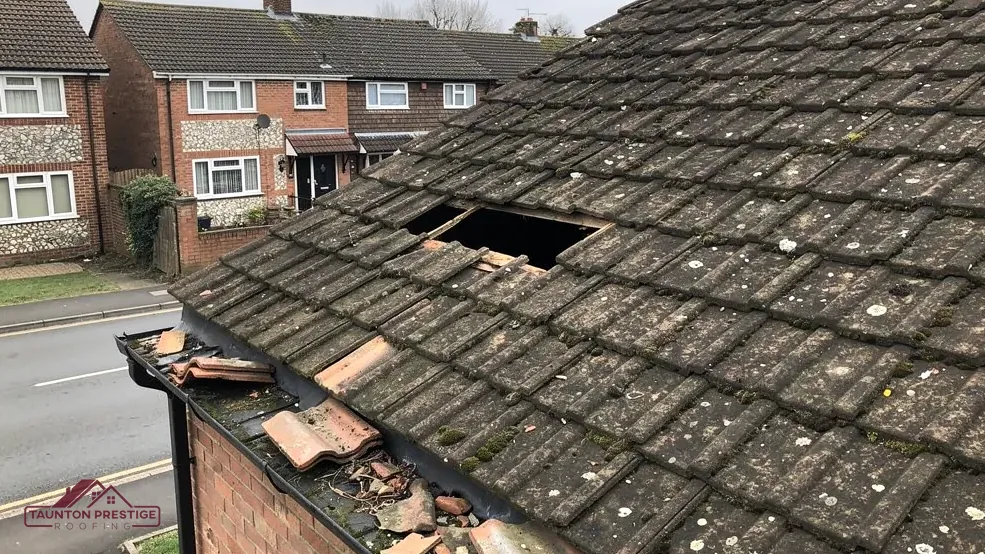
Heavy, wind-driven rain behaves differently from a vertical shower. It blows sideways and upwards, and water that would never get past an overlap in calm weather is pushed under the edge of a slate or tile. That makes winter storms the time when marginal faults show for the first time: a cracked slate, a ridge with a gap at the end, a worn valley, a lifted flashing at a chimney or a verge, the stretch of roof beside a gable wall.
In the Quantock and Blackdown Hills villages and out on the Somerset Levels, wind and driving rain find every weak joint in a roof, which is why a roof that is dry for months can leak on one particular wet, gusty night.
Does a leak only in one wind direction mean anything?
Yes. A leak that appears only when the wind blows from one side points to an exposed face: a gable, a verge, a chimney on that side or a joint on that slope. Writing down the date and wind direction when the drip starts gives a roofer something to work with, and a note of whether the rain was heavy or only steady adds to it. If wind is coming through the ridge, our page on why dry ridge systems fail shows how to spot it.
Make a note of where water enters after each storm, take dated photographs, and keep them for your insurer. Ring the insurer before you spend anything, cover the damage temporarily and hold on to receipts, as our page on storm damage and wear and tear explains.
Can roofers work in winter?
Yes, with limits. A good deal of roof work goes ahead through the colder months, and plenty of repairs are made in the damp season because that is when faults show. What changes is the order and the pace. Safety decides first. We do not put people on a roof that is icy, soaked or in gusty wind, and a job stops when conditions make it unsafe.
Some work is easy to do in winter: replacing slipped slates and tiles, refixing flashings, clearing and refitting gutters, fitting a temporary covering. Other work is better left for a dry spell. Wet mortar and frost do not suit each other, a half-stripped roof is a worry if rain is forecast, and sheets of felt cannot be dressed well in wind. We choose the order accordingly.
What happens if the weather turns during a repair?
We plan each stage so that no part of the roof stands open overnight. A slope is stripped and covered in stages, and a temporary sheet goes on before we leave when needed. You hear what is planned for the day and how the forecast is changing it. Short days matter too: a job that fits one summer afternoon may need two visits in December, and the plan allows for that. Scaffold, or access set up properly, is part of that,. Where the scaffold would stand on the footway or carriageway, the highway authority must grant a scaffold licence first, and we sort that out with the scaffolder. Our temporary roof repair page explains tarpaulins and boards.
If a roof is leaking now, make-safe comes first and permanent repairs follow when the weather allows.
When to call for help, and what it costs
Call a roofer when the water keeps returning after rain, when a ceiling is stained and bulging, when slates have slipped or when a gutter is detaching. In the meantime, move furniture, stand a bucket under the drip and stay out from under a bulging ceiling. Should water reach a light fitting, turn that circuit off at the consumer unit.
Condensation is a different call. A roofer can check the eaves and the loft, but the fix often lies in the house itself: a fan that vents outside, a sealed hatch, insulation pulled back from the eaves, and some heating and ventilation in the rooms below.
What do repairs cost?
The typical UK range for emergency call-outs is £150 to £300, and storm repairs run to £1,200 or more (MyJobQuote, Oct 2026). The average roof repair is around £650 (MyJobQuote, Oct 2026). The figure for your roof turns on its pitch and height, the access and scaffold, the number of slates or the length of lead involved, and what lies under the covering once it is lifted. Ask whether the total in any quote already covers VAT and scaffold hire. The rest of the typical figures depend on the job once the cause is known.
A survey is the way to separate the faults, which matters in winter, when a wet ceiling can come from the roof, the pipes or the air inside the house. We show you what is on the roof and in the loft, then send one total price in writing.
Winter roof worries
Can roofers work in winter?
Yes, when conditions are safe and the surface is dry enough to work on. Slate and tile repairs, flashings and gutters can go ahead in cold weather, while some work waits for a dry spell. A roof is never left open overnight: we cover each stage as we go, and every morning we tell you what that day's work will be.
Why is my loft dripping on a dry, cold morning?
That points to condensation. Damp indoor air has reached cold timber or underlay and turned to water. Check that fans vent outside, the hatch seals, and insulation has not blocked the eaves. A drip that only follows rain is more likely a real leak.
Will a frozen gutter damage the roof?
It can. A blocked, ice-filled gutter sends water over the front or back under the first course of tiles, and the weight can pull loose brackets from the fascia. Wait for a thaw before you clear it, then have the fixings and falls checked so the next freeze finds nothing to hold water.
More on this subject: Emergency and general roof repairs in Taunton