A tiled roof works quietly for most of the year. Then a cold week arrives, followed by a gale and three days of rain, and every small weakness gets tested together. A tile that was already hairline-cracked splits. A ridge tile with tired mortar shifts. A batten that has been damp for years finally lets go of its nails. The damage often shows up in January or February, but it was usually in the making long before.
This guide takes the three winter forces in turn. It explains frost and the flaking called spalling, wind uplift and slipped tiles, and rain soaking into the timber beneath. It then sets out what you can safely check from the ground and the loft after a storm, the faults we look for on roofs across our patch, and the signs that mean a make-safe cannot wait for a convenient week. It sits within our pitched roofing work, and the emergency side is covered in our guide to roof repair in high winds.
How winter finds the weak points
Tiles and slates are tougher than the structure beneath them. Winter exposes the places where the system is not working as a whole: a cracked tile, a missing clip, a gap at a joint, a gutter that has overflowed onto the eaves for months. None of these needs much weather to cause trouble, and cold, wet and windy weather together tests all of them in one go. Winter finds whichever joint overlaps least.
Why do problems appear in the same weeks every year?
Because the seasons line up the stress in a predictable order. Autumn leaves block gutters and valleys, and water that cannot leave the roof finds another way. Cold nights then turn any water in a porous tile or a joint to ice. Storm winds follow, lifting whatever frost and damp have loosened. By the time you see a tile on the lawn, the roof has often been working loose for weeks.
The villages on the Levels and in the hills can be more open to wind and driving rain than the sheltered streets in town, so a repair that is fine in one place may not survive in another. We take the exposure of your site into account when we judge fixings.
Prevention is not mysterious, and it costs very little. Clear gutters in autumn, look at the roof from the road after each stormy spell, and have loose or cracked pieces seen to before the next cold snap. Our guide to preparing your roof for winter has a longer checklist.
Frost, water and spalling
Spalling is the flaking away of a tile's outer face. It happens because tiles are porous. They take in water in wet weather, and when that water freezes it expands and pushes the surface off in small flakes or larger scales. One cold snap rarely does it. Repeated freeze and thaw, season after season, does.
What does spalling look like?
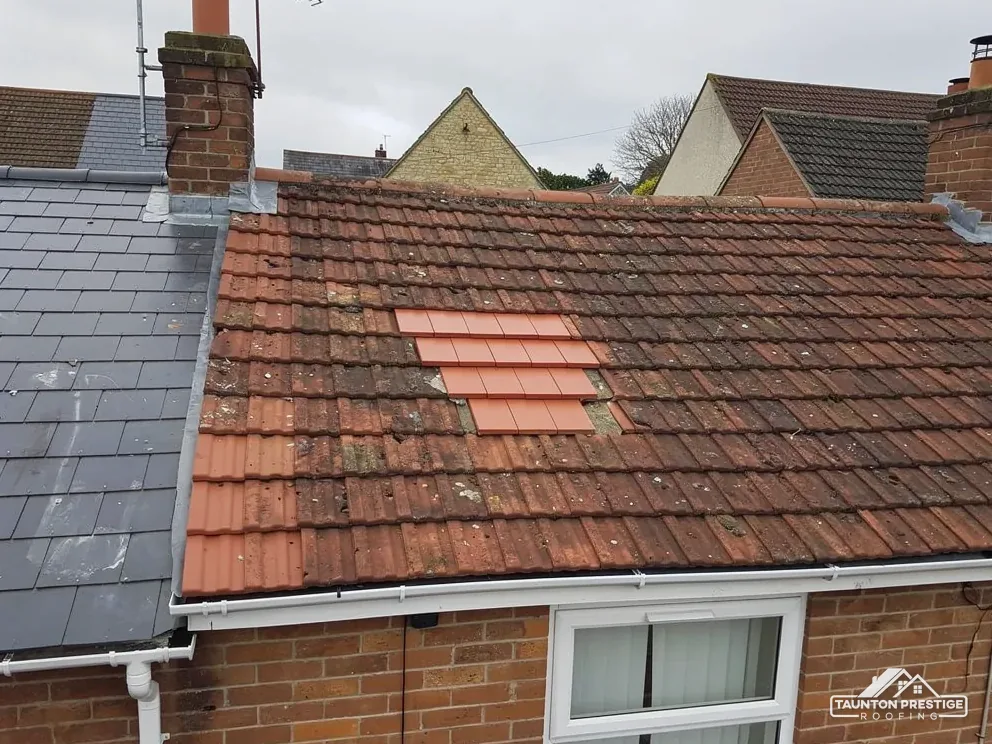
From the ground, you may see tiles with a rough, pitted or peeling face, often darker where the fired surface has come away. In the garden or the gutter you may find orange or grey grit and thin chips. On clay tiles the damage can show as flaking along the edges. A single flaked tile is a repair job. A whole slope of them is a sign the covering is approaching the end of its useful life. Our page on spalling roof tiles goes into the cause in more detail.
Age matters. The BRE puts a minimum life of 60 years on clay tiles specifically, though buildingconservation.com cautions that old hand-made peg tiles do not follow that guide. A clay roof of any age deserves a watchful eye after each winter.
If you find chips, photograph them where they lie, and note the date and the weather. Do not walk on the roof to look for the source, and leave any ladder work to a roofer. Tiles that are already cracked can break underfoot and send you through the covering.
Wind uplift and slipped tiles
Wind does not only blow tiles off the way a hand might. Air rushing over a roof lowers the pressure above it, so the tiles are sucked upwards. Air forced into a gap at the eaves or verge pushes from below. The combined effect is called uplift, and it is why edges, ridges and corners go first.
What lets a tile ride out of place?
Each tile hangs on a batten by a nib, a small projecting lug, and many are also held by a nail or a clip. When the nail rusts, the batten softens, or the clip was never fitted, the tile has nothing to resist uplift except its own weight. It rides up, shifts sideways, or drops a few centimetres and leaves a gap that rain can enter. Our page on whether roof tiles need clips explains the fixing question.
BS 5534 is the code for slating and tiling. Marley notes that following it is voluntary in law, though it is the benchmark a careful roofer works to. At ridges and hips, the 2014 revision made clear that mortar by itself is no dependable hold in a gale, so those tiles are secured mechanically, using metal fixings or a dry-fix system tested to BS 8612. Mortar still has a place, just not as the only fixing.
A tile that has slipped should be put right promptly, because the gap shows up at the next heavy rain. A roofer working from a ladder or a roof ladder can often do it in one visit, provided the batten beneath is sound. One slipped tile can let in water for the whole length of a rafter.
Rain, saturated battens and the slow damage
Of the three winter forces, rain does the most damage over time, because it works quietly. A cracked or slipped tile lets a little water onto the underlay. The underlay carries most of it away, but it soaks the battens, the horizontal laths each tile hooks onto, and the nails holding them.
What happens when battens stay wet?
Timber that stays damp over many weeks softens, then rots. The nails rust in it, the fixings lose their grip, and tiles start to slide in places that never had a visible fault. This is how a small gap in November becomes a patch of slipped tiles in March. If the underlay is old or torn, the water goes further, onto the rafters and the insulation, and then the ceiling.
You can spot the slow damage from the loft, using a torch on a dry afternoon. Look for dark tide marks along the underside of the roof, drips on the insulation, rusty nail tips, and timber that feels soft under a thumb. Where there is a leak, the stain usually runs down from a point above, and a roofer follows it upslope. Our guide to a roof leaking in winter explains the steps in order.
A damp loft in winter is also not always a leak. Damp air from cooking and bathing can turn to water on cold timber, and that calls for ventilation, not a repair. A roofer reading the loft can tell the difference, and the underlay type matters here too.
After a storm: what to check
You can learn a great deal without leaving the ground. Wait until the wind has dropped and it is light.
What can I safely check myself?
Walk round the house and look up. Binoculars help. You are looking for gaps in the pattern of the tiles, a ridge that has developed a kink, tiles sticking out at an angle, and flashing, the metal strip sealing the joint at a chimney or wall, that has lifted or bent. Look at the ground for fragments and at the gutters for overflow marks. Then check the loft with a torch for light where there should be none, and for fresh water stains. Take photos of everything. Never climb up to look, and never lean a ladder on a gutter or a damaged edge.
Which storm faults do we look for on a Taunton roof?
When we survey after a blow, we check slipped and missing tiles, ridge and hip tiles that have shifted, mortar or a dry-verge system that has loosened at the edge, flashings lifted at chimneys and walls, valleys choked with debris, and gutters or fascias pulled away. We also look for what is not visible from below, such as battens that took a soaking.
The survey comes with photos of your own roof. They show what failed, what is sound, and what is only a risk. If one repair is enough, we tell you. If the covering is worn out, we say that plainly, and explain the choice between patching and renewing in the same visit. Our guide to roof inspection after a storm shows what a thorough one covers.
When a make-safe cannot wait
Some things can wait for a survey. Others should not, and it helps to know which is which before you pick up the phone.
Which signs mean it is urgent?
Water running into the house, a ceiling that bulges or drips, tiles hanging loose over a path or door, a chimney that has moved, or a roof sagging in a line all call for a make-safe. That means stopping water coming in or removing the danger first, and doing the permanent repair afterwards. Among the examples of dangerous structures on Somerset Building Control's website are loose or falling roof tiles, and its number is 0300 303 7790. Our page on a dangerous roof in Somerset explains who to contact.
What should you do about insurance?
Contact your insurer at the outset. Next comes a temporary repair to limit further harm, and then the evidence: dated photos, and every receipt kept in one folder. The Institution of Structural Engineers stresses how much a set of pictures helps to show what was damaged. Whether the insurer pays is a matter for your policy and its terms, and nobody outside the insurer can promise how it will go.
The Financial Ombudsman Service publishes its own plain-English test for what counts as a storm, so read it before you put in a claim. It will look at a complaint once eight weeks have passed without a final answer, or once you have an answer you dispute, and you then have six months to bring it. Using the service costs nothing. For consumer advice, the Citizens Advice consumer helpline is 0808 223 1133.
Questions on winter roof damage
Can frost damage a roof tile that looks fine?
It can start damage you cannot see. Water in a porous tile freezes and expands, and the face may flake only after several winters. Look for grit in the gutters, and for tiles whose surface has turned rough or pitted, since those flakes are early signs.
How soon should a slipped tile be put back?
Promptly, and before the next heavy rain. A gap in the covering lets water onto the underlay and battens, and a wet batten loses its grip on the nails over a season. One tile now is a small repair. A winter of wet timber is a larger one.
Does a storm repair need scaffold?
Not always. A few tiles within ladder reach may not need it. A repair across a slope or at a high chimney usually does, and scaffold on a pavement needs the highway authority's licence, which we arrange with the scaffolder before work starts.
More on this subject: Pitched roofing in Taunton