Roofs rarely fail in the first dry week of September. They fail in the third wet week of November, when a gutter that has been silting up since spring finally overflows, when a slipped slate lets water onto a batten, or when a flat roof that has held a puddle all summer starts to seep. By then the weather is bad, the daylight is short and every roofer in the county is busy.
A short autumn check moves that discovery forward by a few weeks. Most of it needs only your eyes, a torch and a pair of binoculars, and none of it needs you on a ladder or the roof. This guide goes through the six places winter finds first: the gutters, the slates and tiles, the ridge and verge, the flashings and lead, flat-roof outlets, and the ventilation in the loft. It says what to look for, what is safe to do yourself and what to leave to a roofer, with typical UK costs from named guides. If something is already leaking, the temporary roof repair guide explains the make-safe steps. Our wider work is on the homepage.
Gutters and downpipes first
Water leaves a roof by one route, and the gutter is the first stage of it. When leaves, silt and moss block the run, water spills over the front edge and runs down the wall or soaks the fascia board behind, the board that carries the gutter. In freezing weather the overflow can ice up and add weight.
What can I check from the ground?
On a wet day, stand outside and watch. Water should run in the gutter and out of the downpipe. Look for drips at joints, a gutter that sags between brackets, plants growing from the run and wet streaks on the wall under it. Listen for a downpipe that gurgles or splashes instead of flowing.
Fall matters as well. Brett Martin's guidance is 1mm for every 600mm, a gentle slope towards the outlet. Standing water along a level run is a sign the fall has gone, often because brackets have shifted.
Who should clear them?
Clearing gutters means leaning a ladder on an edge that is often soft or brittle, and a slip there is costly. Hand it to someone with the right access. MyJobQuote (Oct 2026) lists around £1,000 to £1,600 for replacing guttering, a typical UK range, which is why a cleared, working gutter is cheaper than a failed one. Our how often to clean gutters answer sets out a routine.
Slipped, cracked and missing tiles or slates
Single slipped slates are the most common thing winter finds, because wind lifts a loose piece and rain follows the gap. They are also the easiest to spot in advance.
How do I scan the slopes from the garden?
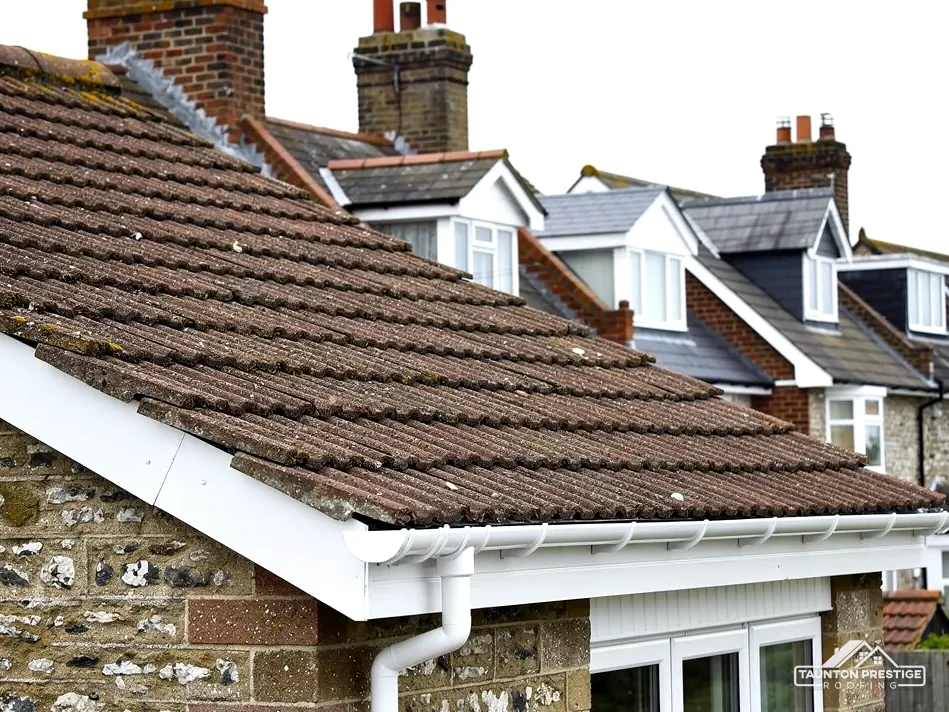
Stand back far enough to see a whole slope, ideally in low sun, and run your eyes along each course. You are looking for lines that dip or wave, dark gaps where a piece has gone, pieces that sit proud of their neighbours and broken fragments on the ground below. Binoculars or a phone zoom help. Walk the garden afterwards, since slate and tile fragments gather near the wall.
The loft gives a second view. On a bright day, switch the light off and look for daylight through the roof. Even a pinprick of light shows where water could find its way in. Check the felt and battens for dark patches and drips, and photograph anything you find.
What does a small repair cost?
MyJobQuote (Oct 2026) puts replacing five tiles at around £215, with a typical UK range of £150 to £200 for five tiles and £200 to £275 for ten to twenty. Access changes this, so a price on a high or awkward slope may be higher. Ask for the fault to be shown in photos.
If slipping is spreading across a slope rather than sitting in one spot, the fixings or battens may be failing. Our winter roof tile damage guide covers when a repair stops being enough.
Ridge and verge before the gales
The ridge is the crest at the very top, where two slopes come together. The verge is the sloping edge that finishes a gable wall. Both stand proud of the roof, face every gale head on and need secure fixing.
Which warning signs matter on the ridge and hips?
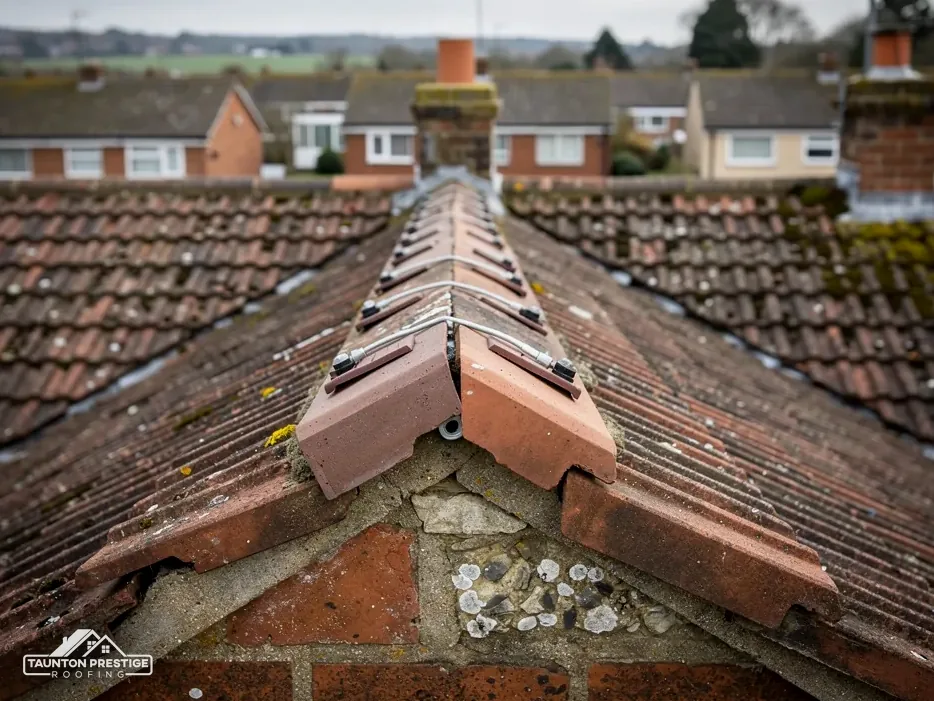
On a ridge, look for tiles that have shifted out of line, mortar that has cracked or crumbled and left dark gaps, and any piece sitting loose at the end. On a verge, look for a mortar edge that has cracked or pulled away from the roof and for tiles that overhang less than they used to. A dry-fix system uses clips, screws and a continuous line instead of mortar, so check that none of the end caps have gone.
Is mortar alone good enough?
Not on its own. Marley points out that since the 2014 revision of BS 5534, mortar on its own is no longer treated as a fixing for ridge and hip tiles, which is why bedded tiles are also held with mechanical fixings. BS 8612 is the standard whose tests dry-fix verge, hip and ridge systems must meet. Mortar is not banned. It simply should not be the sole fixing between a tile and a gale.
What do they cost?
As typical UK figures (MyJobQuote, Oct 2026), replacing ridge tiles averages between £225 and £550, while a dry verge installation tends to land between £500 and £2,000. The range depends on length, access and whether the old bedding has to be cleared first. Our re-bedding ridge tiles guide shows what the work involves.
Flashings, valleys and lead
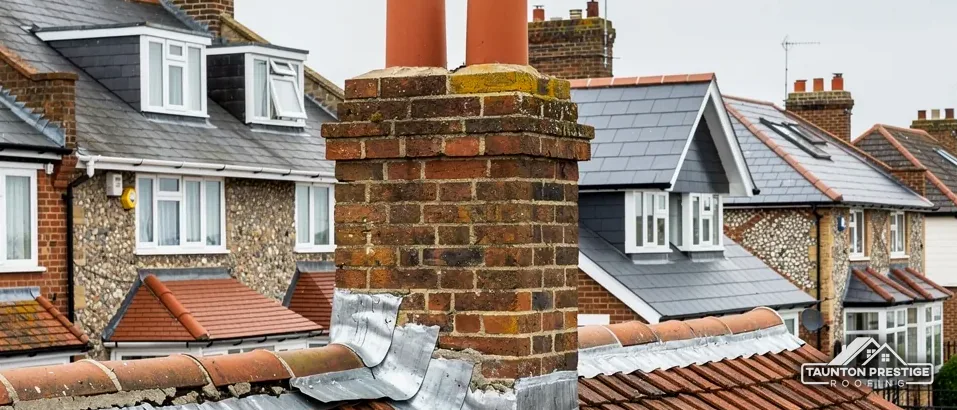
A flashing is a strip of metal, normally lead, which seals the joint where the roof butts against a chimney, a wall, a dormer cheek or the frame of a roof window. A valley is the inward fold between two slopes, where their runoff collects into one channel. These are the joints that move most, so they are where many winter leaks begin.
What can I see from outside?
Look at the lead around the chimney first. Check for a lifted edge, a gap where the lead has pulled away from the brickwork, cracked mortar above it and sealant that someone has smeared over the top. Sealant is a sign that someone has already had a problem here. Lead valleys and chimney trays should lie flat and look undamaged. Moss packed into a valley holds water against the edge.
Lead lasts well when it is detailed properly. According to MyJobQuote, lead flashing can last for over 80 years, which is a floor rather than a forecast. Old, sound lead is often worth repairing instead of replacing.
What does valley or lead work cost?
MyJobQuote (Sep 2026) puts a typical full roof valley replacement at around £540, and (Sep 2026) lists £150 to £250 for patching the leadwork around a chimney, against £350 to £920 for the full job, where scaffolding alters the total. Those are typical UK figures only. Our types of lead flashing guide explains the names you will hear.
A bead of sealant on a flashing is a patch. If you spot one, have a roofer inspect the lead below it.
Flat roofs: outlets, puddles and falls
Flat roofs are the surfaces most often forgotten in autumn, partly because nobody sees them. They also take leaves from every tree nearby, and a blocked outlet turns a flat roof into a shallow pond.
How do I check one safely?
If you can see the roof from an upstairs window, look at the outlets and gutters for leaf piles and check for standing water a day after rain. Indoors, check the ceilings under the roof for stains, sagging or fresh cracks. Do not climb onto a flat roof to look, since a membrane that is slippery with moss or ice is unforgiving.
What fall should a flat roof have?
BS 6229:2025 keeps a 1:80 minimum finished fall across ordinary roof areas and internal gutters. To reach that, IKO, citing the 2018 edition, advises designing the roof with a fall of 1:40. The finished minimum and the design fall are different numbers, and a roof built flat from the start will always hold water. The standard covers membranes such as felt, EPDM, a synthetic rubber sheet, and GRP, which is glass-reinforced plastic. It does not cover lead.
Less (26 Oct 2026) puts the life of torch-on felt at 10 to 20 years, EPDM at 30 to 50 years and GRP at 25 to 40 years, and adds that sources for EPDM vary. Where a flat roof is close to the end of that span, schedule its replacement for spring rather than the depths of winter. Our flat roof winter problems guide covers the faults.
Loft ventilation and a plan for bad weather
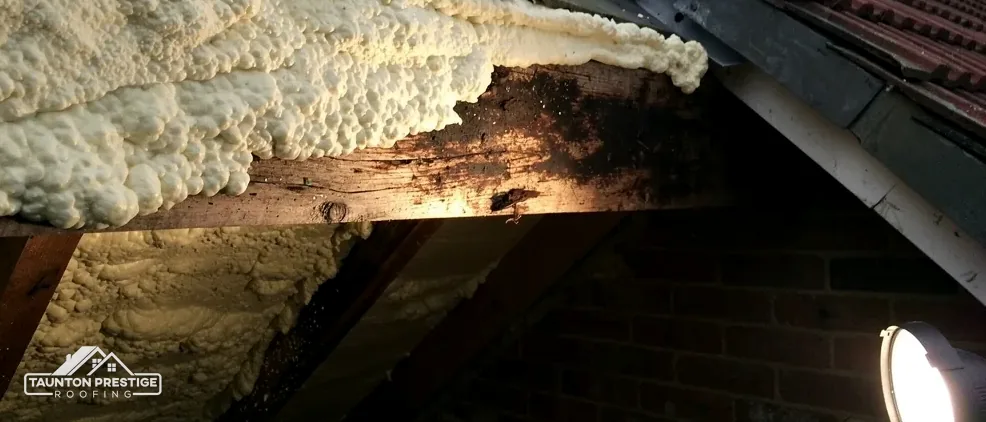
A roof also has to breathe. Moist warm air escaping from living rooms drifts up into the loft, and in winter it reaches cold timber and condenses. That shows up as damp patches, mould and black spots on the underside of the roof.
How much ventilation does a cold roof need?
BS 5250:2021 is the standard covering moisture control in buildings. Marley advises an eaves opening of 25mm on pitches of 15 degrees or less, and 10mm above 15 degrees, when a cold roof has non-breathable HR underlay. With breathable LR underlay and a sealed ceiling the picture changes, and Marley describes 3mm of fortuitous ventilation at the eaves coming from normal construction, subject to third-party certification.
What should I check in the loft?
Look at the eaves. Insulation pushed hard into the gap can block the air path. Check that vents are clear and that bathroom fans do not discharge into the loft. If mould is already visible, a roofer should assess the cause.
What if the weather turns before the check is done?
Keep a note of your plan. Tell the insurer first if damage occurs, make a temporary repair if it is safe, and keep photos and receipts. GOV.UK has a tool to check your long-term flood risk if you want to understand your address. Our roof maintenance checklist turns this guide into a yearly routine.
When the six checks are done, send us anything you cannot explain and we will book the survey around the weather.
Autumn roof check queries
When is the best time in autumn to have the roof checked?
After the leaves have mostly fallen but before the first stormy weeks, which in practice means late October to mid November. Gutters then carry a full load of leaves, and any slipped piece shows up before wind tests it. A dry day gives a safer, clearer survey.
Can I clear my own gutters before winter?
You can scoop leaves from a low, easily reached gutter at ground level. Anything that needs a ladder against the edge or a reach over a conservatory is better left to a roofer. A brittle gutter can snap under a ladder, and the ground below is a long way down.
Should a flat roof be treated differently in autumn?
Yes. Clear leaves from outlets, look for standing water a day after rain and check the ceiling below for stains. A flat roof rarely gives warning before it leaks, so if the membrane is blistered, split or near the end of its typical life, plan the work for spring.
More on this subject: Roofers in Taunton