St Andrew's, Grade I
Listed Grade I; Burnham's first real settlement grew near it around a spa and housing for lodgers.
A Grade I church, spa-era lodgings and railway housing in south Burnham
Burnham-on-Sea grew from a spa near St Andrew's church, then from the railway. We read the roof first and price it second.
Listed Grade I; Burnham's first real settlement grew near it around a spa and housing for lodgers.
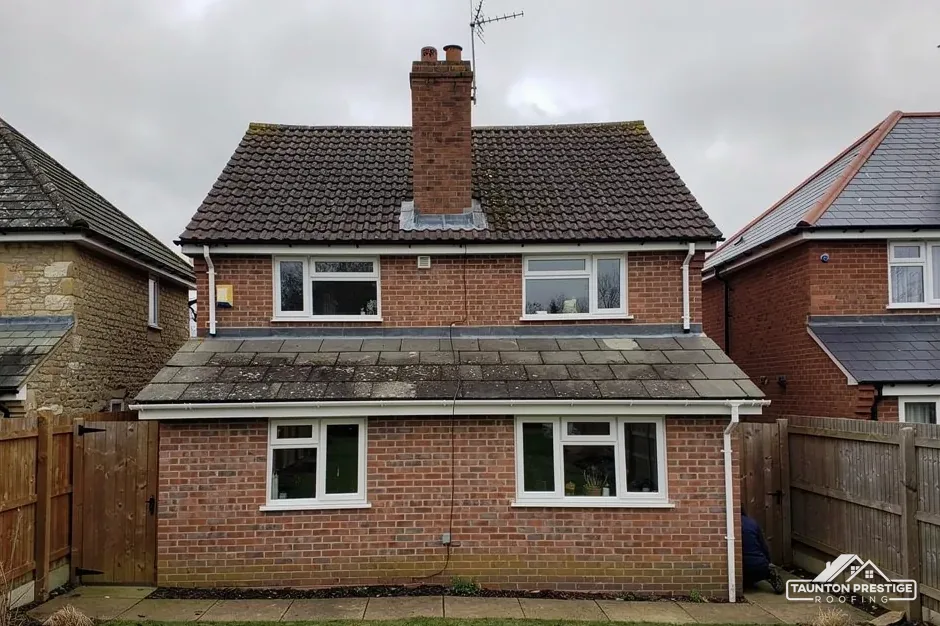
Listed Grade II in May 1985, a house where a matching repair comes before any change of covering.
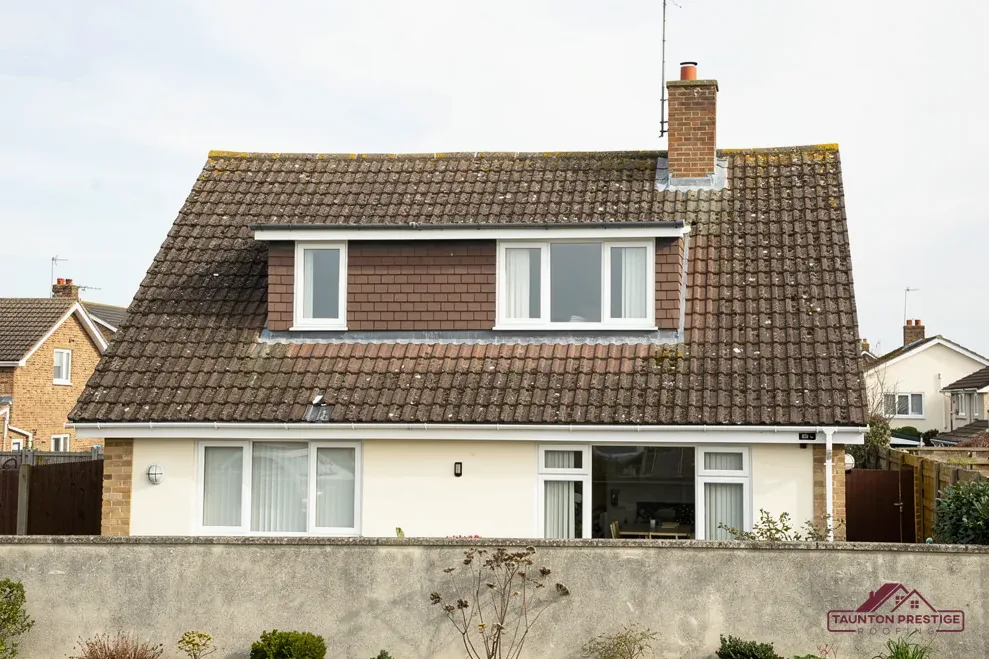
After the railway works opened in 1862, railway housing was built in south Burnham.
Street map of Burnham-on-Sea with Highbridge, Brent Knoll, Berrow, West Huntspill marked around it, and Taunton.
Berrow lies to the north, with Brent Knoll and East Brent to the north-east, while West Huntspill sits to the south and East Huntspill to the south-east.
About 16 miles north of Taunton, Somerset Council (unitary).
Four checks in a spa and railway town
A quartet of questions for any house here, and how each one steers the method, the timing and the final price.
Burnham-on-Sea has a conservation area that lies within about 0.75 km of the town centre, and listed buildings in and around it: St Andrew's church is Grade I and 31 Berrow Road is Grade II. The Somerset Extensive Urban Survey tells how a vicar, the Rev Davies, funded a spa complex near the church from the sale of his private lighthouse, and how the visitors it drew led to Burnham's first real settlement, with elegant housing to provide lodgings. Old buildings of that kind are exactly where the planning rules start to matter.
Ask Somerset Council's planning team and give your full address, because the boundary is a matter for the council and not for us. Inside the area, the rules about dormers are tighter, and changing the look of a roof can need more than a builder's say-so. Our guide to planning permission for roof work sets out where permitted development stops.
Listing leaves a house its permitted development rights, but work that changes its character also needs listed building consent from the council. A matching repair is one thing; a new covering is another. If you are unsure, describe the job to the planning team before ordering materials, and keep the council's answer in writing. That reply is the proof of the route you followed, and a buyer's solicitor may ask to see it years from now.
St Andrew's serves the Church of England as a place of worship, so its roof work goes through a faculty, arranged by the parish, and not through the council's listed building consent. We note on the survey what each slope is covered in now, so that anything sent to the council starts from fact. A lodging-house terrace and a seafront villa are different buildings, and we treat them so.
Look for
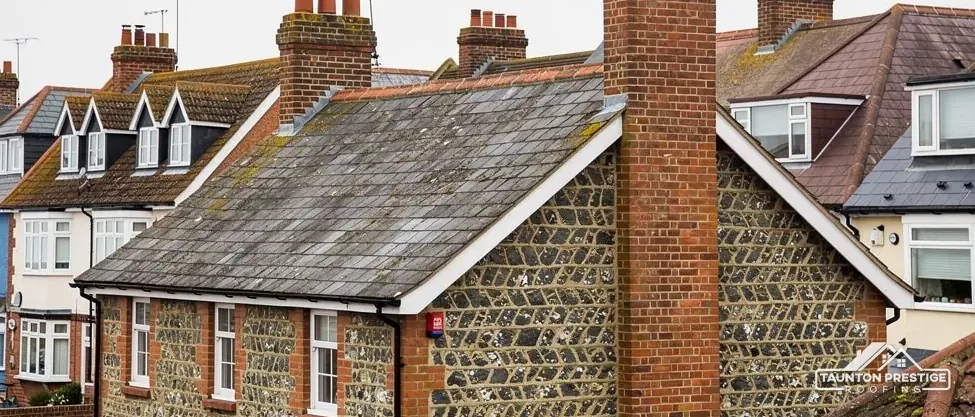
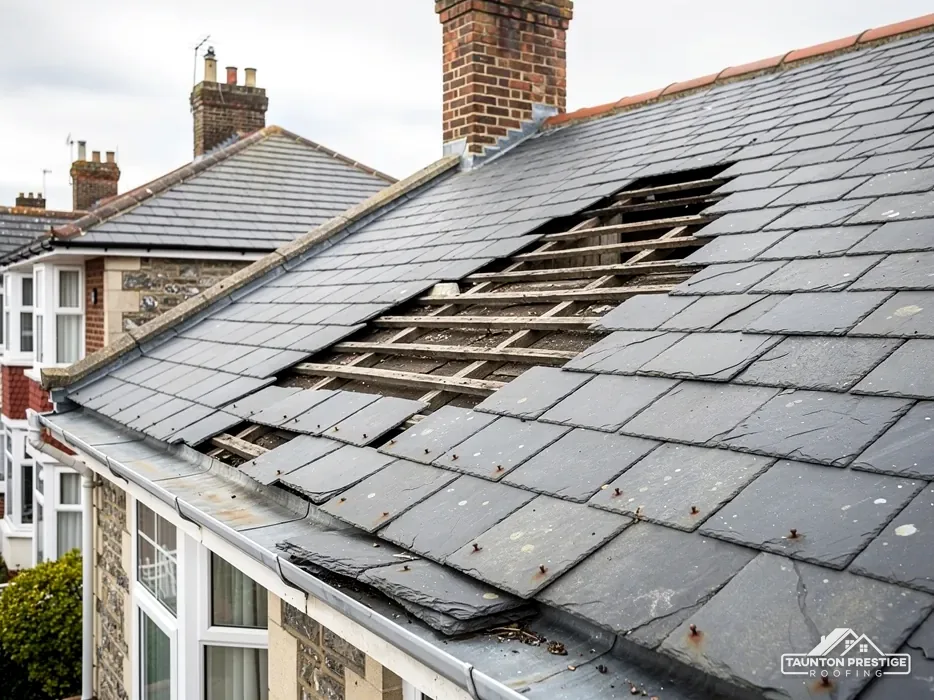
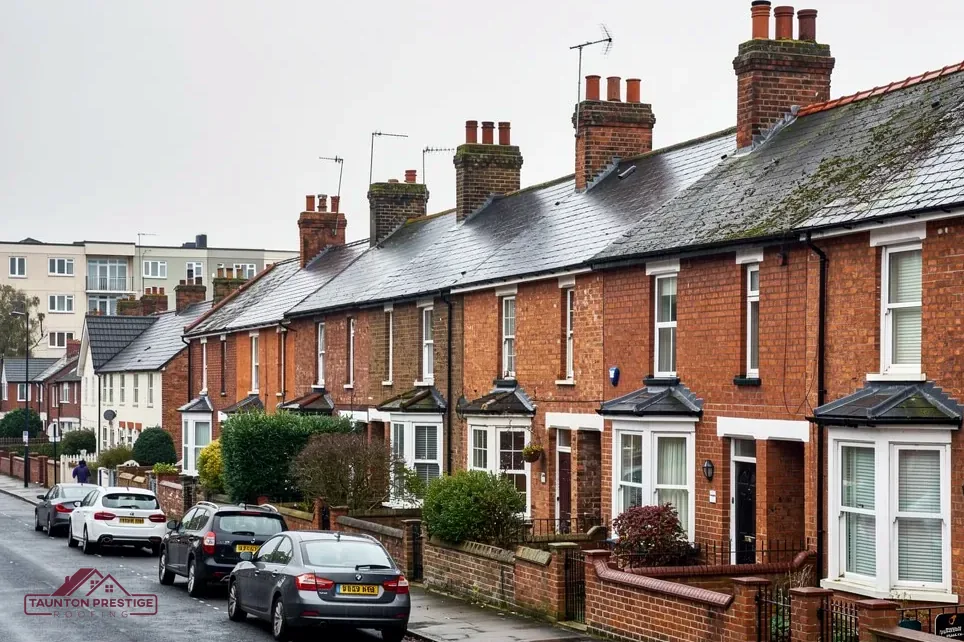
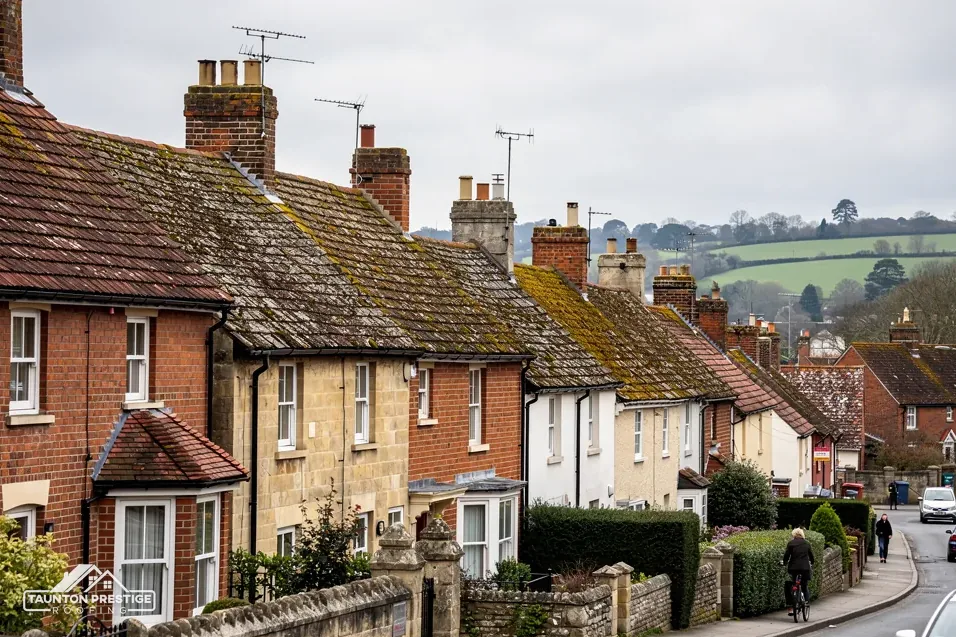
When the Somerset and Dorset railway works opened in 1862, railway housing went up in south Burnham. Rows of that sort share a single roof line, and a fault on one house tends to show on the next. A terrace has more joints than a detached house: party walls that rise through the roof, shared valleys, chimney stacks serving two houses and gutters that run past several doors.
Where a party wall rises above the roof, the join between wall and covering is sealed with lead flashing, and the top of the wall is capped. If the capping cracks or the flashing lifts, water runs down beside the wall and into both houses. Neighbours share that wall, so a repair there is often sensible to arrange together, though each owner is only asked to agree to their own side. Gutters are the other shared item. One run often serves two houses, and a blocked length at the boundary can spill onto the next door wall, so check your own downpipes and ask the neighbour to check theirs.
On a terrace, the roof is a shared thing, and so is a leak that starts in it.
That depends on the title deeds and on any agreement between neighbours, and we are not the people to rule on it. What we can do is survey the stack and describe what it needs. Taking a chimney breast out of a party wall brings in the Party Wall etc. Act 1996 and two months' notice, and the route for a dispute is a party wall surveyor.
It can. On a terrace the poles may have to stand on a neighbour's land or reach across their garden, so speak to them early. For repairs to a stack and its flashings, see our chimney repairs page.
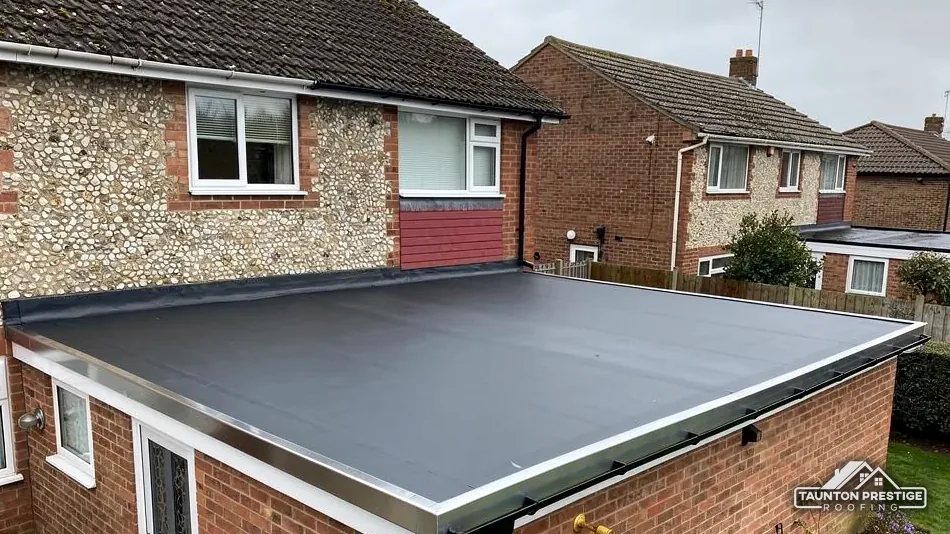
Flat roofs on extensions, garages and dormer cheeks are common in a town this size, and they take the brunt of rain and wind. The covering decides how long one lasts and how it is repaired. Felt is the traditional choice, laid in layers; EPDM is a rubber sheet that arrives as one piece; GRP is fibreglass poured and laid over a timber deck, then cured into a hard shell. Each has its own repair method, so the first step is to find out which one you have.
What decides the price
MyJobQuote (Oct 2026) gives EPDM at around £60 per square metre as a typical UK figure, with an average installed rubber roof of £1,050, and an average felt roof of around £1,500. Less (Oct 2026) notes that a good felt job can last 20 years, but a poor one may fail in under 10, and puts a garage-sized 15 m2 roof at £1,200 to £2,500. Prices vary with access and with the state of the deck beneath.
A flat roof relies on a slope too small to see. BS 6229:2025 keeps a minimum finished fall of 1:80, and designers aim for 1:40 so that settling still leaves the roof draining. A roof that holds a pool for long after rain has lost that slope, has a choked outlet or has a sagging deck. Cheap fixes rarely last when the deck is the cause.
A local split or a lifted edge can be repaired, and it is worth doing early. A covering that blisters, cracks and ponds over its whole surface has reached the end, and patches only delay the replacement. Approved Document L treats a re-covered flat roof as renovation of that part of the building, so insulation may come into the job. See our flat roofing page for the options.
Sound or needs work
The Somerset Levels and Moors are one of the lowest areas in the UK, according to GOV.UK, and records of flooding in the area go back to the 1600s. A flood map is drawn for the ground, not for a single house, so put your own postcode through the GOV.UK long term flood risk checker. Where the roof comes in is shedding rain fast into gutters and drains that actually work. After the floods of 2014, over £250 million was invested to reduce flood risk to properties and infrastructure on the Levels, and the Bridgwater Tidal Barrier is meant to better protect at least 11,300 homes and 1,500 businesses from tidal flooding in Somerset.
What decides the price
Scaffold that blocks the footway or road is licensed by the highway authority, under section 169 of the Highways Act 1980. In Burnham-on-Sea that is Somerset Council, which says that the appointed contractor applies and that only accredited contractors are licensed. The fee is £124.60 per 28-day period (April 2026), with at least 10 working days' notice.
Ring your insurer before you do anything else, get a temporary repair done and hold on to photos and receipts. Which? reported that only 32% of storm-related claims made in 2024 resulted in a payout, so it pays to read your policy. When an insurer is slow, the Financial Ombudsman Service steps in once eight weeks have gone without a final response, and its service is free. You then have six months from the date of that response to bring the case.
Making a leaking roof safe comes ahead of everything else, and one price in writing arrives once the survey is done. Pass on your Burnham-on-Sea address with a note about the damage, and a date follows.
Walked the roof?
When you have read the checks, we walk the roof and show you the photos.
Usually the lead flashing along the wall has lifted, or the wall's capping has cracked. Rain then runs down beside the wall inside both houses. We survey the join from the roof and report what the neighbour's side shows, so that both owners can see the cause before anything is agreed or priced.
Possibly. Under Approved Document L, re-covering a flat roof with a fresh membrane counts as renovation, and the thermal element rules then apply. The aim is a U-value of 0.16 where that is feasible, and paragraph 4.13 allows the best feasible result if the full target cannot sensibly be reached on your house.
A listing means any work that alters the house's special character needs listed building consent. Matching repairs are normally the route that causes least trouble. Ask Somerset Council's planning team about your own property, since each list entry applies to one building, and the house next door may be treated differently from yours.
Put your postcode into the GOV.UK long term flood risk checker. It describes the land around you. A roof re-covering does not hinge on the result, but the answer helps you decide how much to spend on gutters, downpipes and drainage details, which matter more where water has a long way to go.
Send us your Burnham-on-Sea address and a note on what has gone wrong, and we will offer dates.