Inside the Quantock Hills
Natural England's boundary data places the hamlet inside the Quantock Hills National Landscape, formerly an AONB.
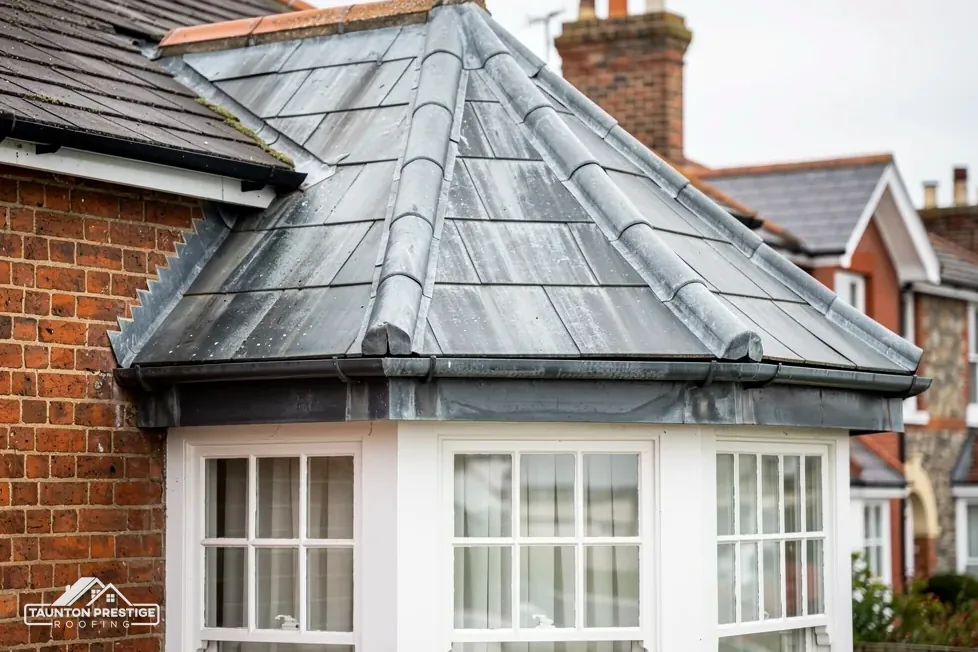
A roadside hamlet inside the Quantock Hills National Landscape
Courtway is a roadside hamlet in Spaxton parish, inside the Quantock Hills National Landscape. We survey each roof and send photos before any price.
Natural England's boundary data places the hamlet inside the Quantock Hills National Landscape, formerly an AONB.
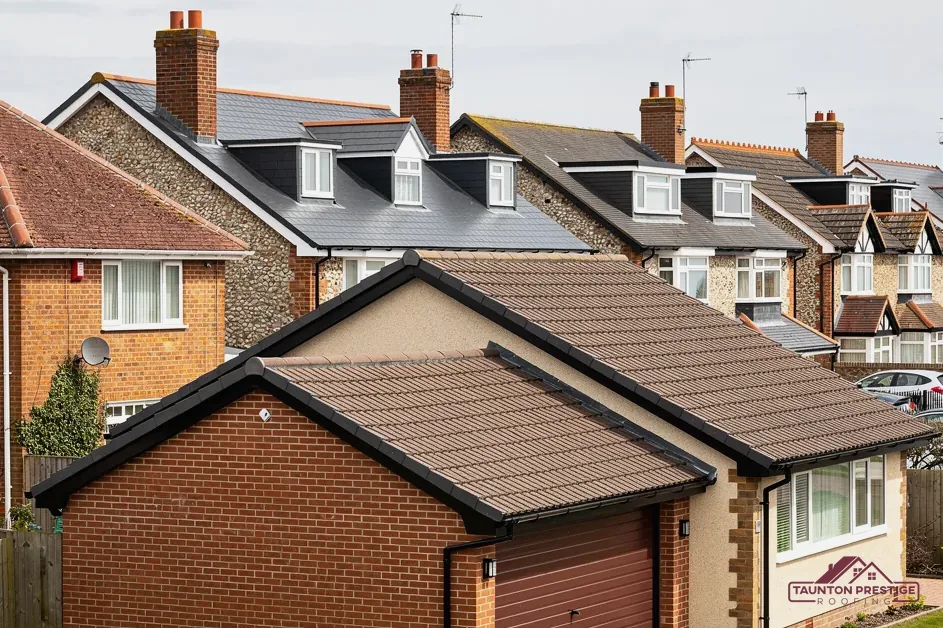
Lower Merridge and Courtway grew up as roadside settlements on the Taunton to Nether Stowey road.
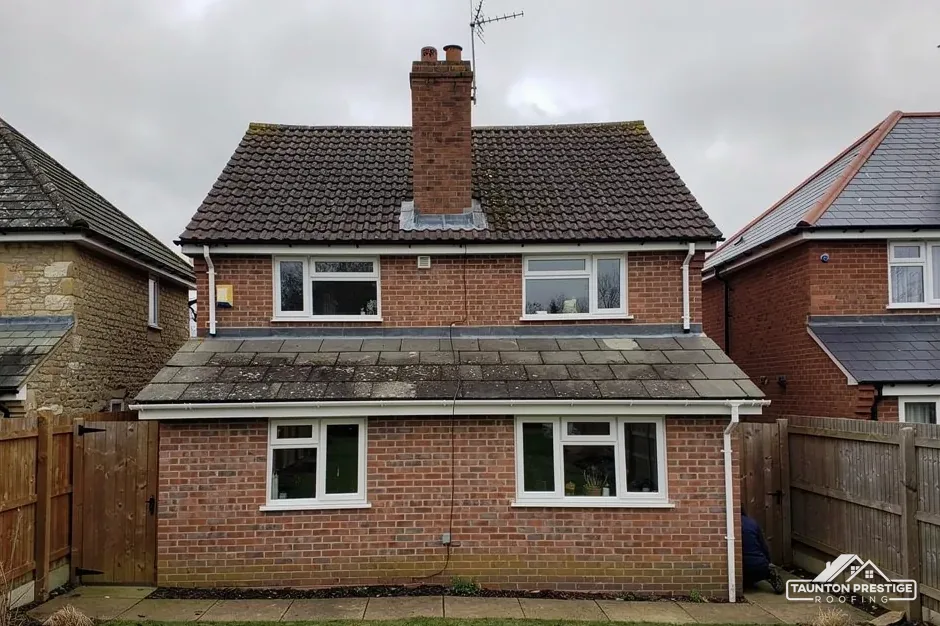
The inn was open by 1841 and closed about 1962; a beerhouse was also recorded here in 1861.
Street map of Courtway with Merridge, Cothelstone, Toulton, Spaxton marked around it, and Taunton.
Merridge sits just north of Courtway, with Spaxton further north, Cothelstone and Toulton to the south-west, and West Bagborough to the west.
About 6 miles north of Taunton, Somerset Council (unitary).
Roof notes from the Quantock edge
Planning in a National Landscape, scaffold beside a through road, moss on hill roofs and what a proper survey covers.
Courtway lies inside the Quantock Hills National Landscape, according to Natural England's boundary as shown in the national planning dataset. National Landscape is simply the rebranded name for an Area of Outstanding Natural Beauty, and the rename of 22 November 2023 left the law as it was. The Quantock Hills were designated as an AONB in 1956 under the National Parks and Access to the Countryside Act of 1949.
Planning law treats this kind of land as protected, and it removes some of the freedoms that apply elsewhere. A dormer is the clearest example, because the quick route that suits an ordinary house is not available in the hills. Roof windows within the usual limits are a smaller matter, but the planning team has the final word for your address. Our page on planning permission for roof work sets out the wider picture.
The closest conservation area on the national dataset, roughly 2.5 km from Courtway, is Cothelstone. Whether your own address falls inside one is a question for Somerset Council, and we put it to the council early in a job that changes the way a roof looks.
It does when you read the paperwork. Planning rules still say area of outstanding natural beauty, and older documents use that wording, so a reference to an AONB and one to a National Landscape point to the same ground. We check which applies before any change of covering or any new opening in the roof is priced.
Repairs that put back what was there are the simplest case, and our survey photos record how the roof looks today. If a plan does need an application, those photos and a short description of the covering, ridge and fixings give the planning team something exact to read, and they cut the chance of a second round of questions after you have submitted.
Look for
Lower Merridge and Courtway grew up as roadside settlements on the Taunton to Nether Stowey road, and a house that fronts a road has less room for a roof job than one set back in a garden. Whenever scaffold has to stand over a pavement or a carriageway, section 169 of the Highways Act 1980 asks for the highway authority's licence. Scaffold wholly within your own boundary does not.
On a road-front house, the first question is how the work gets to the roof.
Somerset Council is the highway authority, and it hands licences to accredited contractors only, with the appointed contractor completing the form. You do not apply yourself. Its guidance asks for at least 10 working days' notice, with emergency applications being the exception, and charges £124.60 for each 28-day period (April 2026). If a job runs on, the licence needs extending.
Then the road may not come into it at all. A garden or yard sometimes gives a way up to the roof, and then the question becomes how materials arrive and where waste waits. We look at both routes at the survey. A back-garden route can keep the road clear, but only if there is a gate or passage wide enough and nothing fragile in the way.
A through road means vehicles pass close to ladders and scaffold. We put the scaffold's footprint on a plan, fit edge protection, and mark the access so that people walking past stay clear of tools and slates. Passing traffic is part of planning the job. We agree where the van and the skip will stand, we tell neighbours when deliveries are due, and we keep the road free of materials between visits. If the verge is soft or a ditch runs alongside, we flag it in advance, because it changes where a tower or a delivery lorry can safely stand.
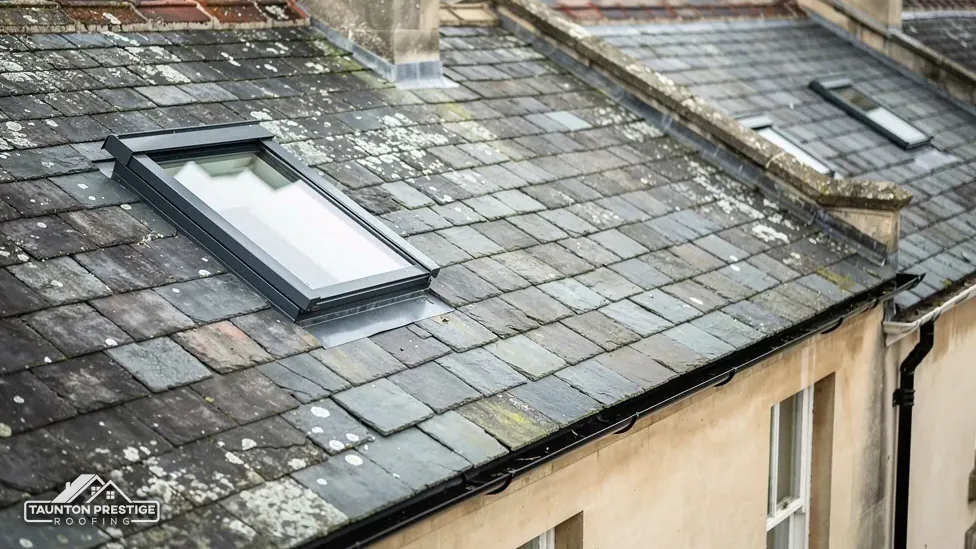
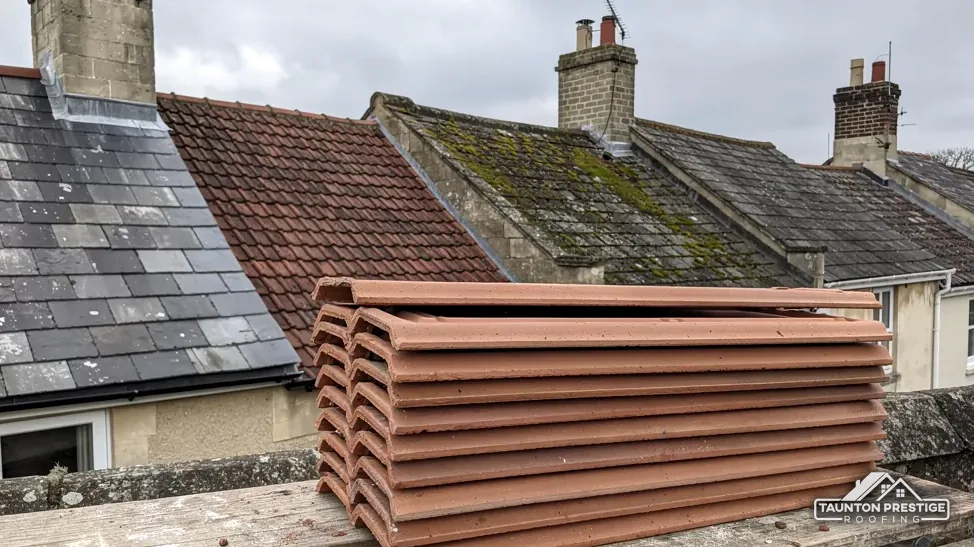
Where trees, a bank or a wall shade a roof, moss can settle and hold damp against the covering. A roof that stays wet ages faster than one that dries, and moss can pack the gutters, the valleys and the gaps behind a ridge. Hillside hamlets have plenty of that sort of shelter, which is why we look at growth on every Courtway survey. We note which slopes hold it, how deep it sits and whether it follows the line of a gutter or a valley, because the pattern often points to the cause.
What decides the price
Look for
A thin green film on a sound roof is usually an appearance problem only. Thick growth that lifts tile edges, blocks a gutter or keeps water pressed against fixings is different, and it tells us the roof needs a closer look. Lichen, the crusty grey or orange growth, spreads more slowly, but it shows that the surface has stayed damp for a long time.
Not a power tool. Marley does not recommend high-powered jet washes, because they can scour the face of a slate or tile and reduce its expected life considerably. A wet, mossy slope is also dangerous underfoot, so please keep off it. We choose a method to suit the covering, and we brush by hand where that works, then check what the growth was hiding.
HSE warns that some biocidal products are intended for professional users only, and that the public should never use them. Products sold to householders are another matter, but the label has to be followed exactly. We explain what we would use and why, and we say when leaving thin moss alone is the sensible choice. Our roof cleaning and moss removal page covers the options, and gutters, soffits and fascias deals with the clear-up afterwards.
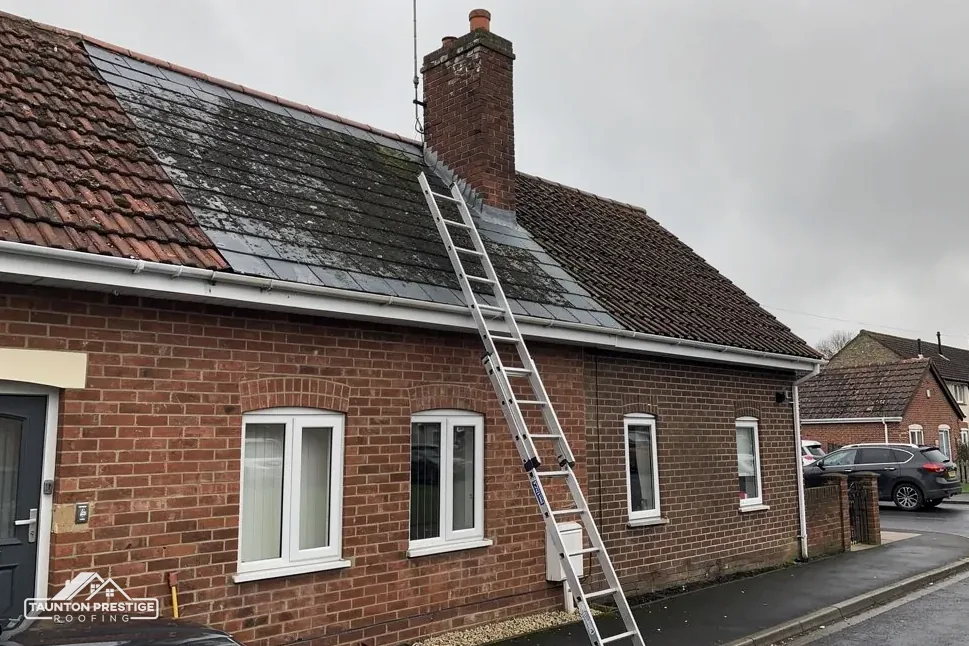
Every job on a Courtway roof starts with a survey, and it is worth knowing what that means in practice. It is a look at the whole roof and the parts that serve it, not a quick glance at the one stain that prompted your call.
We begin on the ground, walking round the house to read the roof line, the gutters, the downpipes and any chimney. Then we go up, where it is safe to do so, and read the main slopes first, then the ridge, the verge edges, the valleys and the flashings. Inside, we look at the loft for daylight, damp, and the state of the underlay and timbers. Each stage is photographed.
They show you your own roof as it is, with the faults marked, so a decision does not rest on what anyone says. You can send them to your insurer, to a neighbour who shares a wall, or to the planning team if the work needs consent. They also give us the starting record if anything changes during the job.
We record the access as well, because it shapes the plan: where ladder feet can stand, whether a tower will do, and whether scaffold has to go on the road. Our roof inspections page lists what each visit covers.
It is one total, in writing, and it follows the survey, because only the survey can say what is wrong and how big the job is. If the roof turns out to need only a small repair, the price says so, and you are never steered towards more work than the roof needs. What drives it is the roof area, the pitch, the access, the covering and what is found underneath.
Send us your Courtway address and the worry that prompted your call, and we will fix a day for the survey.
What decides the price
Walked the roof?
When you have read the checks, we walk the roof and show you the photos.
The national planning dataset, using Natural England's boundary, puts the area around Courtway fully inside it. A boundary can still cut across a property, so Somerset Council can confirm your address. The Quantock Hills were designated an AONB in 1956, and National Landscape is the same area under its newer name.
No. Repairs and like-for-like re-coverings carry on as normal, and many changes need nothing special. Some alterations, such as a dormer, face extra limits in a National Landscape, so ask Somerset Council's planning team before you plan one. We photograph the roof as it is, so any application starts from facts.
Gently, and not by blasting it. Marley does not recommend high-powered jet washes, since they can damage the face of a slate or tile and shorten its life. We look at how the covering has weathered, pick a method to suit, and tell you if leaving thin moss alone is the better choice. Please do not climb up to deal with it.
Yes. Photos are taken at each stage, from the ground, on the roof where it is safe, and in the loft, and they come to you with notes on what each one shows. You can share them with an insurer, a neighbour or the council. The price comes afterwards, so you read the evidence before you see a figure.
Give us your Courtway address and a few words on the problem, and we will pick a day.