The Grade I parish church
Central tower and transepts, largely the product of a major rebuilding in the later 13th and earlier 14th centuries.
A limestone-ridge market town with a Grade I church
South Petherton is a market town on a limestone ridge above the Parrett valley, where St Peter and St Paul's and two Grade II* houses stand near the centre. Surveys come before prices.
Central tower and transepts, largely the product of a major rebuilding in the later 13th and earlier 14th centuries.
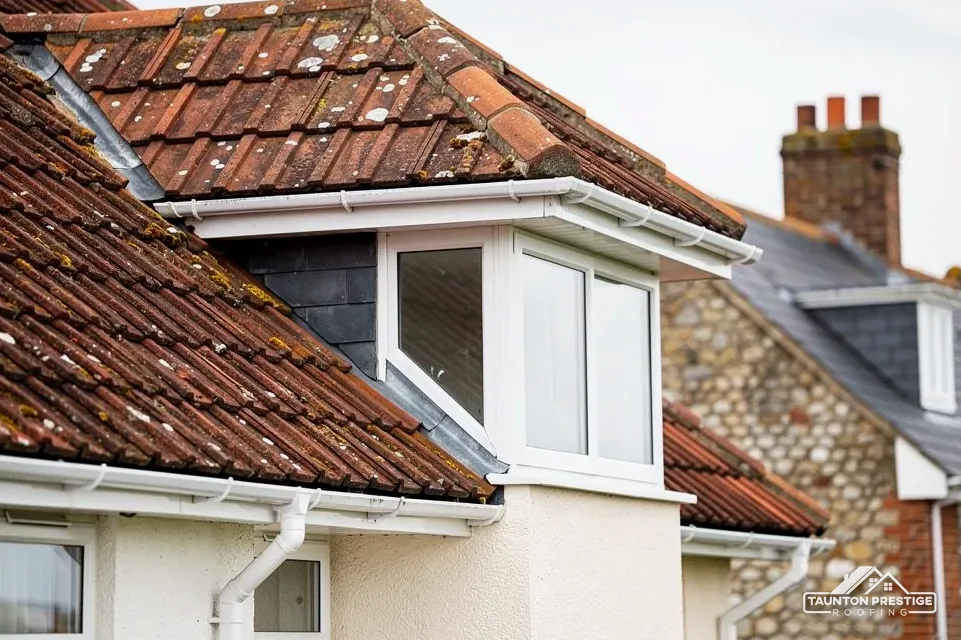
Court House and the Manor House, known as King Ina's Palace, are Grade II*; roof work follows listing rules.
Stratton Farm is a 16th-century building, originally cob-walled, with a cruck-trussed roof and an open hall.
Street map of South Petherton with Shepton Beauchamp, Norton-sub-Hamdon, Martock, Stoke-sub-Hamdon marked around it, and Taunton.
Merriott lies to the south and Shepton Beauchamp to the west, while Martock stands north-east and Norton-sub-Hamdon east of South Petherton.
About 14 miles east of Taunton, Somerset Council (unitary).
Four checks on the Petherton ridge
Four checks for a market-town house: the weight of heritage, locally made tile, chimney stacks, and the contract itself.
South Petherton's centre holds a run of listed buildings, from a Grade I church to Grade II* houses, and a conservation area boundary falls within about 0.75 km of it (planning.data.gov.uk). Court House and the Manor House, known as King Ina's Palace, are Grade II*, as are numbers 3, 5 and 7 at Hayes End Manor. Your own roof may belong to none of these groups or to several, and a roof survey is a good moment to find out which. We look the address up before we talk about materials, because the answer shapes everything that follows.
The consent test is the one every listed house meets. Somerset Council must say yes before an alteration that touches the building's special interest goes ahead, whichever grade it carries. Matching the covering already there remains the plain road. A new material, a roof opening or a different ridge is where the question starts. Our guide to planning permission for roof work covers the rules.
St Peter and St Paul's carries Grade I listing and an active Anglican congregation, so its roof is signed off through the faculty system and not by the council. The parish handles that request. Once a church shuts, or a chapel becomes a house, consent passes to the council. In a town with so many listings, the sensible habit is to settle the consent route before the scaffold is ordered, because the start date and the choice of materials both hang on it. Ask early: a short note to the planning team costs nothing, and the reply arrives long before the roof is stripped.
Photographs from the survey go on file, so that whoever reviews an application sees the roof as it is.
Look for
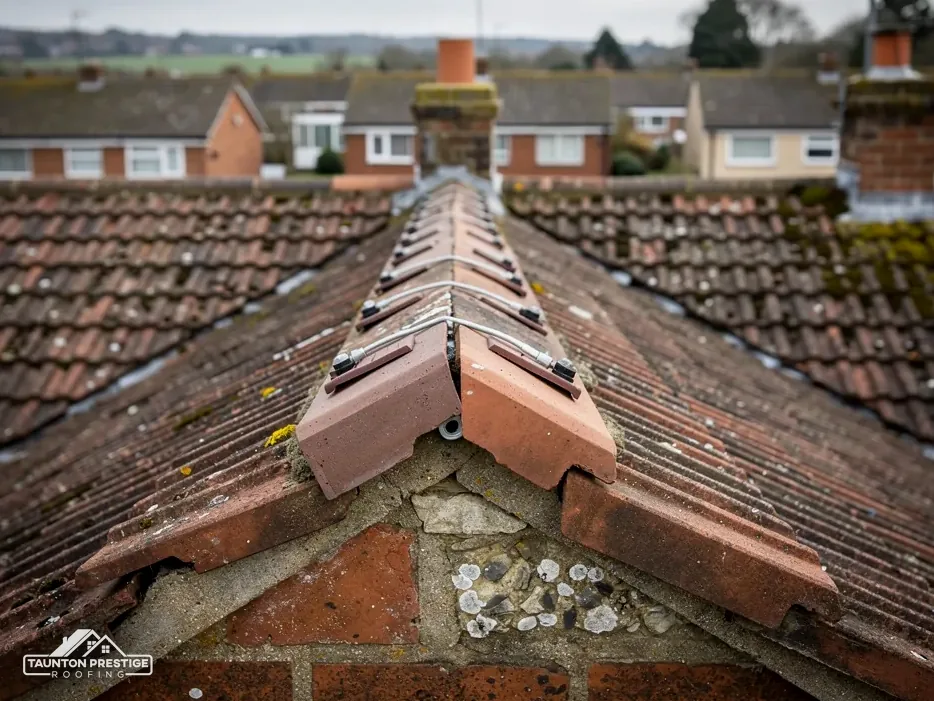
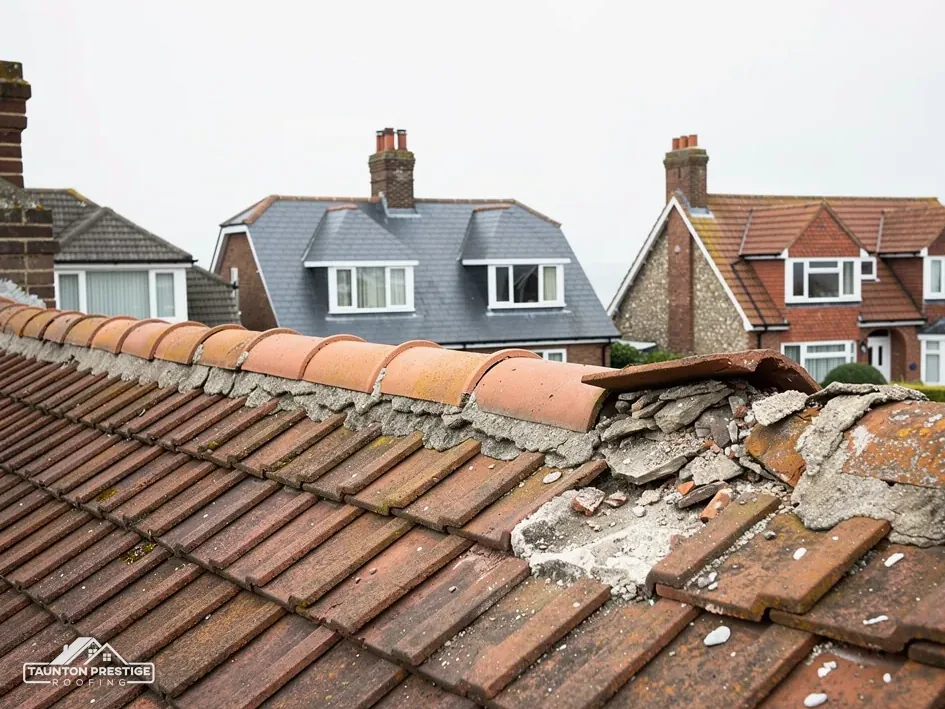
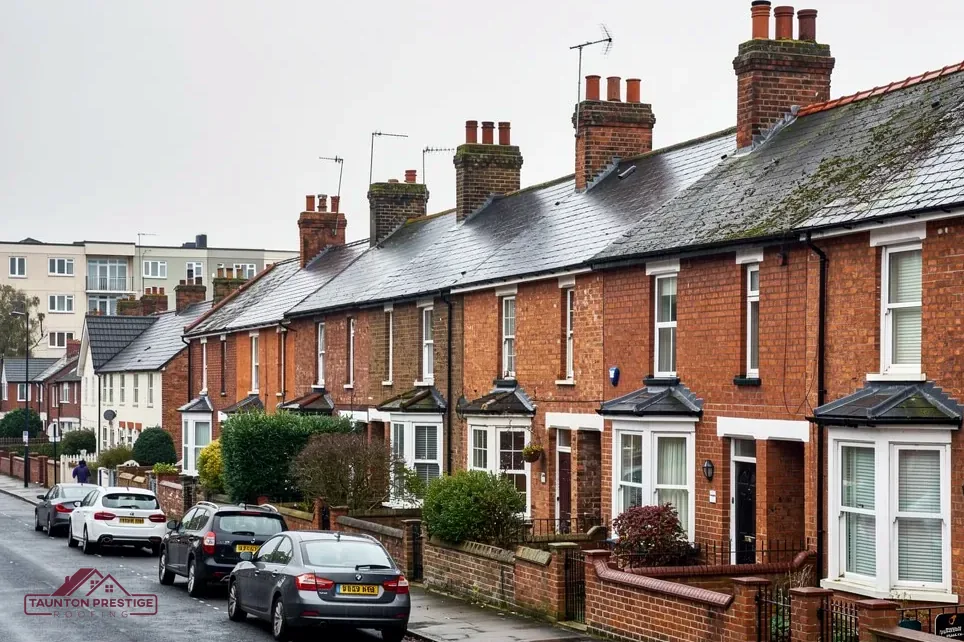
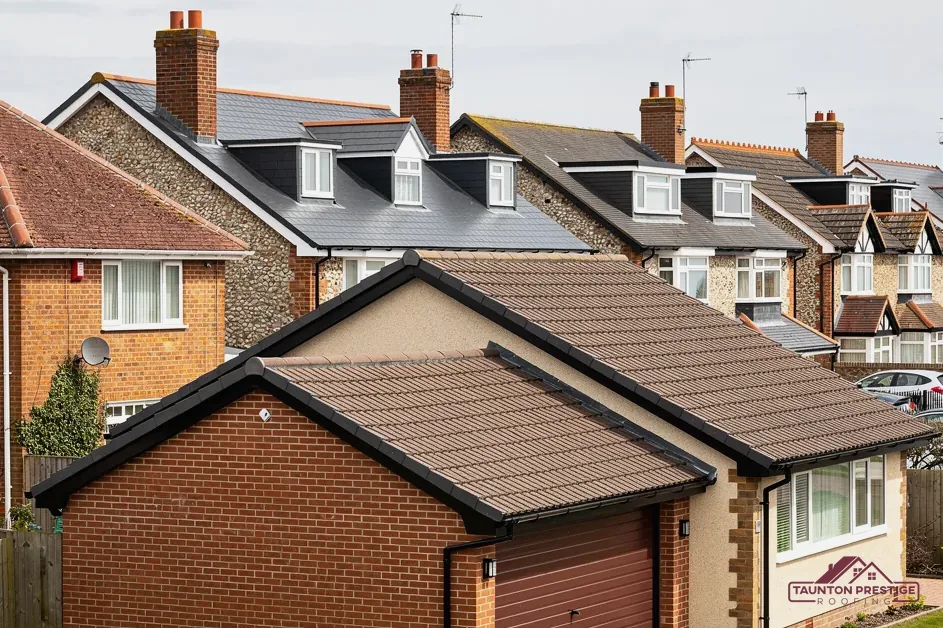
The Victoria County History notes that a ridge of limestone called Petherton stone was quarried at Pitway in the 19th century, and that brick and tile making went on along the slope of Pitway hill and beside the East Lambrook road. Much of the town centre was rebuilt in the same century, while the outskirts and hamlets such as Stratton, Compton Durville and Lambrook keep earlier farmhouses and cottages. This is a place with its own materials, and that matters the moment something has to be matched.
Stratton Farm shows what lies beneath a covering. Its cruck-trussed roof rests on curved timber pairs rising from the walls to the ridge, and the open hall below was once the heart of the house. A roof like that carries history in its timbers, so we photograph what we can see from the loft before anyone proposes a change to the covering. Timber that has stood for centuries deserves a plan that respects it.
What decides the price
Sometimes, with salvaged stock, and sometimes with a close new tile in the right profile and colour. The South West Heritage Trust credits Bridgwater's brickyards and tile works with shaping the look of many towns across the county, so clay has a long history in Somerset. Clay stays clay on a roof designed around it. Marley notes that the BRE sets 60 years as the minimum life for clay tiles, but an article on old peg tiles says that figure cannot be trusted for them.
MyJobQuote gives a typical UK range of £225 to £550 for replacing ridge tiles (Oct 2026). Length, access and reusable stock among the old tiles decide where in that range a job falls, and the survey tells us which. Our pitched roofing page explains how a re-bed or a dry-fix is chosen.
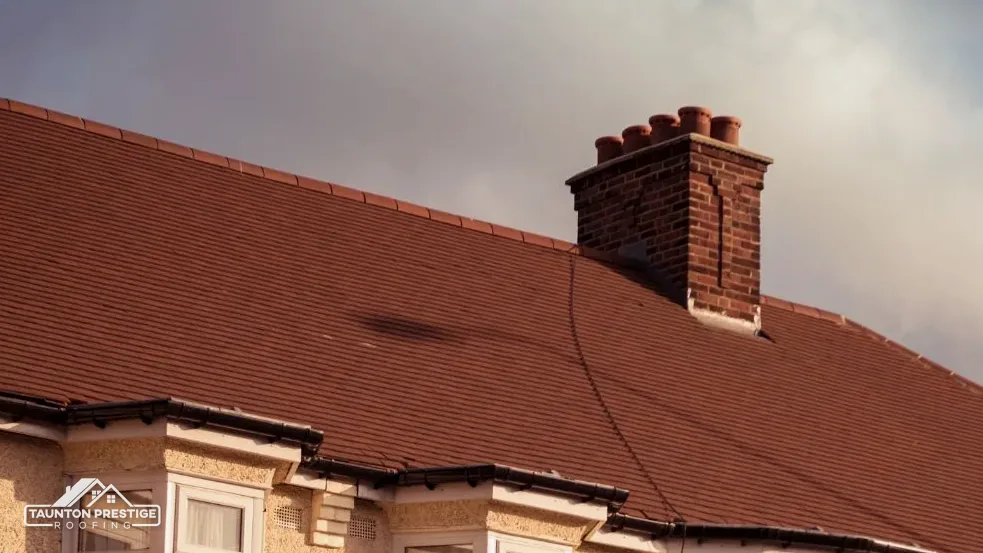
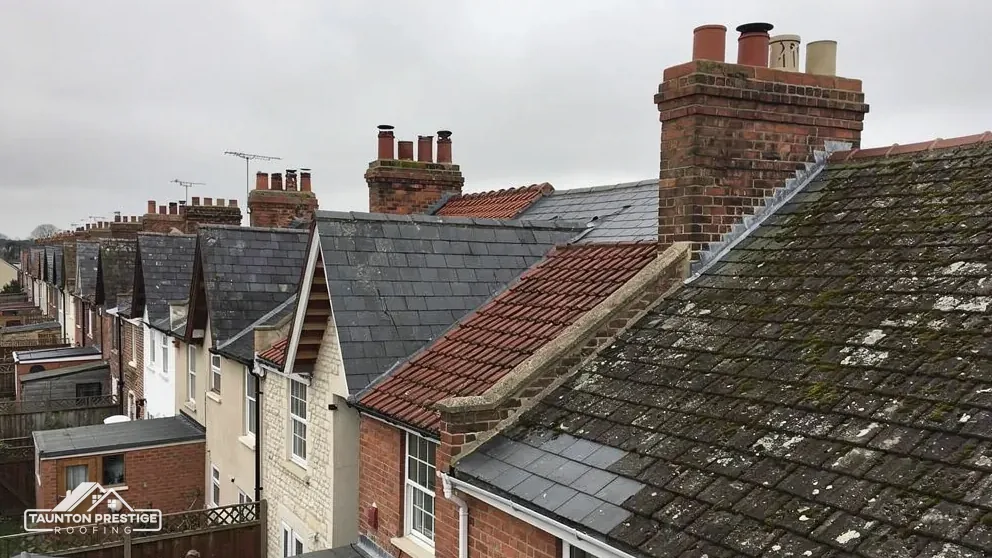
A chimney stack rises through the roof like a small building of its own. Water can attack it from above, down the brickwork or stone, and from below, round the base where the roof meets the masonry. Stacks can be tall and hard to reach, so a ground check with binoculars is a good start. A disused stack needs the same attention as a working one, because rain does not care whether the flue is lit. Cracked pointing, a leaning pot or a damp stain on the chimney breast inside are the early signs.
A stack gets rain from both sides, from above and from the roof it stands on.
Flaunching is the sloping mortar around the base of each pot, and it throws rain away from the flues. Weather and frost break it up over the years, and once water gets underneath, the pointing below starts to rot. Renewing flaunching is a repair and not a rebuild. MyJobQuote gives a typical UK range of £450 to £1,200 for chimney repointing (Oct 2026), and our chimney repairs page explains what else may be involved.
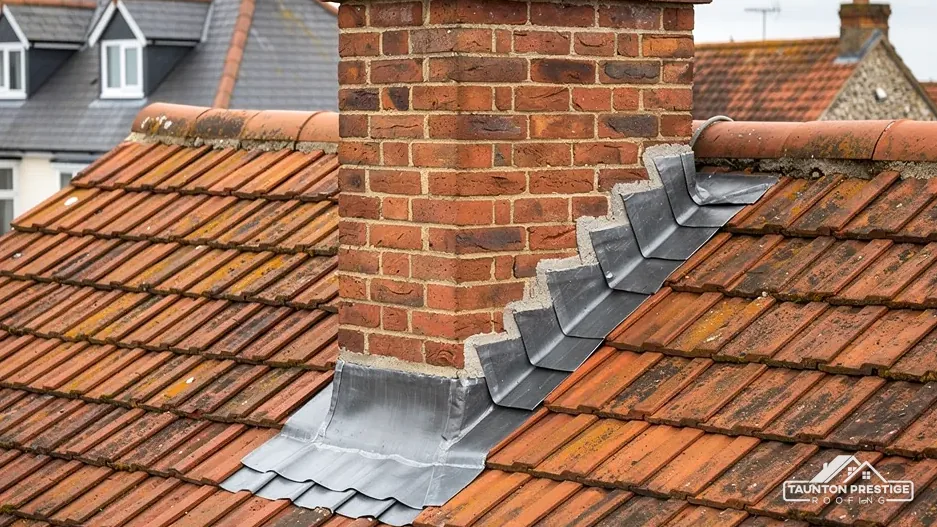
Lead flashings and soakers seal the joint between stack and roof. MyJobQuote says lead can last for over 80 years, and gives a typical UK range of £150 to £250 for a patch and £350 to £920 for a complete renewal, with scaffold the main variable (Sep 2026). A split in the lead, or a gap where it has lifted from the brickwork, lets water into the loft. The survey photos show which of those you have, and our lead work page covers the details.
From the ladder we photograph the pots, the flaunching, the pointing and the flashings, then say which repair is the lightest one that will work. Sometimes that is a patch and sometimes a rebuild of the top courses. Where a stack leans or the joints have opened right through, a patch is false economy, and the photos make the case better than any argument could.
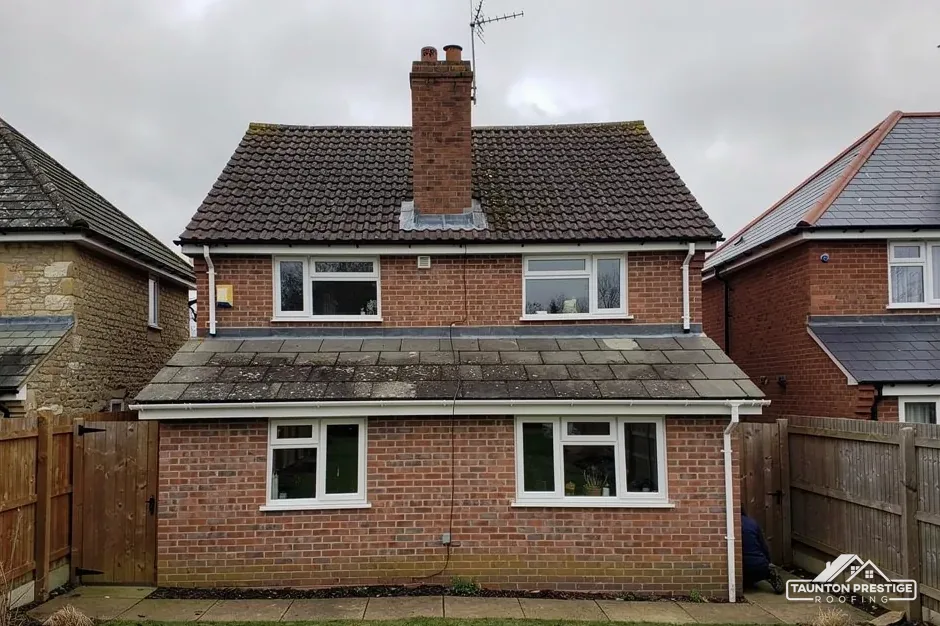
A scaffold on a market-town street faces more constraints than one in a garden. Pavement width, parking and neighbouring doorways all matter. A scaffold that stands on the highway falls under section 169 of the Highways Act 1980, which asks for a licence. In South Petherton the issuing body is Somerset Council, and under its rules only accredited contractors may hold one, with the appointed contractor filing the form. The charge is £124.60 for each 28-day period (April 2026), and 10 working days' notice is the standard request.
What decides the price
Sign at home after a survey and the law calls it an off-premises contract, with 14 days to change your mind. If the trader omits the cancellation information, that window can stretch up to 12 months beyond its normal end. The right does not extend to an urgent-repair visit that you have specifically requested. Citizens Advice runs the consumer helpline on 0808 223 1133 for anything you want checked.
Section 49 of the Consumer Rights Act 2015 sets a standard of reasonable care and skill for services. If a dispute cannot be settled, section 308 of the DMCC Act 2024 requires a trader to tell the customer about any alternative dispute arrangement that is available. A full re-roof is covered on our roof replacement page.
After the survey you hold photos and a single written figure. On a street job tidiness matters more than anywhere: access is set up properly, waste leaves with us, and neighbours and customers are told what happens each day. Give us your South Petherton address and a line on what you can see from the pavement, and we will fit in a survey date.
Walked the roof?
When you have read the checks, we walk the roof and show you the photos.
From the ground, watch for leaning pots, crumbling mortar at the top and brown stains on the chimney breast indoors. Those point to failed flaunching, the sloping mortar around the pots, or tired lead flashing at the base. Lead can last for over 80 years, but the pointing round it ages faster. A survey with photos shows the true state.
The faculty system. St Peter and St Paul's is Grade I with an Anglican congregation, so its repairs skip the council's listed building consent. The parish files the application, and the approved specification is what the roofer follows. Allow time before the scaffold date is fixed, and expect the process to take a while.
Court House has held Grade II* listing since 19 April 1961. Listed building consent from Somerset Council is needed where work would affect its character. Matching the existing covering is the simple case; a different covering, a new roof opening or a new ridge style should be put to the planning team before you order anything.
Usually yes, inside 14 days: agreements signed in your own home after a survey count as off-premises contracts. The exception is an urgent repair visit the customer has specifically asked for. Citizens Advice runs the consumer helpline on 0808 223 1133, and we go through the paperwork with you before you sign anything.
Send your South Petherton address and a note on what the roof is up to, and we book the survey.