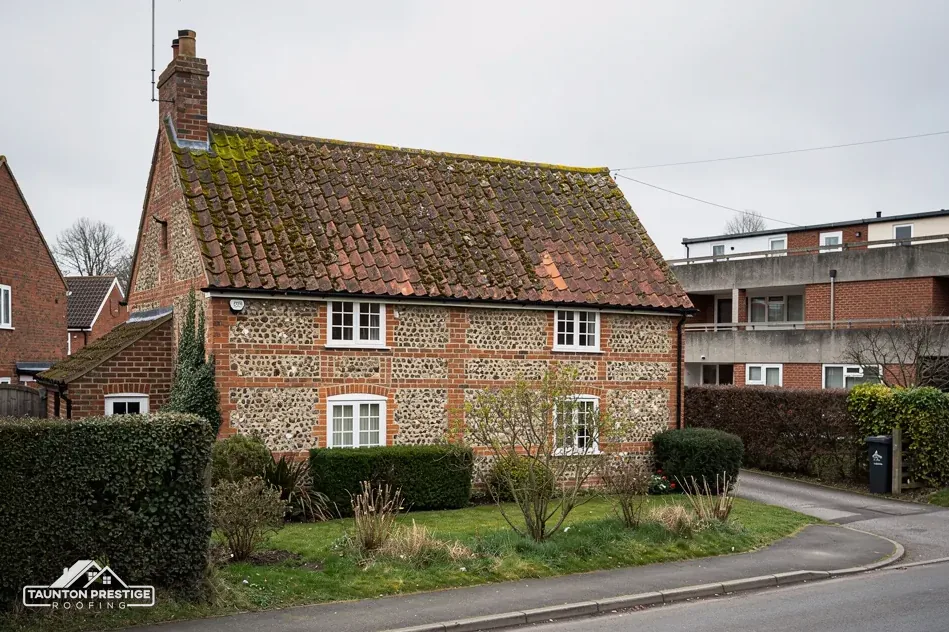
St Thomas's church
Listed Grade II since February 1955. Roof work depends on the denomination, so we ask who owns it first.
A hamlet church, two listed entries and the Blackdown Hills edge
Thurlbear is a hamlet in Orchard Portman parish, with a Grade II church and the Blackdown Hills National Landscape close by. Each roof is surveyed, then priced.
Listed Grade II since February 1955. Roof work depends on the denomination, so we ask who owns it first.
Two entries sit within 500 metres of the hamlet's centre; look up your own address before altering a roof.
Thurlbear lies in this small civil parish, which counted 131 usual residents at the 2021 Census.
Street map of Thurlbear with West Hatch, Haydon, Duddlestone, Thornfalcon marked around it, and Taunton.
West Hatch lies east of the hamlet and Haydon to the north, while Duddlestone sits to the west, Thornfalcon to the north-east and Curland to the south-east.
About 3 miles south-east of Taunton, Somerset Council (unitary).
Four checks for a small hamlet
Four checks covering a listed church, moss on older coverings, outbuilding sheets and the paperwork around a quote, with what sets the price.
St Thomas's church holds Grade II status on Historic England's list, which carries two entries in all within 500 metres of the hamlet's centre. The church is mapped as a place of worship, and the first thing to establish is which denomination uses it, since that decides who grants permission for roof work. Anglican churches in use have the faculty system. Catholic, Methodist, United Reformed and Schedule 1 Baptist buildings answer to their own authorities, and a church that has closed needs listed building consent from the council.
Search your address on Historic England's list, then put a direct question to Somerset Council's planning team about conservation areas. A blank on the national map data for this corner of Somerset proves nothing, because that data is incomplete here. Somerset Council has decided planning applications for Thurlbear since 1 April 2023, when it became the sole principal authority, replacing the former Somerset West and Taunton district council.
On a listed house, listed building consent is required before anything alters the building's special character. Swapping natural slate for a manufactured substitute, steepening the pitch or taking a stack down to roof level all raise that question. Putting back exactly what was there keeps the job simple, and the route is laid out in our guide to listed building roof consent.
A hamlet has few neighbouring roofs to compare against, so the survey photographs each slope close up and records pitch, covering and the state of the battens, the laths under the covering that carry every slate or tile. In a hamlet, access is part of the survey too: we note where a lorry can stand and how far materials must be carried, because that shapes the length of the job and the price. Those notes feed the written price and any application that follows.
Look for
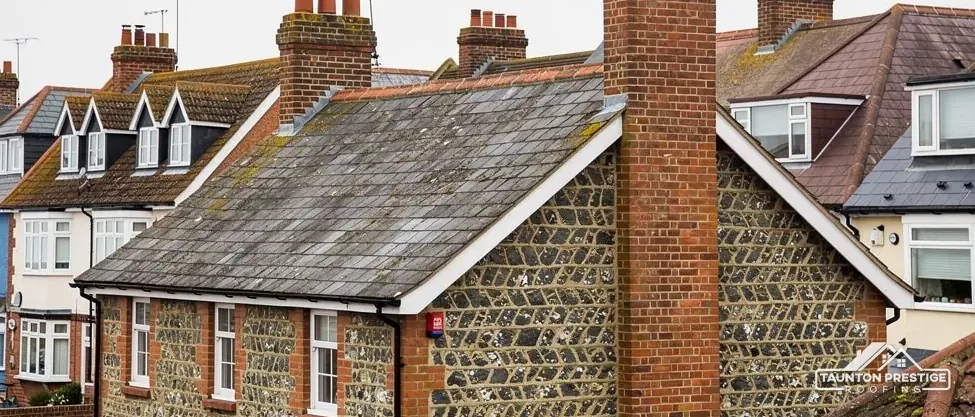
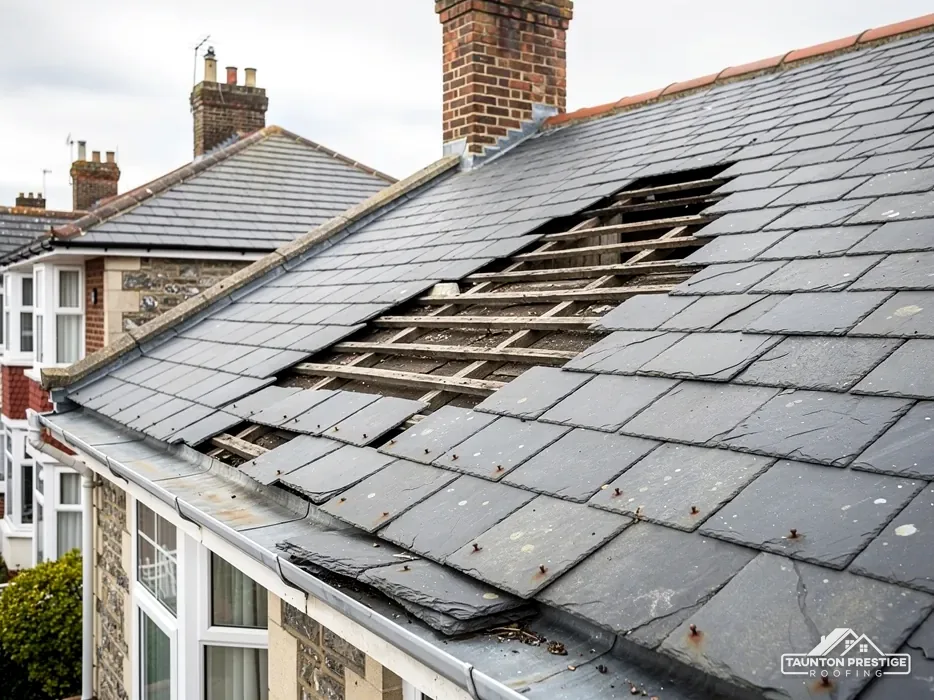
Moss and lichen settle wherever a roof stays damp, such as a slope under overhanging branches or one that never sees the sun. Moss does harm: it holds water against slates and tiles, blocks gutters and can lift tiles as it thickens. It also hides cracks, so the first job is to clean the roof and look at it, not to spray it and walk away.
Marley's advice is to avoid powerful jet washing, which scours slate and tile faces and shortens their working life. A soft brush or a low-pressure rinse, with a suitable treatment, is the gentler route. Biocidal products are regulated: HSE says the public should never use ones meant for professionals only, and its guidance adds that an unapproved product used on a roof is an offence in its own right. We use approved products and follow the label.
Moss is a symptom, so a clean means little until you know what lies underneath.
With the growth cleared away, cracked tiles, slipped slates, worn pointing along the ridge and tired flashings come into view. That is the moment a cleaning job can turn into a repair job, and we photograph what we find before touching it. A roof that cleans up well can carry on for years, whereas one that proves tired is better replaced than treated again. Our roof cleaning and moss removal page covers the methods in more detail.
It helps to know what the roof is made of before choosing a method. Natural slate, clay tile, concrete tile and fibre-cement sheets all react differently to brushing and to treatments, which is why the survey identifies the covering first and the cleaning method second.
Cleaning is also the time to clear gutters and valleys, where two slopes run together, because the moss that washes off ends up there. If the survey finds a run of damaged tiles under the growth, you hear about it before the brush goes near them.
Garages, stores and farm outbuildings sometimes carry corrugated sheet roofs, and sheets laid before 2000 may be asbestos cement. HSE tells owners of pre-2000 buildings to assume asbestos is there unless a test says otherwise, and guidance A14 describes asbestos cement roofs as always fragile. A fragile roof is one you can fall through, so nobody should walk on it without proper boards and edge protection.
What decides the price
Look for
Sheeting that is carefully removed, without being broken up, counts as non-licensed work in HSE's guidance. Sheets that will be substantially broken move the job into notifiable non-licensed work, and HSE's own example of that is 'dropping' a whole asbestos cement roof. Sheets are double-wrapped and labelled, and they leave the site on a hazardous waste consignment note, never in a skip. The survey records what we believe the sheets are and what test would settle it, so nobody is working on a guess.
External soffits are one known home for asbestos insulating board (AIB), and HSE notes that AIB is hard to tell apart from lookalike boards by eye. Soffit work on AIB can be licensed, depending on HSE's risk assessment rules, so that question is settled before a start date is fixed. Our garage and asbestos roofs page sets out the options, including a new covering that contains no asbestos at all.
Profiled steel, fibre-cement made without asbestos, or a pitched covering of tile or slate are the usual choices, and each suits a different structure. A heavier covering needs the purlins and rafters checked first. The survey notes spans, fixings and how sound the timbers are, and the written price names the replacement, so you can see exactly what goes up in place of the old sheets.
When the survey is done you have photos of your sheets and a plain choice: leave them alone, seal them or replace them.
A roof job begins with a survey and ends with one written total, and between the two sit details that protect you. Ask any roofer whether the figure includes VAT and whether it includes scaffolding. Gov.uk gives the standard rate as 20%, and that rate applies to repairs on homes already built. Domestic reverse charge VAT applies only between VAT-registered firms reporting under the Construction Industry Scheme, so a homeowner is not billed under it.
What decides the price
A contract made at your house after the survey is an off-premises contract. You may cancel it without giving a reason up to 14 days after the day it is entered into. Regulation 28(1)(e) of the Consumer Contracts Regulations leaves out a visit you specifically request for urgent repairs, so a leak made safe at your request falls outside the cancellation right. Your paperwork should say which of the two applies to your job.
The Citizens Advice consumer helpline is 0808 223 1133. Citizens Advice recommends collecting at least three written quotes before choosing, and one total price per quote makes that easy to read. Under the Consumer Rights Act 2015, a trader's service must also be performed with reasonable care and skill.
Before you sign anything, read the quote for four things: the address, the work described in plain words, the total and whether the total includes VAT and scaffolding. A page with one total and a clear description is easy to hold us to, and anything unclear should be put right in writing before the start date.
If the covering comes off and the timbers underneath prove worse than the survey could see, we stop and tell you what has changed before any figure moves.
Your next step is a survey of the Thurlbear roof itself. Send the address with a short note of what you can make out from the ground, and a visit gets arranged.
Walked the roof?
When you have read the checks, we walk the roof and show you the photos.
HSE's advice is to presume asbestos in buildings dating from before 2000, and corrugated cement sheets from that era are a likely place to find it. We note the sheets at the survey and say whether a test is worth doing. Leave them unbroken and keep off the roof, since asbestos cement roofs are always fragile.
That turns on the denomination using the building, so the first call is to whoever looks after it. If it is Anglican and still in use, the route is a faculty. Catholic, Methodist and United Reformed churches use their own schemes, while a closed church goes to the council for listed building consent. Settle the route before any roofer starts work.
A small share. The centre point of the hamlet lies outside the boundary, though about 7% of the 1.5 km square around it falls within it. Your house may or may not fall within that sliver. Before planning any addition to a roof, confirm your address with Somerset Council's planning team, and our planning guide sets out the wider rules.
It should be stated either way. The standard 20% rate applies to roof work on a house that already exists, and a written quote ought to show the total you pay. Read it for the words VAT and scaffolding, and ask if either is missing. A homeowner is never billed under the domestic reverse charge, which only runs between CIS-registered businesses.
Send the address and the symptom, and a survey visit to your roof will be set up.