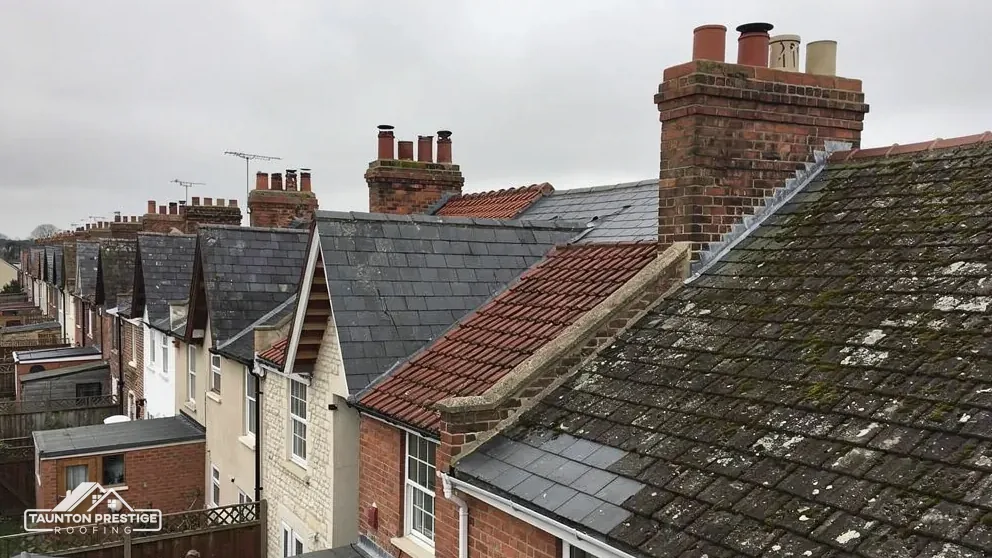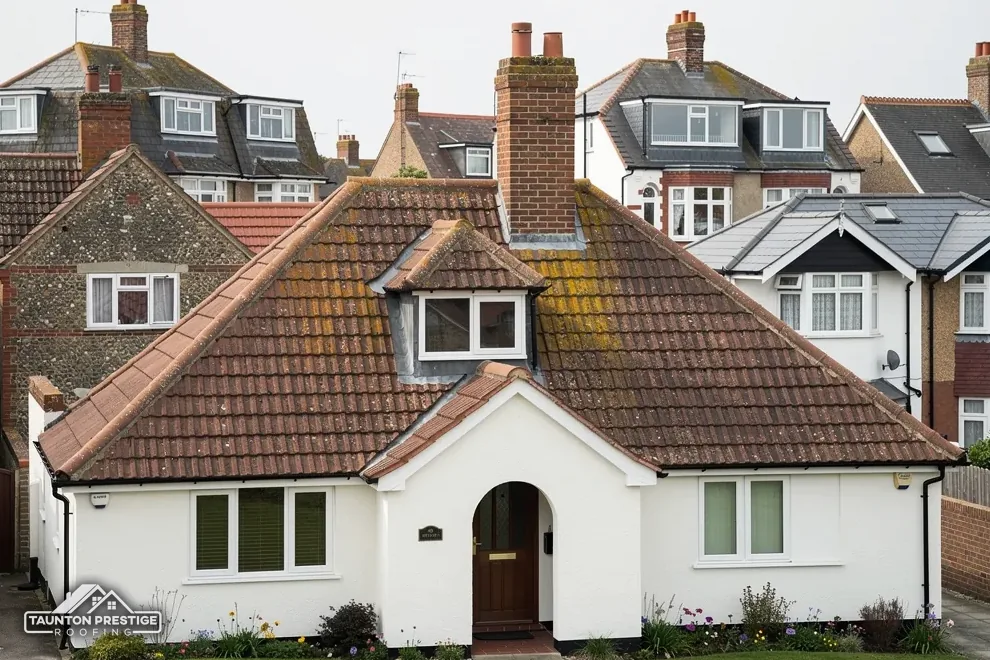
Heathcoat's workers' terraces
Planned housing beside the old factory, which the council's appraisal rates highly in regional and national terms.
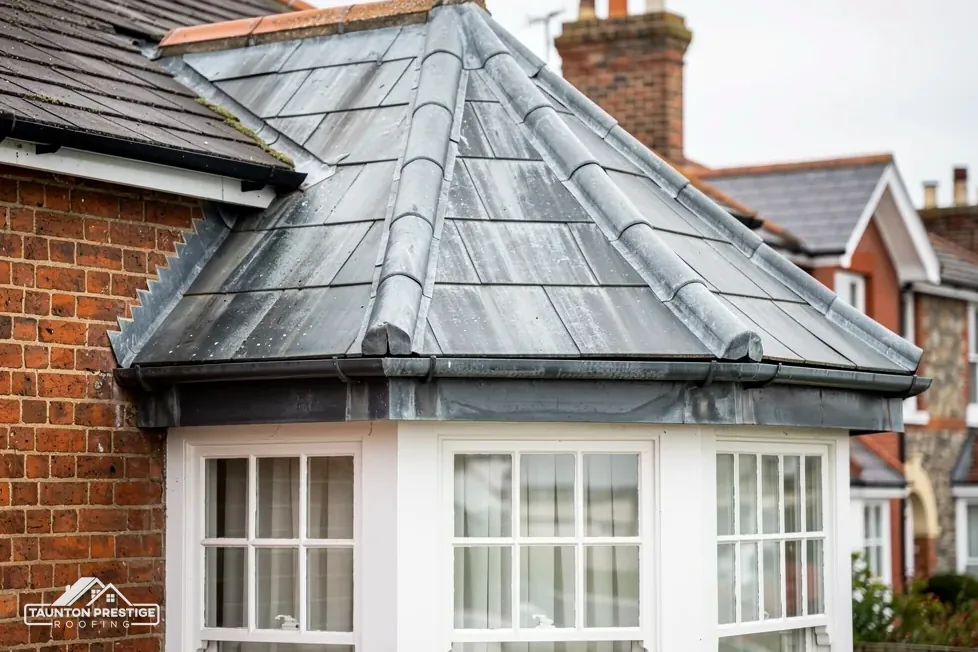
A Mid Devon town whose fires brought a law on roof coverings
Tiverton's conservation area dates from February 1973, and an Act of Parliament once told its householders to roof in lead, slate or tile. We look over the roof first and quote once we have seen it.
Planned housing beside the old factory, which the council's appraisal rates highly in regional and national terms.
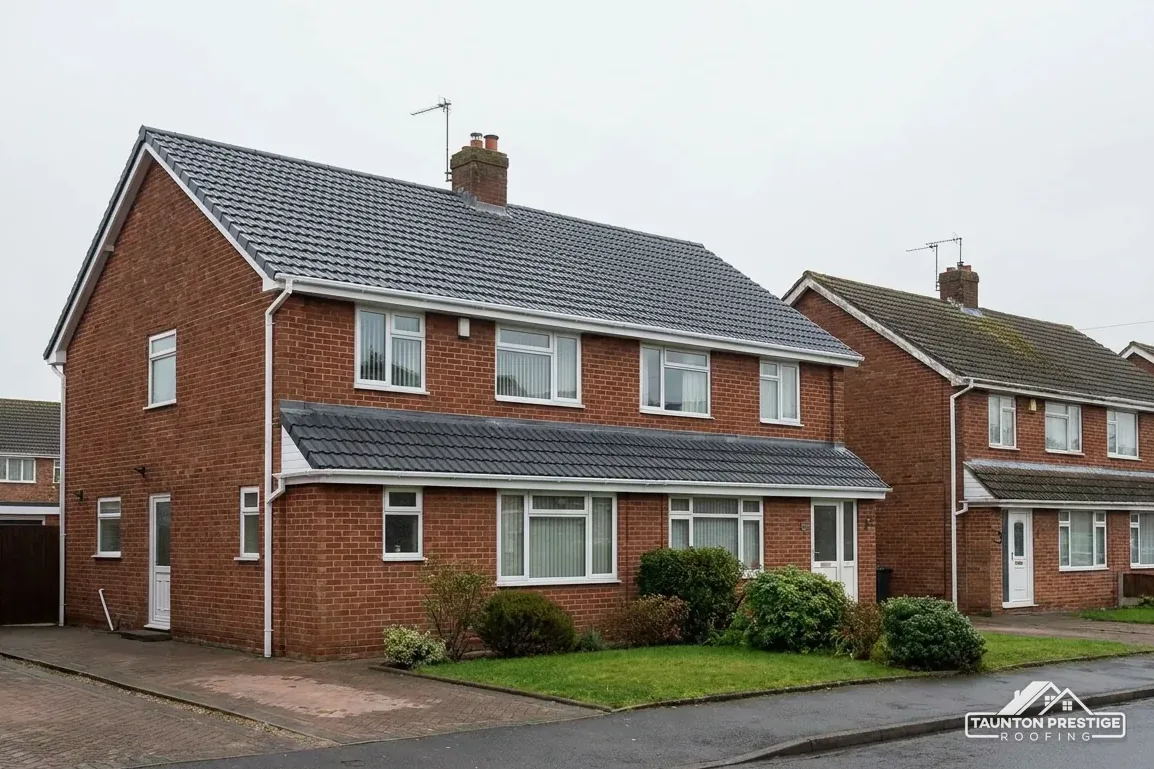
Stone-built and among the oldest buildings in the town, they came through the fires that swept away most early ones.
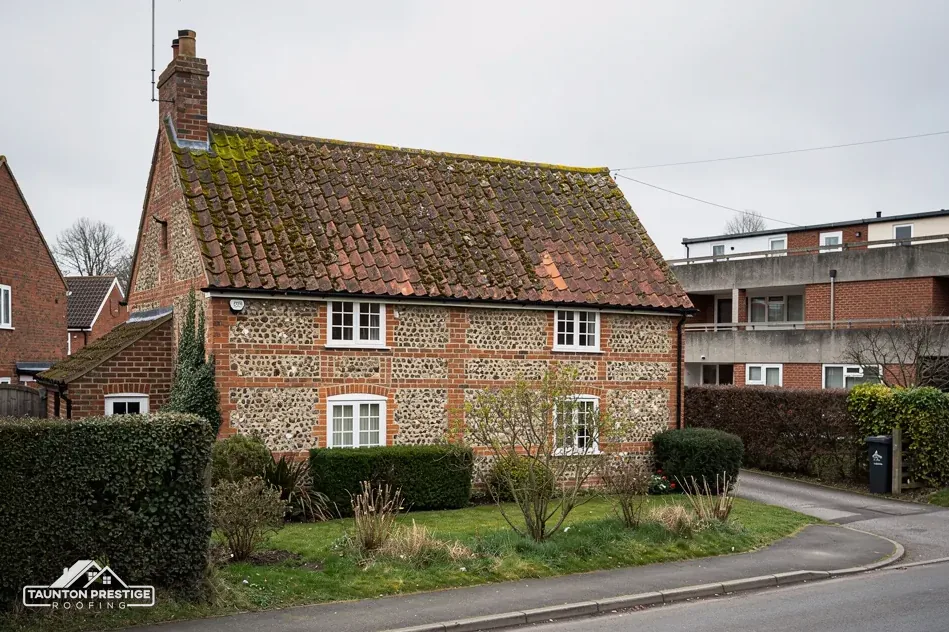
St George's is Grade I; St Peter's is built of local purple stone with Beer stone and Ham stone dressings.
Street map of Tiverton with Halberton, Sampford Peverell, Cullompton, Willand marked around it, and Taunton.
Halberton lies east of Tiverton, with Sampford Peverell and Willand beyond it, also to the east. Cullompton and Bradninch are south-east, and Silverton sits to the south.
About 18 miles south-west of Taunton, Mid Devon District Council and Devon County Council.
Four checks on an Exe valley roof
The history behind the coverings, slate and lead on old buildings, gutters near the river and Devon's scaffold rules, with what each means for your job.
Fire shaped Tiverton's roofs. Mid Devon District Council's conservation area appraisal describes close-packed buildings, many of them thatched, and industrial fires that ran through the town more than once. After one series of fires an Act of Parliament told every householder to roof in lead, slate or tile, and thatch was outlawed. The stone almshouses (Waldrons, Slees and Greenways) came through the blazes and now rank among the oldest buildings standing. A rule about coverings has sat over this town's roofs for generations, and it is the reason a Tiverton survey starts with a look at what is already up there.
The Tiverton conservation area was designated in February 1973 and extended in July 1992 and on 15 June 2005. The town's listed buildings include the castle and the Church of St George (both Grade I), with Amory House and Chilcot School at Grade II*. Our first job on any survey here is paperwork: does your address fall inside the designation, and is the house itself on the National Heritage List? Matching what is already there sits at the easy end of the scale. Switching the covering, adding roof windows to a front slope or building a dormer takes you to the council. Our guide to planning permission for roof work maps those routes, and Mid Devon District Council's planning officers can confirm how they apply to your house.
St George's is Grade I and in active Church of England use. That puts roof repairs under the faculty system: the parish applies, and the chosen roofer follows the approved specification. A chapel, hall or former church elsewhere in the town may sit on a different route, so ask what the building is used for before anyone books a ladder.
Look for
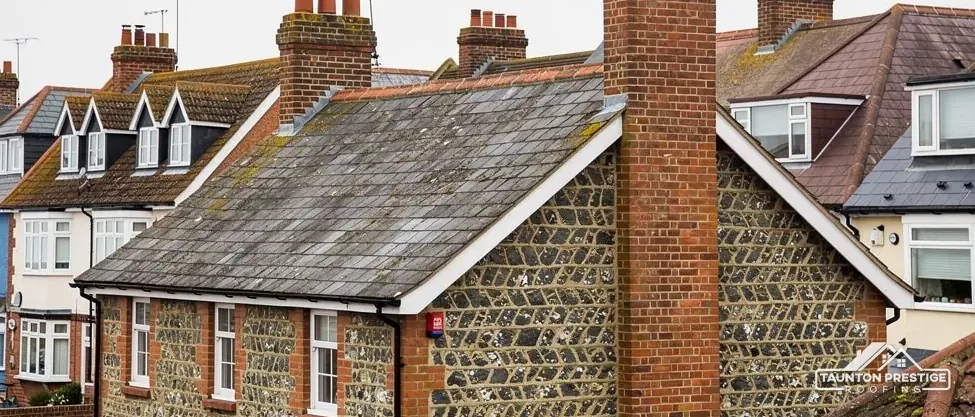
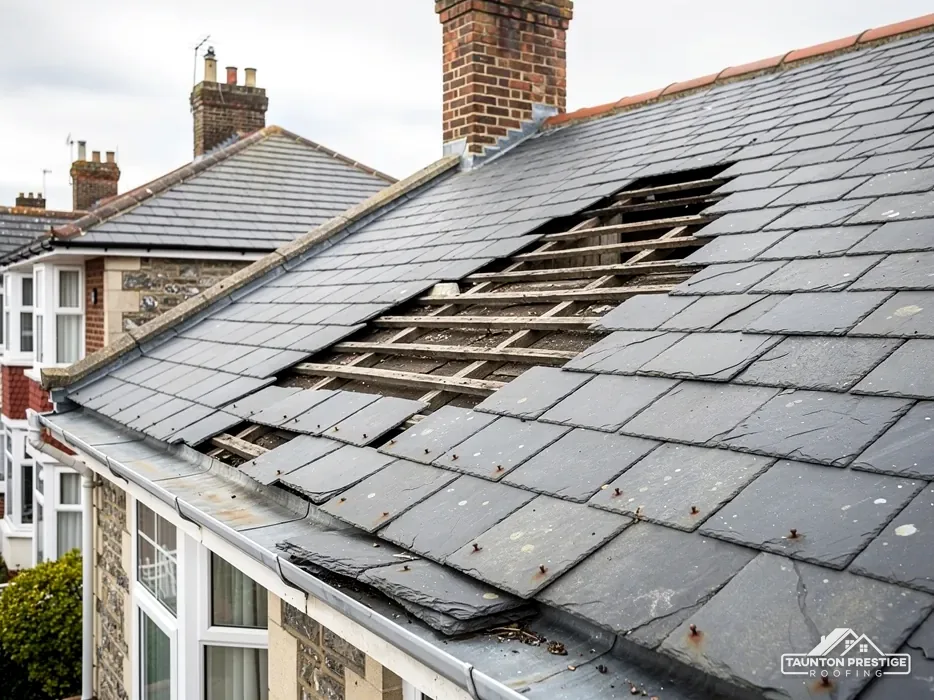
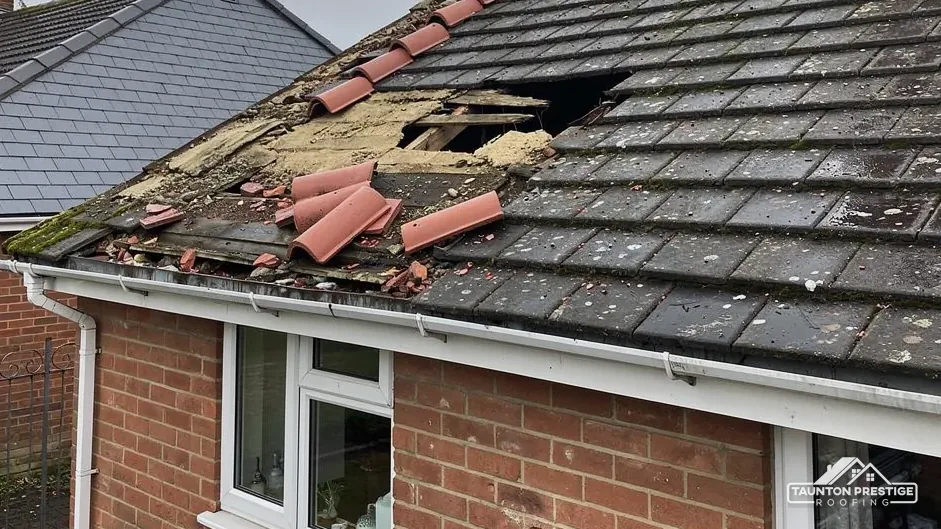
Lead, slate and tile were the three coverings the Act allowed, and Tiverton's roofs still carry all three. A slate hangs from a thin timber lath called a batten, fixed by nail or hook, and the underlay (the waterproof sheet below the laths) catches whatever gets past. Once a fixing rusts through, the slate drops and the underlay is left facing the weather. Natural slate can reach 100+ years if kept in good order, a Confederation of Roofing Contractors figure, while the BRE minimum of 60 years applies to clay tile alone. Those are ranges, never promises, and even a young roof can give up at the fixings.
What decides the price
Frequently, yes. We slide it home under a clip or replace it with a twin, and the rest of the slope stays as it is. The whole slope gets read first, since one drop beside several others shows tired fixings along a run. John Heathcoat's planned terraces make the point: houses that share one roofline with their neighbours show a badly matched patch from the street, so size, colour and texture count, and sound reclaimed slate often blends best.
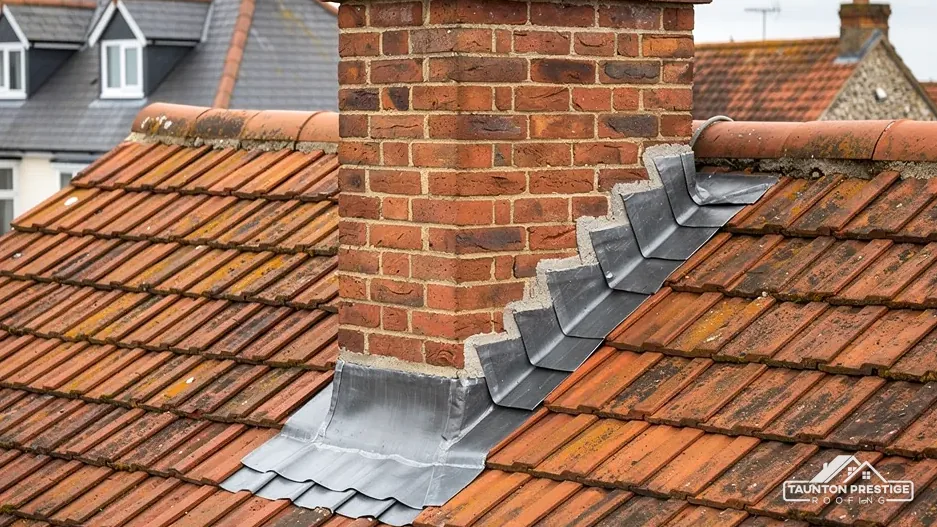
Lead flashing is the strip tucked into a wall and dressed down over the covering to seal the join. Soakers are little folded lead sheets, one per course, that tuck under the slates beside a wall or stack. MyJobQuote (Sep 2026) credits lead flashing with a life of over 80 years, so a flashing that has split early points to a fixing fault or to movement in the wall. Sealant over a split buys a season at best, and a new strip mends the join. See our slate roofing and lead work pages.
The Environment Agency's Flood Map for Planning places Tiverton within about 250 metres of Flood Zone 3, and the castle stands on a cliff above the Exe valley. A flood map describes land, and GOV.UK offers a postcode-based flood-risk checker for any single address. The roof's contribution is to throw rain off quickly and pass it to the drains, which puts the weight on gutters, downpipes and any flat section.
Rain bound for the Exe passes through your gutters first, so check them as carefully as the slates.
A gutter that spills at one joint in every downpour is telling you about that joint: a clog, a failed seal or a sag that tips the channel the wrong way. The hopper head, the funnel where a downpipe begins, is another place where leaves collect and water backs up. Brett Martin's guidance asks for a drop of 1mm in every 600mm, so one bracket that has slipped leaves a standing puddle. Fascia is the visible board along the eaves, and soffit is the panel on the underside of the overhang, between that board and the wall. Seasons of spillage onto fascia timber soften it until the brackets work loose, so we test both before writing a price.
Standing water days after a shower means the deck has lost its slope, an outlet is blocked or the boards have sagged. BS 6229:2025 sets a minimum finished fall of 1:80, and IKO advises designing for 1:40, which leaves margin once the roof is built. Lifespans differ by source. For EPDM, the single-sheet synthetic rubber option, Less quotes 30 to 50 years against GreenSpec's 20 to 30; for GRP, a glass-fibre plastic cast wet in place, Less quotes 25 to 40. Less lists torch-on felt at 10 to 20 years and warns that a poor job can fail inside 10. See gutters, soffits and fascias.
Section 169 of the Highways Act 1980 requires a licence for scaffold from the highway authority before poles go up over a pavement or road. For Tiverton that authority is Devon County Council, which requires the scaffolder to submit the application for the householder. The licence costs £158 and wants a minimum of 10 working days' notice, and a shorter lead time makes it an emergency application at £238. A licence is issued for the working dates, up to 12 weeks, and amending or extending it costs £100. Poles set wholly on your own drive or lawn sit off the highway, and plenty of small repairs are reached by ladder or tower instead. Where water is already getting in, the make-safe comes first and licence paperwork follows.
What decides the price
Mid Devon District Council's business page links to NMD Building Control, a joint service shared with North Devon. Under the Planning Portal's guide, a re-roof affecting under 25 per cent of the building envelope and under 50 per cent of the roof is normally a no-application job for building control. A new covering 15 per cent or more heavier needs Building Regulations approval and a structural check, which matters if heavy slate is replacing lighter tile.
Birds and bats can change the timing. Intentionally destroying an active nest breaks the Wildlife and Countryside Act 1981, and for bats GOV.UK puts roof repair among the work that may disturb roosts, which the law protects. Our survey looks for both first, and the start date bends around what turns up.
Photographs of your own roof come first, then a single written sum for the whole job, and we take the waste away when the work ends. Give us your Tiverton address, tell us what you have seen, and survey dates will follow.
Walked the roof?
When you have read the checks, we walk the roof and show you the photos.
A match matters on a planned terrace, because neighbouring roofs read as one line along the street. Whether the council has a say depends on whether your house is in the conservation area or listed, so ask Mid Devon District Council's planning team. We look for slate matching in size, colour and texture, and use sound reclaimed pieces.
Tiverton Castle is listed Grade I and is not a church in use, so any change touching its character needs listed building consent from the council. Mid Devon District Council acts as the planning authority here. If any part of the site is also a scheduled monument, scheduled monument consent is a separate step.
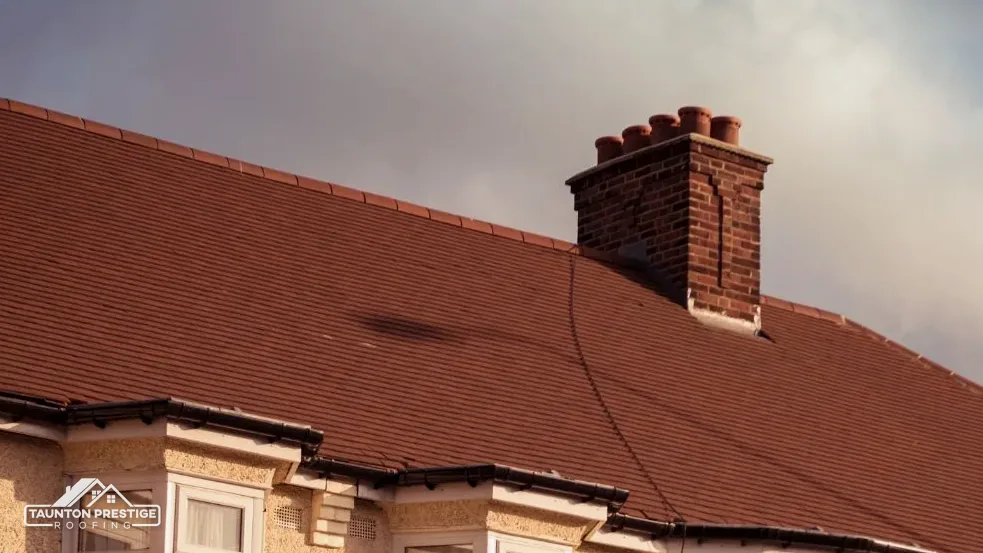
Sometimes. MyJobQuote credits lead flashing with over 80 years of life, so a split one after a shorter run points to a fixing or movement problem that sealant will not cure. We inspect flashing, flaunching (mortar bedding round the pots) and pointing as one unit, then tell you which repair will hold.
Mid Devon District Council points to NMD Building Control, run jointly with North Devon. Put the question to them when the work touches 25 per cent or more of the building envelope, when the new covering weighs 15 per cent or more extra, or when the job reaches 50 per cent or more of the roof. Bring our survey photos with you.
Name your Tiverton address and the slope troubling you, then pick a survey slot with us.