Holy Trinity church
Built 1865-6 of coursed lias; its aisle was reroofed in 1935 with green Westmorland slate, later replaced by Welsh slate.
A lias church with a Welsh slate aisle, west of Street
Walton lies immediately west of Street, and its Holy Trinity church was built in 1865-6 of coursed lias. Every roof here is surveyed before we price it.
Built 1865-6 of coursed lias; its aisle was reroofed in 1935 with green Westmorland slate, later replaced by Welsh slate.
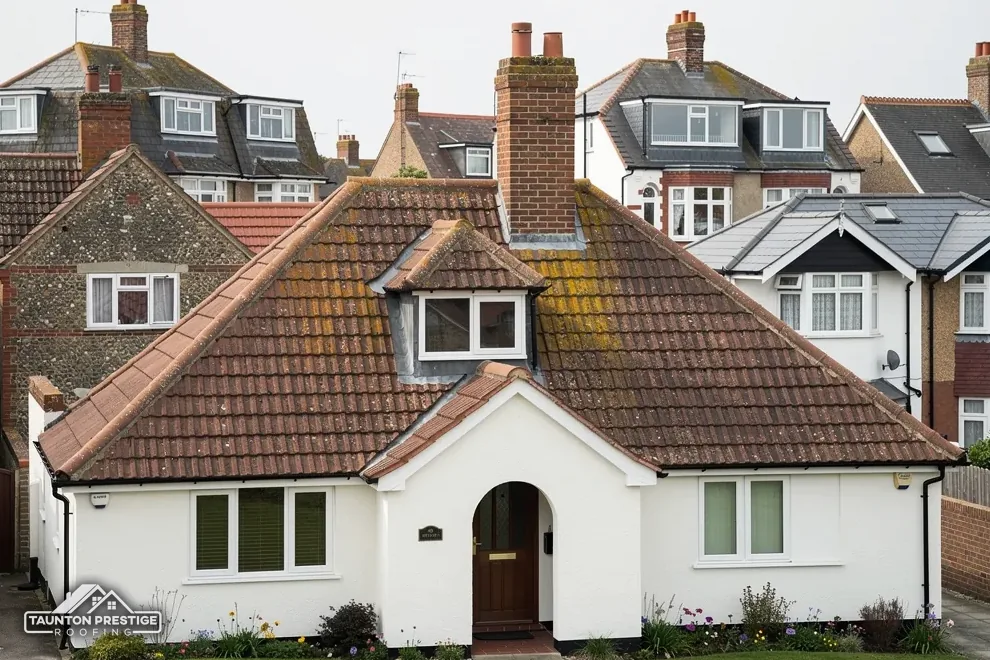
Listed Grade II* on 22 November 1966, so a change of covering there is a listed building consent matter.
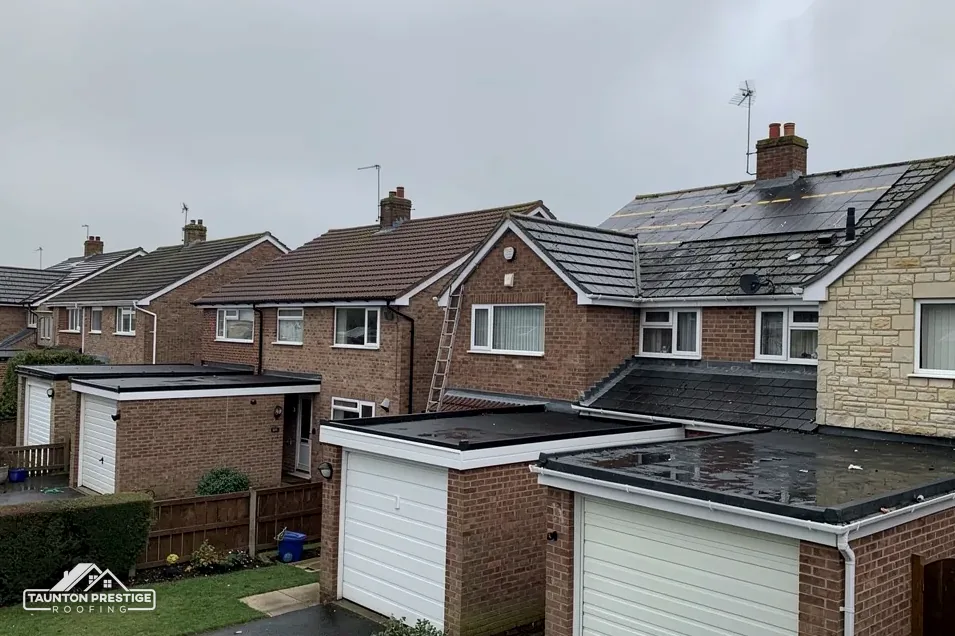
Each is a listed Grade II farmhouse, which puts consent ahead of any change of covering.
Street map of Walton with Street, Ashcott, Compton Dundon, Glastonbury marked around it, and Taunton.
Meare lies to the north, Glastonbury to the north-east, Butleigh to the south-east, High Ham to the south-west and Ashcott to the west, with Street immediately east.
About 17 miles north-east of Taunton, Somerset Council (unitary).
Four checks near Street
What a village next to Street asks of its roofs: the listings, the slate, the stone and the access, in the order we work through them.
Walton is small enough to count its listings on one hand. Holy Trinity church (Grade II) and the Old Parsonage (Grade II*) were both listed on 22 November 1966, and Ben Ash Farmhouse and Yewtree Farmhouse have a Grade II listing too, and they are the sort of building where a repair is judged by how well the new work blends with the old. The National Heritage List counts just five entries inside a 500-metre radius of the village centre. That leaves plenty of Walton roofs outside any listing, and finding that out takes a few minutes at the start of a job. It also means the houses that are listed deserve more care, because there are so few of them and each one carries a good share of the village's character.
Holy Trinity still holds Anglican worship, so its roof is handled by the faculty process of the Church of England. The parish petitions, and the council's listed building consent plays no part. We supply photographs of the existing slate and a short description of the repair for that petition. If a church ever closed, the council route would take over from the faculty.
Street holds the nearest conservation area, within about 2.5 km of Walton. Whether a given address sits inside a boundary is for Somerset Council's planning team to say, and a phone call settles it. Knowing before slate is ordered beats finding out afterwards, because a conservation area changes how the council weighs a new look for a roof. Our guide to planning permission for roof work gives the wider picture.
The Old Parsonage and the two farmhouses follow a simpler rule. Repairs in matching material are the gentler path, while a change to the covering, the ridge or the chimney heads calls for listed building consent from Somerset Council before anyone climbs a ladder.
Look for
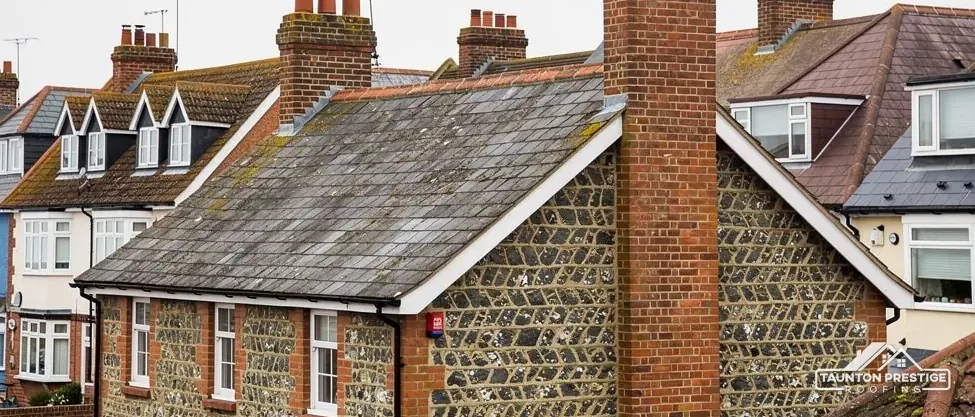
Holy Trinity carries a small history of slate in its own roof. The aisle was reroofed in 1935 with green Westmorland slate, which was later swapped for Welsh slate. Two slates on one building show how rarely a slate roof stays untouched, and how much a good match counts. Slate varies in colour, thickness and size, and a patch in the wrong tone stays visible for years afterwards, particularly on a roof people look at from a lane.
What decides the price
For a slate roof that is looked after, the trade body CORC gives a figure of 100+ years. Take that as a published expectation and not a promise, because nails and hooks usually give out well before the stone does. When only a few slates have dropped, refixing them or slipping in matches is a sound repair. Stripping the whole slope is justified once the fixings are failing right across it, and the survey photographs show you which of those two you have.
Marley advises against high-powered cleaning of slate and tile because the surface can be damaged and the roof's expected life cut considerably. We therefore clear growth by gentler means, working from the top of the slope down, and we do not blast the surface. Moss left to build up holds water against the slate, so clearing it before it thickens is worth doing. Our slate roofing page covers repair and replacement, and the roof cleaning page covers moss.
Pitch limits the choice as well, and it is cheap to find out early. For natural slate, BS 5534 indicates a floor of 20 degrees, and Cupa warns off slate hooks on slopes under 25 degrees, which is why the tape goes on the slope before we talk about fixings.
Sound or needs work
Lias was quarried to the east of Walton until the workings were abandoned and filled in during the early twentieth century, and Quarry Batch and Asney grew up beside them from the late eighteenth century. The parish church shows how the stone looks once built: coursed lias with freestone dressings. Walls like that are heavy and unforgiving, and they push a roof's weak spots into a few places, chiefly the chimney stack, the wall edge and the gutter line. Each moves a little with the seasons, and each is a joint a roofer has to make watertight against a surface that is never perfectly square.
A leak at a chimney is nearly always a joint that failed, not a stack that wore out.
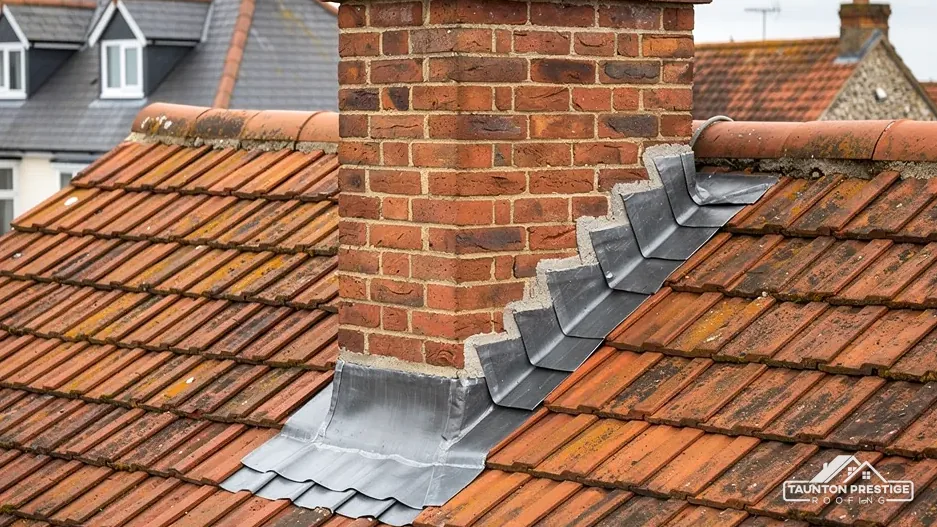
The joint between stack and slope is sealed with lead flashing, lead folded and dressed into the stonework. Royston's brochure lists sheet codes 4 to 6 for flashings, the higher number being the thicker, harder-wearing lead. Flashing can last for over 80 years, so a leak there usually means lifted edges or crumbled pointing in the joint and not a worn-out sheet.
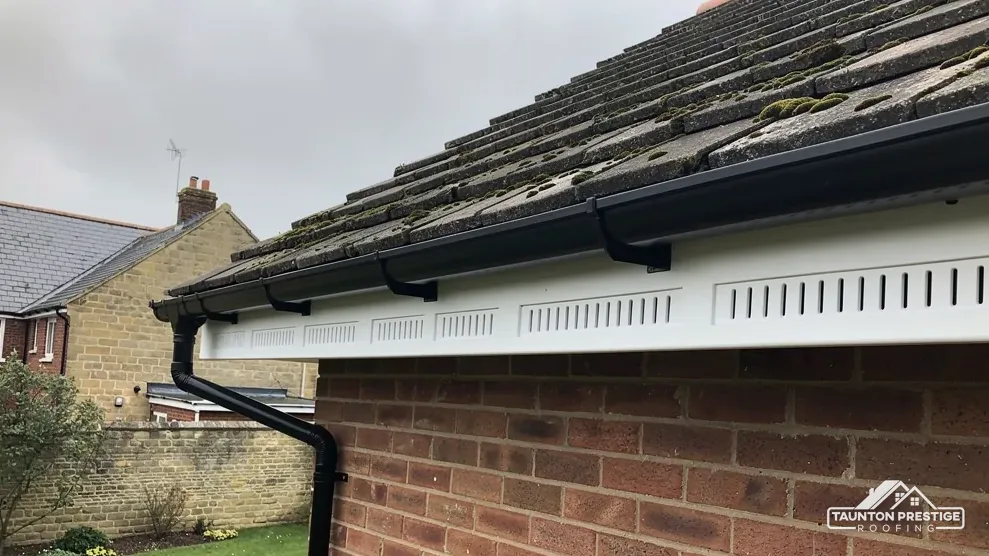
Spill at one point tends to mean leaves in the outlet, a coupling that has split, or a bracket that has dropped. Brett Martin suggests 1 mm of fall for every 600 mm of run, and a single bracket sagging by a few millimetres can undo that. Gutters are fixed to the fascia, the long board under the roof edge, with the soffit boxing in the eaves below. Timber that stays wet softens, and then the brackets slip. Cleaning the gutter and resetting the run is often the whole job, and when it is, that is all you pay for and the boards are left alone. Our gutters, soffits and fascias page lists the repairs.
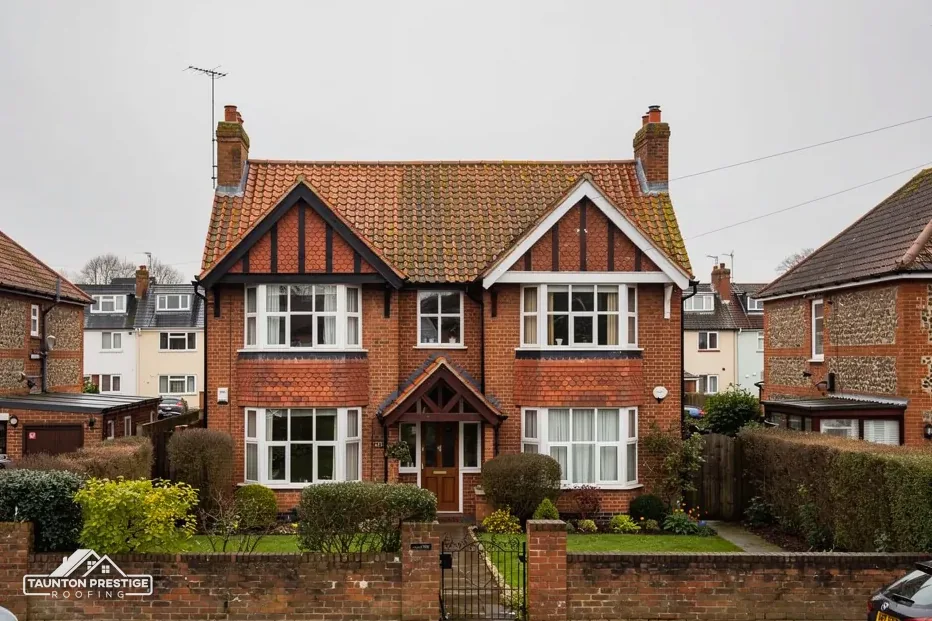
Scaffold standing on a Walton lane or verge falls under section 169 of the Highways Act 1980, so a Walton job needs the highway authority's licence before the poles go up. In this part of Somerset that means Somerset Council, which grants them to accredited contractors and nobody else. Whoever is appointed to carry out the work makes the application. The fee is £124.60 per 28-day period (April 2026), and the council asks for 10 working days' notice. We plan the start around that notice, so a roof is never left stripped while a form waits in a queue. Work on a drive or in the garden stays off the highway, and a ladder or low tower is enough for many small repairs.
The Planning Portal's yardstick is under 25 per cent of the building envelope and under 50 per cent of the roof. Inside both figures an application is not normally needed. Choose a covering at least 15 per cent heavier and Building Regulations approval is required, with a structural check. Somerset Building Control, on 0300 303 7790, can talk through your address.
The Wildlife and Countryside Act 1981 protects a nest in use against intentional damage. Bat roosts in a Walton roof are fully protected, and GOV.UK counts work on a roof among the things that can disturb them. We look for droppings, nest material and gaps during the survey and arrange the work around any finds.
When the survey is finished you look through the photographs of the roof together with us, and a single written Walton total follows, covering the job from first pole to last slate. Send the address and describe the fault, and a Walton survey date goes in the diary.
What decides the price
Walked the roof?
When you have read the checks, we walk the roof and show you the photos.
Different slate is possible, but its colour, thickness and size should match what is there, especially on a listed house or near the church. Holy Trinity's aisle changed from green Westmorland slate to Welsh slate, so matching is a real question in Walton. We compare samples against your existing slate at the survey.
Holy Trinity has a Grade II listing and a congregation still meets there. For a church in that state the faculty system, and not the council's listed building consent, approves roof work. The parish makes the petition and the roofer follows the outcome. If worship stopped, the council route would apply.
Yes. The Old Parsonage, which the Victoria County History says was probably rebuilt in the 15th century, holds a Grade II* listing, so any alteration to its look or its fabric needs listed building consent from Somerset Council on top of any ordinary permissions. Matching repairs are simpler. A new covering, ridge or chimney alteration needs that consent before the work begins.
Flashing is fixed on the roof, often at height, where a fall is a serious risk. It also has to be dressed into the stone joints with care, or water can track behind it. We can check it from the ground first, then repair or replace the lead from safe access and show you the result in photographs.
Say where the Walton roof is letting you down, and photographs from a survey visit follow.