1 to 10 Royal Crescent
Listed Grade II on 9 March 1953, so a change to one roof is judged against its neighbours.
Weston Stone walls, Royal Crescent and a Grade II* church
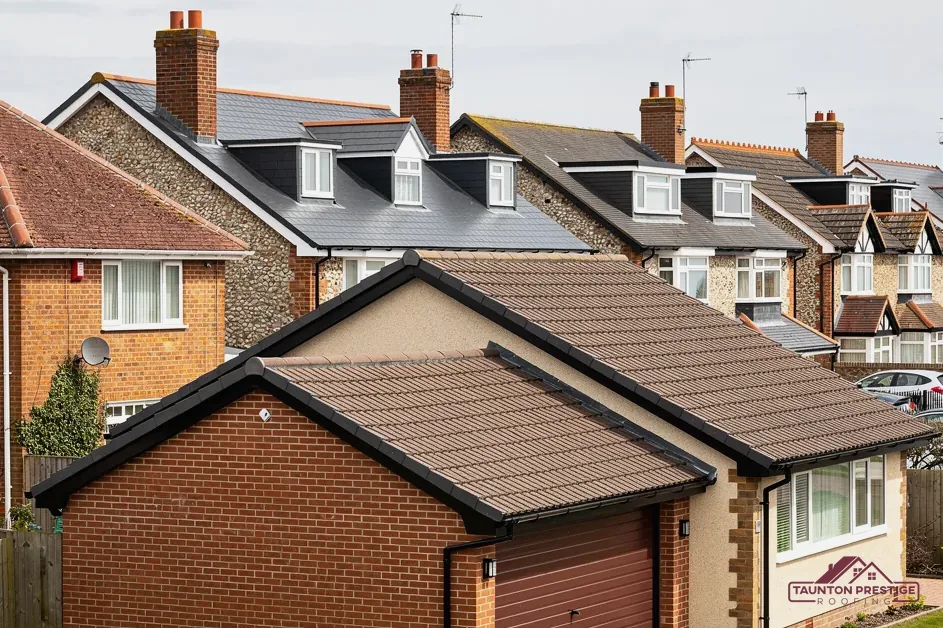
Weston-super-Mare grew as a Victorian seaside resort in grey limestone, and 48 listed entries stand within 900 metres of the centre. We read each Weston roof before pricing it.
Listed Grade II on 9 March 1953, so a change to one roof is judged against its neighbours.
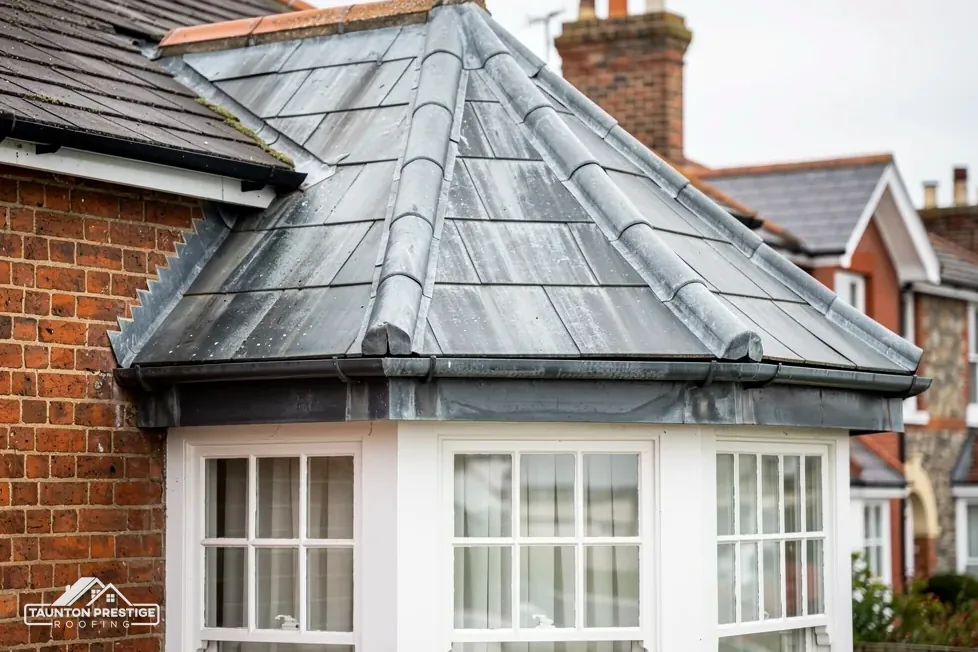
Grade II*, listed 19 May 1983; the council's appraisal notes lead and occasional copper on church roofs and turrets.
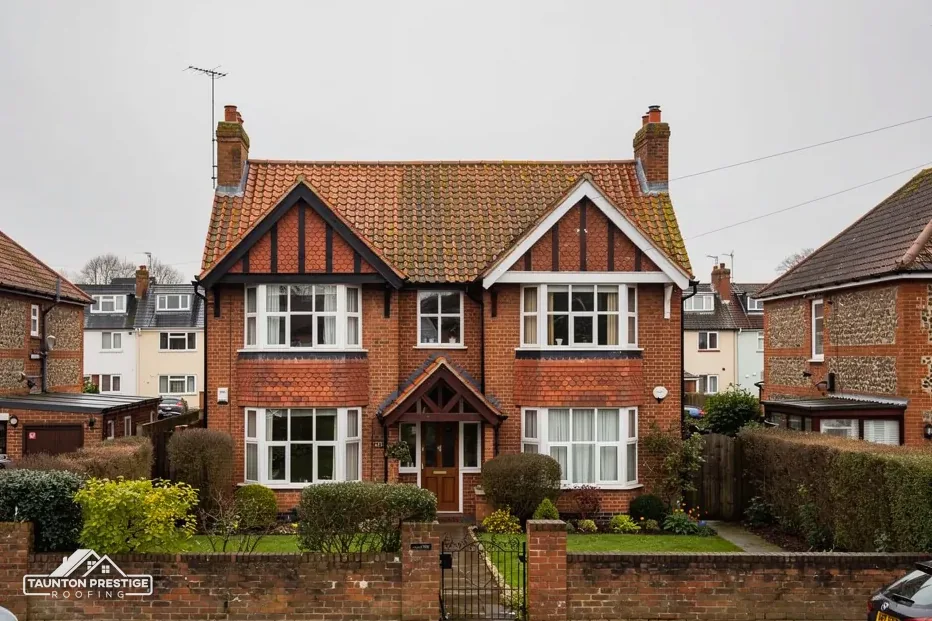
North Somerset's appraisal names both among the coverings of the Victorian town, over Weston Stone walls.
Street map of Weston-super-Mare with Uphill, Hutton, Bleadon, Lympsham marked around it, and Taunton.
Uphill lies just south of Weston-super-Mare, with Hutton and Bleadon to the south-east, Lympsham and Berrow further south and Winscombe to the east of them.
About 24 miles north of Taunton, North Somerset Council (unitary).
Four checks in a Victorian resort town
Matching old coverings, shared chimneys, flat decks and busy-road scaffold: four checks, and how each one decides the price.
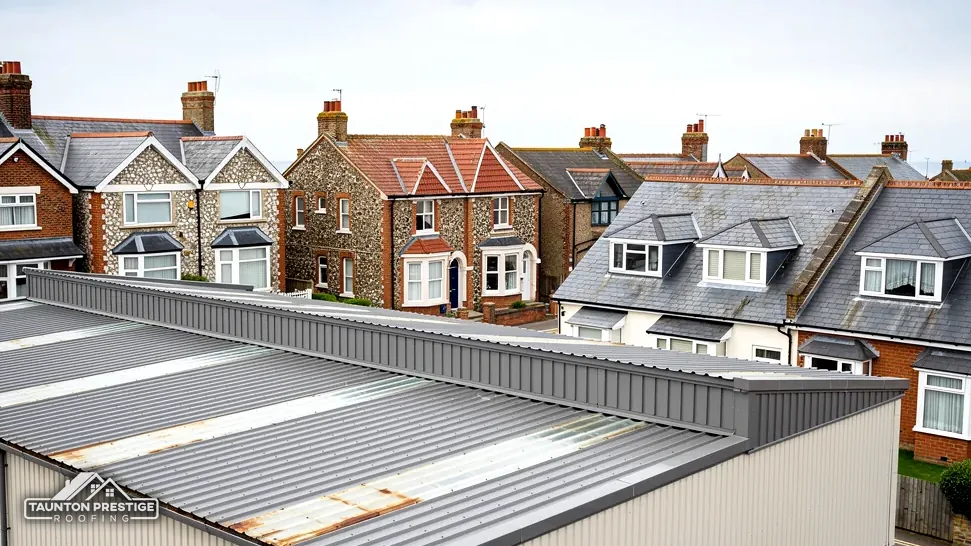
Weston-super-Mare's growth is easy to read in its roofs. North Somerset Council's conservation area introduction says the town's turning point came after 1800 with the promotion of sea bathing, that the first hotel opened in 1810, and that the railway of the 1840s brought visitors in large numbers as building spread inland and south towards Uphill. It records Welsh slate and Roman tile among the coverings on the Victorian town's roofs, with lead and occasionally copper on church roofs, turrets and cupolas.
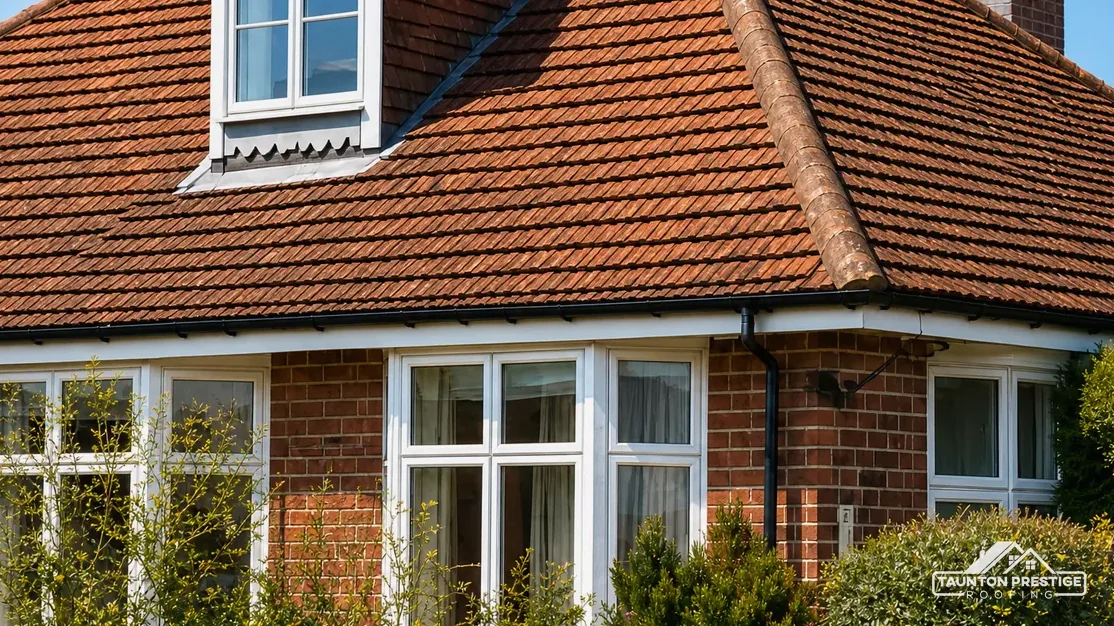
It means a good match matters. Welsh slate has its own colour and texture, and a modern grey slate laid beside it stands out like a patch on a coat. A Roman tile has a profile as well as a colour, and a replacement must share both. Where a roof is original, we match the old in size and tone, and reuse sound pieces from the less visible slopes.
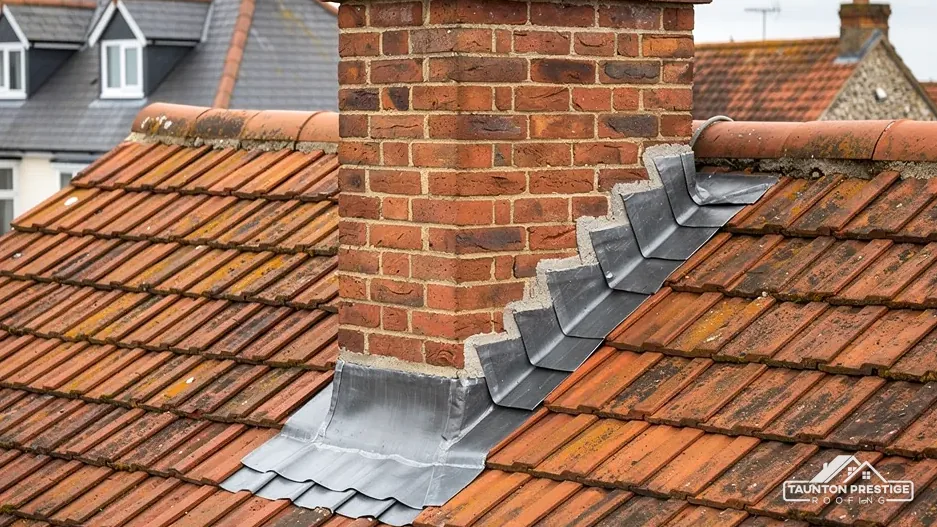
Brick and stone decide how a roof meets a wall. Where a slate roof abuts Weston Stone, the lead flashing is let into the mortar joint, and re-pointing that joint with the wrong mortar can open it. So the wall gets as much attention as the slates.
The national dataset names several around the centre: Weston-super-Mare, Beach Lawns, Birnbeck, Boulevard/Montpelier, Ellenborough Crescent and Melrose/Grove Park, with an extension to the last. North Somerset Council's planning team can tell you which one, if any, holds your house. The Church of All Saints is Grade II* and 1 to 10 Royal Crescent is Grade II. With 48 listed entries within 900 metres of the centre, listed building consent may apply to work that would alter a listed house's character.
The survey records which covering you have, slope by slope, and the photos show a match is possible before anything is ordered.
Look for
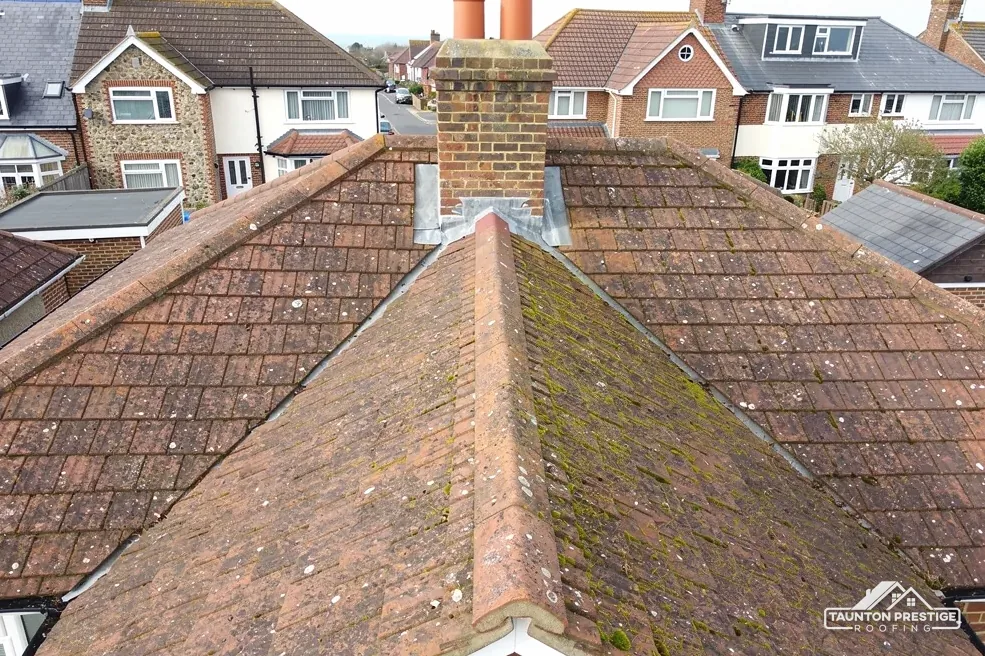
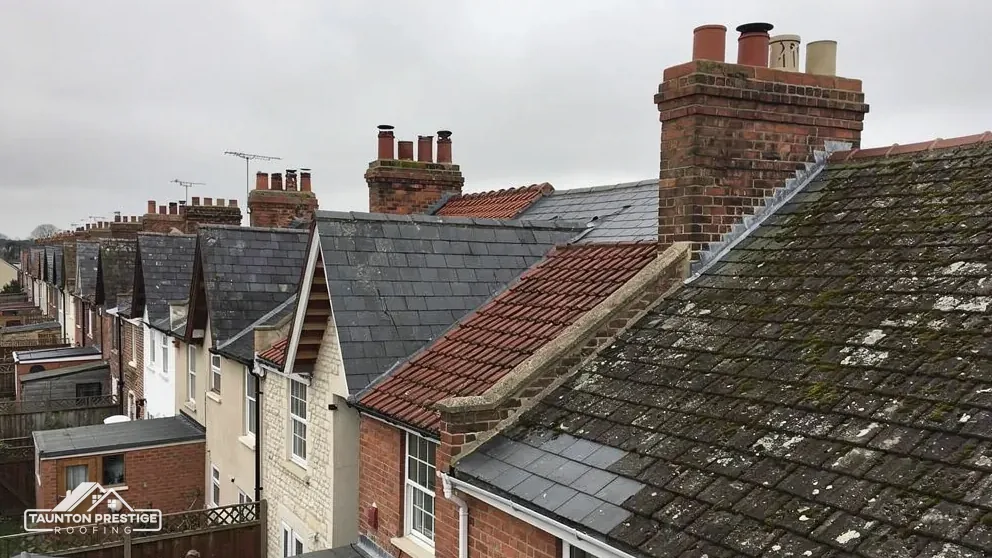
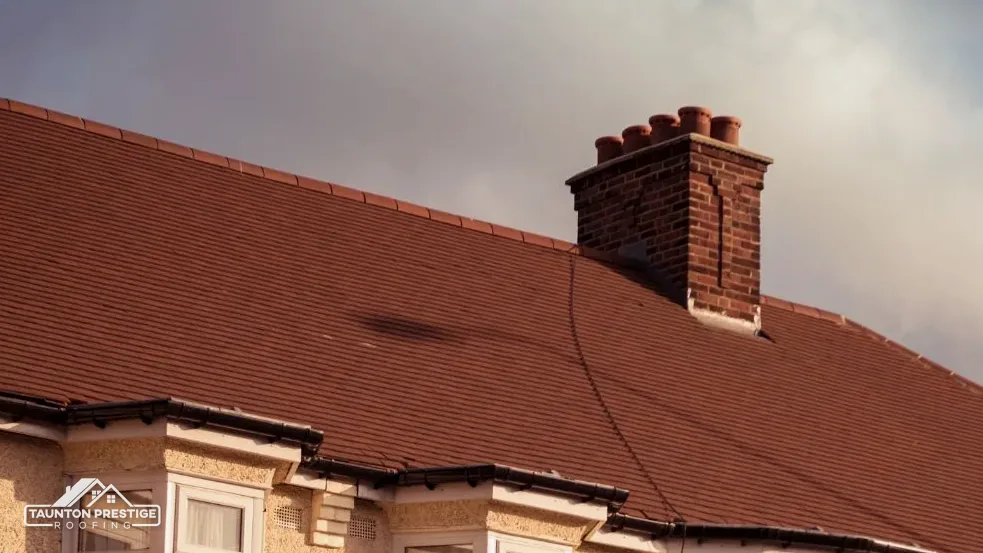
The same introduction says stone came from local quarries including the Town Quarry on the side of Worlebury Hill, that quarries were active in Weston-super-Mare until the 1920s, and that red brick was introduced after the 1860s, with local brickworks at Milton and Locking Road. Brick stacks and stone walls meet the roof at the same places everywhere: at the chimney, the abutment and the parapet. Each of those junctions depends on lead flashing and sound mortar.
Look for
Not without involving the neighbour. Section 2(2)(g) of the Party Wall etc. Act 1996 lets an owner cut away any projecting chimney breast, jamb or flue from a party wall in Weston as anywhere else, and GOV.UK treats taking chimneys out of a party wall as notifiable. The notice has to reach the neighbour a clear two months before the start, and a reply that never comes is not consent. Building Regulations approval is needed as well, since the breast is structural. Our answer on party walls and roof work goes through the steps.
That is a matter between neighbours and, where the Act applies, their surveyors. Our part is to record the stack's condition with photographs from the roof side, which both parties can see. The photos turn a disagreement about what was there before into a conversation about what to do now.
The condition of the mortar, the state of the lead and the scaffold needed to reach it. Chimney repointing runs to £450 to £1,200 on MyJobQuote's typical UK range (Oct 2026). Our chimney repairs page shows how a stack is rebuilt, repointed or capped.
Our survey pictures show the stack from the roof side, with the joints and the collar around the pots in plain view.
Sound or needs work
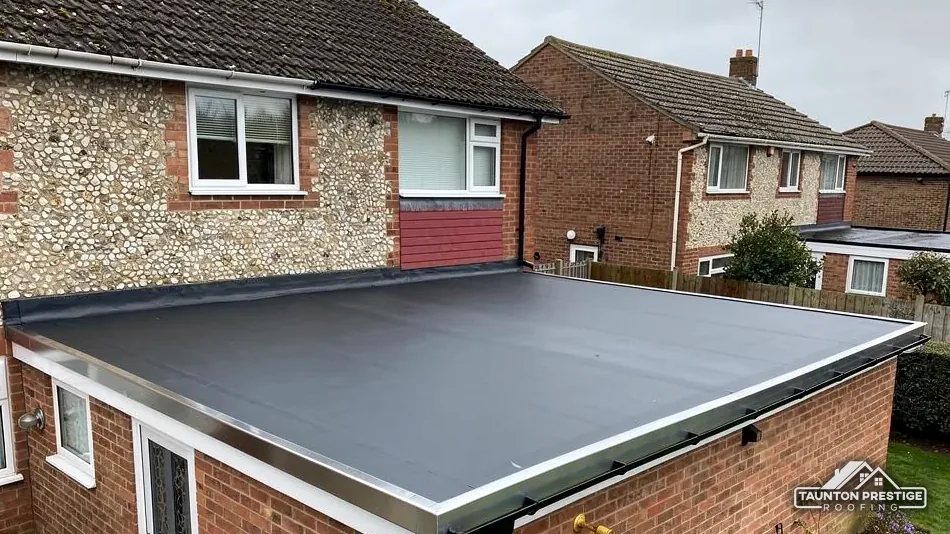
Every flat roof depends on a gentle fall towards an outlet, and the covering on top has to survive years of sun, frost and the odd footstep. Three coverings dominate the choices. EPDM is a rubber-type membrane that arrives as a single sheet. GRP is a glass-reinforced plastic that is laid wet over matting. Torch-on felt is bitumen felt fixed down by heating it with a torch.
Flat is how a flat roof looks; the slope hidden in it is what keeps the building dry.
The sources differ, so quote them by name. GreenSpec gives EPDM an expected service life of 20 to 30 years, while Less says 30 to 50 years. Less puts GRP at 25 to 40 years and torch-on felt at 10 to 20, remarking that a well-laid felt roof can reach 20 while a badly laid one may fail within 10. None of these is a guarantee.
BS 6229:2025 keeps a minimum finished fall of 1:80, while IKO recommends designing to 1:40 so the built roof clears its water. Water that stays for days means the fall has failed or something is clogging the outlet.
It is worth considering: Approved Document L treats a new membrane on a Weston flat roof as renovation, so insulation comes into the discussion. We note the deck, any existing insulation and the height of the upstands at the survey, because adding thickness raises the roof edge and everything that meets it. Old brickwork nearby can carry old repairs too: a hard cement repair on softer brick can trap water behind it.
On MyJobQuote's typical UK range a flat roof replacement costs £1,500 to £6,000 (Oct 2026), with EPDM at around £60 per square metre. Our flat roofing page shows where each covering fits, and the survey measures your roof before we write a price.
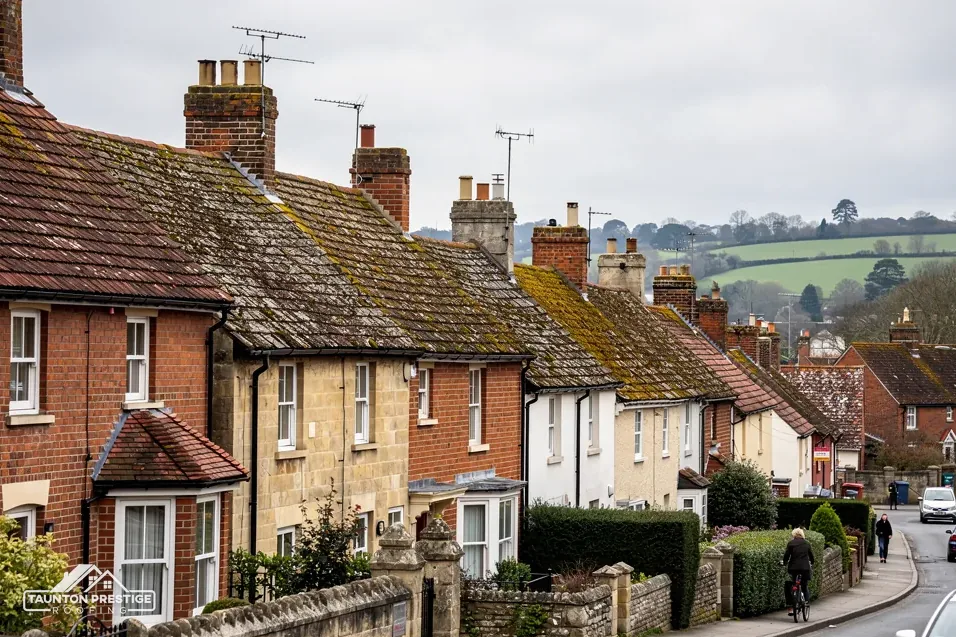
Section 169 of the Highways Act 1980 puts scaffold on a road or pavement under the highway authority's licence. In Weston-super-Mare that is North Somerset Council, which looks for the application to come from whichever firm supplies the service or carries out the job. A permit can cover anything from one day up to 28 days, and the council wants at least five working days' warning, or four weeks for an oversailing licence, such as a tower crane over the road. It also asks the applicant for public liability insurance with a minimum value of £5m.
A road with heavy traffic needs more thought than a quiet close. A walkway past the scaffold and the position of the skip have to be planned before the first pole goes up, and we agree them with you at the survey. Waste is taken away when the job is done.
Your building control body gives the final answer. The Planning Portal's test is generous to small jobs: below 25 per cent of the building envelope and below 50 per cent of the roof, no building control application is usual. A covering that adds 15 per cent or more in weight is the exception, and does need approval.
Read the total and ask whether scaffold, VAT and waste removal are inside it. GOV.UK's standard VAT rate of 20% applies to repairing or re-roofing an existing Weston home. All waste is cleared by us when the work ends, and each day you are told how the job is going.
From the survey you take away a photographic record of your roof and a written price for the full job, one figure for everything. Tell us the Weston-super-Mare address and the road it is on, and we will set the visit and plan the scaffold timing together.
What decides the price
Walked the roof?
When you have read the checks, we walk the roof and show you the photos.
Yes, and it is usually the better choice where the covering is original. We match the size, colour and profile, reuse sound pieces from low-visibility slopes and keep new material to what is needed. In a conservation area or on a listed house, ask North Somerset Council's planning team before switching material.
Mortar joints keep the stack's masonry together, while lead flashing seals the junction between the stack and the roof covering. MyJobQuote puts lead flashing at over 80 years as a minimum. When one fails the other usually follows, so we check both during the survey and photograph each from the roof side.
For scaffold on the highway, North Somerset Council expects whichever firm is doing the job to apply, giving at least five working days' notice. Ask your roofer who is applying and when. We agree that with the scaffolder at the survey, so the licence does not hold up the start.
A breast on a party wall falls under the Party Wall etc. Act 1996, which requires a party structure notice, served two months before the work starts, before it is cut away. Removing any chimney breast also needs Building Regulations approval. A party wall surveyor resolves disputes; building control does not.
Tell us whether it is slate, a stack or a flat deck, and we will arrange a visit.