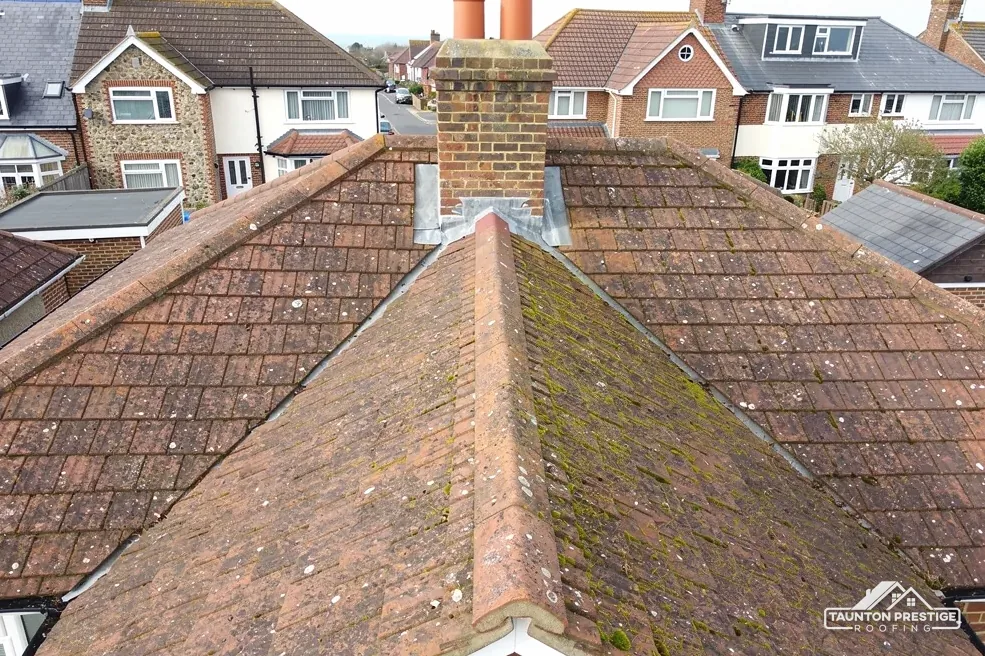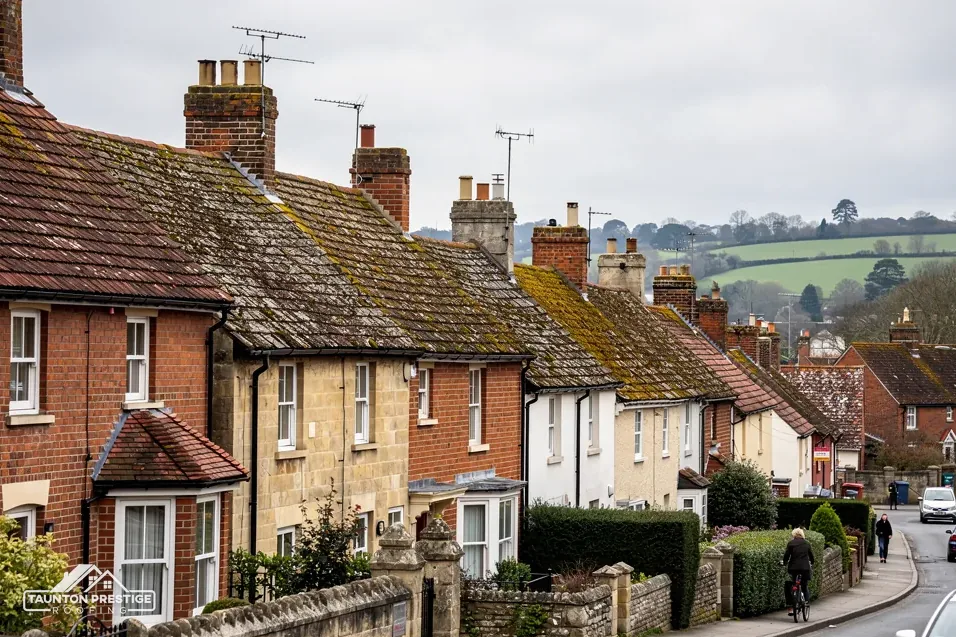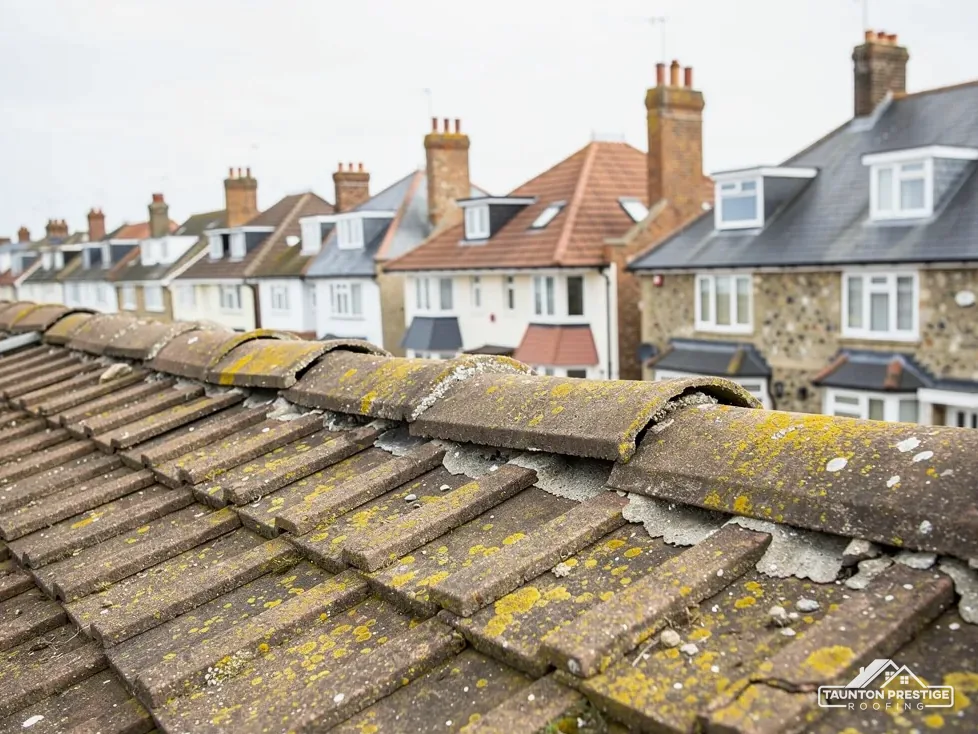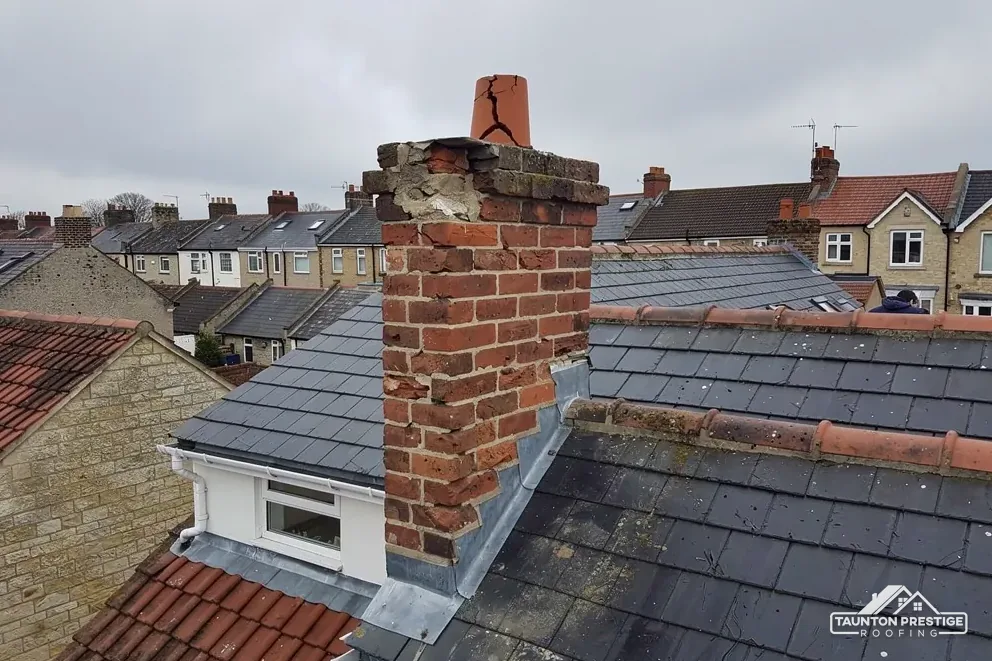
No other part of the roof is as exposed as the stack. It stands proud of the ridge, faces every wind, and carries joins where brick, mortar, lead and the roof covering all meet. When it fails, the symptoms show indoors: a brown mark spreading across the chimney breast, a damp patch in the corner of a bedroom, or soot and water in a fireplace.
People ask what chimney repair costs, and the honest answer is that there is no single figure, because the repairs are very different. Repointing the brickwork is one job. Replacing the lead flashings around the base is another. Taking a chimney breast out of the house is a third, with its own structural questions and its own paperwork. This post gives the typical UK range published by a national cost guide for each of those, with its name and date, then explains what actually moves the price across Taunton and the surrounding villages.
None of these are our prices. Typical UK ranges come from MyJobQuote, a cost guide that collects figures from roofing and building jobs across the country. Our own price comes after we have seen your stack, and it rests on what the survey finds and the photos we show you.
Typical UK figures for the common jobs
These are the figures as published, each with its guide and the month it was last updated. Use them to test whether a quote looks sensible, not as a prediction for your chimney.
| Job | Typical UK range | Guide |
|---|---|---|
| Chimney repointing | £450 to £1,200 | MyJobQuote, Oct 2026 |
| Chimney leadwork, patch repair | £150 to £250 | MyJobQuote, Sep 2026 |
| Chimney leadwork, full set | £350 to £920 | MyJobQuote, Sep 2026 |
| Chimney breast removal | £1,200 to £3,500, average £2,500 | MyJobQuote, Aug 2026 |
What is each of these jobs?
Repointing means raking out the old mortar between bricks and filling the joints with new. The brickwork then sheds water again instead of soaking it up. Leadwork is the sheet metal around the base of the stack: a front apron, side flashings and a back gutter, a small trough that carries water round behind the chimney. A patch repair fixes a split or a lifted edge. A full set renews all of it. Chimney breast removal is internal work, taking out the brickwork that rises through the house from the fireplace.
Do these figures include scaffold?
The leadwork page says the full set depends on scaffold, which is why its range is so wide. The other figures do not make clear how they treat it, so ask any quote whether scaffolding and VAT are included before comparing totals. We come back to scaffold below, because it is usually the swing cost.
What decides the price on your stack
Neighbouring chimneys on one street may call for quite different amounts of repair. The survey decides which applies to yours, and here is what we are looking for.
How much of the chimney is actually failing?
A stack with a few eroded joints near the top needs less than one with crumbling bricks all the way down. Weather works hardest at the top of a stack, where the masonry is wet from both sides, so the top few courses are often worse than the rest. A chimney that is leaning, or has a crack running up it, is a rebuild question rather than a repointing one, and that moves it into a different cost bracket entirely. Our page on the cost and method of chimney repointing goes through what the work involves.
What else sits on top of the brickwork?
Flaunching, pots, cowls and aerials all add to the job. Flaunching is the sloping mortar collar at the foot of the pots, which holds them and throws rain clear. Flaunching is usually priced as part of the whole chimney job. Pots, cowls and aerial brackets work the same way: each adds time, and the survey shows which ones your stack needs. The same is true of chimney pots, which vary by size and pattern. Our page on chimney flaunching explains why it fails and what a repair involves.
Once the stack is open we show you photos of each of these parts. You see the same cracks we do, then you choose what gets done.
Scaffold is the swing cost
On a low bungalow, a ladder and a roof ladder may be enough. On a two-storey house with the stack at the ridge, scaffold goes up, and it can cost as much as the chimney repair itself. That is why the range for leadwork is so wide. Pricing from the roof alone misses this, which is why we check the access before we write the total.
What do cost guides say scaffold costs?
HomeBuilding, in September 2025, puts scaffolding at approximately £1,000 for a semi with three bedrooms, with permits included, in the context of a full re-roof. MyJobQuote, in October 2026, gives £550 to £750 to hire it for a week on a front elevation. The two figures describe different jobs, so read them as a sense of scale, not a rate.
Does scaffold need a licence?
Only where it blocks the public highway. Under Highways Act 1980 section 169 that takes a licence from the highway authority, which in Taunton means Somerset Council. Its fee is £124.60 for each 28-day period (April 2026), and Somerset Council licenses scaffold for accredited contractors only, and whoever is appointed files the paperwork, so the scaffolder or roofer handles it. Our scaffold licence page sets out the notice period and the process.
On a Devon-edge job the highway authority is Devon County Council. Scaffold on a private drive or in a back garden needs no highway licence. Where one is needed, we sort it out alongside the scaffolder, and the page on scaffolding for chimney repairs covers when a tower or a ladder will do.
A chimney job done during a re-roof can share the scaffold, which spreads the cost.
Removing a chimney breast
This is the most expensive job in the table, and the one with the most paperwork. A chimney breast is the brickwork that projects into a room and carries the flue up from the fireplace. Removing it frees up floor space but changes how the wall and the stack above are supported.
What does breast removal cost?
MyJobQuote, in August 2026, gives a typical UK range of £1,200 to £3,500, with an average of £2,500. The spread depends on how many floors the breast passes through, whether the stack above is kept or taken down, how the load is carried afterwards and how much making good the plaster and floors needs. A structural engineer may be needed when the stack above stays in place.
Does a shared wall change anything?
It can. Houses in a row often share a breast with next door. The Party Wall etc. Act 1996 covers cutting back a breast, jamb or flue that projects, with a notice served two months ahead of the start (sections 2 and 3), and GOV.UK lists taking out chimneys on a party wall as notifiable work. Silence from the neighbour is not consent. Ask a party wall surveyor rather than building control, and our page on party wall rules for chimneys sets this out.
Removal can also touch Building Regulations and, in some places, planning. Our page on chimney breast removal goes through the steps, and if your house is listed, listed building consent comes first.
Somerset houses and the work they ask for
Local conditions change both the work and the route to getting it done. Three local points deserve a section.
Why does an older stack take more care?
Older stacks were built in lime mortar, which is softer and breathes. Repointing with a hard cement mix can trap moisture in the brick and make the damp worse, so the mortar has to match the original. Lime takes time to cure and does not suit being applied in frost. Our page on lime mortar for chimneys covers when it matters.
What about a conservation area or a listed house?
Somerset Council has designated conservation areas in Taunton and in many villages nearby. A listed house needs listed building consent for stack work that changes its character, even though roof permitted development rights still apply. The council also lists Article 4 directions for some places; their contents are unread by us, so check your address with the planning officers before any stack comes down or is rebuilt. Our page on chimney listed building consent explains the route.
How does hill and levels weather affect a stack?
Exposed stacks on the Quantock and Blackdown Hills edge face driving rain and frost, and both work on mortar joints. That is why top-of-stack repointing comes back sooner than the lower courses.
Where it is safe we go up to the stack itself and photograph every part, so you are looking at the same things we are.
Getting a quote you can compare
When you collect quotes, you want to compare like with like. Much of the confusion in chimney pricing comes from quotes that cover different amounts of work.
What should a chimney quote include?
A quote should say what is being done, in plain words: repointing to which height, lead renewed or patched, flaunching replaced or left, pots refixed or changed. It should state whether scaffolding is included, whether VAT is included, and what happens to the waste. Ours is a single total, so there is no moving figure to chase.
What can I check myself?
From the ground, look for staining on the breast inside, crumbling mortar visible with binoculars, bricks lying on the roof or in the gutters, and a stack that leans. From the loft, look for damp on the brickwork where it passes through. Please leave the roof to a roofer. Our page on chimney repairs is the starting point for each job.
When is repair better than rebuild?
When the bricks themselves are sound and only the joints and the lead have given up, repair wins on value. A rebuild makes sense when bricks are crumbling through, the stack leans or cracks run through the brick, because repointing over that only hides the problem. The survey tells you which side yours is on, and the photos let you decide.
Send us the address and a ground photo of the stack, and tell us whether the leak shows indoors.
Chimney costs and rules
Is chimney repointing cheaper than a rebuild?
Repointing has a typical UK range of £450 to £1,200 (MyJobQuote, Oct 2026), and a rebuild costs more because bricks, mortar and often scaffold go on for longer. Repointing is only right for a stack with sound bricks, so the survey decides which route is sensible for yours.
Do I need my neighbour's agreement to remove a chimney breast?
Only when the breast is part of a shared wall, where the Party Wall etc. Act 1996 needs a notice served two months ahead. GOV.UK says silence is not agreement. A party wall surveyor settles it, not building control.
Does home insurance pay for a damaged chimney?
Ring the insurer first, and arrange a temporary repair to hold things steady, and keep every photo and receipt. What is paid depends on the policy wording and the cause of the damage. The Financial Ombudsman Service handles complaints if you and the insurer disagree.
More on this subject: Chimney repairs in Taunton