Despite the name, a flat roof is built with a slight slope. It has a slight slope, called a fall, that leads water to an outlet or a gutter, and the whole system depends on that water leaving. When it does not, the roof starts to fail in small ways: a puddle that lingers, a blister in the surface, a split along an edge. Once a stain reaches the ceiling, the water has often been finding its way in for a season or more.
That is why flat roofs deserve a closer eye than pitched ones, and a more regular one. This guide covers the membrane, the upstands and trims, the outlets and gutters, the fall and ponding, and the insulation and structure under the surface. It says what you can check from a window or a safe ladder, when to look, and what needs a roofer. It belongs to our roof inspections work around Taunton, and sits beside our roof inspection report page and our guide to flat roof maintenance.
Why flat roofs are looked at more often
A pitched roof sheds water quickly and has many overlapping joints, so a single fault is often forgiving. A flat roof has one continuous waterproof layer and very little margin. If that layer is pierced, split or lifted, water gets in, and on a slow fall it stays on the surface for longer, which works at any weakness.
Each covering has a working life, and the published ranges are wide. For EPDM, GreenSpec expects 20 to 30 years of service, while Less says 30 to 50 years (Less, Oct 2026), so the sources disagree. Less gives GRP as 25 to 40 years and torch-on felt as 10 to 20 years, and notes that felt laid well can reach 20 years, whereas a careless job can give out inside 10. Treat these as published ranges and never as promises. The distance between good and poor workmanship is the reason to look.
How often should a flat roof be checked?
More often than a pitched roof, and at set points in the year. A sensible rhythm is a look after the leaves have fallen, a look after winter, and another after any storm or heavy rain that leaves puddles or noise from the loft. Some roofs, such as those below trees or on a north side, want an extra look. A roofer's visit every so often adds a close view of the parts you cannot reach, and a dated set of photos that shows how the roof is ageing from one year to the next. Our guide to flat roof winter problems explains what cold weather does.
The membrane: what the surface tells you
The membrane is the waterproof skin. It might be EPDM, a single rubber sheet; GRP, glass-reinforced plastic that sets hard; or felt laid in layers, with torch-on felt being the layered kind that is heat-fused. Each fails in a characteristic way.
- EPDM: lifted edges, shrinkage away from the upstand, punctures, and loose or failing seams.
- GRP: hairline cracks and crazing, often at corners, edges and where the deck moves.
- Felt: blisters, splits, open laps, bare patches and surface grit that has washed into the gutter.
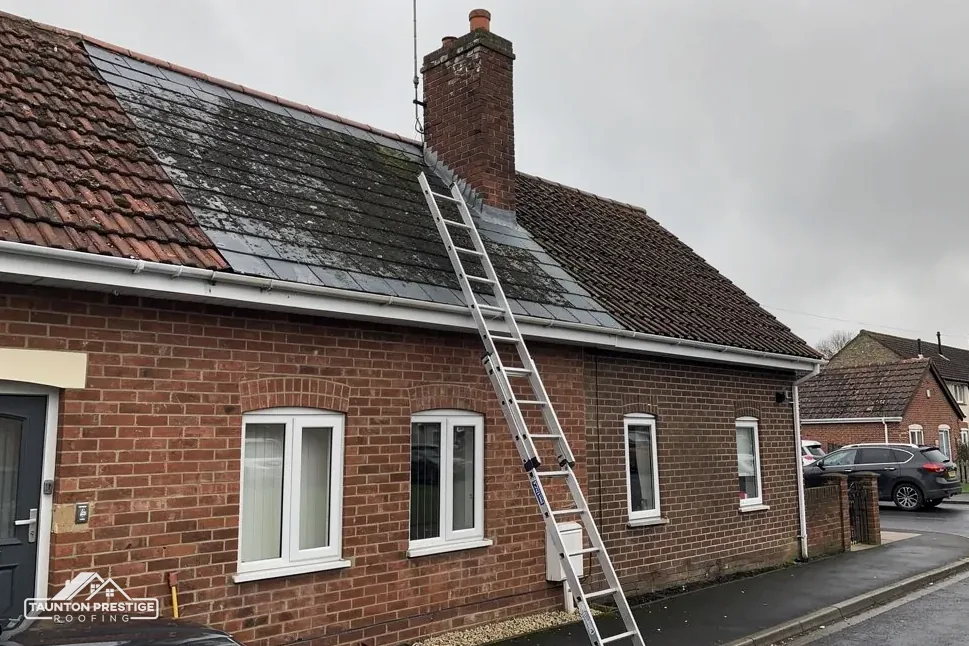
Look from a window, a safe upper floor or a ladder at the eaves. Do not walk on a flat roof you are unsure about, as many are not designed for foot traffic and the deck beneath may be weak.
What does a blister on a felt roof mean?
A blister is trapped air or moisture lifting the layers. A small one may be stable, but it is a weakness, because foot traffic or frost can split it. Our page on felt roof blistering explains the causes. For GRP, our page on GRP roof cracking sets out why cracks form and what a repair involves.
Photograph anything unusual, and note where it sits against a fixed point such as a downpipe or a window. That helps a roofer find it again. Do not seal a split with a tube of mastic and forget it. It may hold for a month and hide the problem, while the water goes on spreading under the surface where you cannot see it, and the next owner or surveyor finds a patchwork of old repairs to untangle.
Upstands, trims and the edges
An upstand is the upturned lip of membrane at a wall, a parapet or a rooflight kerb. It holds the membrane up above water level so rain cannot run behind it. Trims are the metal or plastic edge profiles that finish the roof along its outer edge and guide water into the gutter.
Edges and junctions are where leaks tend to begin, because the membrane changes direction there, and every joint is a place for movement and fatigue. Check along the wall junction for gaps, lifted edges, cracked sealant, and flashing that has pulled away. Check the drip edge at the front, where the membrane should lap over the trim and into the gutter.
Why do upstands matter so much?
Because they take the most movement and the most weather. Walls expand and contract against the roof, sun bakes the vertical face, and rain runs down the brickwork onto the junction. Our pages on flat roof trims and upstands and flat roof wall abutments cover how they are formed.
Look inside as well. A damp patch on the ceiling just below the wall junction, or a stain on the wall inside, can mean water is getting behind the upstand. Look at the brickwork above it for cracks, loose pointing or lead that has lifted. On the energy side, Approved Document L caps a site-built upstand at 0.35W/(m2·K) in its table for new or replacement elements, a detail a roofer settles in the design.
Outlets, gutters and clearing the water
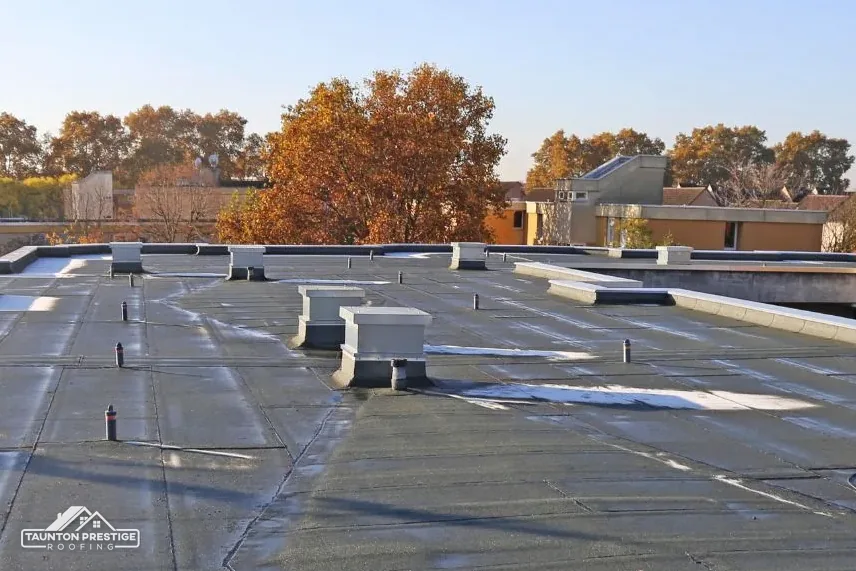
Water leaves a flat roof through an outlet, a gutter or a downpipe. If any of those is blocked, the roof stores the water, and a flat roof is not built to hold a pond.
Start at the outlets. Leaves, moss, grit and roof debris collect around them, and the grit washed off a felt roof ends up in the same place. Check that water can flow freely, that the gutter is not sagging or full, and that the downpipe runs clear at the bottom. Clearing a gutter by hand is simple work, but only from a safe position with a stable ladder, and never by leaning out from the top rung. Where the outlet sits out of reach, or the roof edge has no guard, leave it to a roofer.
What if the outlet keeps blocking?
Then something is feeding it. Trees overhead drop leaves, a failing surface sheds grit, or the fall is so shallow that debris collects where water slows. A leaf guard can help, but it also needs cleaning. Our page on blocked flat roof outlets goes through the causes and fixes.
Check the gutter fall too. Brett Martin's guidance for rainwater systems gives 1mm for every 600mm. Water standing in a gutter, or overflowing at the front in rain, shows the fall is wrong or the gutter is blocked. Where moss is growing on a flat roof, that is often a sign of slow drainage as well, covered in our guide to moss on a flat roof.
Ponding and the fall
Ponding is standing water that remains on the roof more than a short time after rain stops. A little dampness at an edge is normal. A shallow puddle that is still there days later is a sign that the fall is not doing its job.
The code for flat roofs with continuously supported flexible waterproof coverings is BS 6229. BS 6229:2018 was withdrawn on 16 December 2025, and BS 6229:2025 is the current edition, written for roofs pitched at no more than 10 degrees. It retains a finished fall of 1:80 as the minimum for general areas and internal gutters. IKO, citing the 2018 edition, says to design for a fall of 1:40 so that the finished roof reaches that minimum. The standard covers membranes, not lead.
Is ponding a problem or just a puddle?
It depends on how long it lasts and how often. Water that lingers is a problem because it speeds up wear, lets dirt and algae build, and can freeze and lift the surface in winter. Our flat roof ponding in Somerset post looks at it in more detail, and our page on the flat roof minimum fall explains the numbers.
A simple check is to look at the roof the morning after rain and note where water sits. Photograph it with a coin or a ruler for scale. Marks on the surface, such as a ring of dirt, show where water has stood. If the same places hold water every time, tell a roofer, because tapered insulation or a new deck may be needed to put the fall right.
Insulation, structure and what a roofer adds
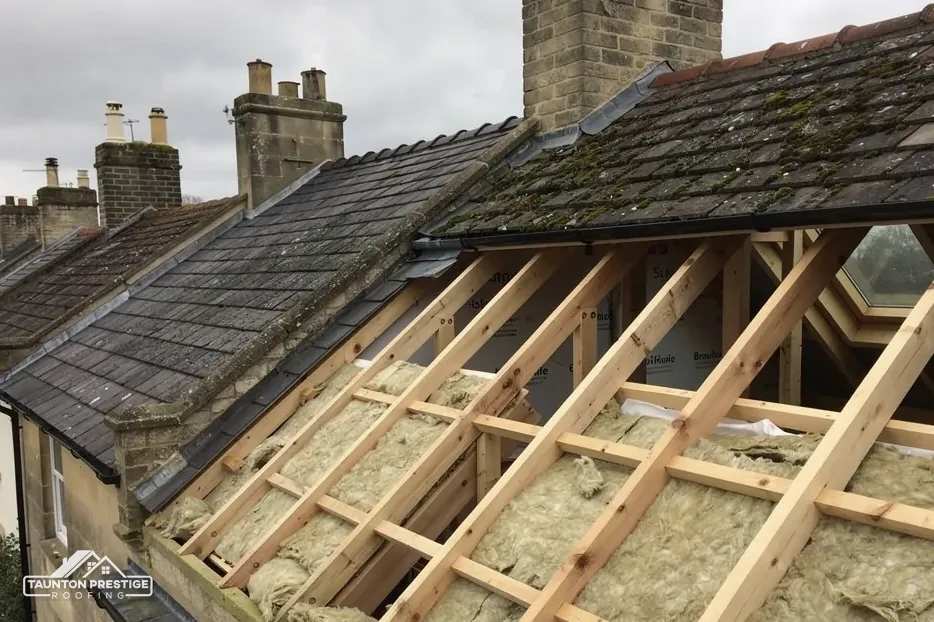
What lies under the membrane matters as much as the surface. A flat roof may be a warm roof, with the insulation above the deck, or a cold roof, with it between the joists and a ventilated void above. Each has its own failure modes, covered in our guide to warm roof versus cold roof.
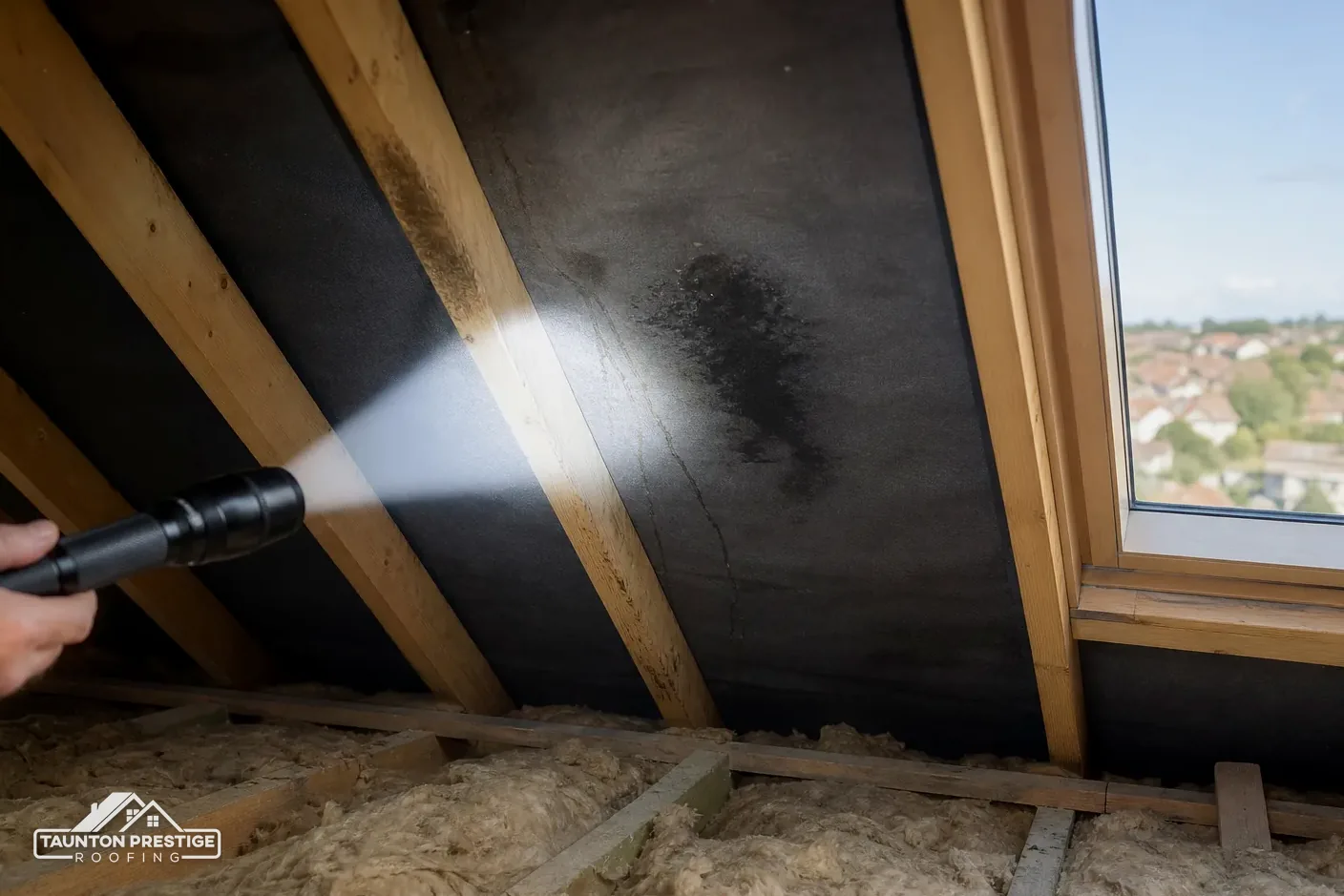
From inside, look for stains on the ceiling, a spongy feel to the plasterboard, mould in corners, a musty smell and condensation on windows below. A roof that feels soft underfoot or a ceiling that sags points to wet insulation or a rotting deck. Do not go onto the roof to test it.
What does a roofer check that I cannot?
Close up, a roofer can feel the surface for soft spots, probe the seams and edges, check the fixings and trims, look at the outlet connections and measure how water moves. They can open a small cut to see whether the insulation below is wet, and photograph it. They can also advise on whether a patch, an overlay or a full replacement makes sense.
For a sense of scale, MyJobQuote gives flat roof replacement as between £1,500 and £6,000 (MyJobQuote, Oct 2026), and Less gives £1,200 to £2,500 for a 15 m² garage (Less, Oct 2026). Both are typical UK ranges, and a cost guide cannot see your roof. Under Part L, a new membrane on a flat roof is renovation work, so the insulation joins the discussion. A survey lets us photograph each part of your flat roof and put one written price on what it needs.
Flat roof checking questions
How often should I inspect my flat roof?
Look after the autumn leaf fall, after winter, and after any storm or spell of heavy rain. Roofs under trees or in shade deserve extra looks. A roofer's visit adds a close check of seams, edges and outlets, which are hard to judge from a window or a ladder.
Should I worry about water that stays on my flat roof?
If it lingers for days after rain, yes. BS 6229:2025 keeps a minimum finished fall of 1:80, so water should drain. Persistent ponding speeds up wear, lets algae and dirt build, and can freeze and lift the surface. Note where it sits and tell a roofer.
Can I walk on my flat roof to check it?
Avoid it unless you know the roof is designed for foot traffic. Many membranes mark or split under boots, and the deck beneath may be weak. Look from a window or a safely footed ladder, photograph any problem and leave the close inspection to a roofer.
More on this subject: Roof inspections in Taunton